
CCNP ENCOR 350-401 Complete Notes
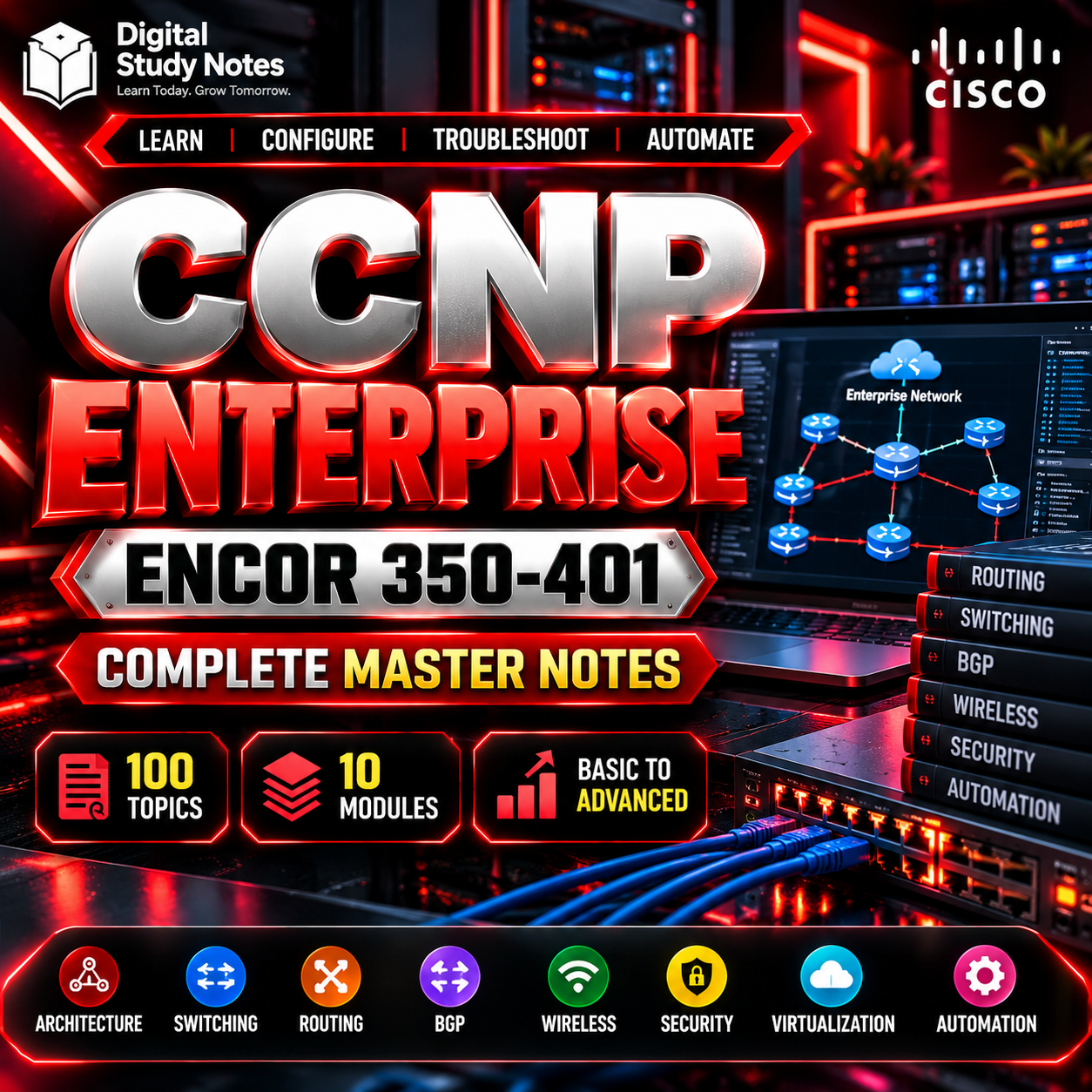
CCNP ENTERPRISE ENCOR (350-401)
COMPLETE MASTER NOTES
100 Topics | 10 Modules | Basic to Advanced | Enterprise Networking
Take your networking knowledge beyond CCNA and develop a deeper understanding of enterprise networking technologies with the CCNP Enterprise ENCOR (350-401) Complete Master Notes by Digital Study Notes.
Whether you are preparing for the Cisco CCNP Enterprise certification, strengthening your routing and switching knowledge, or developing advanced networking skills, this structured study resource provides a topic-wise roadmap to guide your learning.
📚 Join Free IT Resources:
📘 WHAT'S INCLUDED?
100 TOPICS • 10 MODULES • COMPLETE LEARNING ROADMAP
MODULE 01 — Enterprise Network Architecture
Understand how modern enterprise networks are designed, structured, connected, and managed.
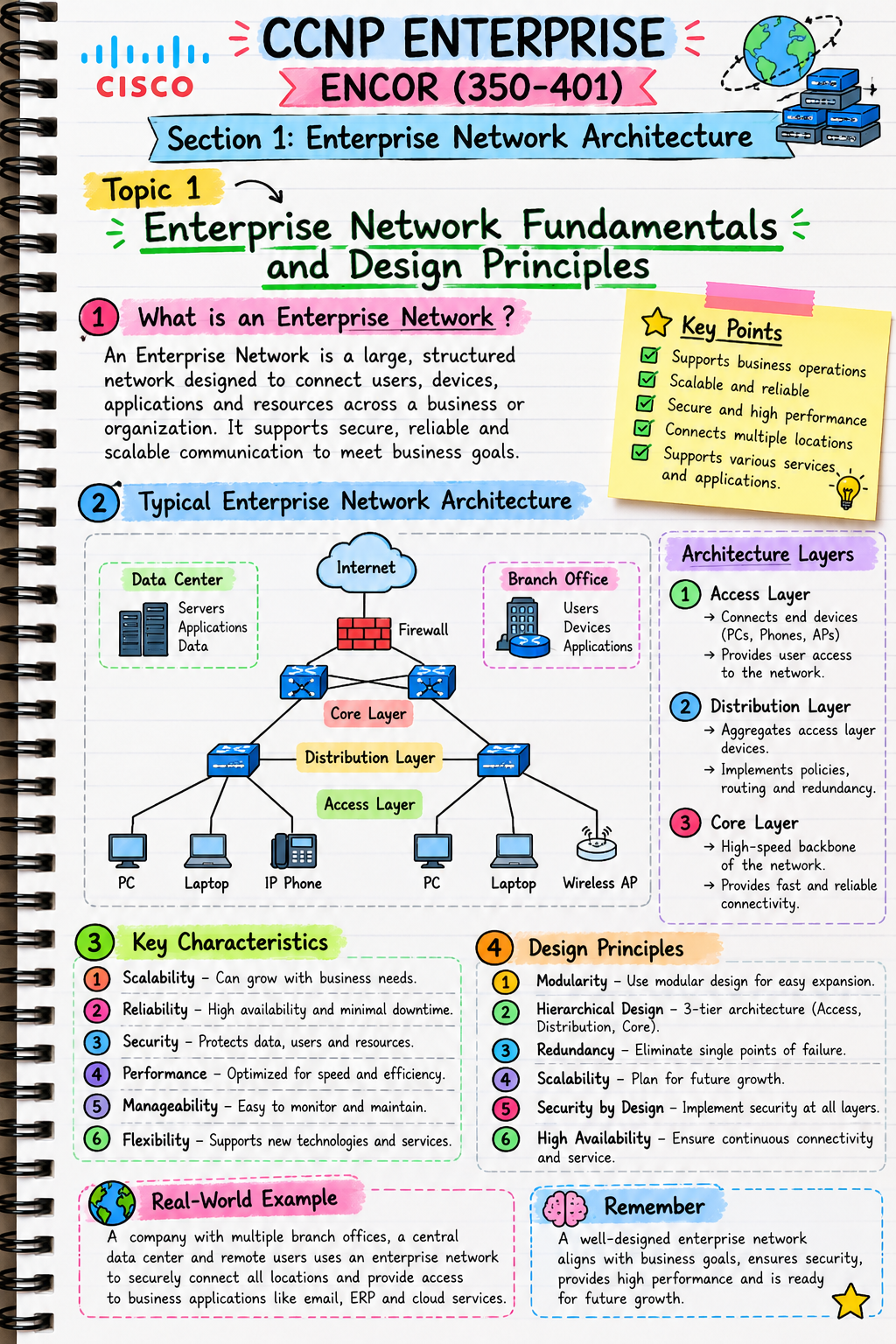
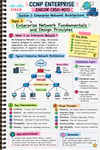
- Enterprise Network Fundamentals and Design Principles
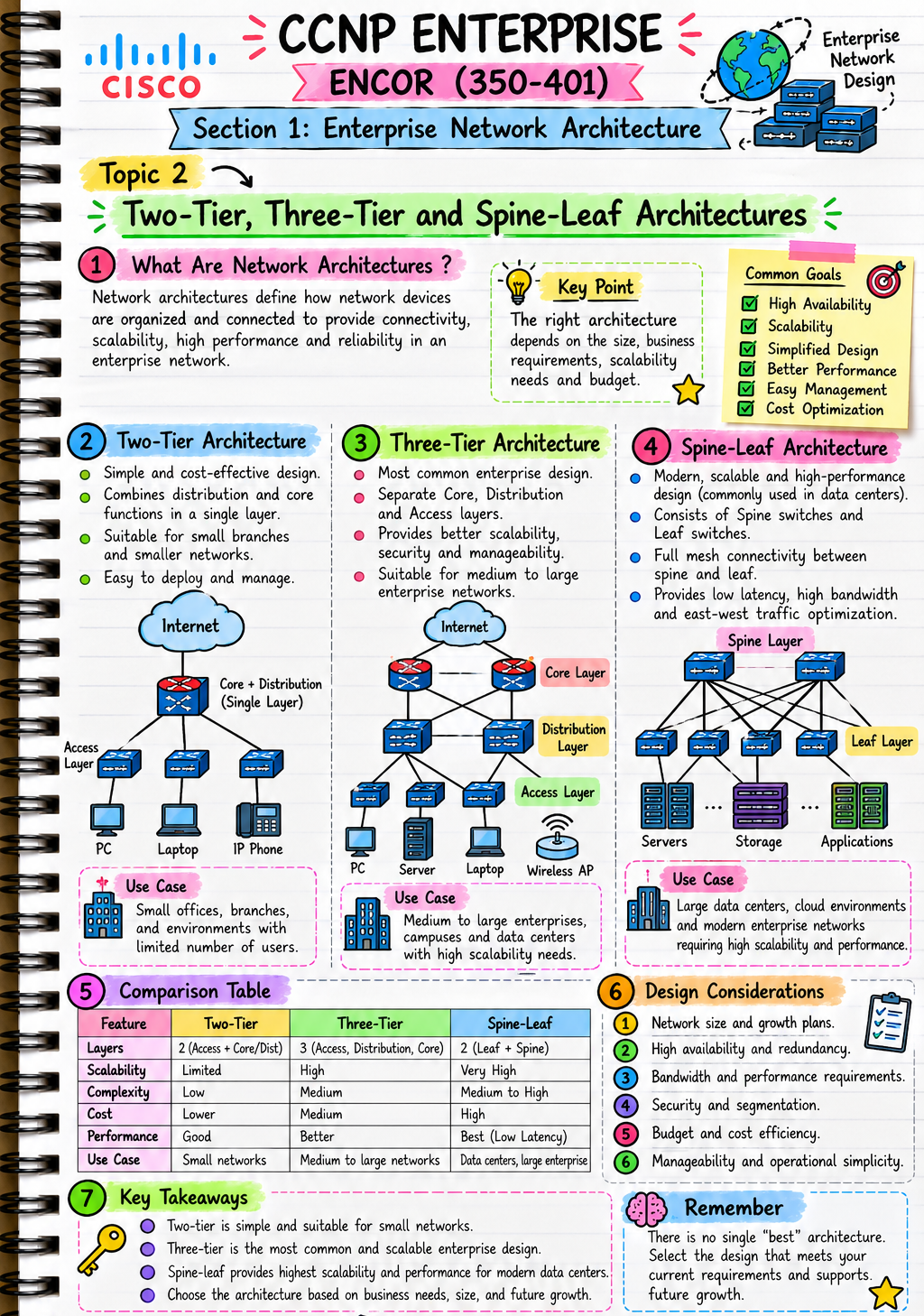
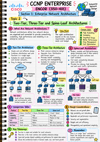
- Two-Tier, Three-Tier and Spine-Leaf Architectures
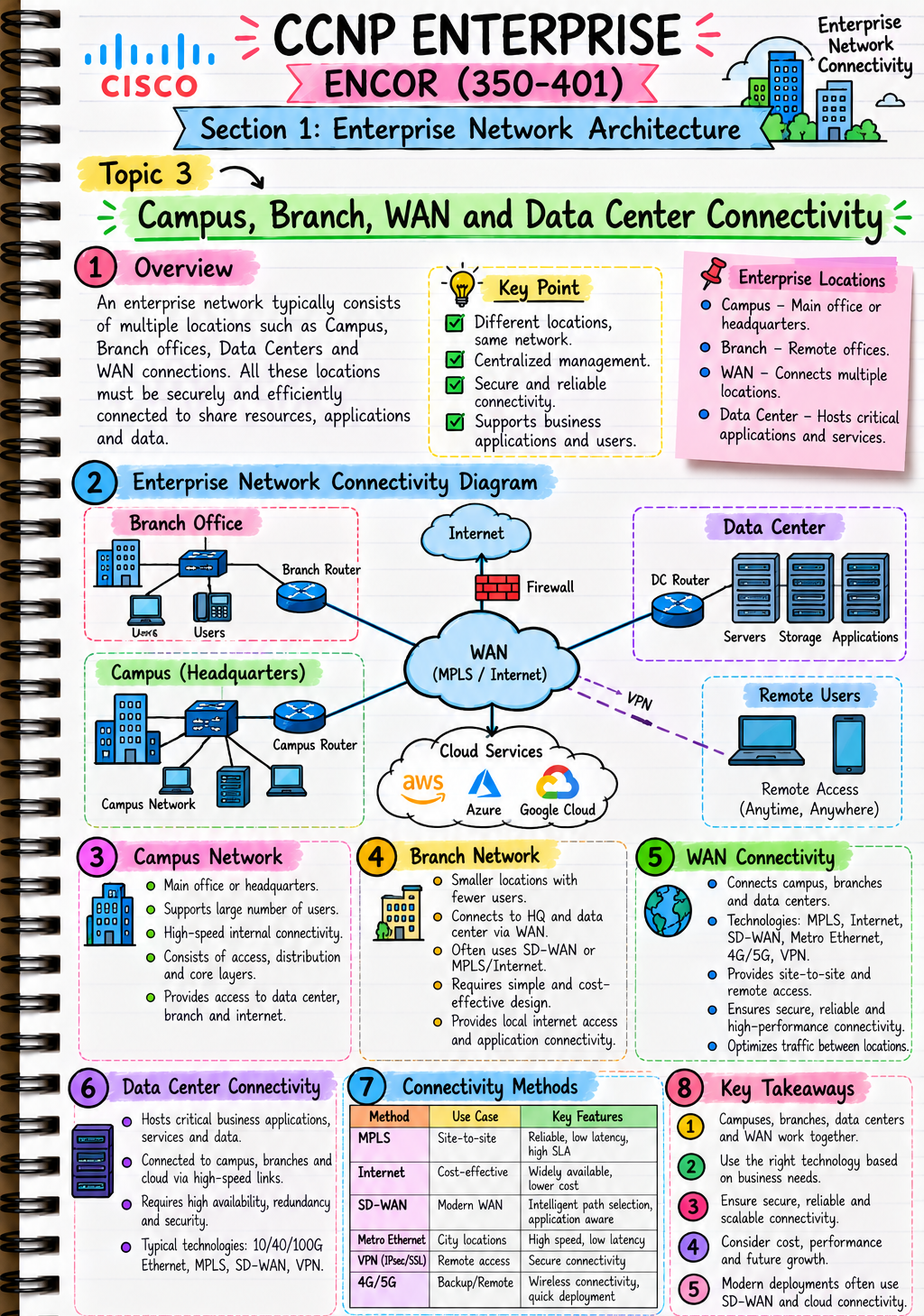
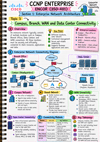
- Campus, Branch, WAN and Data Center Connectivity
- Core, Distribution and Access Layers
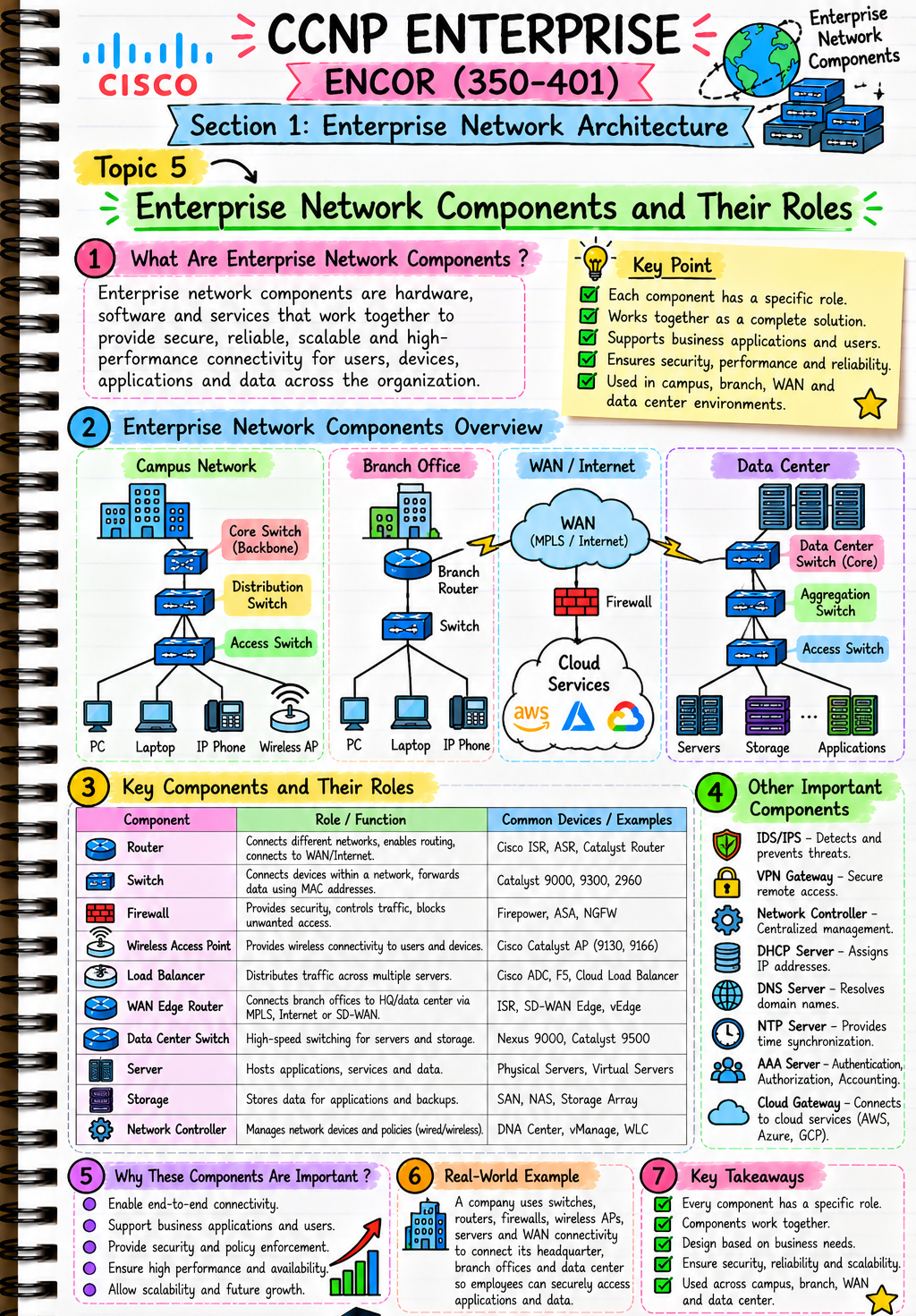
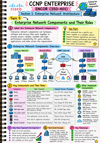
- Enterprise Network Components and Their Roles
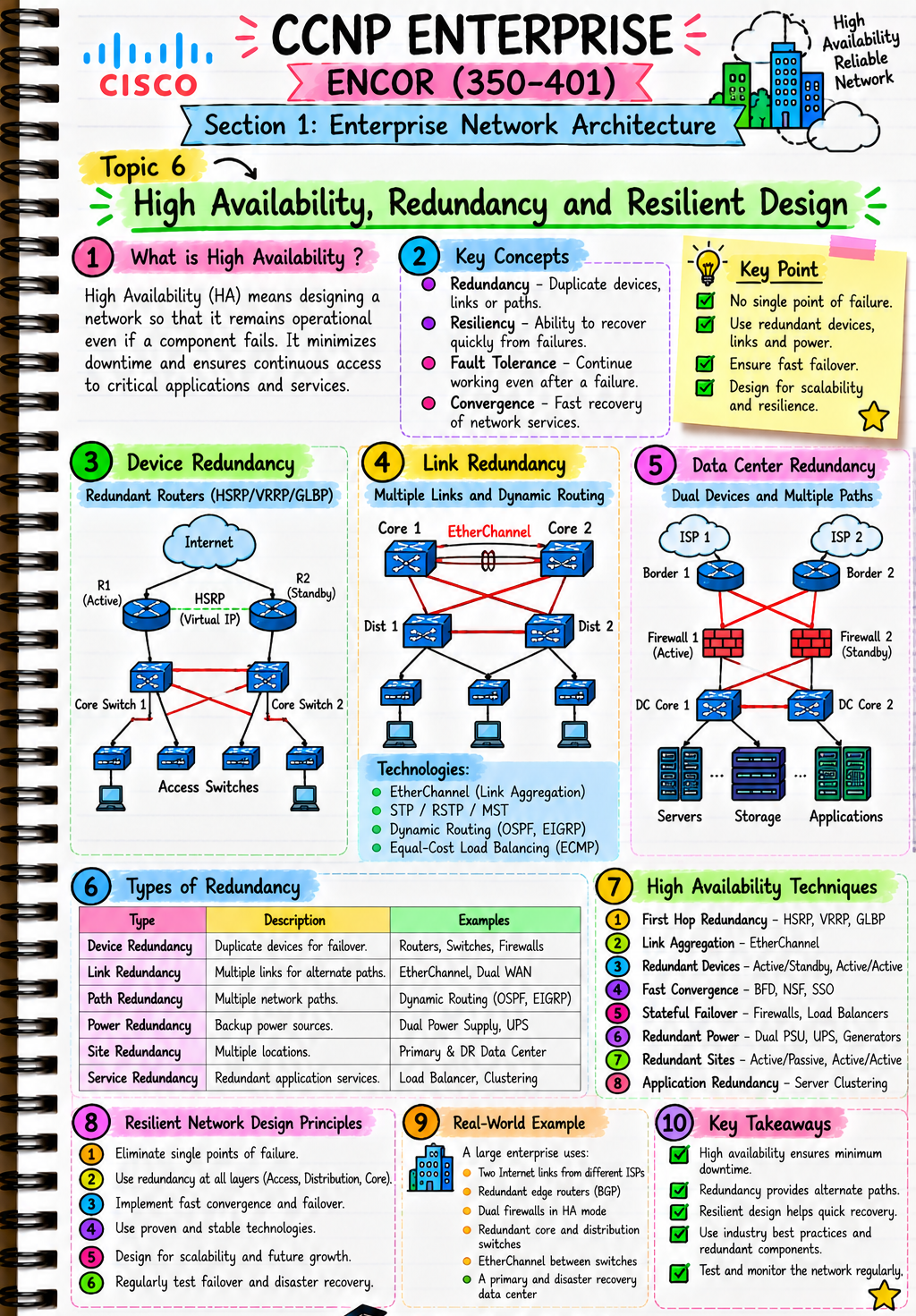
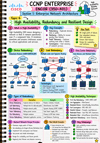
- High Availability, Redundancy and Resilient Design
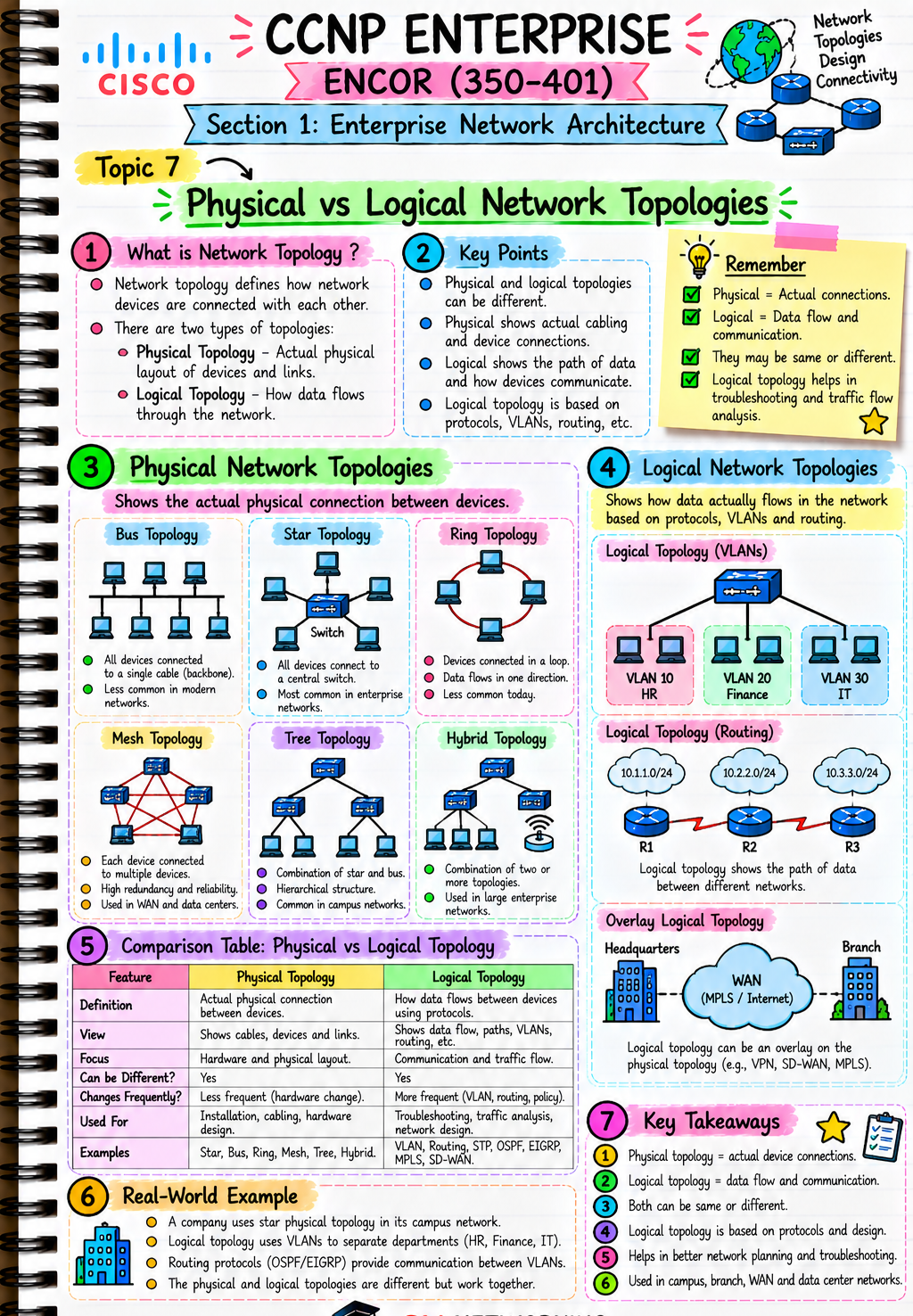
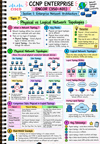
- Physical vs Logical Network Topologies
- Control Plane, Data Plane and Management Plane
- Traditional Networking vs Software-Defined Networking
- Enterprise Network Design Case Study and Diagram
MODULE 02 — Layer 2 Switching
Build your understanding of enterprise switching, VLAN segmentation, spanning tree, and link aggregation.
- Ethernet Switching and MAC Address Learning
- VLAN Configuration and Segmentation
- Access Ports, Trunk Ports and 802.1Q
- Native VLAN and VLAN Trunk Troubleshooting
- Inter-VLAN Routing and Layer 3 Switching
- Spanning Tree Protocol (STP) Fundamentals
- Rapid PVST+ and Multiple Spanning Tree Concepts
- Root Bridge Election, Port Roles and Port Costs
- EtherChannel, LACP and Link Aggregation
- Advanced Switching Verification and Troubleshooting Labs
MODULE 03 — Layer 3 Routing
Explore routing technologies, route selection, dynamic routing protocols, and enterprise routing operations.
- Routing Table Structure and Route Selection
- Longest Prefix Match, Administrative Distance and Metrics
- IPv4 and IPv6 Static Routing
- Default Routes and Floating Static Routes
- OSPF Fundamentals and Neighbor Formation
- OSPF Areas, LSAs and Route Selection
- EIGRP Fundamentals and Metric Concepts
- EIGRP Neighbors, Successors and Feasible Successors
- Route Redistribution Fundamentals
- Enterprise Routing Configuration and Troubleshooting Labs
MODULE 04 — Advanced BGP
Develop your knowledge of Border Gateway Protocol, BGP attributes, routing policies, and scalable enterprise routing.
- BGP Fundamentals and Autonomous System Numbers
- eBGP vs iBGP and Peer Relationships
- BGP Neighbor Establishment and State Machine
- BGP Attributes: Weight, Local Preference and AS Path
- Origin, MED and Next-Hop Attribute
- BGP Best-Path Selection
- Route Advertisement, Filtering and Prefix Lists
- Route Maps, Communities and Routing Policies
- Route Reflectors and BGP Scalability
- BGP Configuration, Verification and Troubleshooting Labs
MODULE 05 — IP Services
Understand essential network services used to support enterprise network communication and performance.
- DHCP, DHCP Relay and Address Allocation
- DNS Architecture and Name Resolution
- Network Address Translation (NAT) and PAT
- Network Time Protocol (NTP)
- Simple Network Management Protocol (SNMP)
- Syslog, Logging and Severity Levels
- Quality of Service (QoS) Fundamentals
- Classification, Marking, Queuing and Congestion
- First-Hop Redundancy Protocols (FHRPs)
- IP Services Verification and Troubleshooting
MODULE 06 — First-Hop Redundancy and High Availability
Learn gateway redundancy, network availability, failover concepts, and redundancy protocols.
- High Availability Fundamentals and Failure Domains
- HSRP Architecture and Operation
- HSRP Priority, Preemption and Tracking
- VRRP Architecture and Election Process
- GLBP Fundamentals and Load Balancing
- HSRP vs VRRP vs GLBP
- Gateway Redundancy for IPv4 and IPv6
- Link and Object Tracking Concepts
- Redundancy Failure Detection and Troubleshooting
- FHRP Configuration and Failover Labs
MODULE 07 — Wireless Networking
Explore enterprise wireless architecture, RF technologies, WLAN design, authentication, and troubleshooting.
- Wireless Network Architecture and Components
- Access Points, WLCs and Wireless Client Connectivity
- RF Fundamentals: Frequency, Channels and Interference
- 2.4 GHz, 5 GHz and 6 GHz Wi-Fi Bands
- WLAN Design, Coverage and Capacity
- Wireless Roaming and Client Association
- WPA2, WPA3 and Enterprise Authentication
- Centralized vs Distributed Wireless Architectures
- Wireless Monitoring, RF Analysis and Troubleshooting
- Enterprise WLAN Design and Verification Scenarios
MODULE 08 — Network Virtualization
Understand logical network separation, tunneling, overlays, and modern enterprise virtualization technologies.
- Network Virtualization Fundamentals and Use Cases
- Virtual Routing and Forwarding (VRF)
- VRF-Lite Configuration and Route Separation
- GRE Tunnels and Tunnel Interfaces
- IPsec VPN Concepts and Secure Tunneling
- Overlay vs Underlay Networking
- VXLAN Fundamentals and Use Cases
- Network Virtualization in Enterprise and Data Centers
- Virtual Network Troubleshooting and Packet Flow
- VRF and Tunnel Configuration Labs
MODULE 09 — Infrastructure Security
Learn how enterprise infrastructure is protected through secure management, authentication, access control, and monitoring.
- Enterprise Security Architecture and Threat Models
- Device Hardening and Secure Management Access
- AAA: Authentication, Authorization and Accounting
- RADIUS and TACACS+ Concepts
- Access Control Lists and Traffic Filtering
- Control Plane Policing (CoPP) Fundamentals
- DHCP Snooping, Dynamic ARP Inspection and Port Security
- Secure Routing and Infrastructure Protection
- Logging, Monitoring and Security Event Analysis
- Infrastructure Security Verification and Troubleshooting
MODULE 10 — Automation and Programmability
Explore modern network automation tools, APIs, data formats, programmability, and controller-based management.
- Network Automation Fundamentals and Benefits
- Traditional vs Controller-Based Network Management
- REST APIs, HTTP Methods and API Responses
- JSON and YAML Data Structures
- Python Fundamentals for Network Automation
- NETCONF and RESTCONF Concepts
- YANG Data Models
- Cisco Catalyst Center and Controller-Based Automation
- Configuration Management, Templates and Automation Workflows
- API-Based Network Data Collection and Practical Exercises
🎯 WHO IS THIS RESOURCE FOR?
This study resource is suitable for:
- CCNA Students: Ready to progress toward advanced networking concepts.
- CCNP Aspirants: Preparing for the Enterprise ENCOR (350-401) certification.
- Networking Students: Looking for structured enterprise networking study material.
- Network Engineers: Strengthening knowledge of routing, switching, BGP, and infrastructure technologies.
- IT Professionals: Developing knowledge of enterprise network operations and troubleshooting.
- Automation Learners: Exploring Python, APIs, NETCONF, RESTCONF, and network programmability.
⭐ WHY CHOOSE DIGITAL STUDY NOTES?
A structured approach to learning enterprise networking.
✓ 100 carefully organized topics
✓ 10 comprehensive learning modules
✓ Exactly 10 topics in each module
✓ Basic-to-advanced learning roadmap
✓ Enterprise routing and switching coverage
✓ OSPF, EIGRP and advanced BGP concepts
✓ Wireless networking and network virtualization
✓ Infrastructure security and high availability
✓ Network automation and programmability
✓ Useful for systematic learning and revision
🚀 SKILLS YOU WILL EXPLORE
By following the learning roadmap, you will develop your understanding of:
- Enterprise network architecture and design
- VLANs, trunking, STP and EtherChannel
- IPv4, IPv6, OSPF and EIGRP
- BGP attributes and routing policies
- DHCP, DNS, NAT, NTP, SNMP and QoS
- HSRP, VRRP and GLBP
- Enterprise wireless networking
- VRF, GRE, IPsec and VXLAN
- AAA, ACLs and infrastructure protection
- Python, REST APIs, NETCONF and RESTCONF
📥 PRODUCT DETAILS
Product Name: CCNP Enterprise ENCOR (350-401) Complete Master Notes
Brand: Digital Study Notes
Coverage: 100 Topics
Structure: 10 Modules
Learning Level: Basic to Advanced
Subject Area: Networking | Cisco Enterprise Networking
Access: Digital study material
Delivery: After successful purchase, access the provided PDF link through Google Drive. You can open the link to view or download your study material.
💡 YOUR NETWORKING LEARNING JOURNEY STARTS HERE
Don't just memorize networking terms. Build your understanding of how enterprise networks are designed, connected, secured, managed, and automated.
LEARN → UNDERSTAND → CONFIGURE → TROUBLESHOOT → ADVANCE
Take the next step in your networking journey with CCNP Enterprise ENCOR (350-401) Complete Master Notes.
GET YOUR NOTES TODAY!
Thank you for supporting Digital Study Notes.
Learn Today. Grow Tomorrow.
IMPORTANT PURCHASE INFORMATION
- This is a digital study resource. No physical product will be shipped.
- Your PDF access link will redirect you to Google Drive.
- An internet connection may be required to access the material.
- Please ensure that you are purchasing the correct product before completing payment.
- This resource supports independent learning and certification preparation. It does not guarantee exam success, employment, or job placement.
- Cisco and CCNP are trademarks of Cisco. Digital Study Notes is an independent educational resource and is not affiliated with or endorsed by Cisco.
Digital Study Notes — Professional IT Learning Resources.