Kitson Machine Learning for Trading Lab: Why Most ML Results on Prices Don't Hold Up (Opus 5.5)
See on your own price file why most machine-learning results on prices don't hold up.
This is a lab for learning how good-looking machine-learning results on prices are made, and why most of them don't hold up when tested honestly. It does not build a model to trade.
Add your own historical price file (CSV: at least the date and the close) or use the made-up sample. Pick a few simple features (recent returns, gaps from moving averages, volatility, the bar's range) and a simple model written in plain code: logistic regression or a small decision tree.
Machine Learning for Trading Lab trains and tests it in code on your own computer, the honest way:
- a time-ordered split with a gap, so no training label reads a price after the test starts;
- walk-forward testing, block by block;
- a check that no feature reads later bars;
- the baseline of always predicting the more common answer, and a noise band showing what luck alone can do;
- the result after costs, against simply holding through.
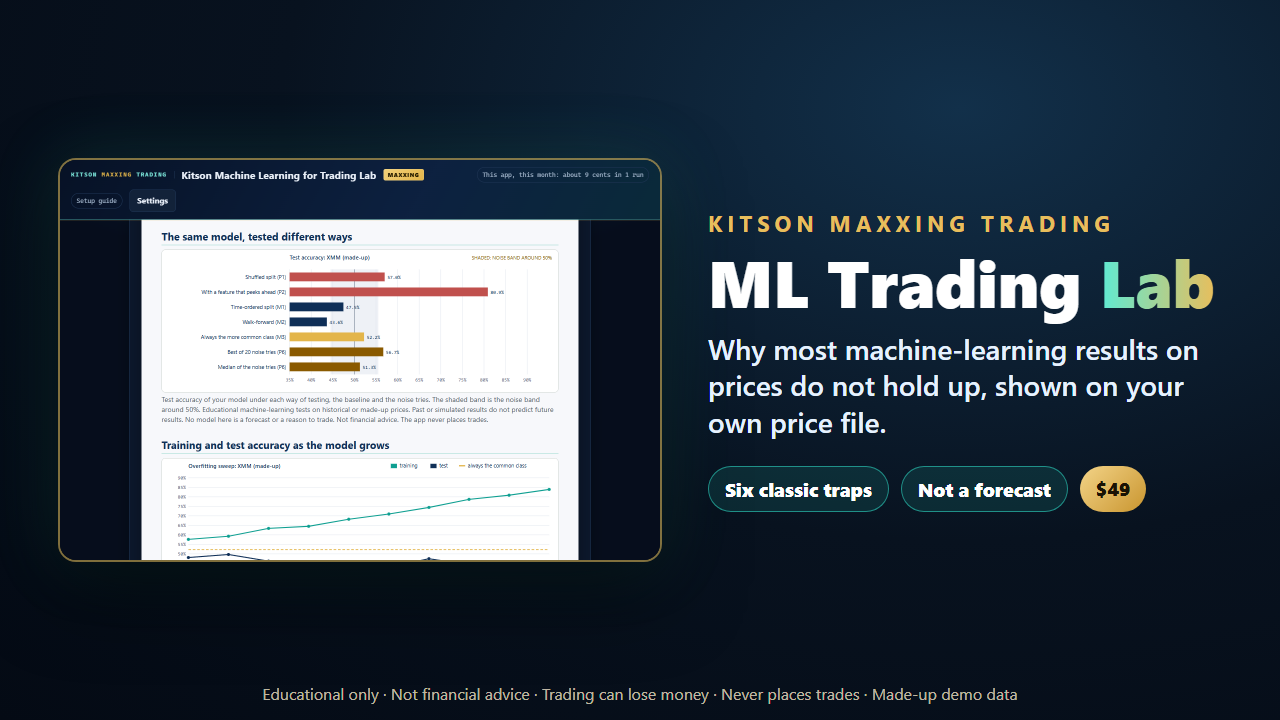
Then it measures six classic traps on the same file, side by side: a shuffled split, a feature that peeks ahead, overfitting as the model grows, accuracy against the result after costs, the baseline, and the best of 20 tries on pure random numbers. On the made-up sample, a shuffled split or a feature that peeks ahead makes the same model look far better than the honest test, which scores below the simple baseline.
Claude Opus 5.5 then explains in plain words what the figures show, which trap mattered most on your file and what to test next.
What makes it different
- It shows why results fail, not how to trade. It never says a model will work, never calls anything a buy or sell signal, and never claims an edge. If the explanation drifts into advice, forecasts or promises, the app catches it and asks for a rewrite.
- The models and tests are in plain code you can read, with the methods stated, and the same file, settings and seed always give the same figures.
- Every number in the explanation is checked in code against the app's own figures, and the result of that check is shown to you.
- Your price file stays on your computer. No price or date from it is sent: only the app's own figures and your question go to Anthropic, and you can see exactly what will be sent before anything goes.
- The cost is shown before every run, and you set a limit. In our own test on the made-up sample, a run cost about 9 cents on our own Anthropic account, and one change about 7 cents more. The training and testing are free.
- A Word report and an Excel file of every test, trap, walk-forward block, look-ahead check and test bar, with three charts.
What you need
- Free Node.js 18+ (Windows, Mac or Linux).
- Your own Anthropic account and API key, with a little credit. A Claude chat subscription does not include API access.
- Your own historical price file (at least date and close, 300 to 5,000 bars), or use the made-up sample in the zip.
You pay Anthropic directly for what you use, on top of the price of the app.
Educational only. Machine-learning tests on historical or made-up prices. Past or simulated results do not predict future results. No model here is a forecast or a reason to trade. Not financial advice. It does not recommend any trade, model or strategy. The app never places trades. Trading involves risk of loss. If we can't get the app running for you, email kit376351@gmail.com within 14 days for a refund of the app price. Kitson Workshop is not affiliated with or endorsed by Anthropic.
Watch the review: https://youtu.be/3z2Noieo0ng