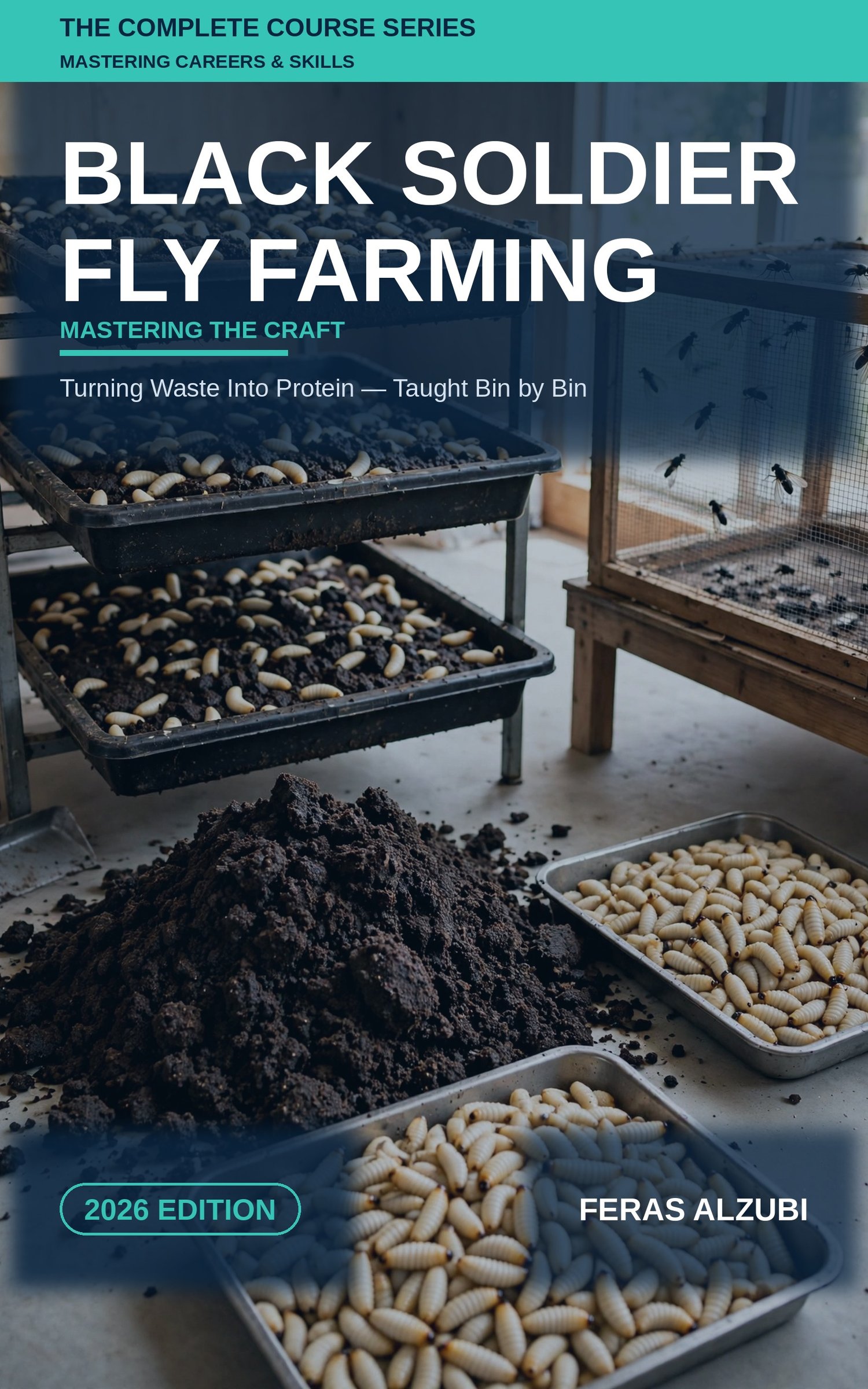
Black Soldier Fly Farming: Mastering the Craft
Black Soldier Fly Farming: Mastering the Craft
What this book teaches. The black soldier fly enterprise — raising Hermetia illucens, whose larvae turn prepared organic substrates into protein, fat, and fertilizer — taught A to Z in one volume, from first principles to a working, documented operation. The foundations come first: the venture itself, waste streams in and larvae and frass out; the fly — a non-pest insect whose adults neither bite nor feed, and whose larvae suppress the house flies that plague ordinary compost and manure; the life cycle stage by stage, because every production decision in this trade is a life-cycle decision; and the rules and authority — what the larvae were raised on decides what the product may lawfully be called, under ingredient definitions written by AAFCO and enforced by state feed officials, while the frass answers to state fertilizer law. Then the production system: choosing the operation — larvae, frass, or conversion; the breeding unit, where sunlight in the cage makes eggs; the nursery, where microscopic neonates get their controlled start; grow-out in bins, substrate, and feeding; and conversion at work — the mass balance that tells the farmer what a batch actually did, and how to read the residue. Health and husbandry follow: climate in the shed — heat, moisture, and air; colony health, prevention, and the crash signs; pests and contaminants — keeping the wrong insects out; and sourcing genetics — eggs, neonates, and colony renewal. Then harvest and sales: the self-harvest, where prepupae climb the ramp and harvest themselves, and separation; processing — killing, drying, meal, and oil; claims and labels — the guarantees that go on every bag; and markets and money — feed mills, farms, and gardeners, with the enterprise budget taught as structure from stated givens. The book closes with the working farmer's world: the farmer's week of rounds in the shed, records, failures, and learning from each batch, and the farmer's path — skills, community, and the working life of the people building this young trade.
Who it is for. The beginning farmer starting a small, serious black soldier fly production venture who wants the whole trade in the order the colony itself lives it; the working insect farmer who already runs bins and wants the operation tightened — steadier breeding, cleaner grow-out, a truer mass balance, fewer crashed batches, and records that turn one batch's experience into the next batch's decisions; and farmers, growers, and diversified operations adding a waste-conversion enterprise to an existing business — prepared organic material in, larvae and frass out — who need the enterprise whole: the insect, the unit, the batch rhythm, the law, and the channels.
What's inside (every count verified against the actual book):
Complete course — 20 chapters in five parts, foundations to the farmer's path
340 practice questions — every answer explained, right and wrong
40-question diagnostic — know where you stand before you start
240 chapter questions — a 12-question check closes every chapter
60-question final review — sampling the whole trade
40 labeled figures — production diagrams and farm maps, two in every chapter
27 tables — sequences, targets and reference data for the shed
150-term glossary · 8 cheat sheets · 3 study plans — Plan A, the full read (12 weeks), Plan B, the working farmer (6 weeks), and Plan C, market-first (8 weeks)
Enterprise arithmetic taught as structure — the mass balance and the budget built from stated givens, worked example by worked example
Every one of the 340 questions is original, written for this book, and every explained answer tells you why the right answer is right and why each wrong answer is wrong. The book's facts rest on verified sources, listed in a Sources & Verification Note at the back of the book: feed-ingredient status is taught through the AAFCO definitions and state feed law that govern it, composition is taught as reported ranges that vary with substrate — the label guarantee, not a textbook number, is what a lot is sold on — and chemical names and doses appear nowhere, because hygiene in this trade is process: cleaning, drying, separation, and exclusion. This book makes no income promises: black soldier fly farming is a real enterprise with real buyers, and like every livestock business its returns vary with skill, substrate, energy costs, and markets — the book teaches the production and the arithmetic, honestly, and guarantees nothing.
Read the first chapter free — the sample on this page is Chapter 1 of this book, exactly as it appears in the full edition.
From the Mastering Careers & Skills library — complete A-to-Z professional teaching books for careers, trades, and certifications.
This book is an independent teaching work. It teaches the trade — feed-ingredient status, fertilizer registration, and waste-handling permissions come only from your own state officials and agencies, and no credential comes from this book: this book does not itself confer a license, a permit, or a certification.
Refunds: Please read the free sample chapter before you buy. This is a digital ebook, delivered instantly by download. If the file is defective, or you cannot open or download it and we cannot fix the problem, you will receive a full refund — email us within 14 days of purchase. Because the book is delivered instantly as a downloadable file, all other sales are final.
How to read this book (EPUB format): After checkout, download the EPUB file, then open it in any free ebook reader app. On iPhone or iPad: Apple Books — it is already on your device. On Android phones and tablets: Google Play Books (free: https://play.google.com/store/apps/details?id=com.google.android.apps.books) — upload the file in the app — or ReadEra (free). On a Windows or Mac computer: Thorium Reader (free: https://thorium.edrlab.org) or Adobe Digital Editions (free). On Kindle: use Amazon's free Send to Kindle (https://www.amazon.com/sendtokindle) to add the file to your Kindle library.