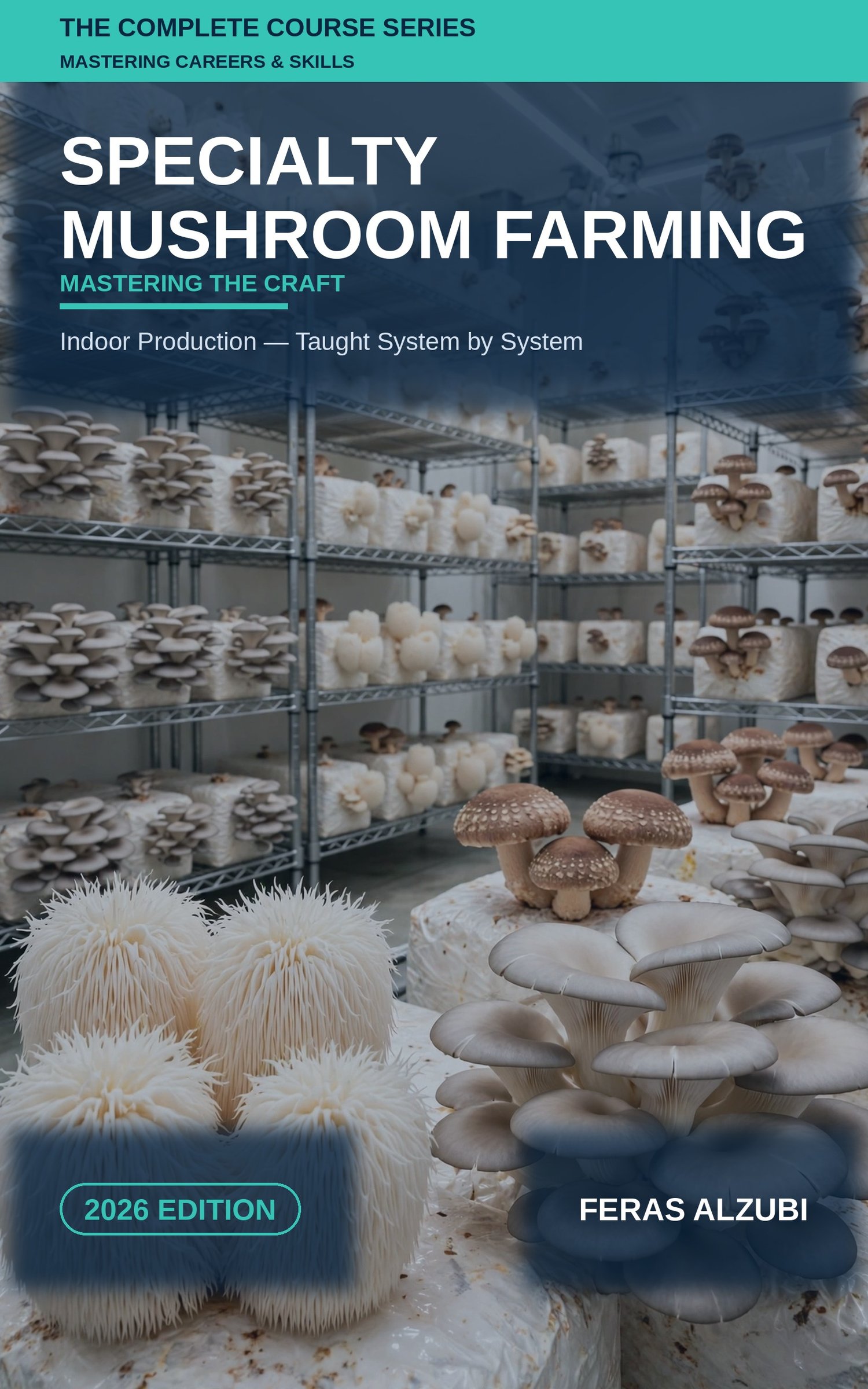
Specialty Mushroom Farming: Mastering the Craft
Specialty Mushroom Farming: Mastering the Craft
What this book teaches. The indoor specialty mushroom enterprise — growing oyster, lion's mane, shiitake on blocks, chestnut, and their companions on prepared substrates under controlled conditions, and selling them as food — taught A to Z in one volume, from first principles to proved, documented production. The foundations come first: the venture itself and the markets it serves; the biology of the fungus in grower's terms — mycelium, spawn, substrate, and fruiting body; the production system of rooms and workflow that keeps clean work clean; and the rules and authority — food safety, extension guidance, and the spawn supplier's strain data — that decide what correct means. From those foundations the book builds the growing system: species and strain selection; substrates from straw to supplemented sawdust; spawn and its handling; pasteurization and sterilization matched to the substrate; and the inoculation discipline on which every crop stands or falls. The production part follows: incubation and the spawn run, fruiting and its environmental controls, flush management and block retirement, and the contamination diagnosis every grower eventually needs. Then harvest and sales: picking, cooling, and packing a perishable food to a buyer's standard; food safety and quality in the pack; the restaurant, farmers market, and wholesale channels; and the enterprise arithmetic of biological efficiency and unit costs — taught as method and arithmetic, honestly, with no income promises. The book closes with the working grower's world: the weekly rhythm of a production business, records and compliance, and the grower's own path of skills and training. Every stage is taught so you can explain it, run it, and trust your conclusion — and the spawn supplier's strain data and your extension service's guidance always govern the specifics of the crop in front of you.
Who it is for. The beginning grower starting an indoor mushroom enterprise — on a farm with an unused building, in a rented space, or at the scale of a serious sideline intended to grow; the working grower who already fruits blocks and wants the operation tightened — cleaner technique, steadier fruiting, better flush management, and records that turn experience into improvement; farmers adding a specialty mushroom enterprise to an existing operation, who need the indoor system whole — rooms, workflow, food safety, and channels — alongside the crops they already grow; and the reader weighing this venture before spending on it, who wants an honest picture of the work, the discipline it demands, and the perishability it never escapes. No general book replaces the guidance for the specific strain and substrate in front of you — the book teaches the systems, the principles, and the method.
What's inside (every count verified against the actual book):
- Complete course — 20 chapters in five parts, foundations to the grower's path
- 340 practice questions — every answer explained, right and wrong
- 40-question diagnostic — scored by domain, with a routing worksheet
- 240 chapter questions — a 12-question check closes every chapter
- 60-question final review — sampling the whole enterprise, with routed re-study
- 40 labeled figures — production-system diagrams and grow-room maps, two in every chapter
- 27 tables — substrate recipes, treatment data, and enterprise reference data
- 150-term glossary · 8 cheat sheets · 3 study plans — the full read (12 weeks), the working grower (6 weeks), and the market-first grower (8 weeks)
- Food safety taught as structure — sanitation, prompt cooling, lot traceability, and the rule that questionable product is never sold, throughout
Every one of the 340 questions is original, written for this book, and every explained answer tells you why the right answer is right and why each wrong answer is wrong. The book's facts rest on verified sources, listed in a Sources & Verification Note at the back of the book: the USDA specialty-mushroom definition (any non-Agaricus mushroom) as carried by Cornell Cooperative Extension, the Cornell Small Farms specialty mushroom program and the Cornell–Fungi Ally commercial cultivation guide, UF/IFAS extension pasteurization practice, and the rule that spawn-supplier strain data and extension guidance govern species-specific values. This book makes no income promises and states no earnings or yield figures as promises: mushroom farming is a real enterprise with real buyers, and like every farm business its returns vary with markets, skill, and costs — the book teaches the production and the arithmetic, and guarantees nothing.
Read the first chapter free — the sample on this page is Chapter 1 of this book, exactly as it appears in the full edition.
From the Mastering Careers & Skills library — complete A-to-Z professional teaching books for careers, trades, and certifications.
This book is an independent teaching work. It teaches the enterprise — no license or credential comes from this book: the permits and rules for selling food are set by your state and locality and are obtained from those authorities, and this book does not itself confer a license or a certification.
Refunds: Please read the free sample chapter before you buy. This is a digital ebook, delivered instantly by download. If the file is defective, or you cannot open or download it and we cannot fix the problem, you will receive a full refund — email us within 14 days of purchase. Because the book is delivered instantly as a downloadable file, all other sales are final.
How to read this book (EPUB format): After checkout, download the EPUB file, then open it in any free ebook reader app. On iPhone or iPad: Apple Books — it is already on your device. On Android phones and tablets: Google Play Books (free: https://play.google.com/store/apps/details?id=com.google.android.apps.books) — upload the file in the app — or ReadEra (free). On a Windows or Mac computer: Thorium Reader (free: https://thorium.edrlab.org) or Adobe Digital Editions (free). On Kindle: use Amazon's free Send to Kindle (https://www.amazon.com/sendtokindle) to add the file to your Kindle library.