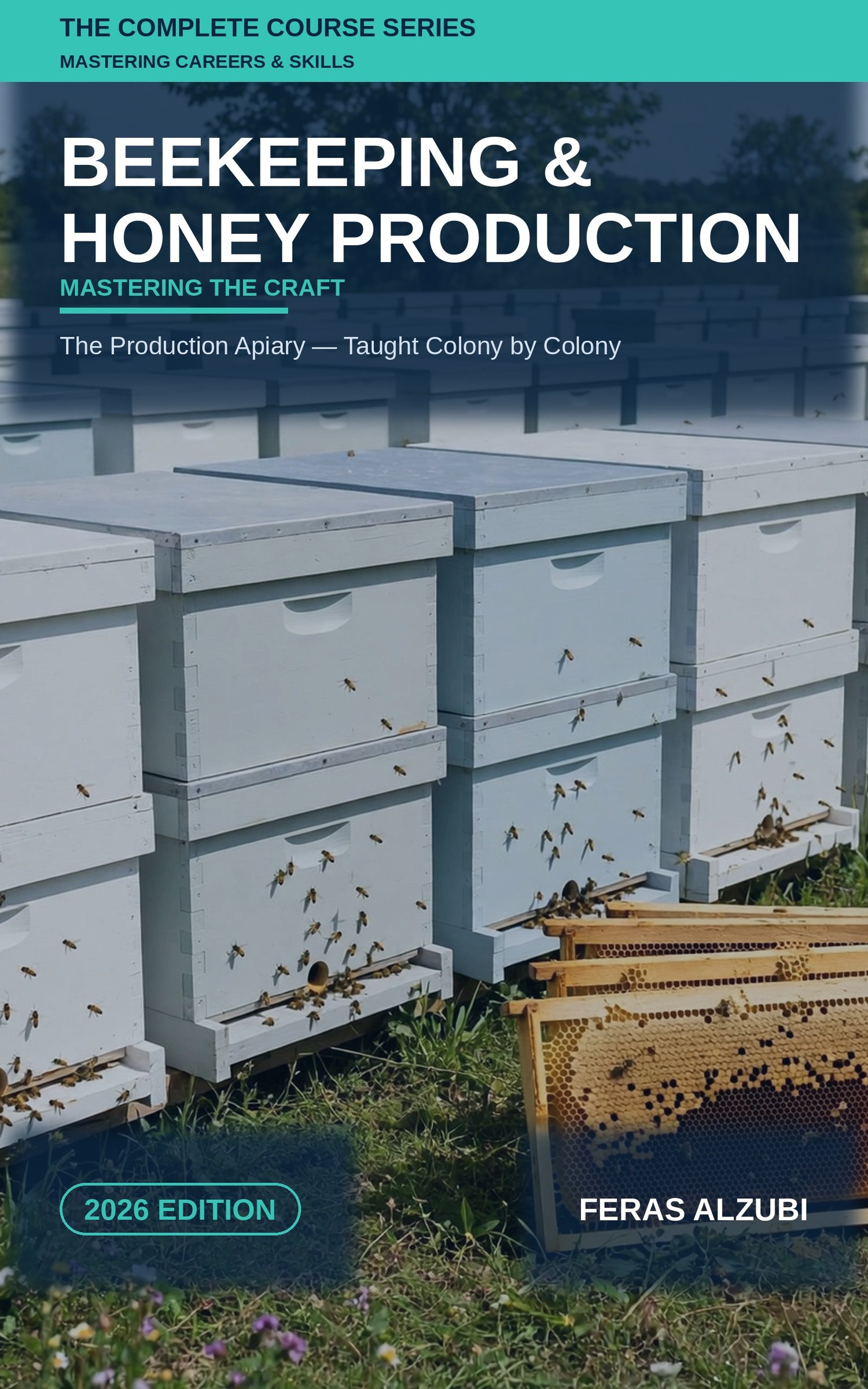
Beekeeping & Honey Production: Mastering the Craft
Beekeeping & Honey Production: Mastering the Craft
What this book teaches. The production apiary as a business — honey bee colonies kept in Langstroth equipment as production units, and the honey, beeswax, nucleus colonies, queens, packages, and contracted pollination services those colonies produce — taught A to Z in one volume, from first principles to a proved, documented season. The foundations come first: the venture and the products it sells; the colony — queen, workers, and drones, and how each develops and works; the hive of stacked boxes, bee space, and movable frames; and the rules and authority — apiary registration, state inspection, honest labeling, and the extension and label documents that govern the specifics. Then the production system: choosing the operation's products among honey, nucs, queens, and pollination; the apiary site and its forage; getting bees by package, nuc, and split; the frame-by-frame inspection that reads a colony; and colony numbers planned as production. The health part follows: varroa monitoring, thresholds, and integrated control; foulbrood and the other diseases and pests; the beekeeper's year from spring build-up through the flow; and feeding and wintering. Then harvest and sales: pulling ripe supers, the extraction line of uncapping, extracting, settling, and bottling, grading and the label, and the channels and enterprise arithmetic of the bee business. The book closes with the working beekeeper's world: the week's yards and rounds, records and winter losses, and the beekeeper's own path — skills, community, and working life. Queen rearing and nuc production are taught inside the book, where the colonies are — they are the beekeeper's second and third products, not a separate volume.
Who it is for. The beginning beekeeper who intends from the start to sell what the bees produce — honey first, and in time nucs, queens, or pollination — and wants the whole production system in the order the season itself lives it; the working beekeeper with colonies already in the field who wants the operation tightened — varroa held under threshold on a monitoring schedule, fewer winter losses, cleaner extraction, honest labels, and records that turn one season's experience into the next season's decisions; and farmers and diversified operations adding an apiary enterprise to an existing business — forage on the farm, a pollination need of their own, a farm-store shelf for local honey — who need the enterprise whole: colonies, health, harvest, and channels.
What's inside (every count verified against the actual book):
Complete course — 20 chapters in five parts, foundations to the beekeeper's path
340 practice questions — every answer explained, right and wrong
40-question diagnostic — know where you stand before you start
240 chapter questions — a 12-question check closes every chapter
60-question final review — sampling the whole enterprise
40 labeled figures — colony, hive, and production diagrams, two in every chapter
28 tables — sequences, thresholds, and reference data for the apiary
150-term glossary · 8 cheat sheets · 3 study plans — Plan A, the full read (12 weeks), Plan B, the working beekeeper (6 weeks), and Plan C, market-first (8 weeks)
Enterprise arithmetic taught as structure — the budget built from stated givens, worked example by worked example
Every one of the 340 questions is original, written for this book, and every explained answer tells you why the right answer is right and why each wrong answer is wrong. The book's facts rest on verified sources, listed in a Sources & Verification Note at the back of the book: treatment products, doses, and application specifics are assigned throughout to the product label — the label is the law for any registered treatment — manufacturers' data, extension publications, and the state apiarist, where they belong. This book makes no income promises: a production apiary is a real enterprise with real buyers, and like every livestock business its returns vary with skill, forage, weather, and markets — the book teaches the production and the arithmetic, honestly, and guarantees nothing.
Read the first chapter free — the sample on this page is Chapter 1 of this book, exactly as it appears in the full edition.
From the Mastering Careers & Skills library — complete A-to-Z professional teaching books for careers, trades, and certifications.
This book is an independent teaching work. It teaches the enterprise — apiary registration, inspection, and labeling duties are set state by state, registration and permits come from the state, and no credential comes from this book: this book does not itself confer a license, a certification, or a permit.
Refunds: Please read the free sample chapter before you buy. This is a digital ebook, delivered instantly by download. If the file is defective, or you cannot open or download it and we cannot fix the problem, you will receive a full refund — email us within 14 days of purchase. Because the book is delivered instantly as a downloadable file, all other sales are final.
How to read this book (EPUB format): After checkout, download the EPUB file, then open it in any free ebook reader app. On iPhone or iPad: Apple Books — it is already on your device. On Android phones and tablets: Google Play Books (free: https://play.google.com/store/apps/details?id=com.google.android.apps.books) — upload the file in the app — or ReadEra (free). On a Windows or Mac computer: Thorium Reader (free: https://thorium.edrlab.org) or Adobe Digital Editions (free). On Kindle: use Amazon's free Send to Kindle (https://www.amazon.com/sendtokindle) to add the file to your Kindle library.