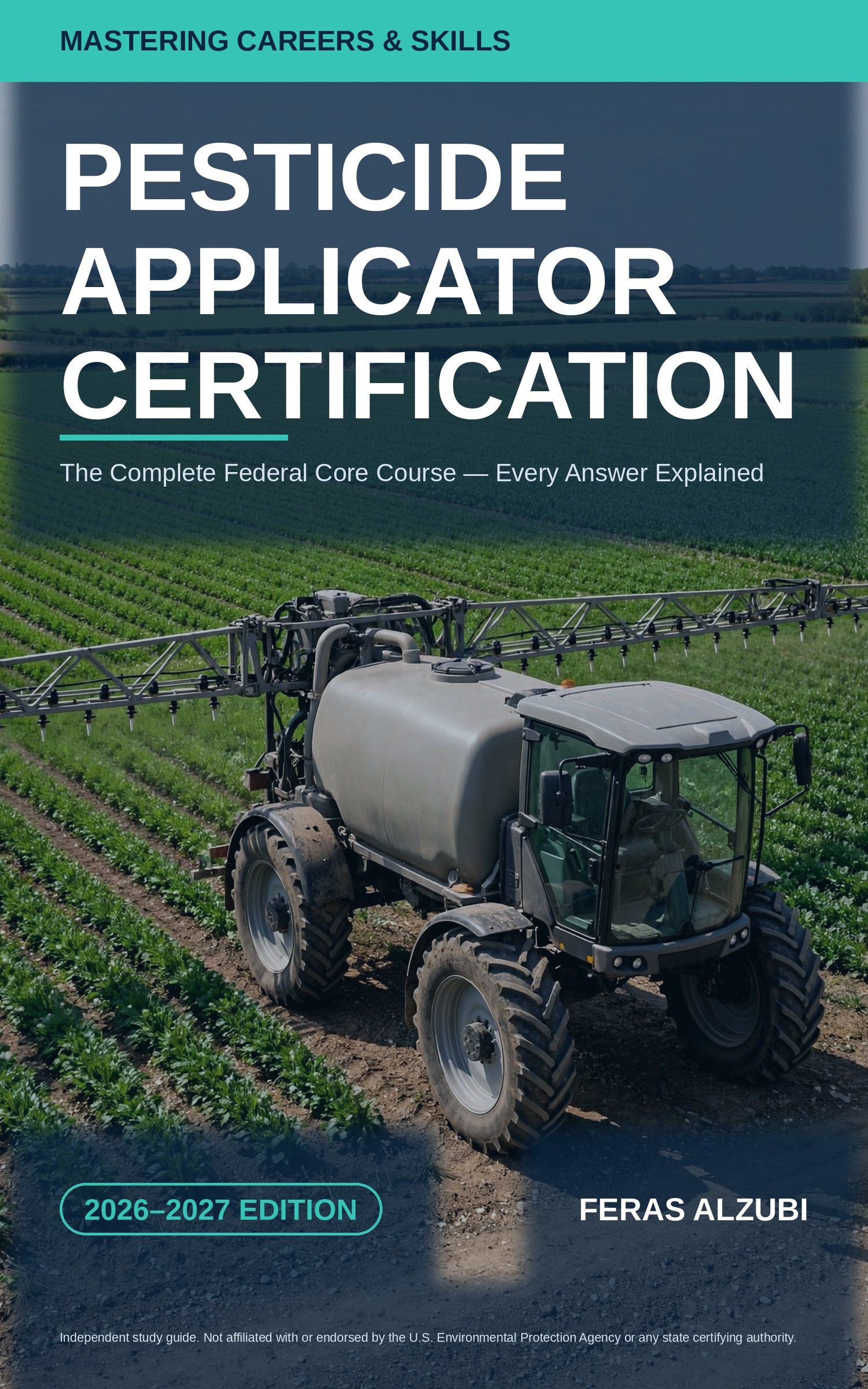
Pesticide Applicator Certification
Pesticide Applicator Certification — The Complete Federal Core Course
Pesticide Applicator Certification teaches the federal core of pesticide applicator certification whole. The framework is set by regulation: under 40 CFR Part 171, the U.S. Environmental Protection Agency sets the federal core knowledge standards — the commercial applicator standards at §171.103(c) and the parallel private applicator standards at §171.105(a) — and certification is granted by state certifying authorities, each working under a certification plan the U.S. Environmental Protection Agency has approved. There is no single national examination for this credential: no national item count, sitting length, fee, or passing standard exists, and none is stated in this book. Your examination, when you sit one, is your own certifying authority's examination. This book teaches the federal core whole, for commercial and private applicators alike, and it teaches the state layer as method — a worked protocol for finding and verifying your own authority's requirements — and never as one state's facts.
This is the complete federal core course in one volume: 24 chapters and 306,044 words, with 730 practice questions, every answer explained — a 50-item diagnostic that routes you by band to the chapters your own readiness needs first, chapter quizzes closing every chapter, six skills drills of 20 items each, and 2 full practice tests of 100 items each, sat under this book's own pacing guidance — plus 34 figures and a glossary of 195 terms. The practice tests and the diagnostic are spread across this book's eight design bands over the Part 171 core areas; those proportions are this book's design proportions, set from the core areas' teaching mass in the federal standard and corroborated against the National Core Manual's published scope. They are not federal weights, not any state's weights, and not any examination's weights, and no score on this book's practice material predicts any result on your authority's examination.
What this book teaches. The course's arc runs in the core's own order. The label comes first — how a pesticide label is built, how to read it whole, and how every later decision answers to it. Then safety, hazards, and personal protective equipment; the environment, in water, soil, air, and drift; pests and integrated pest management; formulations; equipment, calibration, and application taught as knowledge, with the calibration arithmetic worked in full; the Worker Protection Standard at core level; and records, supervision, and professionalism. Part V works one complete specimen day end to end and closes with exam craft — how to prepare for your own authority's sitting, using the verification protocol to reach test day with your authority's own facts in hand. All label reading and all worked arithmetic in this book run on fictional specimen labels and a locked specimen canon, labeled as such wherever they appear: Specimen Product A, a fictional liquid concentrate, and Specimen Product B, a fictional granular product, on one fictional specimen site. No real product, brand, or registrant is named or imitated anywhere in this book, and no specimen fact may be read onto a real product.
Who it is for. Candidates preparing for pesticide applicator certification under their own state certifying authority — commercial and private applicators alike — who want the complete federal core course beneath the examination: the field taught whole, not just test practice, with the state layer taught as a verification method each reader applies to their own authority's requirements.
What's inside (every count verified against the actual book):
24 chapters — the complete federal core course, in the core's own order: the label first, then safety and the environment, pests and formulations, equipment, calibration and application, the professional frame, the worked specimen day, and exam craft
730 original practice questions, every answer explained — why the correct answer is correct and why each wrong answer is wrong
A 50-item diagnostic, taken first and taken cold, spread across the book's eight design bands over the Part 171 core areas, scored by band and routing you to the chapters your own readiness needs first
360 chapter-quiz items — a 15-item quiz closing every one of the 24 chapters, every answer explained
120 skills drills in six sets of 20 items that train the core's judgment moves — label reading on the specimens, calibration arithmetic in two sets, drift and weather decisions, safety, protective equipment and incident decisions, and records and supervision decisions
Two full, independent practice tests of 100 items each, spread across the eight design bands in the book's stated design proportions, each item explained in its key and routed back to its chapters by band
34 figures at 36 teaching placements — photorealistic plates of the applicator's physical world and diagrams, each verified against its dossier
A 195-entry glossary, harvested from the chapters' own key terms and defined where each term is first taught
Three study plans, cheat sheets, and a standards crosswalk appendix mapping every core area of §171.103(c) and §171.105(a) to the chapters that teach it
A companion is in preparation. Book #282, Structural Pest Control, is a forthcoming companion to this book — it is not yet available, and no date or price is stated for it here. The pair rule bounds both books, and it is stated here in full: this book teaches the federal core, the shared foundation under every category of applicator work. Structural pest control carries its own category body of knowledge, taught in Book #282, and structural work requires that category body plus your own state's category certification. The core alone is not sufficient preparation for structural work, and this book never presents it as such. A reader whose goal is structural work should treat this book as the foundation it is, and the companion's category body plus their state category certification as the rest of the preparation.
This is the 2026–2027 Edition, built against 40 CFR Part 171 as it stands in the 2025-07-01 edition of the Code of Federal Regulations and against the National Pesticide Applicator Certification Core Manual, Third Edition (2025), as the current edition of that manual.
Read the first chapter free — the sample on this page is Chapter 1 of this book, exactly as it appears in the full edition.
From the Mastering Careers & Skills library — complete A-to-Z professional teaching books for careers, trades, and certifications.
Not-affiliated disclosure: This is an independent study guide. It is not affiliated with or endorsed by the U.S. Environmental Protection Agency or any state certifying authority. Names of agencies, programs, and regulations are used here in nominative form only, to identify the framework this book teaches about. This book teaches pesticide applicator knowledge and examination preparation. It does not grant a certification or a license, and it makes no promise about any reader's examination result, certification, employment, or income. Passing an examination is not itself certification: certification is granted by the reader's own certifying authority under its own requirements, which each reader must verify with that authority.
Refunds: Please read the free sample chapter before you buy. This is a digital ebook, delivered instantly by download. If the file is defective, or you cannot open or download it and we cannot fix the problem, you will receive a full refund — email us within 14 days of purchase. Because the book is delivered instantly as a downloadable file, all other sales are final.
How to read this book (EPUB format): After checkout, download the EPUB file, then open it in any free ebook reader app. On iPhone or iPad: Apple Books — it is already on your device. On Android phones and tablets: Google Play Books (free: https://play.google.com/store/apps/details?id=com.google.android.apps.books) — upload the file in the app — or ReadEra (free). On a Windows or Mac computer: Thorium Reader (free: https://thorium.edrlab.org) or Adobe Digital Editions (free). On Kindle: use Amazon's free Send to Kindle (https://www.amazon.com/sendtokindle) to add the file to your Kindle library.