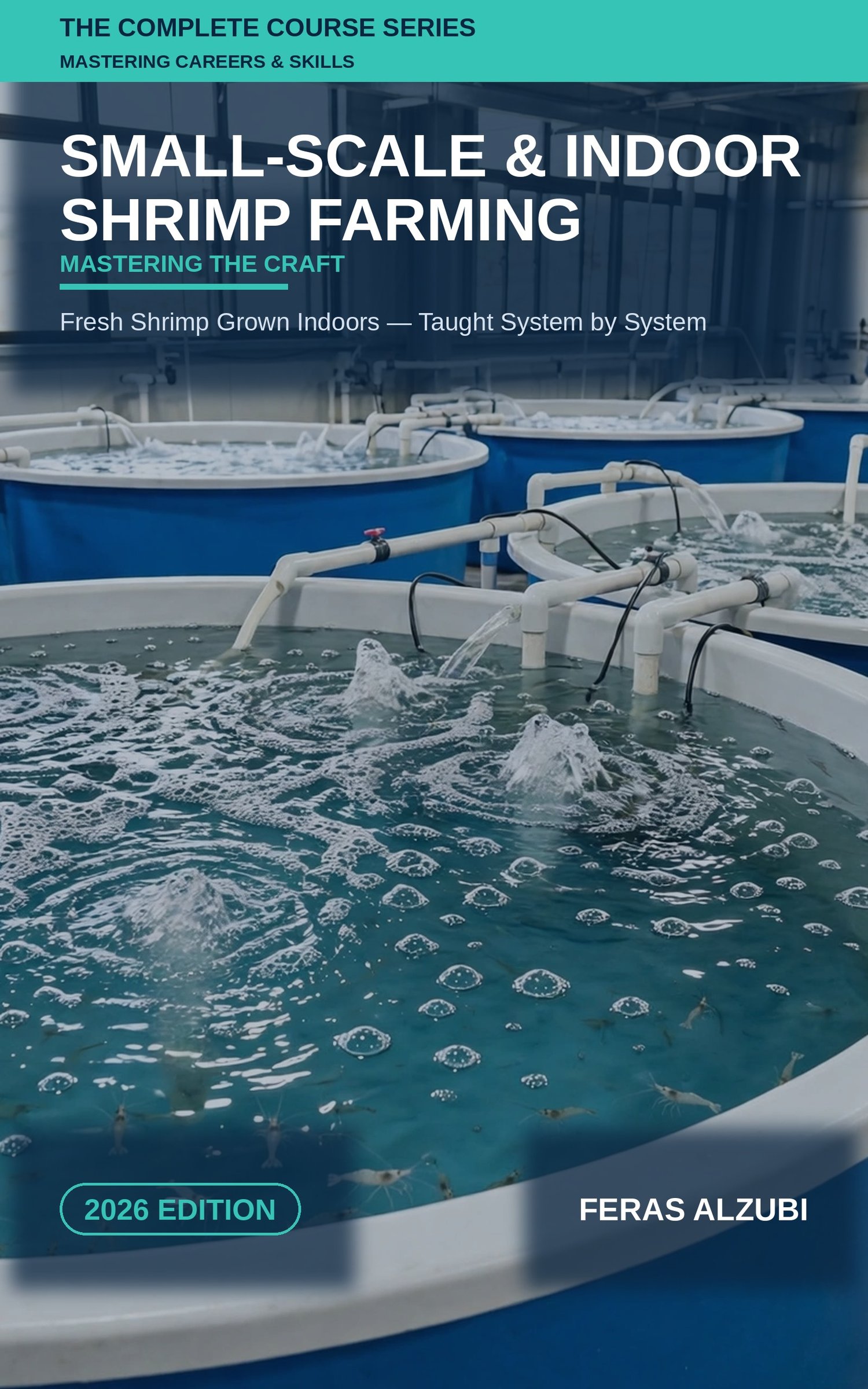
Small-Scale & Indoor Shrimp Farming: Mastering the Craft
Small-Scale & Indoor Shrimp Farming: Mastering the Craft
What this book teaches. The inland marine shrimp enterprise — raising Pacific white shrimp (Litopenaeus vannamei) indoors, in farm buildings, garages, and purpose-fitted rooms, in biofloc and tank systems, and selling a fresh, never-frozen local product — taught A to Z in one volume, from first principles to a proved, documented crop. The foundations come first: the venture and the buyers it serves; the animal — its life stages, its molting growth, and what it asks of its water; the production chain of hatchery, nursery, and grow-out, and the inland farmer's place in it as a buyer of postlarvae; and the rules and authority — state aquaculture permits, food safety, and honest selling. Then the production system: choosing between biofloc, clear-water, and hybrid systems; the facility of buildings, tanks, and layout; the life support of aeration, heating, and backup power; making seawater inland with the right ionic balance; and stocking — postlarvae quality, acclimation, and the nursery phase. The water part follows: the parameters that decide the crop and their published targets, the biofloc community as a living filter, feeding and feed conversion, and the health and biosecurity discipline that keeps disease out rather than fighting it inside. Then harvest and sales: monitoring growth and biomass, harvest day, grading by count and packing on ice, and the channels and enterprise arithmetic of the fresh-shrimp business. The book closes with the working farmer's world: the week's rounds and tests, records across cycles and learning from each crop, and the farmer's own path — skills, the extension and research community, and the working life. This is the grow-out book, not the hatchery book: broodstock, maturation, and larval rearing are a specialist enterprise of their own, and the inland industry this book teaches buys its postlarvae from certified hatcheries.
Who it is for. The beginning farmer starting an indoor shrimp enterprise — in a farm building, a fitted garage or barn, or a small purpose-built room — who wants the whole production system in the order the crop itself lives it; the working shrimp farmer who already runs tanks and wants the operation tightened — steadier water quality, a better-managed biofloc, cleaner feeding, fewer lost crops, and records that turn one cycle's experience into the next cycle's decisions; and farmers and diversified operations adding an indoor aquaculture enterprise to an existing business — an unused building, a year-round product, a local fresh market — who need the enterprise whole: systems, water, health, harvest, and channels.
What's inside (every count verified against the actual book):
- Complete course — 20 chapters in five parts, foundations to the farmer's path
- 340 practice questions — every answer explained, right and wrong
- 40-question diagnostic — know where you stand before you start
- 240 chapter questions — a 12-question check closes every chapter
- 60-question final review — sampling the whole enterprise
- 40 labeled figures — system diagrams and production maps, two in every chapter
- 30 tables — water-quality targets, sequences and reference data for the farm
- 150-term glossary · 8 cheat sheets · 3 study plans — Plan A, the full read (12 weeks), Plan B, the working farmer (6 weeks), and Plan C, market-first (8 weeks)
- Enterprise arithmetic taught as structure — the budget built from stated givens, worked example by worked example
Every one of the 340 questions is original, written for this book, and every explained answer tells you why the right answer is right and why each wrong answer is wrong. The book's facts rest on verified sources, listed in a Sources & Verification Note at the back of the book: water-quality targets are taught as the published extension ranges (Purdue FNR-495-W; Virginia Tech AREC-314P), and feed formulations, chemical doses, treatment protocols, and equipment settings are assigned throughout to suppliers, extension publications, and aquatic animal health professionals, where they belong. This book makes no income promises: indoor shrimp farming is a real enterprise with real buyers, and like every livestock business its returns vary with skill, systems, energy costs, and markets — the book teaches the production and the arithmetic, honestly, and guarantees nothing.
Read the first chapter free — the sample on this page is Chapter 1 of this book, exactly as it appears in the full edition.
From the Mastering Careers & Skills library — complete A-to-Z professional teaching books for careers, trades, and certifications.
This book is an independent teaching work. It teaches the enterprise — commercial aquaculture is permitted state by state, the permit comes from the state, and no credential or permit comes from this book: this book does not itself confer a license, a certification, or a permit.
Refunds: Please read the free sample chapter before you buy. This is a digital ebook, delivered instantly by download. If the file is defective, or you cannot open or download it and we cannot fix the problem, you will receive a full refund — email us within 14 days of purchase. Because the book is delivered instantly as a downloadable file, all other sales are final.
How to read this book (EPUB format): After checkout, download the EPUB file, then open it in any free ebook reader app. On iPhone or iPad: Apple Books — it is already on your device. On Android phones and tablets: Google Play Books (free: https://play.google.com/store/apps/details?id=com.google.android.apps.books) — upload the file in the app — or ReadEra (free). On a Windows or Mac computer: Thorium Reader (free: https://thorium.edrlab.org) or Adobe Digital Editions (free). On Kindle: use Amazon's free Send to Kindle (https://www.amazon.com/sendtokindle) to add the file to your Kindle library.