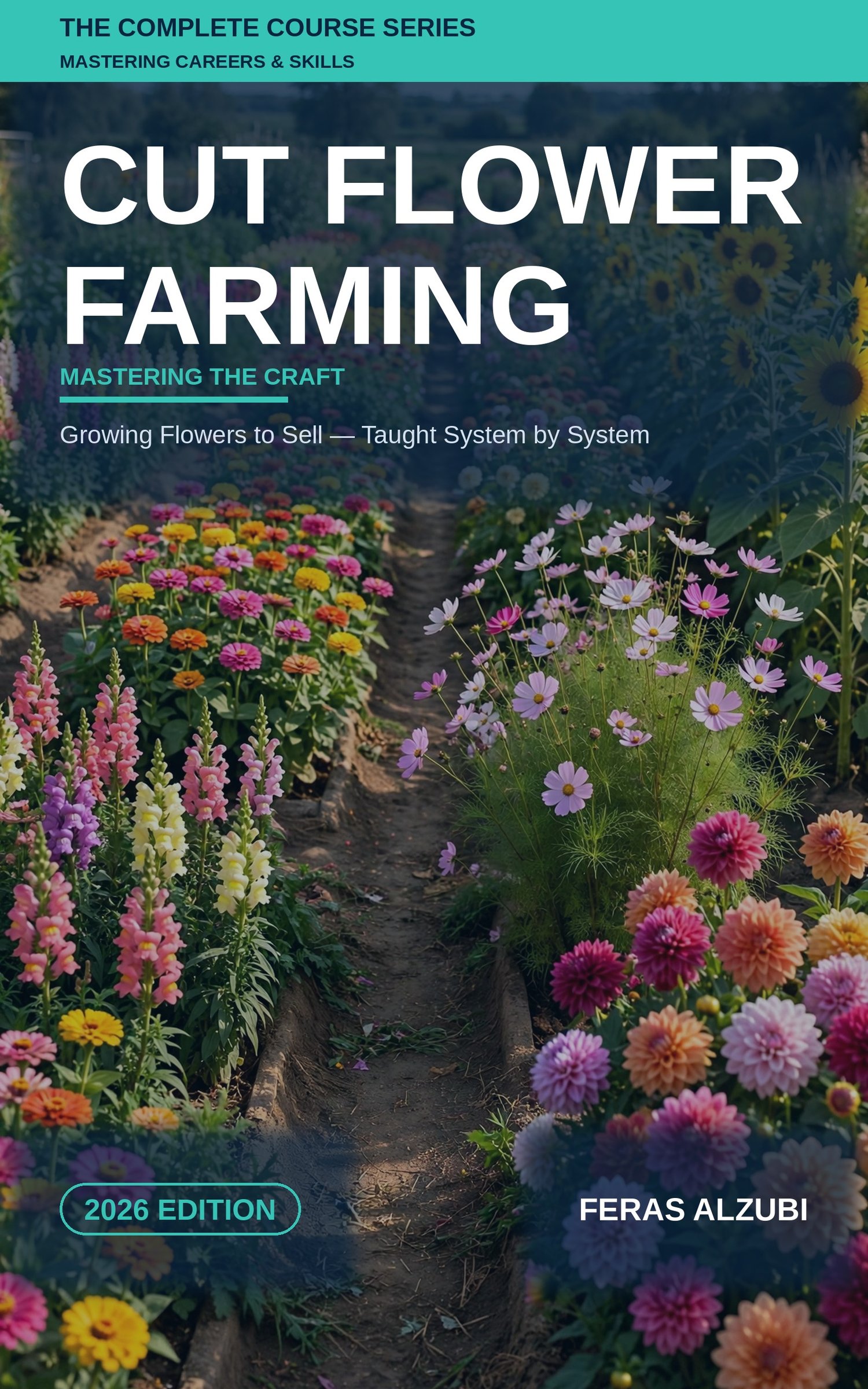
Cut Flower Farming: Mastering the Craft
Cut Flower Farming: Mastering the Craft
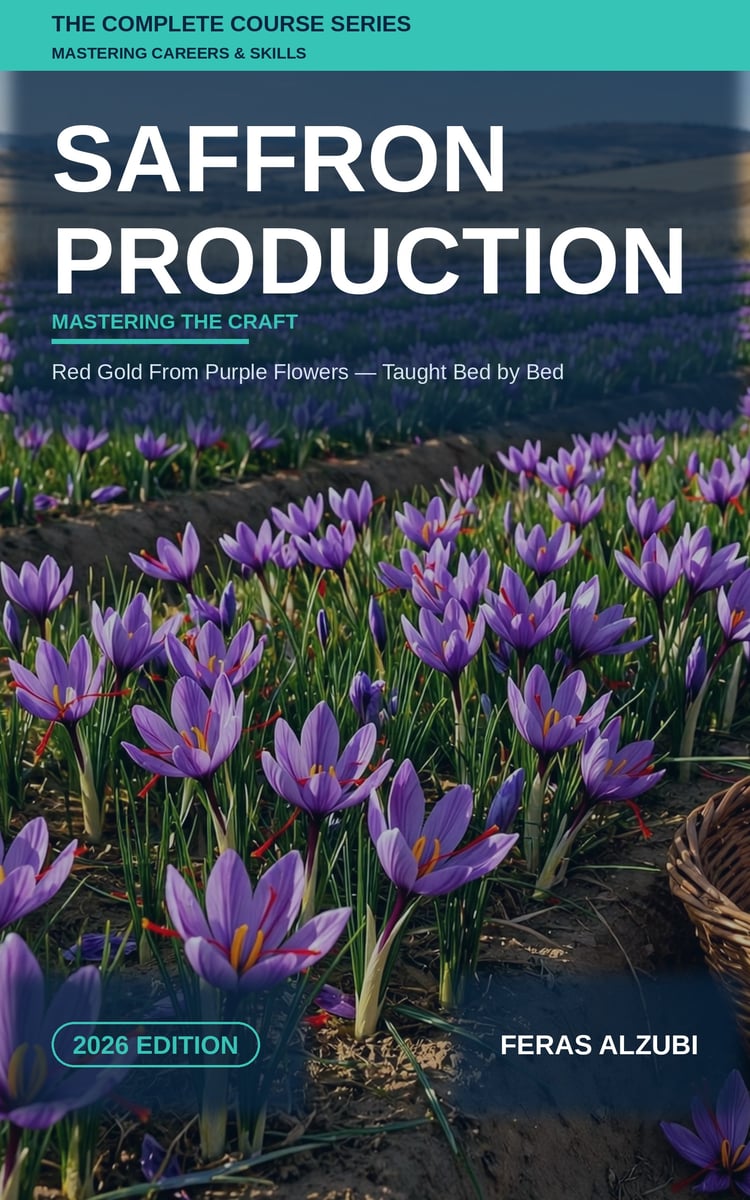
What this book teaches. The full specialty cut-flower enterprise — growing flowers as a crop and selling the stems to florists, grocery and retail stores, farmers market customers, and bouquet subscribers — taught A to Z in one volume, from first principles to a proved, documented season. The foundations come first: the venture itself and the buyers it serves; the cut flower plant — stem, bloom stage, and the vase life everything is judged by; the production system of beds, rows, and season flow; and the rules and authority for selling flowers legally, including the clean boundary between growing flowers and arranging them. Then the growing system: choosing crops across annuals, perennials, bulbs, woodies, and everlastings; soil and bed preparation; starting plants from seed, transplants, plugs, and bulbs; planting, spacing, pinching, and support; and the water, feeding, weeding, and care a crop receives. The production part follows: season planning and the bloom calendar, succession planting for stems every week, crop problems — pests, disease, and weather — and season extension in hoophouses and protected cropping. Then harvest and sales: cutting at the right stage and hour, hydration, conditioning, and cooling to protect vase life, the dried-flower crop and its handling, and the channels and enterprise arithmetic of florists, stores, markets, and subscriptions, taught with stated givens only. The book closes with the working grower's world: the flower farm's week and season, records, on-farm trials, and variety decisions, and the grower's own path — skills, the Association of Specialty Cut Flower Growers (ASCFG) community, and the working life. Every stage is taught so you can explain it, work it, and trust your conclusion — and the seed supplier's cultivar data, the ASCFG variety trials, and your extension service always govern the specifics for the cultivar and climate in front of you.
Who it is for. The beginning grower starting a cut-flower enterprise — on a farm adding a flower enterprise, on a small acreage, or at the scale of a serious sideline intended to grow; the working grower who already sells stems and wants the operation tightened — better succession planning, cleaner harvest and conditioning, fewer lost stems, and records that turn one season's experience into the next season's variety decisions; market gardeners and diversified farms adding flowers to an existing operation, who need the flower enterprise whole alongside what they already run; and the reader weighing this venture before spending on it, who wants an honest picture of the work and the life first. No general book replaces the guidance for the specific cultivar and climate in front of you — the book teaches the systems, the principles, and the method.
What's inside (every count verified against the actual book):
- Complete course — 20 chapters in five parts, foundations to the grower's path
- 340 practice questions — every answer explained, right and wrong
- 40-question diagnostic — scored by domain, with a routing worksheet
- 240 chapter questions — a 12-question check closes every chapter
- 60-question final review — sampling the whole enterprise, with routed re-study
- 40 labeled figures — schematic diagrams of the plant, the beds, and the season, two in every chapter
- 34 tables — crop data, calendars, sequences and reference data for the field
- 150-term glossary · 8 cheat sheets · 3 study plans — the full read (12 weeks), the working grower (6 weeks), and the market-first route (8 weeks)
- Quality taught as structure — only stems meeting the standard are sold, and represented honestly, throughout
Every one of the 340 questions is original, written for this book, and every explained answer tells you why the right answer is right and why each wrong answer is wrong. The book's facts rest on verified sources, listed in a Sources & Verification Note at the back of the book: the Association of Specialty Cut Flower Growers (ASCFG) and its variety trials, NCAT/ATTRA's specialty cut flower guidance, and Cooperative Extension publications and programs. This book makes no income promises: flower farming is a real enterprise with real buyers, and like every farm business its returns vary with climate, skill, markets, and costs — the book teaches the production and the arithmetic, honestly, and guarantees nothing. Cultivar specifics — days to bloom, stems per plant, vase life, spacing, and harvest stage — belong to the seed supplier's data, the ASCFG variety trials, and your extension service, and the book says so wherever such a number would otherwise be invented.
Read the first chapter free — the sample on this page is Chapter 1 of this book, exactly as it appears in the full edition.
From the Mastering Careers & Skills library — complete A-to-Z professional teaching books for careers, trades, and certifications.
This book is an independent teaching work. The Association of Specialty Cut Flower Growers (ASCFG) is named as the trade association it is; this book is not published by, endorsed by, or affiliated with it or with any seed supplier or extension body. It teaches growing and selling stems — growing is not a licensed act, and no credential comes from this book: the Louisiana florist license named in Chapter 4 governs arranging, a separate trade with its own book; this book does not itself confer a license or a certification.
Refunds: Please read the free sample chapter before you buy. This is a digital ebook, delivered instantly by download. If the file is defective, or you cannot open or download it and we cannot fix the problem, you will receive a full refund — email us within 14 days of purchase. Because the book is delivered instantly as a downloadable file, all other sales are final.
How to read this book (EPUB format): After checkout, download the EPUB file, then open it in any free ebook reader app. On iPhone or iPad: Apple Books — it is already on your device. On Android phones and tablets: Google Play Books (free: https://play.google.com/store/apps/details?id=com.google.android.apps.books) — upload the file in the app — or ReadEra (free). On a Windows or Mac computer: Thorium Reader (free: https://thorium.edrlab.org) or Adobe Digital Editions (free). On Kindle: use Amazon's free Send to Kindle (https://www.amazon.com/sendtokindle) to add the file to your Kindle library.