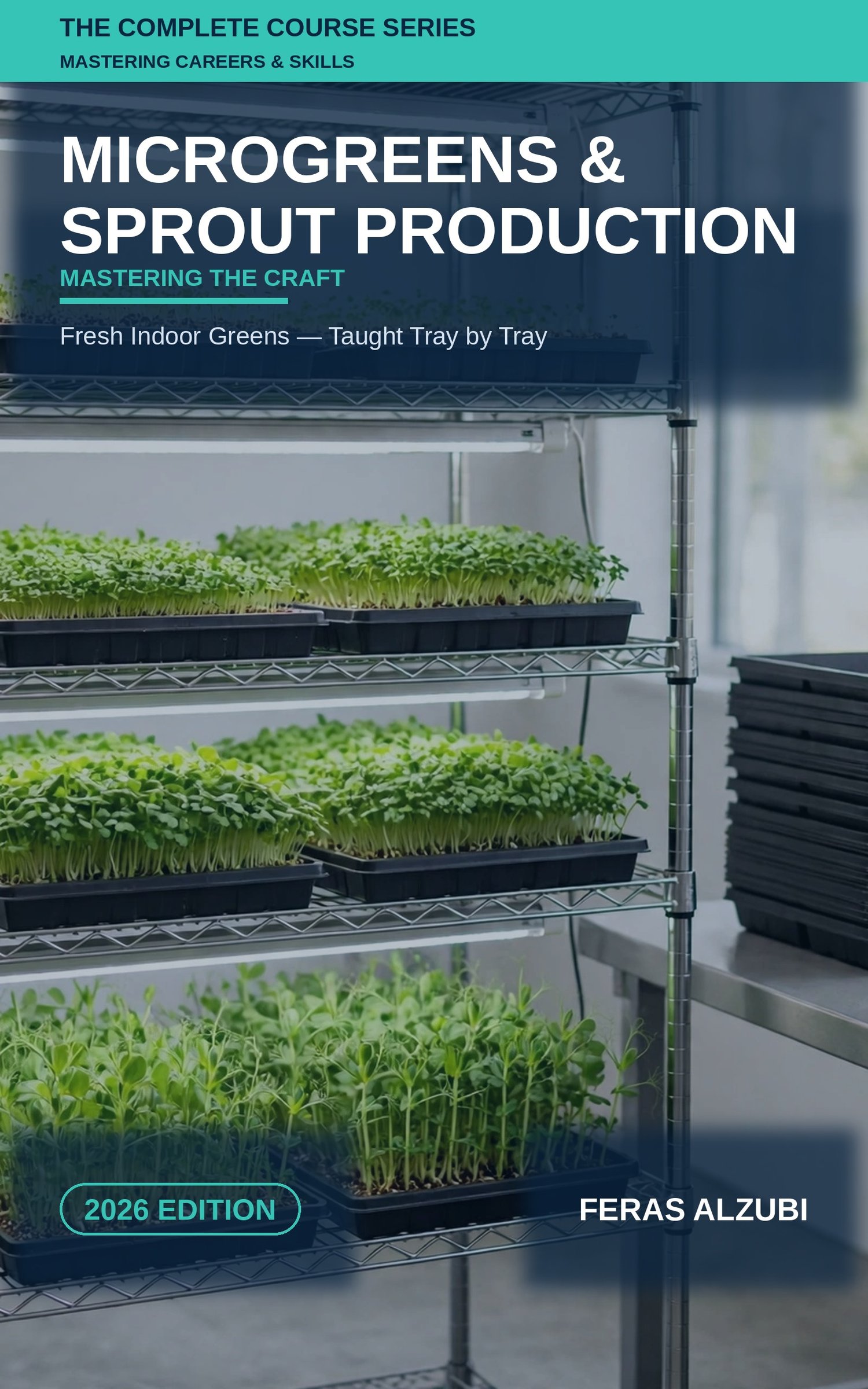
Microgreens & Sprout Production: Mastering the Craft
Microgreens & Sprout Production: Mastering the Craft
What this book teaches. The indoor greens enterprise — microgreens, shoots, and sprouts grown in trays under lights as a business — taught A to Z in one volume, from first principles to a proved, documented production routine. The foundations come first: the venture and the channels it sells into; the three crops defined precisely — sprouts eaten whole, microgreens cut above the medium at the first true leaf, and shoots and baby greens beyond them — because the definitions decide which rules apply; the growing room of racks, 1020 trays, light, and water; and the rules and authority — the FDA Produce Safety Rule that covers this produce, the dedicated sprout subpart that governs one of the three crops, and the state and market rules layered on top. Then the production system: choosing crops, channels, and scale; the crop library and its timings; sowing, medium, seed, and the germination days; growing on under light, water, and air; and crop numbers planned by the tray. The safety part follows, and it is the spine of the book: the pathogens and how they enter, the sprout discipline of seed control, batch testing, and test-and-hold, the daily sanitation round, and quality reading that saves crops before they fail. Then harvest and sales: the cut, the dry product, and the cold chain; packing, containers, lots, and the label; claims and grades that say only what is true; and the channels and enterprise arithmetic of the greens business. The book closes with the working grower's world: the week's rhythm of sowing, harvest, and delivery days; records, failures, and learning from each cycle; and the grower's own path — skills, community, and the working life.
Who it is for. The beginning grower who intends from the start to sell what the trays produce — to restaurants, grocers, markets, and subscribers — and wants the whole production system, safety discipline included, in the order the work itself lives it; the working grower with trays already cycling who wants the operation tightened — steadier germination, fewer lost trays, cleaner harvests, a sprout line run under its full discipline, labels and claims that can be stood behind, and records that turn one cycle's experience into the next cycle's decisions; and farmers and diversified operations adding an indoor greens enterprise to an existing business — a winter income line, a farm-store shelf, a restaurant account of their own — who need the enterprise whole: crops, room, safety, harvest, and channels. It is also for the reader weighing this venture before spending on it, who wants an honest picture of the work and the life.
What's inside (every count verified against the actual book):
Complete course — 20 chapters in five parts, foundations to the grower's path
340 practice questions — every answer explained, right and wrong
40-question diagnostic — know where you stand before you start
240 chapter questions — a 12-question check closes every chapter
60-question final review — sampling the whole enterprise
40 labeled figures — production diagrams and enterprise maps, two in every chapter
26 tables — crop timings, sequences and reference data for the growing room
150-term glossary · 8 cheat sheets · 3 study plans — Plan A, the full read (12 weeks), Plan B, the working grower (6 weeks), and Plan C, market-first (8 weeks)
Enterprise arithmetic taught as structure — the budget built from stated givens, worked example by worked example
Every one of the 340 questions is original, written for this book, and every explained answer tells you why the right answer is right and why each wrong answer is wrong. The book's facts rest on verified sources, listed in a Sources & Verification Note at the back of the book: the produce-safety duties are taught from the FDA Produce Safety Rule (21 CFR Part 112) and its sprout subpart, crop guidance from university extension publications, and nutrition evidence from the 2012 Maryland/USDA study as it was actually written; sanitizers, seed treatments, laboratory methods, and local licensing are assigned throughout to product labels, the regulation, and state programs, where they belong. This book makes no income promises: a greens enterprise is a real business with real buyers, and its returns vary with skill, seed, season, and markets — the book teaches the production and the arithmetic, honestly, and guarantees nothing.
Read the first chapter free — the sample on this page is Chapter 1 of this book, exactly as it appears in the full edition.
From the Mastering Careers & Skills library — complete A-to-Z professional teaching books for careers, trades, and certifications.
This book is an independent teaching work. It teaches the enterprise — produce safety and sprout production are governed by federal and state rules, legal standing comes from those rules and the state, and no credential comes from this book: this book does not itself confer a license, a certification, or a permit.
Refunds: Please read the free sample chapter before you buy. This is a digital ebook, delivered instantly by download. If the file is defective, or you cannot open or download it and we cannot fix the problem, you will receive a full refund — email us within 14 days of purchase. Because the book is delivered instantly as a downloadable file, all other sales are final.
How to read this book (EPUB format): After checkout, download the EPUB file, then open it in any free ebook reader app. On iPhone or iPad: Apple Books — it is already on your device. On Android phones and tablets: Google Play Books (free: https://play.google.com/store/apps/details?id=com.google.android.apps.books) — upload the file in the app — or ReadEra (free). On a Windows or Mac computer: Thorium Reader (free: https://thorium.edrlab.org) or Adobe Digital Editions (free). On Kindle: use Amazon's free Send to Kindle (https://www.amazon.com/sendtokindle) to add the file to your Kindle library.