
Thoughts vs. Feelings How to tell them apart, and why it matters.
Thoughts vs. Feelings
How to tell them apart, and why it matters.
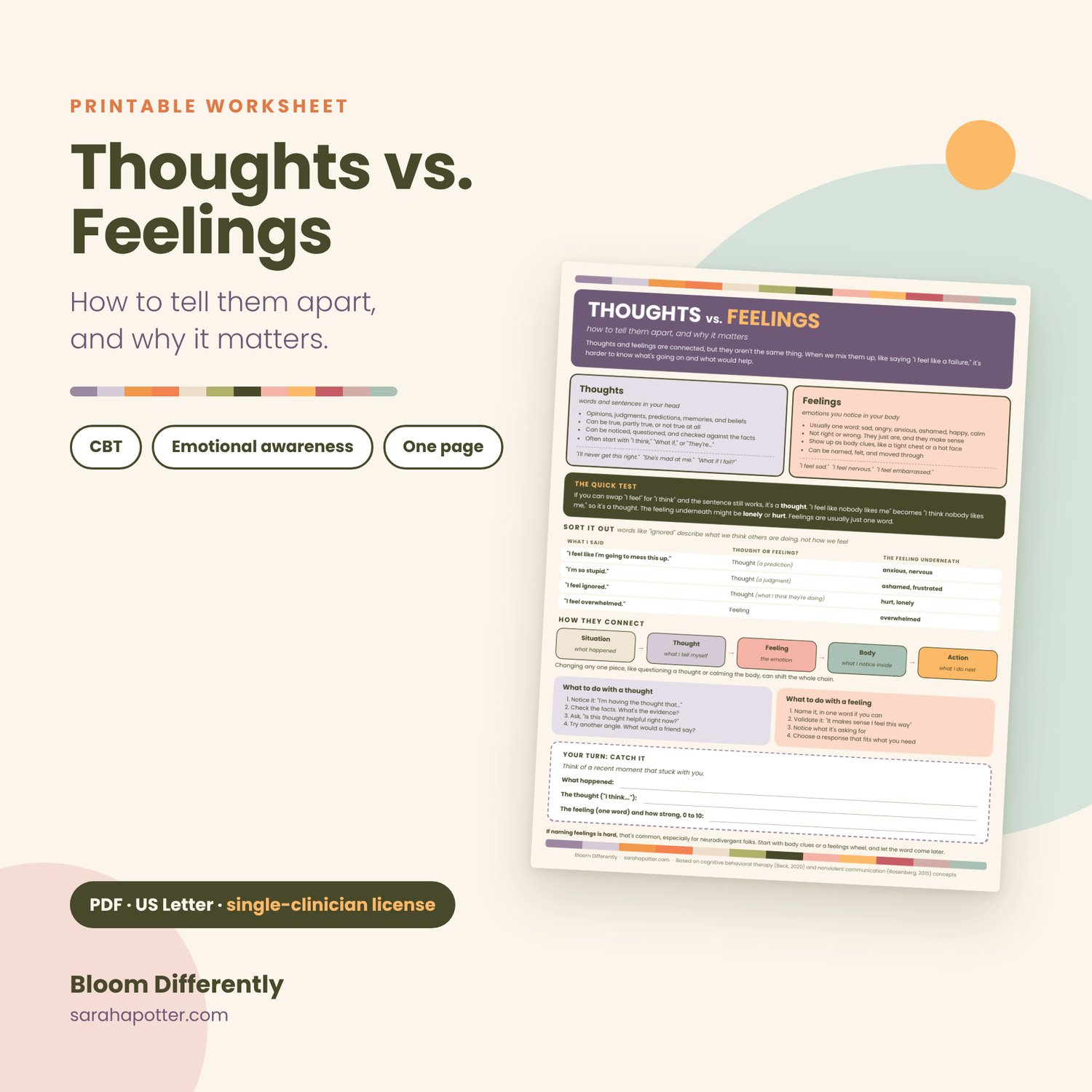
“I feel like a failure” sounds like a feeling, but it’s really a thought. When we mix the two up, it’s harder to know what’s going on and what would help. This one-page worksheet makes the difference clear, with a quick test anyone can use.
What’s inside
- Side-by-side comparison: thoughts (words and sentences in your head: opinions, predictions, judgments) next to feelings (emotions you notice in your body, usually one word), with examples of each.
- The quick test: if you can swap “I feel” for “I think” and the sentence still works, it’s a thought.
- Sort it out: a table of common phrases like “I feel ignored” and “I’m so stupid,” showing whether each is a thought or a feeling and the feeling underneath it.
- How they connect: the chain from situation to thought, feeling, body and action, showing that changing any one piece can shift the whole chain.
- What to do with each:For a thought: notice it, check the facts, ask if it’s helpful, and try another angle.
- For a feeling: name it, validate it, notice what it’s asking for, and respond to the need.
- A “Your Turn: Catch It” practice section for a real moment, including rating the feeling from 0 to 10.
Who it’s for
Teens and adults in CBT, DBT or emotion-focused work, and anyone who says “I feel like...” when they mean “I think...” It’s useful for therapists, school counselors and group facilitators.
Ways to use it
- Teach the thought-feeling difference early in treatment.
- Help a client find the real feeling underneath a judgment or prediction.
- Pair it with the ANTs worksheet for a complete intro to cognitive work.
- Use the connection chain to explain why coping skills work.
Why it’s different
It includes a note that naming feelings can be hard, especially for neurodivergent folks, and suggests starting with body clues or a feelings wheel and letting the word come later. Feelings are treated as valid, never wrong.
What you get
A one-page printable PDF, US Letter, available as an instant download. It’s based on cognitive behavioral therapy (Beck, 2020) and Nonviolent Communication (Rosenberg, 2015). Single-clinician license included.
Pairs well with: ANTs: Automatic Negative Thoughts, Feelings + Needs Inventory, Whole-Body Feelings Wheel