
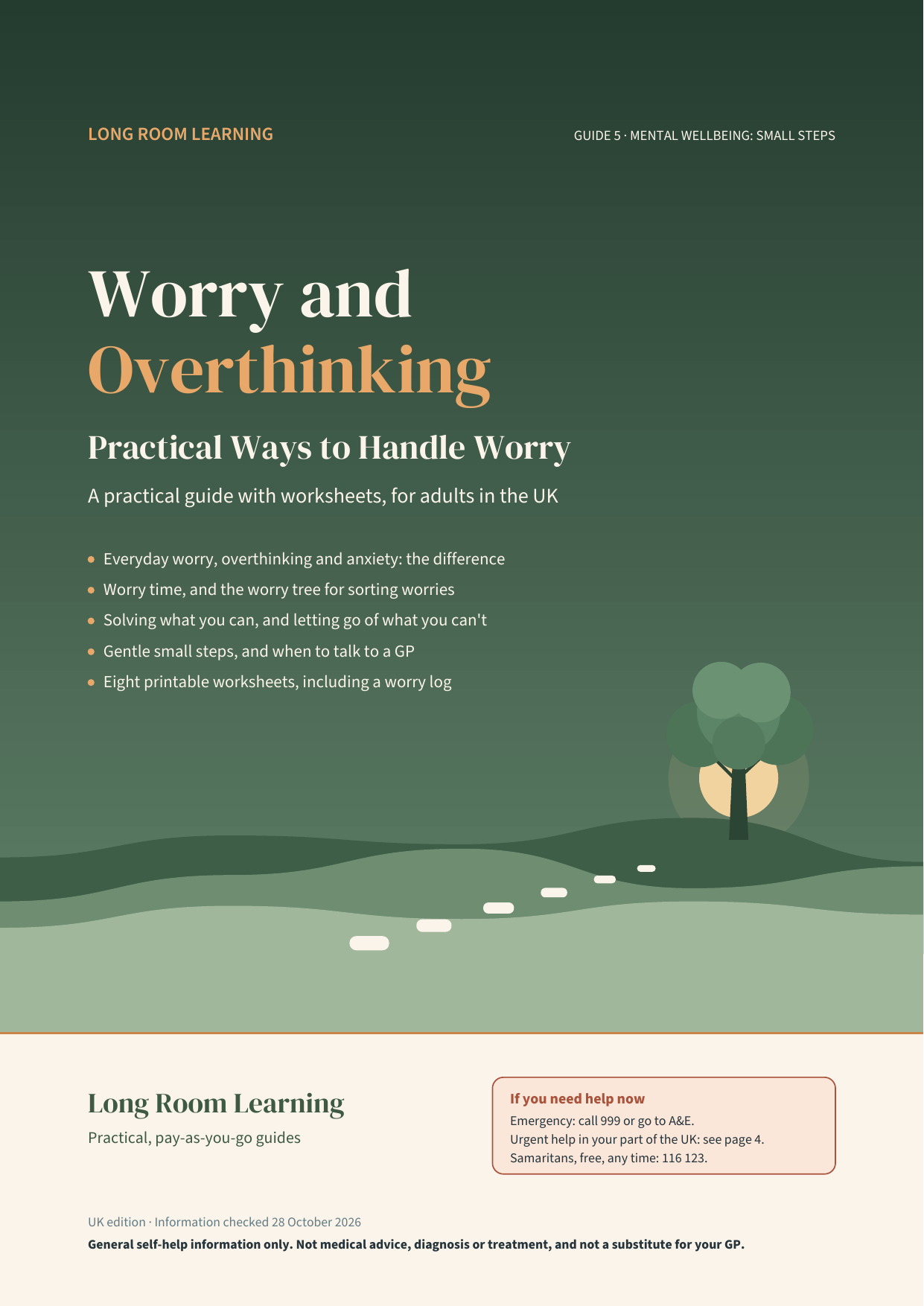
Worry and Overthinking: Practical Ways to Handle Worry (PDF Guide)
Thoughts going round in circles? A calm, practical UK guide to sorting your worries, setting them aside and knowing when to get help, with eight printable worksheets.
Everyone worries sometimes. Worry can help us plan and take care. But when worries pile up, keep you awake or go round and round, they can start to take over your day. This guide brings together official UK health information and what the mental health charity Mind says about everyday worry, and turns it into small, manageable steps.
It explains, in plain words, the difference between everyday worry and anxiety that may need help, the two kinds of worry (problems you can solve and "what ifs"), and how worry can show up in your body, your thoughts and what you do. Then it walks you through practical self-help techniques: writing worries down, a short daily worry time, the worry tree, step-by-step problem solving, and "catch it, check it, change it" for unhelpful thoughts. There are gentle ideas for letting go of what you cannot control, coming back to the present, and taking small everyday steps instead of avoiding things.
A clear chapter explains when to see a GP and how to get NHS talking therapies in England, Scotland, Wales and Northern Ireland. Urgent help contacts for each part of the UK are at the front and again at the back. The guide does not diagnose anything: if you think you may have an anxiety disorder, it encourages you to speak to a GP.
The eight A4 worksheets are spaced for handwriting: a worry log, understanding my worries, a worry time planner, my worry tree, a problem-solving plan, catch it, check it, change it, small steps instead of avoiding, and a calm toolkit with space to prepare for a GP appointment.
What you get: one 33-page A4 PDF. Print the worksheets as often as you like for your own use. Information checked against official UK health and charity pages on 28 October 2026, with every source listed.
Please note: This guide is general self-help information only. It is not medical advice, therapy, diagnosis or treatment, and it is not a substitute for your GP. It cannot tell you whether you have an anxiety disorder. No particular result is promised. It does not give medicine or supplement advice: please ask your GP or a pharmacist. If worry or anxiety is affecting your daily life, speak to a GP. If you feel unsafe or someone's life is at risk, call 999 or go to A&E. Samaritans are free to call on 116 123, day or night.
Guide 5 in the Mental Wellbeing: Small Steps series from Long Room Learning. Guide 1, Coping with Seasonal Low Mood, and Guide 2, Better Sleep, are also available.