
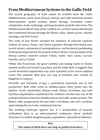
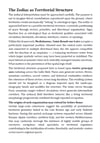
Gaul Systems. A Structural Reading of Zodiacal Territorial Systems
A landscape organized. Across rivers, mountains, sacred centers, pilgrimage routes, ancient capitals and forgotten frontiers, a hidden territorial structure emerges beneath the geography of Gaul. This book proposes a structural reading of the territory inspired by the work of Jean Richer and expanded through a continental-scale analysis of landscapes, cities and symbolic systems. What appears to be a mosaic of regions gradually reveals an underlying coherence. Not provinces. Not kingdoms. A system.
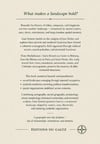
What this book reveals
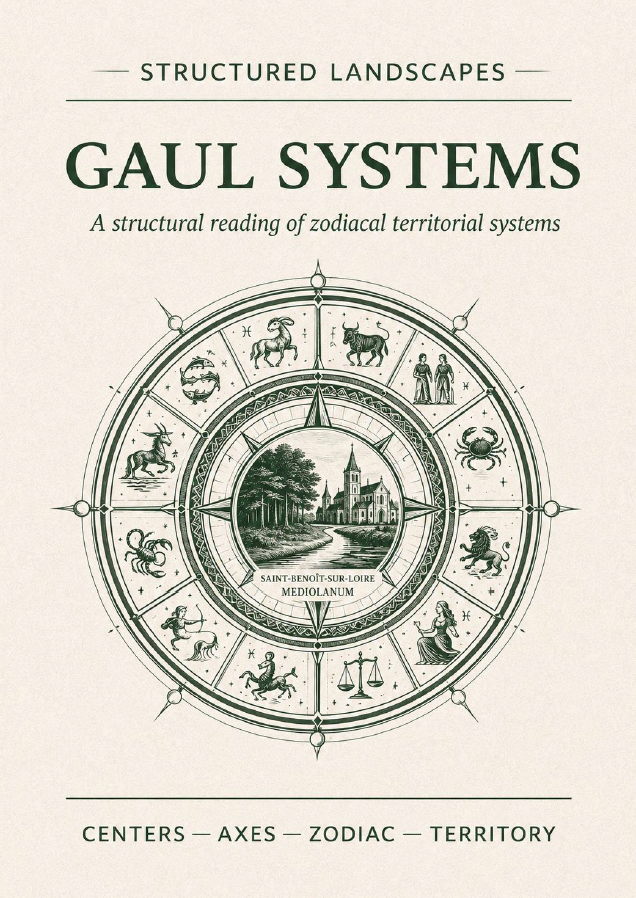
From Brittany to Alsace, from the Channel coast to the Pyrenees, the territory unfolds through twelve major sectors organized around a central framework. The book explores:
• the twelve territorial sectors of the Gaulic Zodiac
• sacred centers and omphalos traditions
• rivers as organizing corridors
• mountains as symbolic thresholds
• pilgrimage routes and ancient circulation networks
• cities as structural nodes rather than political capitals
• the interaction between geography, mythology, memory and territorial continuity
• the persistence of ancient symbolic frameworks beneath modern landscapes
What appears fragmented becomes connected.
Core Insight
The territory of Gaul may be read as more than a collection of historical regions. It functions as a structured landscape where rivers, routes, mountains, cities and sacred places participate in a larger territorial logic.
The question is not: "Where are the regions?"
but: "How is the territory organized?"
Through hundreds of maps, diagrams, illustrations and case studies, this volume reconstructs a territorial system extending across centuries of cultural transformation.
Inside the Book
✔ 500+ pages
✔ More than 250 maps, diagrams and illustrations
✔ Twelve territorial sectors from Aries to Pisces
✔ Sacred geography and symbolic landscapes
✔ Historical cities, pilgrimage routes and forgotten corridors
✔ Rivers, mountains and long-term territorial structures
✔ A synthesis of mythology, geography, history and spatial organization
A Different Way of Seeing Territory
This is not a historical atlas.
It is not a guidebook.
It is not a study of regional folklore.
It is an exploration of how landscapes organize themselves through recurring structures that survive political change, dynastic shifts and cultural transformations.
Beneath the visible territory lies another geography.
A geography of relations.
A geography of continuity.
A geography of structure.
Format: PDF
Length: 504 pages
Series: Symbolic Landscapes. Part of the Symbolic Landscapes collection. Not regions. Structures.