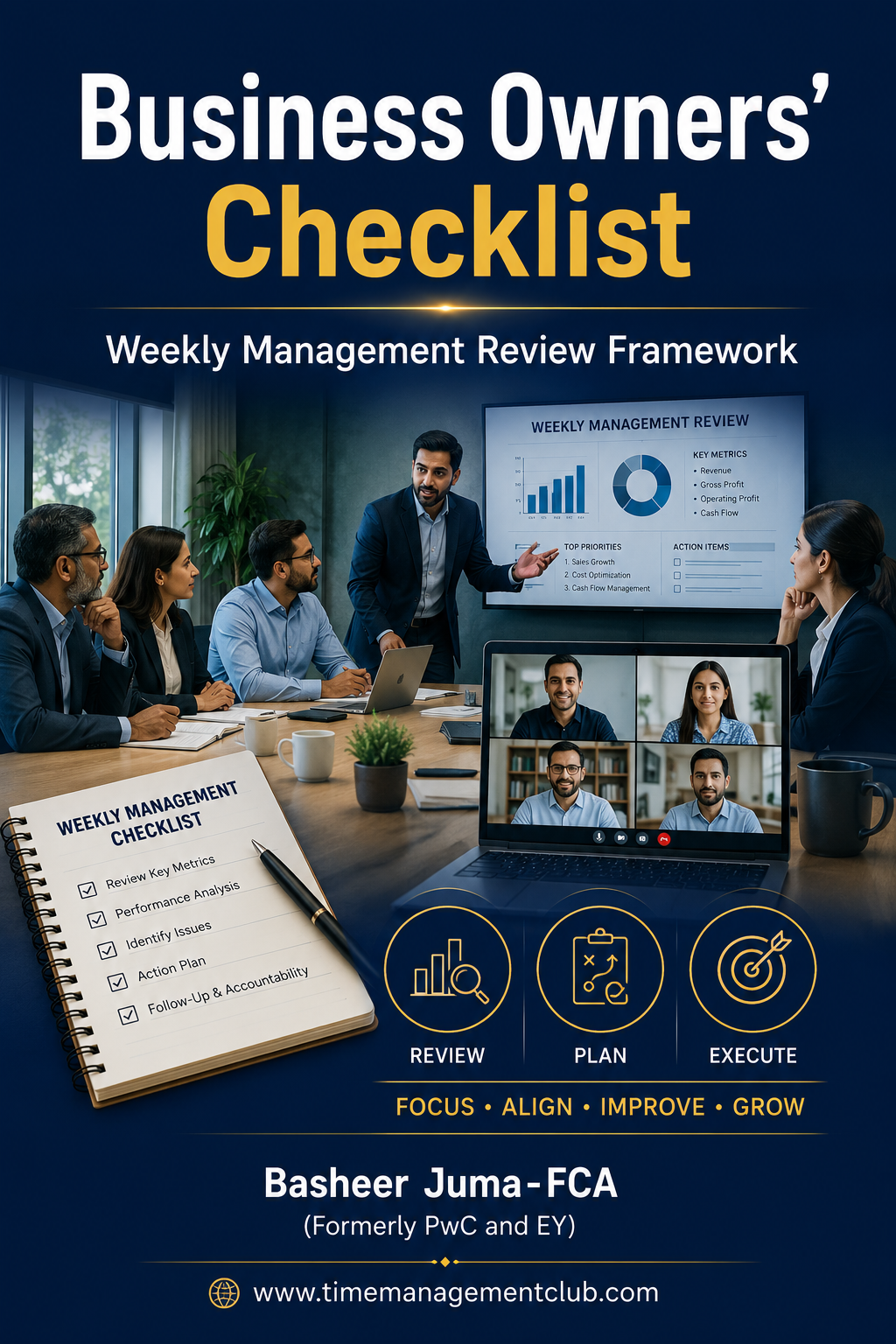
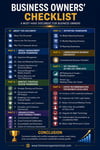
Business Owners' Checklist
Why Every Business Needs a Governance Framework
The Cost of Running Without a System
Ask any business owner what their biggest challenge is, and you will rarely hear “we lack talent” or “our product is not good enough.” More often, you will hear something like this:
■ "We have too many meetings, and nothing changes."
■ "I don’t know our real cash position until it’s too late."
■ "Everyone is busy, but the important things are not getting done."
■ "We grow in good times, but we don’t know why we struggle in bad ones."
These are not complaints about markets or competition. They are symptoms of one underlying problem: the absence of a structured management and governance system.
Governance is not a word reserved for large corporations or publicly listed companies. Every business, from a family-owned trading firm to a growing professional services practice to a nonprofit serving vulnerable communities, needs governance. It simply means running your organization with clarity, accountability, and discipline.
What This Framework Provides
This book provides a complete, practical system for weekly and monthly management reviews. It is designed around one central belief: that the disciplines of the world’s best-managed organizations are not secret. They are transferable, teachable, and available to any business that commits to applying them.
When you implement this framework, you will be able to:
■ Run better meetings.
Every session will have an agenda, a data foundation, and a set of decisions and actions to conclude.
■ Track what truly matters.
A small number of well-chosen KPIs, reviewed consistently, will tell you more about your business than any amount of gut feeling.
■ Hold people accountable with respect.
Clear ownership of every action item transforms a meeting from a conversation into a commitment.
■ Identify risks before they become crises.
A structured monthly review cycle surfaces problems early, when they are still manageable.
■ Align your team with your strategy.
When everyone understands the priorities and can see the scoreboard, they move in the same direction.
■ Build institutional memory.
Documented decisions, recorded minutes, and maintained action logs mean that your organization’s knowledge survives beyond any single individual.
How This Book Is Organized
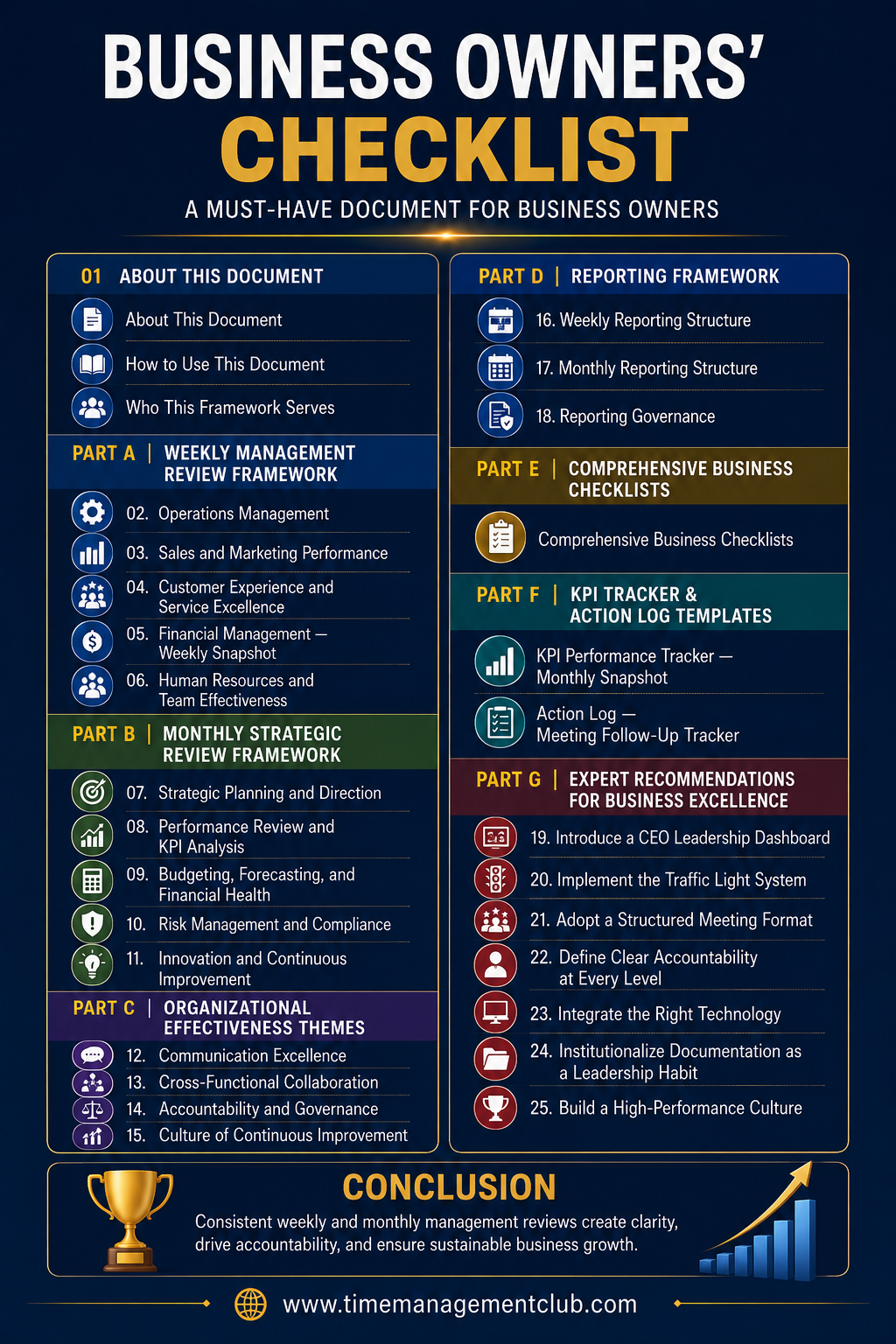
This framework is organized into seven parts, each addressing a distinct dimension of business governance and management practice:
■ Part A — Weekly Management Review Framework. Six critical areas to review every week: operations, sales, customer experience, financial health, and human resources.
■ Part B — Monthly Strategic Review Framework.
Five strategic disciplines for monthly review: strategic direction, KPI analysis, budgeting, risk management, and innovation.
■ Part C — Organizational Effectiveness Themes.
Four cross-cutting themes — communication, collaboration, accountability, and culture — that determine organizational health.
■ Part D — Reporting Framework.
A complete reporting architecture covering weekly, monthly, and quarterly structures with clear audience and format guidance.
■ Part E — Comprehensive Business Checklists.
Three ready-to-use checklists — weekly, monthly, and quarterly/annual — with owner and status columns for immediate use.
■ Part F — KPI Tracker and Action Log Templates.
Printable templates for tracking key performance indicators and managing meeting commitments.
■ Part G — Expert Recommendations.
Seven high-impact recommendations, including the CEO Dashboard, the Traffic Light System, and the Structured Meeting Format.
Who This Book Is For
This framework has been designed to serve a wide range of leaders and organizations:
■ Business owners and CEOs who want to move from reactive management to proactive leadership
■ Family businesses seeking to introduce governance structures without losing their human culture
■ Corporate leadership teams that need a shared language and rhythm for performance management
■ Nonprofit and charity organizations that must demonstrate accountability to donors, boards, and beneficiaries
■ Management students and emerging leaders who want to understand how high-performing organizations operate
■ 21st Century Entrepreneurs and business starters.
How to Use This Book
This is a working document, not a reading document. You are encouraged to write in it, print sections for your meetings, adapt the checklists to your specific business, and share relevant parts with your leadership team. The value of this framework is entirely proportional to the consistency with which you apply it.
A practical suggestion: begin with Part E. Select the weekly checklist and use it in your very next management meeting. Experience the discipline it creates. Then, over the following weeks, layer in the review questions from Parts A and B. Build the habit before you build the system.
The businesses that will benefit most from this framework are not those that read it carefully and file it on a shelf. They are those who open it every Monday morning and ask: “Of the things that matter most to this organization, how are we doing today?
That question, asked consistently and answered honestly, is the foundation of every well-governed enterprise.
Welcome to the framework. Let’s begin.
Contents
Why Every Business Needs a Governance Framework
The Cost of Running Without a System
What This Framework Provides
How This Book Is Organized
Who This Book Is For
How to Use This Book
Part A | Weekly Management Review Framework
02. Operations Management
2.1 Weekly Priorities and Execution Focus
2.3 Operational Challenges and Resolutions
03. Sales and Marketing Performance
3.1 Weekly Sales Targets
3.2 Pipeline and Opportunities
3.3 Marketing Effectiveness
04. Customer Experience and Service Excellence
4.1 Customer Satisfaction Monitoring
4.2 Complaint Resolution and Service Recovery
4.3 Customer Onboarding and Retention
05. Financial Management — Weekly Snapshot
5.1 Cash Flow Monitoring
5.2 Receivables, Payables, and Collections
5.3 Financial Reporting Integrity
06. Human Resources and Team Effectiveness
6.1 Workforce Changes and Capacity
6.2 Training and Development
6.3 Employee Engagement and Team Morale
Part B | Monthly Strategic Review Framework
07. Strategic Planning and Direction
7.1 Alignment with Vision and Annual Goals
7.2 New Initiatives and Expansion Plans
7.3 Market, Industry, and Competitor Intelligence
08. Performance Review and KPI Analysis
8.1 Departmental KPI Scorecard
8.2 Performance Gap Analysis
8.3 Talent Recognition and Performance Management
09. Budgeting, Forecasting, and Financial Health
9.1 Budget vs Actual Review
9.2 Cost Optimization and Efficiency
9.3 Revenue Forecasting and Pipeline Review
10. Risk Management and Compliance
10.1 Risk Identification and Assessment
10.2 Regulatory Compliance and Legal Obligations
10.3 Business Continuity and Disaster Recovery
11. Innovation and Continuous Improvement
11.1 Technology Adoption and Digital Transformation
11.2 Process Optimization and Waste Elimination
11.3 Growth Opportunities and New Revenue Streams
Part C | Organizational Effectiveness Themes
12. Communication Excellence
13. Cross-Functional Collaboration
14. Accountability and Governance
15. Culture of Continuous Improvement
Part D | Reporting Framework
16. Weekly Reporting Structure
16.1 KPI Dashboard
16.2 Progress and Milestone Updates
16.3 Sales and Revenue Snapshot
16.4 Customer Metrics
16.5 Operational and People Metrics
17. Monthly Reporting Structure
17.1 Financial Statements
17.2 Strategic Goal Achievement
17.3 Marketing and Sales Analytics
17.4 Customer Insights and Voice of Customer
17.5 Operational Review and Improvement Log
18. Reporting Governance
18.1 Reporting Cadence
18.2 Reporting Formats
18.3 Reporting Audience and Distribution
Part E | Comprehensive Business Checklists
Weekly Checklist
Monthly Checklist
Quarterly and Annual Checklist
Part F- | KPI Tracker & Action Log Templates
KPI Performance Tracker — Monthly Snapshot
Action Log — Meeting Follow-Up Tracker
Part G | Expert Recommendations for Business Excellence
19. Introduce a CEO Leadership Dashboard 58
20. Implement the Traffic Light System
21. Adopt a Structured Meeting Format
22. Define Clear Accountability at Every Level
23. Integrate the Right Technology
24. Institutionalize Documentation as a Leadership Habit.
25. Build a High-Performance Culture
Conclusion
Use this document to: