
The Science Behind Heat Overwhelm in Autism
The Science Behind Heat Overwhelm in Autism — Educational Infographic (Printable, A2)
You will receive the printable unwatermarked version of this infographic
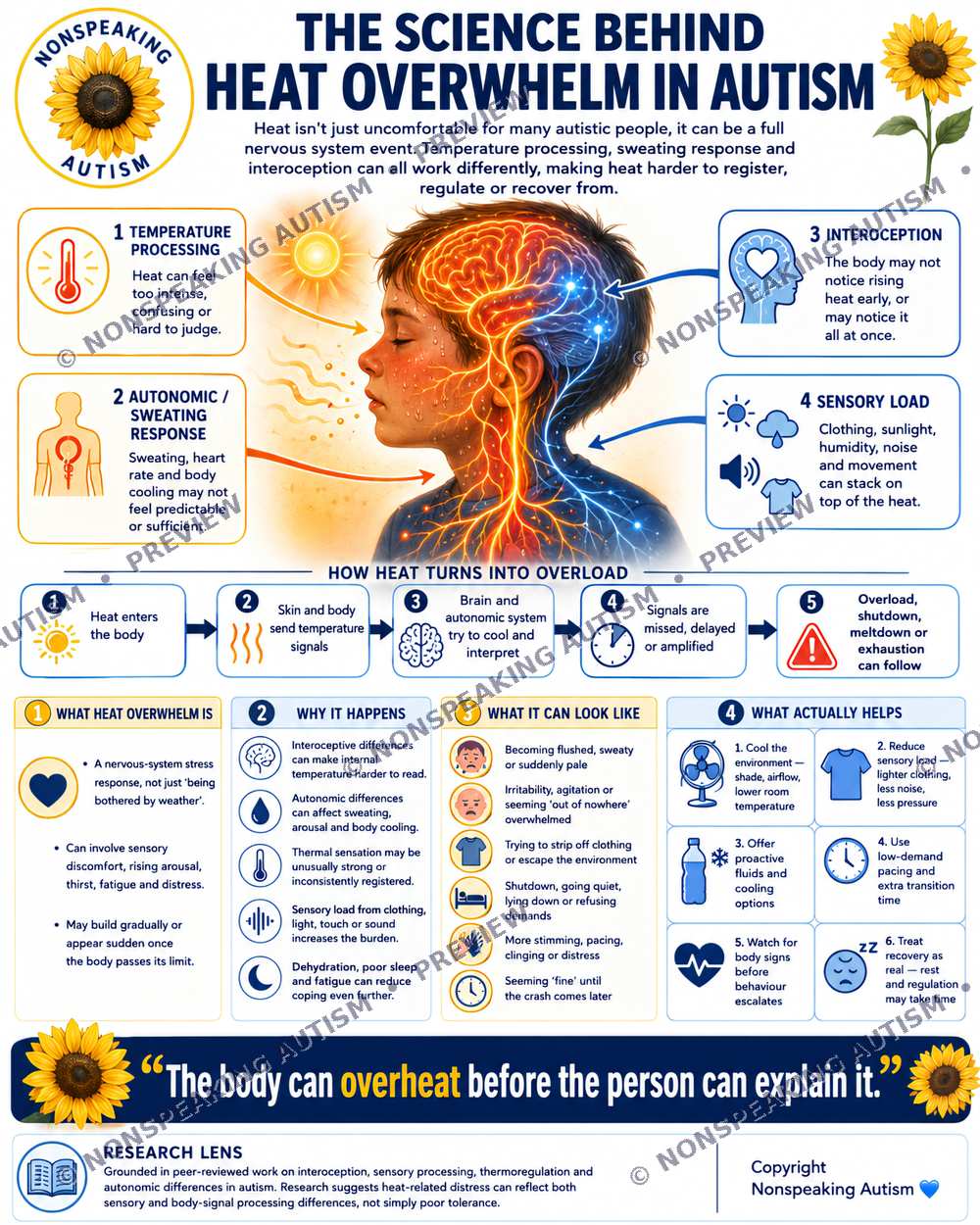
A research-grounded visual explaining why heat isn't just uncomfortable for many autistic people — it can be a full nervous system event.
This infographic covers:
- Four contributing factors: temperature processing, autonomic/sweating response, interoception, and sensory load
- How heat turns into overload: heat enters the body → temperature signals sent → brain and autonomic system try to cool and interpret → signals missed/delayed/amplified → overload, shutdown, meltdown or exhaustion
- What heat overwhelm is: a nervous-system stress response, not just "being bothered by weather"
- Why it happens: interoceptive and autonomic differences, unusual thermal sensation, sensory load stacking, dehydration and fatigue
- What it can look like: becoming flushed or pale, irritability "out of nowhere," trying to strip off clothing, shutdown, seeming "fine" until the crash comes later
- What actually helps: cool the environment, reduce sensory load, offer proactive fluids, use low-demand pacing, watch for body signs, treat recovery as real
- Grounded in peer-reviewed research on interoception, sensory processing, and thermoregulation in autism
What you get:
- High-resolution PDF, print-ready and scalable up to A2 (420 × 594mm)
- Instant digital download
Perfect for: SEND training, therapy rooms, schools, parent carer forums, and home use, especially in summer months.
For personal, classroom, and professional educational use. Not for resale or redistribution.
© Nonspeaking Autism
Disclaimer:
This resource is intended for educational and informational purposes only. It is designed to support understanding of autism, sensory processing, nervous system regulation, and behaviour from a neurodevelopmental perspective.
The information provided is not medical, psychological, therapeutic, or legal advice and should not be used as a substitute for assessment, diagnosis, or treatment by a qualified healthcare professional.
Every autistic person is unique. Strategies and supports should always be tailored to the individual's needs, strengths, and circumstances.
If a child displays a sudden change in behaviour, severe distress, signs of illness, injury, or behaviours that place themselves or others at risk, seek appropriate medical advice or emergency assistance where necessary.
While every effort has been made to ensure the information is accurate and reflects current understanding, knowledge in autism and neuroscience continues to evolve.
This resource is for the purchaser's personal, educational, or professional use only. It may not be copied, redistributed, resold, edited, shared publicly, or reproduced in whole or in part without prior written permission.
© Nonspeaking Autism 💙