
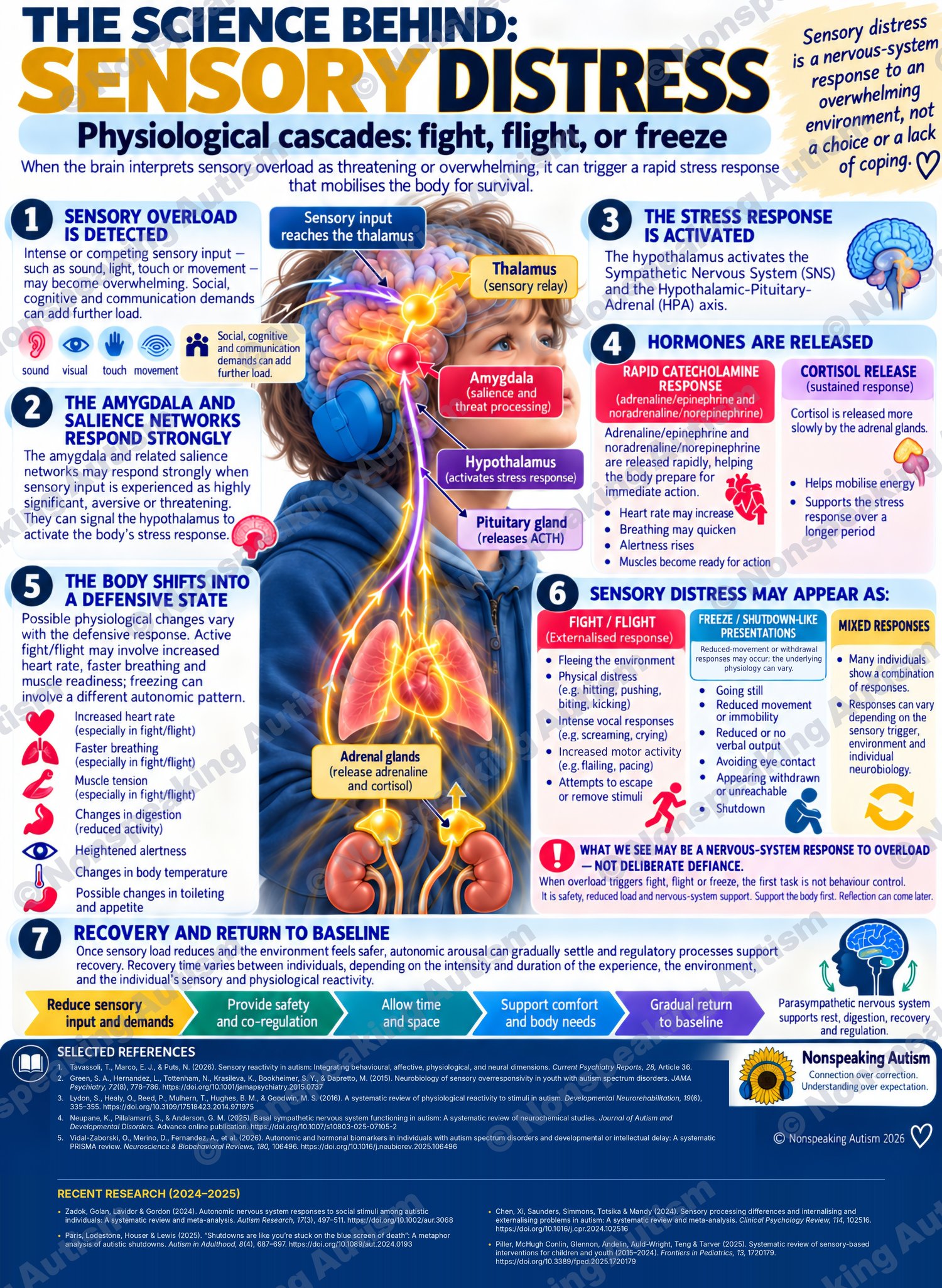
The Science Behind: Sensory Distress Physiological Cascades: Fight, Flight or Freeze
The Science Behind: Sensory Distress
Physiological Cascades: Fight, Flight or Freeze
A Research-Informed Autism, Sensory Overload & Nervous-System Educational Poster
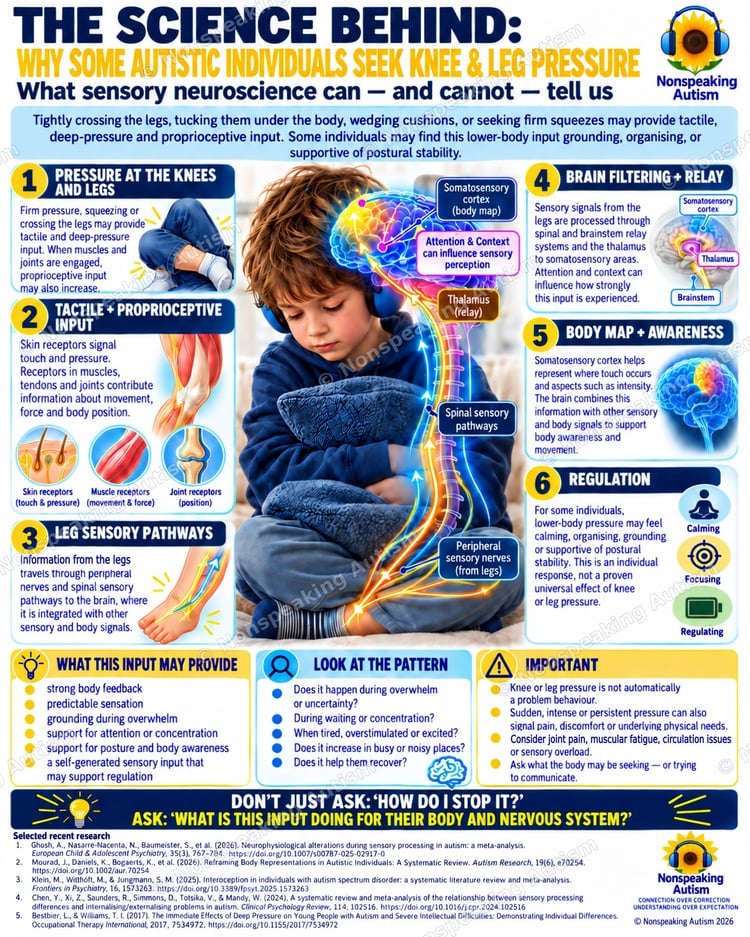
Sensory distress is not simply a person “overreacting,” refusing to cope or choosing difficult behaviour.
When sensory, social, cognitive or communication demands become overwhelming, the body may respond with a real physiological stress response. Changes in arousal, movement, communication, attention and behaviour may follow.
The Science Behind: Sensory Distress is a detailed, research-informed educational poster from Nonspeaking Autism, designed to help families, educators and professionals understand what may be happening beneath the visible behaviour during sensory overload.
The central message is:
Sensory distress may be a nervous-system response to an overwhelming environment — not a deliberate choice or a lack of coping.
🧠 What This Poster Explores
This resource visually explores a possible pathway from overwhelming sensory input to physiological stress and eventual recovery.
It covers:
- sensory overload
- sound, light, touch and movement
- social, cognitive and communication load
- the thalamus
- amygdala and salience networks
- hypothalamus
- sympathetic nervous system
- hypothalamic-pituitary-adrenal (HPA) axis
- adrenaline and noradrenaline
- cortisol
- autonomic arousal
- fight/flight responses
- freeze/shutdown-like presentations
- mixed responses
- recovery and return towards baseline
The poster is designed to make complex neuroscience accessible while making clear that real nervous-system responses are more complex and individualized than any single diagram can show.
1️⃣ When Sensory Load Becomes Too Much
Sensory input can come from many sources:
- 🔊 sound
- 👁️ visual information
- ✋ touch
- movement
- crowds
- smells
- temperature
- competing sensory information
But sensory load does not exist in isolation.
A person may simultaneously be managing:
- communication demands
- uncertainty
- transitions
- social interaction
- cognitive demands
- fatigue
- pain
- anxiety
- unfamiliar environments
The amount of input a person can manage may therefore vary substantially from one situation or day to another.
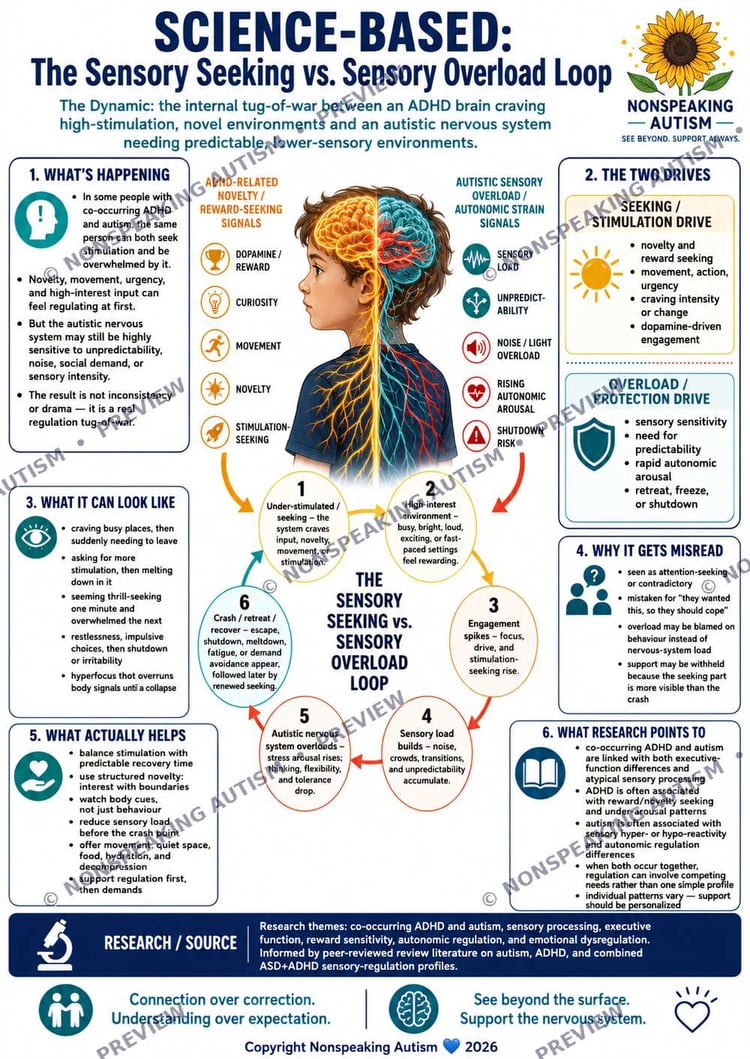
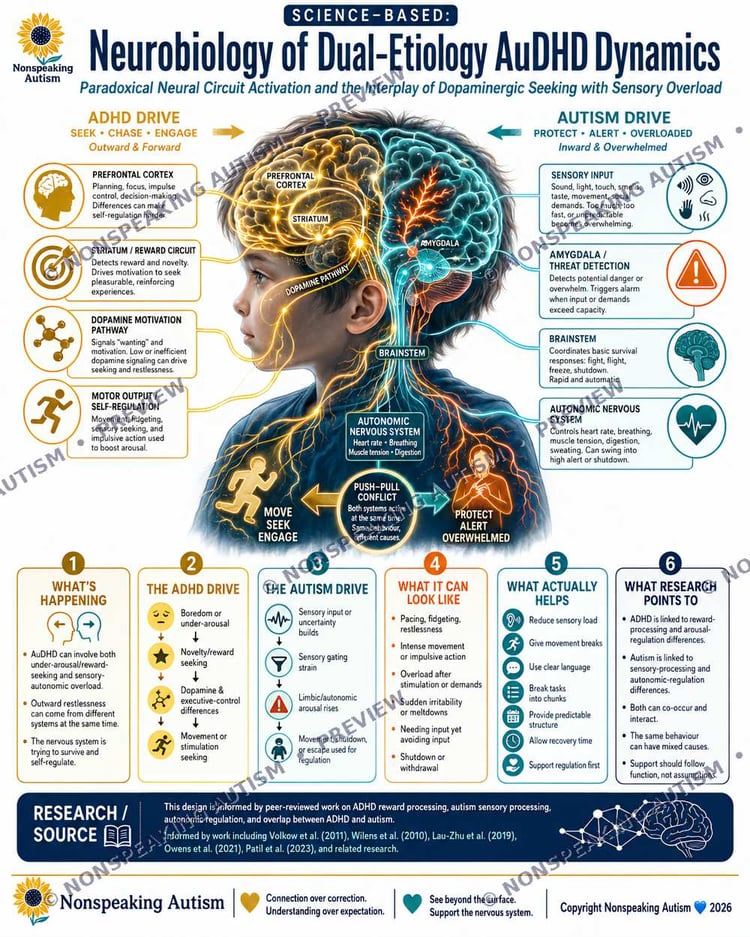
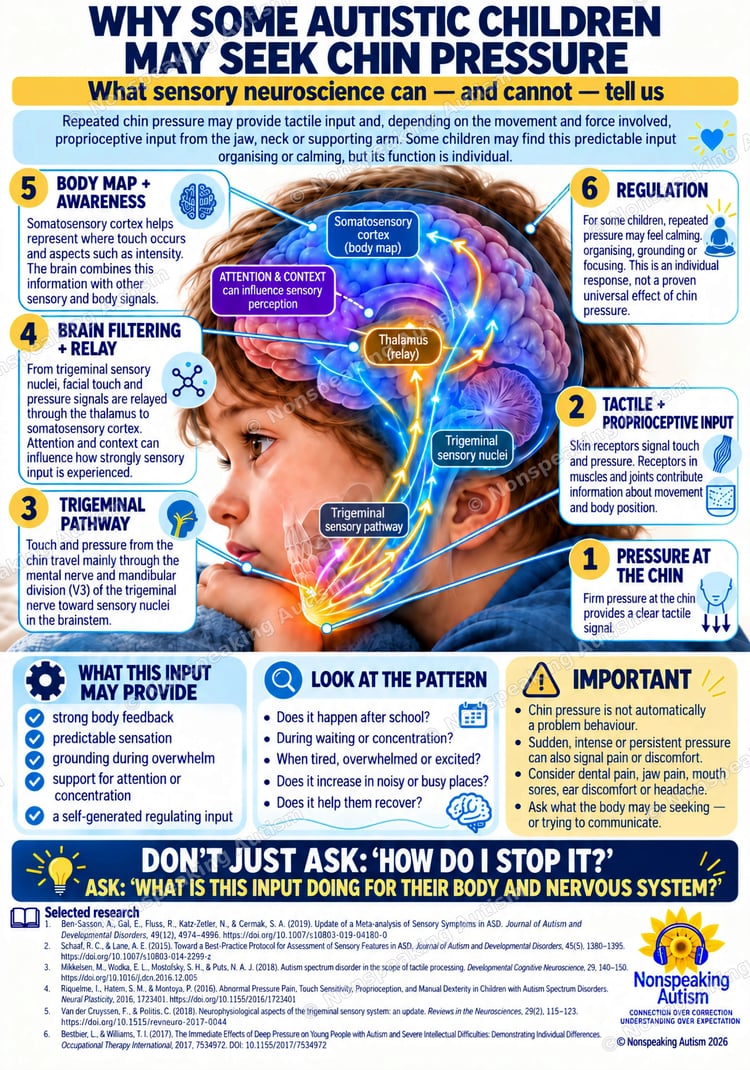
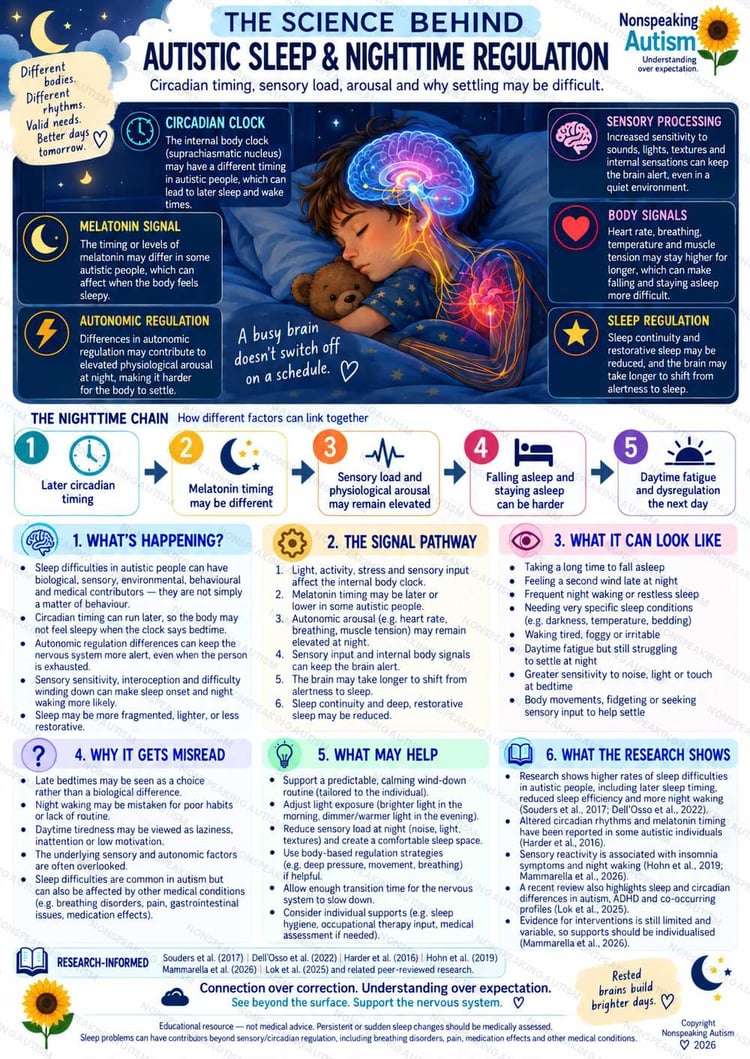
Look at the total load — not one sensory trigger in isolation.
2️⃣ Salience, Threat & the Amygdala
The brain continuously evaluates incoming information for relevance and significance.
The amygdala participates in wider neural networks involved in emotional learning and detecting biologically significant or potentially threatening information.
When sensory experiences are highly intense, aversive or associated with threat, stress-related neural systems may become more strongly engaged.
This does not mean that the amygdala acts as a simple “fear switch,” nor that every autistic person's sensory distress follows an identical neurological pathway.
The poster therefore presents a simplified educational model, rather than a literal moment-by-moment brain scan of sensory overload.
3️⃣ The Stress Response
When the brain and body detect significant threat or stress, several interconnected physiological systems can become involved.
These include the:
- sympathetic nervous system (SNS)
- hypothalamus
- pituitary gland
- adrenal glands
- HPA axis
Together, these systems can alter arousal and prepare the body to respond to demanding circumstances.
4️⃣ Adrenaline, Noradrenaline & Cortisol
Stress responses can involve different timescales.
⚡ Rapid response
Catecholamines such as adrenaline/epinephrine and noradrenaline/norepinephrine contribute to rapid physiological responses.
Possible changes can include:
- increased heart rate
- faster breathing
- heightened alertness
- increased muscle readiness
⏳ Slower stress response
Activation of the HPA axis can contribute to cortisol release over a different timescale.
Cortisol has complex functions within the body's broader stress and energy-regulation systems.
Importantly, an outward behaviour cannot tell us exactly which hormone is elevated or which neural pathway is active.
5️⃣ The Body May Shift Into a Defensive State
During significant distress, physiological changes may include:
- changes in heart rate
- altered breathing
- muscle tension
- changes in digestion
- heightened alertness
- temperature changes
- altered movement
- changes in communication access
Different people can show very different patterns.
Even the same person may respond differently depending on context, sensory trigger, physical health, fatigue, previous experiences and current regulatory capacity.
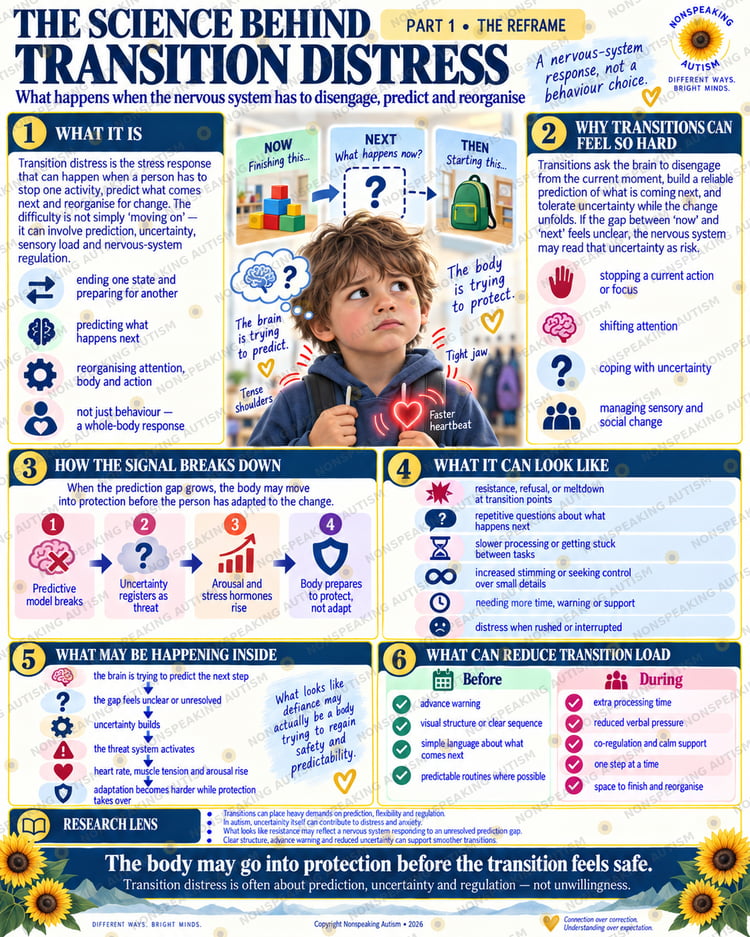
6️⃣ What Sensory Distress May Look Like
🔴 Fight / Flight-Like Responses
Visible distress might include:
- trying to leave or escape
- intense movement
- pushing away
- hitting or kicking
- screaming or crying
- pacing
- increased stimming
- removing sensory input
These behaviours should be understood in context rather than automatically interpreted as deliberate defiance.
🔵 Freeze / Shutdown-Like Presentations
Other people may become less visibly active.
This might include:
- going still
- reduced movement
- reduced speech
- reduced access to communication
- avoiding eye contact
- withdrawal
- appearing unreachable
- shutdown-like behaviour
A quieter presentation does not necessarily mean the distress has ended.
🟡 Mixed Responses
People do not always fit neatly into “fight,” “flight” or “freeze.”
Responses may overlap, change rapidly or occur in different combinations.
Human stress physiology is more complex than three fixed categories.
❗ Behaviour Is Not a Direct Readout of the Brain
One of the most important principles in this resource is that outward behaviour cannot prove a particular internal neurological state.
Hitting, escaping, becoming silent, pacing or crying can have multiple possible causes.
Always consider:
- sensory overload
- pain or illness
- fear
- communication barriers
- fatigue
- hunger or thirst
- medication effects
- uncertainty
- environmental demands
- emotional distress
- other physical or psychological factors
Observe the behaviour. Investigate the context. Avoid assuming the cause.
💬 Communication During Distress
Speech and communication access may change when a person is overwhelmed.
Support should not depend on the person being able to produce speech.
Keep established communication methods available, including:
- AAC
- symbols
- pointing
- gestures
- typing
- writing
- yes/no responses
- body movement
- speech where accessible
Reduced speech access is not the same as having nothing to communicate.
🌱 Recovery & Return Towards Baseline
When sensory load reduces and the environment becomes safer or more manageable, physiological arousal may gradually settle.
Support might involve:
Reduce sensory input and unnecessary demands → Provide safety and co-regulation → Allow time and space → Support comfort and body needs → Gradually return to usual activity
Recovery time varies considerably.
A person may continue to experience fatigue, reduced communication, sensory sensitivity or a need for additional space after the visible distress has passed.
Recovery should not be rushed.
🤝 Supporting the Person
During sensory distress, priorities may include:
- reducing unnecessary sensory input
- reducing verbal pressure
- providing physical space
- keeping communication accessible
- removing unnecessary demands
- allowing safe stimming or movement
- providing familiar regulation supports
- checking for pain and physical needs
- allowing recovery time
The aim is not to make someone look calm.
The aim is to reduce unnecessary load and support safety, communication and regulation.
🔬 Research-Informed
Research supports meaningful relationships between autism and sensory-processing differences, while also showing substantial variability between individuals.
Studies have additionally examined autonomic nervous-system activity, physiological reactivity, sensory responsivity and stress-related processes in autistic people.
However, the evidence does not justify assuming that every episode of sensory distress follows one identical physiological cascade.
This poster therefore uses neuroscience to support understanding — not to claim certainty about an individual's internal state.
📚 Selected Research & References
Green, S. A., Hernandez, L., Tottenham, N., Krasileva, K., Bookheimer, S. Y., & Dapretto, M. (2015). Neurobiology of sensory overresponsivity in youth with autism spectrum disorders. JAMA Psychiatry, 72(8), 778–786.
Lydon, S., Healy, O., Reed, P., Mulhern, T., Hughes, B. M., & Goodwin, M. S. (2016). A systematic review of physiological reactivity to stimuli in autism. Developmental Neurorehabilitation, 19(6), 335–355.
Chen, Y., Xi, Z., Saunders, R., Simmons, D., Totsika, V., & Mandy, W. (2024). A systematic review and meta-analysis of the relationship between sensory processing differences and internalising/externalising problems in autism. Clinical Psychology Review, 114, 102516.
Ben-Sasson, A., Gal, E., Fluss, R., Katz-Zetler, N., & Cermak, S. A. (2019). Update of a meta-analysis of sensory symptoms in ASD: A new decade of research. Journal of Autism and Developmental Disorders, 49, 4974–4996.
🔬 Up-to-date research (2024–2026) Tavassoli, T., Marco, E. J., & Puts, N. A. J. (2026). Sensory reactivity in autism: Integrating behavioural, affective, physiological, and neural dimensions. Current Psychiatry Reports, 28, Article 36. [on poster] → Supports: 1 Sensory Overload Is Detected; whole-cascade framing Luo, H., et al., & Schwarzlose, R. (2026). Specific, replicable behavioral and neural correlates of sensory over-responsivity in childhood. Journal of the American Academy of Child & Adolescent Psychiatry. Published online 13 August 2026. → Supports: 1 Sensory Overload Is Detected; 2 brain responses to sensory input Vidal-Zaborski, O., Merino, D., Fernandez, A., Mercery, M., Herbreteau, L., Askenazy, F., Zuluaga, M. A., Ismailova, E., Douet-Vannucci, V., & Thümmler, S. (2026). Autonomic and hormonal biomarkers in individuals with autism spectrum disorders and developmental or intellectual delay: A systematic PRISMA review. Neuroscience & Biobehavioral Reviews, 180, 106496. https://doi.org/10.1016/j.neubiorev.2025.106496 [on poster] → Supports: 3 The Stress Response Is Activated; 4 Hormones Are Released (cortisol / HPA axis) Neupane, K., Pillalamarri, S., & Anderson, G. M. (2025). Basal sympathetic nervous system functioning in autism: A systematic review of neurochemical studies. Journal of Autism and Developmental Disorders. Advance online publication. https://doi.org/10.1007/s10803-025-07105-2 [on poster] → Supports: 3 The Stress Response Is Activated; 4 Rapid Catecholamine Response Zadok, E., Golan, O., Lavidor, M., & Gordon, I. (2024). Autonomic nervous system responses to social stimuli among autistic individuals: A systematic review and meta-analysis. Autism Research, 17(3), 497–511. https://doi.org/10.1002/aur.3068 [on poster] → Supports: 1 "Social, cognitive and communication demands can add further load"; 7 parasympathetic recovery Chen, Y., Xi, Z., Saunders, R., Simmons, D., Totsika, V., & Mandy, W. (2024). A systematic review and meta-analysis of the relationship between sensory processing differences and internalising/externalising problems in autism. Clinical Psychology Review, 114, 102516. https://doi.org/10.1016/j.cpr.2024.102516 [on poster] → Supports: 6 Sensory Distress May Appear As (fight/flight and withdrawal) Paris, K., Lodestone, A. Z., Houser, M., & Lewis, L. F. (2025). "Shutdowns are like you're stuck on the blue screen of death": A metaphor analysis of autistic shutdowns. Autism in Adulthood, 8(4), 687–697. https://doi.org/10.1089/aut.2024.0193 [on poster] → Supports: 6 Freeze / Shutdown-like Presentations Loureiro, F., Ringold, S. M., & Aziz-Zadeh, L. (2024). Interoception in autism: A narrative review of behavioral and neurobiological data. Psychology Research and Behavior Management, 17, 1841–1853. https://doi.org/10.2147/PRBM.S410605 → Supports: 5 The Body Shifts into a Defensive State (digestion, temperature, toileting and appetite) Kumar, J., Hartzell, C., Abelson, E., Jastrowski Mano, K., & Chidambaran, V. (2026). Prevalence, expression, assessment, mechanisms, and management of pain in autistic children: A scoping review. A&A Practice, 20(4), e02178. https://doi.org/10.1213/XAA.0000000000002178 → Supports: 7 "Support comfort and body needs"; distress may also reflect pain Piller, A., McHugh Conlin, J., Glennon, T. J., Andelin, L., Auld-Wright, K., Teng, K., & Tarver, T. (2025). Systematic review of sensory-based interventions for children and youth (2015–2024). Frontiers in Pediatrics, 13, 1720179. https://doi.org/10.3389/fped.2025.1720179 [on poster] → Supports: 7 Recovery and Return to Baseline ("Reduce sensory input and demands")
📖 Foundational research also cited on the poster Green, S. A., Hernandez, L., Tottenham, N., Krasileva, K., Bookheimer, S. Y., & Dapretto, M. (2015). Neurobiology of sensory overresponsivity in youth with autism spectrum disorders. JAMA Psychiatry, 72(8), 778–786. https://doi.org/10.1001/jamapsychiatry.2015.0737 → Supports: 2 The Amygdala and Salience Networks Respond Strongly Lydon, S., Healy, O., Reed, P., Mulhern, T., Hughes, B. M., & Goodwin, M. S. (2016). A systematic review of physiological reactivity to stimuli in autism. Developmental Neurorehabilitation, 19(6), 335–355. https://doi.org/10.3109/17518423.2014.971975 → Supports: 3–5 physiological stress responses 🔬 How the research is used Findings are presented as group-level evidence, not predictions about an individual. Research suggests that autistic people's stress systems are not necessarily "always switched on", but that some may react more strongly to particular sensory or social demands — and responses vary widely between people. The poster's cascade is a simplified model to aid understanding; real nervous systems are more complex and individual.
Observe the individual. Look at context. Track patterns. Adjust support. Review again.
Sources:
- Neupane et al. 2025 – Yale Medicine
- Vidal-Zaborski et al. 2026 – EURECOM
- Zadok et al. 2024 – Autism Research
- Paris et al. 2025 – Autism in Adulthood
📖 Evidence Note
These references support the broader principles of sensory-processing differences, sensory over-responsivity, physiological reactivity and individual variation.
They should not be interpreted as proving that a specific behaviour demonstrates activation of the amygdala, sympathetic nervous system, HPA axis or a particular hormone.
The anatomical pathways and numbered cascade shown on the poster are simplified educational representations of complex and interacting biological systems.
The poster is not a validated physiological, sensory or behavioural assessment.
👨👩👧 Who Is This Resource For?
Suitable for:
- autistic people and their families
- parents and carers
- teachers and teaching assistants
- SENCOs and SEND teams
- mainstream and specialist schools
- support workers
- occupational therapists
- speech and language therapists
- psychologists
- healthcare professionals
- social-care professionals
- multidisciplinary teams
- autism and disability organisations
It can support home education, classroom practice, staff training, professional reflection and conversations about sensory distress and regulation.
📦 What You Receive
Your purchase includes:
1 × The Science Behind: Sensory Distress — Physiological Cascades: Fight, Flight or Freeze educational poster
1 × high-resolution printable digital PDF
The purchased file is supplied clear and without the promotional preview watermark shown in the listing image.
Watermarks on Payhip preview images are for copyright and listing protection only.
Digital download only — no physical product will be shipped.
⚠️ Important Disclaimer
This is a research-informed educational resource, not medical advice.
It is not a diagnostic tool, neurological assessment, sensory assessment, psychological assessment, behavioural assessment, occupational therapy assessment, crisis plan, risk assessment or individualized treatment recommendation.
Fight, flight and freeze are useful educational descriptions of broad defensive-response patterns, but they should not be treated as a diagnostic classification system or a way of determining someone's precise internal physiology from behaviour.
Sudden, severe, unusual, persistent or unexplained changes in behaviour, consciousness, movement, communication or physical condition should be appropriately assessed.
Serious injury, breathing difficulty, seizure, loss of consciousness or suspected medical emergency requires appropriate urgent medical assistance.
©️ Copyright & Permitted Use
Copyright © 2026 Nonspeaking Autism. All rights reserved.
Purchase permits personal/family use, use within your own classroom or educational setting, your own clinic or individual professional educational practice, and direct support work.
No resale, redistribution, file-sharing, uploading elsewhere, commercial reproduction, altered resale or inclusion in another product for sale or distribution.
Please direct others wanting their own copy to the original Nonspeaking Autism listing.
💛 The Message Behind the Resource
When someone becomes overwhelmed, what we see on the outside may be only one part of what is happening.
Instead of beginning with:
“How do we control this behaviour?”
consider:
What is overwhelming them?
What can we reduce?
Can they communicate?
Could something hurt?
What makes the environment safer?
What does their body need now?
WHAT WE SEE MAY BE A NERVOUS-SYSTEM RESPONSE TO OVERLOAD — NOT DELIBERATE DEFIANCE.
Support the body first. Reflection can come later.
Connection over correction. Understanding over expectation. 💛🌻
© Nonspeaking Autism 2026