
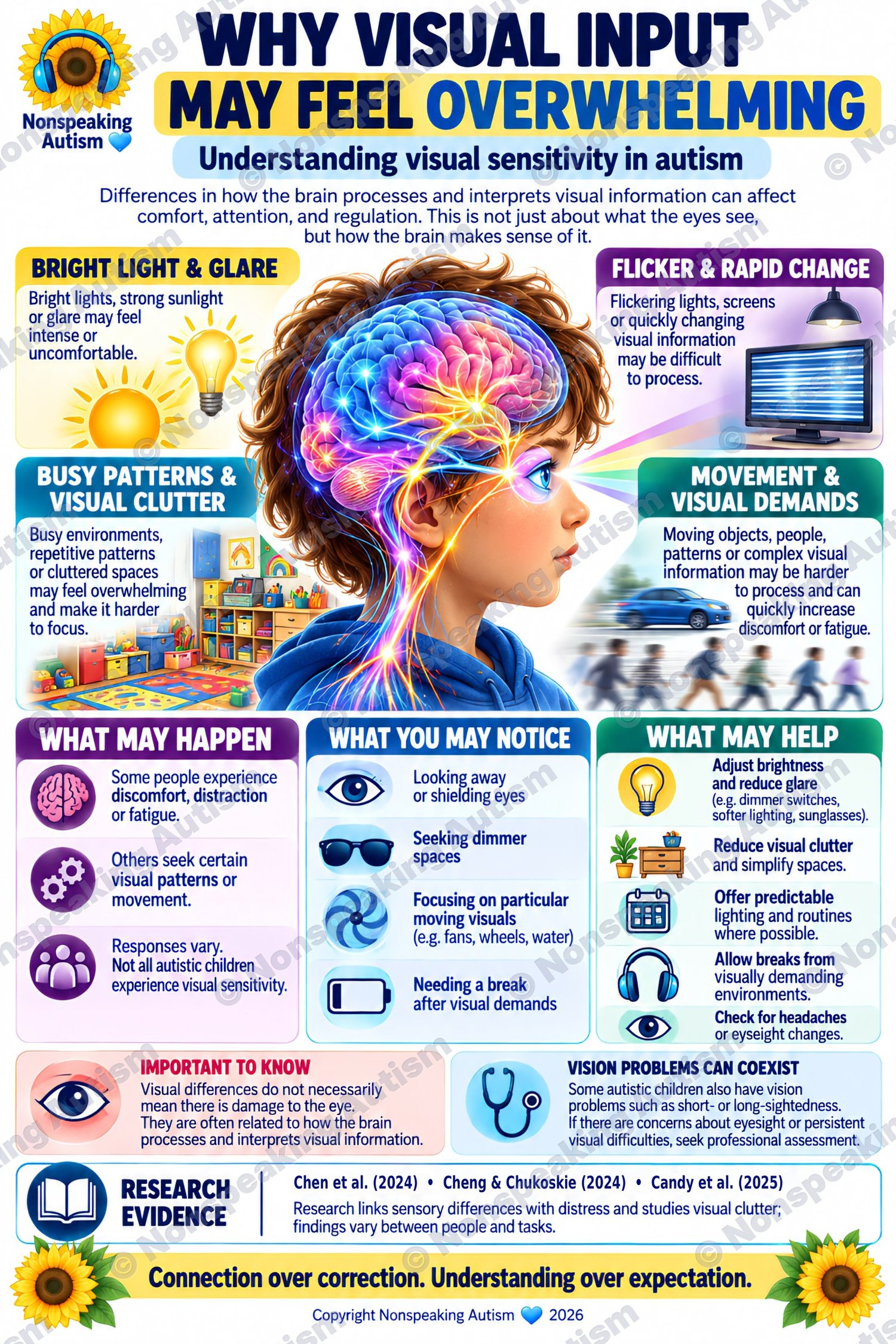
💙 WHY VISUAL INPUT MAY FEEL OVERWHELMING
💙 WHY VISUAL INPUT MAY FEEL OVERWHELMING
Understanding Visual Sensitivity in Autism
UK Edition | Research-Informed Autism & Sensory Processing Educational Poster | Nonspeaking Autism
🌻 Visual overwhelm is not just about what the eyes see. It may also involve how the brain processes, prioritises and interprets visual information.
A brightly lit classroom may feel comfortable to one child but exhausting to another.
Sunlight reflecting off a window, flickering lighting, moving people, colourful displays or a visually crowded environment may make it harder for some autistic people to concentrate, participate or feel comfortable.
A child might look away, shield their eyes, seek dimmer spaces or need a break.
Another child might enjoy watching spinning objects, flowing water or repeating visual patterns.
These experiences are not necessarily contradictory. Visual sensory preferences can differ between individuals and across situations.
Why Visual Input May Feel Overwhelming is an illustrated, research-informed educational poster designed to help parents, carers, teachers, SENCOs and professionals understand visual sensitivity in autism.
It explores possible sources of visual discomfort, differences in visual attention, signs that a child may need support and practical environmental adjustments.
The central message:
Connection over correction. Understanding over expectation.
🧠 UNDERSTANDING VISUAL SENSITIVITY IN AUTISM
Visual processing involves more than eyesight alone.
The eyes detect visual information, while the brain contributes to interpreting features such as brightness, colour, contrast, movement, patterns and spatial relationships.
Some autistic people may experience particular visual environments as intense, distracting, tiring or uncomfortable.
For example, a child may be able to see classroom materials clearly but struggle to concentrate when there are many competing visual distractions.
Another child may be particularly uncomfortable under bright or flickering lighting.
Others may enjoy specific visual experiences, including movement or repeating patterns.
Visual sensory differences do not necessarily mean that a person's eyesight is impaired.
However, visual processing differences and ordinary vision problems can coexist.
Not every autistic person experiences visual sensitivity, and no single visual profile applies to everyone.
🌈 WHAT THIS POSTER EXPLORES
1. BRIGHT LIGHT & GLARE
Bright lights, strong sunlight and glare may feel intense or uncomfortable.
Possible sources include:
- Strong sunlight
- Bright classroom lighting
- Reflections from windows
- Glare from whiteboards
- Overhead lighting
- Bright screens
- Highly reflective surfaces
Some children may squint, shield their eyes, look away or prefer dimmer spaces.
Others may experience headaches or fatigue in visually demanding environments.
Possible support includes adjusting lighting, reducing glare and offering appropriate choices about seating or workspace.
The goal is not necessarily to remove all light, but to make the environment comfortable and accessible.
2. FLICKER & RAPID VISUAL CHANGE
Flickering lights, screens and quickly changing visual information may be difficult for some people to tolerate or process.
Examples include:
- Flickering lamps
- Some forms of artificial lighting
- Rapidly changing screen content
- Flashing displays
- Fast-moving animations
- Repeated visual transitions
Some autistic individuals may experience discomfort or distraction when exposed to these visual demands.
Responses vary, and not every autistic person is sensitive to flicker.
Where possible, reducing unnecessary flashing or rapidly changing visual content may improve comfort.
3. BUSY PATTERNS & VISUAL CLUTTER
Busy environments, repetitive patterns and crowded visual spaces may increase competing demands on attention.
Examples include:
- Heavily decorated classrooms
- Crowded noticeboards
- Busy worksheets
- Patterned carpets
- Cluttered shelves
- Multiple colourful displays
- Visually complex learning spaces
Some children may find it harder to locate important information or maintain attention when surrounded by competing visual details.
Simplifying layouts, reducing unnecessary clutter and presenting information clearly may support participation.
An accessible classroom does not have to be visually empty. It should allow pupils to find and use the information they need.
4. MOVEMENT & VISUAL DEMANDS
Moving objects, people and complex visual scenes may increase discomfort or fatigue for some individuals.
Possible examples include:
- Busy corridors
- Crowds
- Moving vehicles
- Fast-changing visual scenes
- Multiple people moving nearby
- Complex moving patterns
Some people may find these experiences distracting or overwhelming.
Others may actively enjoy watching movement, such as fans, wheels or flowing water.
The same category of visual input may be comforting in one context and difficult in another.
🔬 WHAT MAY HAPPEN DURING VISUAL OVERWHELM?
The poster explains that visual experiences may affect comfort, attention and regulation.
For some individuals, visually demanding environments may be associated with:
- Discomfort
- Distraction
- Fatigue
- Difficulty maintaining attention
- A desire to reduce visual input
- A need for recovery time
Some autistic people may also actively seek preferred visual patterns or movement.
These differences may relate to sensory preferences, attention and visual processing.
However, no single neurological mechanism explains every experience of visual overwhelm.
The illustrated brain on the poster is an educational representation, not a scan or a confirmed pathway showing how visual overload occurs.
The person's own experience is more informative than assumptions made from their outward behaviour.
💙 WHAT YOU MAY NOTICE
The poster highlights four possible responses.
Looking Away or Shielding the Eyes
A child may look away from bright lighting, cover their eyes or avoid certain visual environments.
This may indicate discomfort, but the reason should not be assumed without considering the context.
Seeking Dimmer Spaces
Some children may prefer softer lighting or environments with fewer competing visual demands.
Focusing on Particular Moving Visuals
A child may enjoy watching fans, wheels, water or other repeating movement.
This may reflect a preferred sensory experience, interest or another individual reason.
It should not automatically be treated as a problem.
Needing a Break After Visual Demands
Visually demanding activities may be tiring for some individuals.
A child may benefit from breaks, reduced visual clutter or a different environment.
These signs are possible clues, not diagnostic rules.
🌻 WHAT MAY HELP?
The poster introduces five practical approaches.
1. ADJUST BRIGHTNESS & REDUCE GLARE
Possible adjustments include:
- Dimmer switches
- Softer lighting
- Reducing reflections
- Changing seating positions
- Appropriate sunglasses or tinted lenses when suitable
- Reducing unnecessary screen brightness
Adjustments should be guided by individual comfort and, where relevant, professional advice.
2. REDUCE VISUAL CLUTTER
Consider simplifying:
- Classroom displays
- Workspaces
- Worksheets
- Visual schedules
- Storage areas
- Learning materials
Present important information clearly and avoid unnecessary competing visual details.
3. OFFER PREDICTABLE LIGHTING & ROUTINES
Some individuals may benefit from knowing when lighting or visual environments will change.
Support might include:
- Preparing for transitions
- Avoiding unnecessary flashing displays
- Providing predictable environments
- Offering choices about lighting
- Explaining upcoming changes using accessible communication
4. ALLOW BREAKS FROM VISUALLY DEMANDING ENVIRONMENTS
Provide opportunities to rest or move away from visually busy environments when needed.
A break may support comfort and participation.
Breaks should not be used as punishment or made conditional on tolerating distress.
5. CHECK FOR HEADACHES OR EYESIGHT CHANGES
Visual discomfort may have several possible explanations.
Consider whether the person may be experiencing:
- Headaches
- Eye strain
- Blurred vision
- Difficulty seeing at certain distances
- Persistent squinting
- New sensitivity to light
- Other changes in eyesight
Do not automatically attribute visual difficulties to autism.
Seek professional assessment when concerns about eyesight or persistent visual discomfort arise.
👁️ VISUAL SENSITIVITY IS NOT THE SAME AS A VISION PROBLEM
An autistic person may experience visual sensory differences without having an identifiable problem with their eyesight.
For example, a child may have normal visual acuity but find glare or busy visual environments uncomfortable.
However, autism does not prevent someone from also having short-sightedness, long-sightedness, eye coordination difficulties or other vision conditions.
If a child experiences persistent headaches, squinting, changes in vision or other concerns, an appropriate eyesight assessment is important.
In the UK, an optometrist can assess many common vision concerns and advise whether further referral is needed.
Sensory differences and medical or optical needs should both be considered.
🏫 USING THIS RESOURCE IN UK SCHOOLS & SEND SETTINGS
This poster may help school staff consider how the visual environment affects accessibility and participation.
It can support discussions about:
- Classroom lighting
- Glare from windows and whiteboards
- Busy wall displays
- Visually cluttered worksheets
- Screen brightness
- Fast-moving visual information
- Visual demands during transitions
- Quiet or low-stimulation spaces
- Individual sensory preferences
- Appropriate recovery breaks
- Reasonable adjustments
A pupil who looks away during teaching may not be deliberately ignoring an adult.
A pupil who struggles in a heavily decorated classroom may benefit from clearer presentation of information.
A child who watches repetitive movement may be engaging with a preferred visual experience rather than displaying behaviour that needs to be stopped.
The resource may be useful for teachers, teaching assistants, SENCOs, occupational therapists, educational psychologists and other SEND professionals.
Where relevant, visual accessibility needs may contribute to individual SEND planning or an Education, Health and Care Plan (EHCP) in England.
The aim is to reduce avoidable visual barriers while respecting individual preferences and autonomy.
📚 RESEARCH & SCIENTIFIC EVIDENCE
The poster references research concerning sensory processing differences, visual attention and visual clutter in autism.
Research suggests that some autistic people experience differences in sensory responses and aspects of visual processing.
However, findings vary between individuals, studies and tasks.
It would be inaccurate to suggest that all autistic people experience the same visual sensitivities or that one brain mechanism explains every response.
Selected Research Printed on the Poster
Chen et al. (2024)
Research relating to sensory processing differences and associated difficulties in autism.
Cheng & Chukoskie (2024)
Research relating to visual attention and processing in autism.
Candy et al. (2025)
Research relating to visual processing or visual clutter.
Reference verification note: These author–year references are reproduced from the supplied poster. Their complete article titles, publication details and relevance to specific claims have not been independently verified for this description.
Scientific Evidence Note
The poster's brain illustration is educational and should not be interpreted as a clinical image or a proven neurological mechanism.
Group-level research cannot determine what is happening in an individual person's brain during a particular experience.
This poster is not a validated sensory assessment, visual processing assessment or diagnostic tool.
- Chen, Y., Xi, Z., Saunders, R., Simmons, D., Totsika, V., & Mandy, W. (2024). A systematic review and meta-analysis of the relationship between sensory processing differences and internalising/externalising problems in autism. Clinical Psychology Review, 114, 102516. https://doi.org/10.1016/j.cpr.2024.102516
- Cheng, M., & Chukoskie, L. (2024). Effects of visual cluttering in virtual reality on visuomotor integration in autistic individuals. In Proceedings of the 2024 Symposium on Eye Tracking Research and Applications (ETRA '24). ACM. https://doi.org/10.1145/3649902.3653008
- Candy, C., Ryan, D., Milne, E., Dickinson, A., et al. (2025). Dissociation between subjective sensory reactivity and visual perceptual sensitivity in autistic and non-autistic adults: A brief report. Brain and Behavior, 15(9), e70865. https://doi.org/10.1002/brb3.70865
Sources:
👨👩👧 WHO IS THIS RESOURCE FOR?
This educational poster may be useful for:
- Parents and carers of autistic children
- Autistic young people and adults
- Teachers and teaching assistants
- SENCOs and SEND teams
- Occupational therapists
- Educational psychologists
- Optometrists and relevant healthcare professionals
- Early years practitioners
- Family support workers
- Professionals supporting sensory accessibility
- Anyone wanting to understand visual sensitivity in autism
It may be displayed in homes, classrooms, SEND support areas, therapy rooms, staff training spaces and other educational settings.
📦 WHAT YOU RECEIVE
PAID DIGITAL DOWNLOAD — INDIVIDUAL POSTER
Your purchase includes:
1 × Why Visual Input May Feel Overwhelming — Understanding Visual Sensitivity in Autism
The poster features:
- Bright light and glare
- Flicker and rapid visual change
- Busy patterns and visual clutter
- Movement and visual demands
- Possible effects on comfort, attention and regulation
- Signs that someone may need visual adjustments
- Practical environmental support strategies
- Important information about eyesight and visual sensory differences
- Selected research references
- Nonspeaking Autism illustrated design
The listing image contains promotional preview watermarks. The final purchased file should be provided without these promotional watermarks.
Digital download only — no physical poster will be posted.
Exact print dimensions and resolution should be confirmed against the final downloadable file.
⚠️ IMPORTANT DISCLAIMER
This poster is provided for educational and informational purposes only.
It does not constitute medical advice, an eyesight examination, a neurological assessment, an occupational therapy assessment or an individualised treatment plan.
Visual discomfort and sensitivity can have several causes, including sensory differences, eye conditions, headaches, migraine or other health concerns.
Do not assume that visual symptoms are caused by autism without considering other explanations.
Sudden loss of vision, severe eye pain or other urgent visual symptoms require prompt medical attention.
Support should be individualised, safe, respectful and responsive to the person's preferences and communication.
©️ COPYRIGHT & PERMITTED USE
Copyright © 2026 Nonspeaking Autism. All rights reserved.
Purchase permits personal, family, classroom, school and individual professional educational use.
You may print the poster for these purposes.
You may not:
- Resell the poster or digital file
- Redistribute the purchased digital file
- Upload the file to another website or digital platform
- Remove branding and claim the artwork as your own
- Reproduce the artwork commercially
- Include the poster in another product for resale without permission
Please share the original Payhip listing rather than distributing the purchased file.
💛 THE MESSAGE BEHIND THIS RESOURCE
A child who looks away may be uncomfortable.
A child who shields their eyes may be experiencing glare or visual discomfort.
A pupil who struggles in a busy classroom may need a clearer, calmer environment.
A child who enjoys watching moving objects may be exploring a preferred sensory experience.
And someone who needs a break after visually demanding activities may be experiencing genuine fatigue.
We do not need to assume that every autistic person experiences vision in the same way.
We can listen.
We can observe.
We can offer choices.
We can adjust the environment.
And we can check whether additional eyesight support is needed.
The goal is not to make children tolerate uncomfortable visual environments without support.
The goal is to make everyday environments more accessible.
Reduce visual barriers. Respect sensory differences. Support participation.
🌻 Connection over correction. Understanding over expectation. 💙
Nonspeaking Autism © 2026