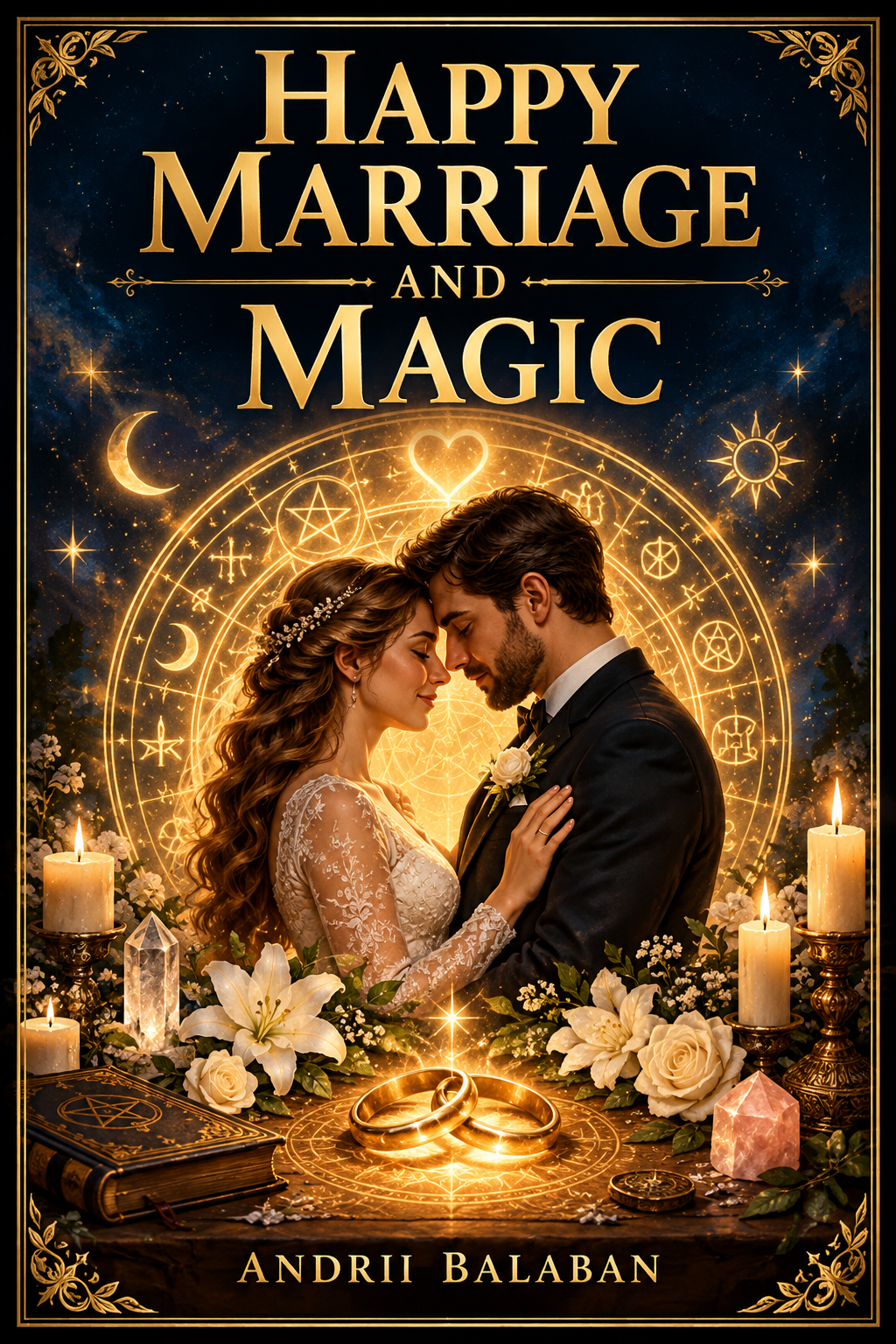
Happy marriage and magic
Happy marriage and magic
A practical guide to marriage magic, finding a life partner, transforming relationships, and protecting the family
Andrii Balaban
Author’s preface
Marriage is one of the oldest human institutions, yet no ceremony, promise, legal document, or declaration of love can by itself guarantee that two people will remain happy together. A marriage may begin with passion and gradually become cold. Two people may love one another and nevertheless become separated by resentment, exhaustion, jealousy, financial difficulties, interference from relatives, unspoken grievances, incompatible expectations, or the simple accumulation of years in which neither partner has truly listened to the other. In other cases, the problem begins much earlier: a woman may sincerely desire marriage and family life but repeatedly find herself alone, enter relationships that lead nowhere, meet unsuitable partners, or become so discouraged by previous disappointments that she no longer believes a lasting union is possible. The magical traditions surrounding love, courtship, marriage, the household, fertility, fidelity, reconciliation, and family protection developed around precisely these fundamental human hopes and fears.
This book is devoted not merely to the magic of getting married, but to the much larger art of creating, transforming, strengthening, and protecting a union between two people. There is an important difference between attracting a wedding and creating a marriage capable of surviving ordinary life. A wedding is an event. Marriage is a continuing relationship. The first may occupy a single day; the second may extend across decades. For this reason, the magic described in these pages will concern not only attraction, courtship, proposals, and marriage rituals, but also the home, communication, intimacy, reconciliation, loyalty, mutual respect, shared purpose, protection, renewal, and the ability to pass together through periods of change.
Throughout history, people have turned to symbolic and ritual practices at the thresholds of family life. Rings were blessed. Knots were tied. Candles were burned for unity. Bread, salt, flowers, water, ribbons, keys, coins, herbs, written petitions, household objects, and images of the bride and groom acquired ceremonial meanings. Prayers were spoken for a suitable spouse, for peace between husband and wife, for the return of tenderness, for protection of the home, and for the preservation of the family against hostility, envy, gossip, temptation, conflict, and misfortune. Different traditions explained the power of these practices differently, but their underlying purpose was remarkably consistent: to give form to intention at moments when human beings faced uncertainty in one of the most emotionally important areas of their lives.
The rituals in this book are therefore presented as deliberate acts rather than substitutes for life. A woman seeking a husband cannot remain isolated from the world and expect a candle to introduce her to someone. A person wishing to transform an unhappy marriage cannot perform a ceremony and then continue indefinitely repeating the same destructive patterns. A ritual for reconciliation cannot replace an honest conversation when a conversation is possible. Protection of the family cannot mean ignoring a genuine threat, abuse, addiction, serious financial problems, or circumstances requiring professional assistance. Magic becomes most meaningful when the ritual and the practical action move in the same direction.
The same principle establishes an important ethical boundary. Marriage magic should not be understood as permission to erase another person's will or to transform obsession into love. A ritual can be directed toward opening opportunities for meeting a compatible partner, strengthening an existing mutual bond, creating conditions for reconciliation, understanding one's own behavior, restoring warmth, or protecting a household. It should not be used to justify coercion, stalking, domination, or remaining in a dangerous relationship. Sometimes the transformation of a marriage means saving it. Sometimes it means discovering what must change if it is to survive. And in some circumstances wisdom consists in recognizing that preserving the outward form of a relationship at any cost is not the same thing as preserving love.
For the unmarried reader, the work begins before the future spouse appears. The desire for marriage must first become clear. What kind of union is actually being sought? Which qualities matter in a partner? Which old attachments, fears, expectations, and repeated choices make it difficult to recognize a suitable person? Rituals of cleansing, opening the road to marriage, preparing the home for partnership, working with candles, written intentions, rings, ribbons, symbolic keys, and lunar or planetary timing can create a ceremonial structure around this process. But after the ritual comes participation in life: meeting people, accepting invitations, communicating, choosing, observing, and allowing a real relationship to develop without forcing it into a fantasy created in advance.
For those already married, the work is different. An unhappy marriage often cannot be repaired by one dramatic act because it did not become unhappy in one dramatic moment. Distance is frequently constructed from hundreds of small injuries, disappointments, silences, habits, and neglected opportunities for affection. The corresponding magical work should therefore also have stages. There can be rituals for removing accumulated bitterness, rituals of reconciliation, rituals for restoring tenderness and intimacy, household ceremonies for renewing the union, practices for ending destructive patterns, and anniversary rites through which husband and wife symbolically choose their marriage again. The purpose is not to pretend that conflict never existed, but to prevent yesterday's conflict from becoming the permanent architecture of tomorrow.
Protection forms another essential part of marriage magic. Every family develops boundaries between what belongs within the household and what should remain outside it. Traditional magical language often speaks of visible and invisible enemies. The visible may include malicious interference, deliberate attempts to create conflict, destructive gossip, manipulation, or people who refuse to respect the boundaries of the couple. The invisible can be approached within the spiritual worldview of the practitioner through prayer, blessing, purification, protective symbols, household rites, and other traditional forms of spiritual protection. At the same time, ordinary causes must never be neglected. A conflict that has an understandable human explanation should not automatically be attributed to an invisible enemy. Good protection begins with discernment.
The deepest idea of this book is therefore simple: a happy marriage is not merely something one finds. It is something two people repeatedly create. Magic can surround that creation with symbols, ceremonies, intentions, moments of reflection, and acts of renewal. It can mark the beginning of a search, the crossing of a threshold, the healing of an old wound, the restoration of affection, or the protection of a home. Yet after every candle has burned down and every ritual has been closed, two people still have to live together. They must speak, listen, forgive when forgiveness is appropriate, establish boundaries, share responsibility, preserve affection, and choose what kind of family they are building.
This book follows that entire path: from the person who has not yet met a future spouse to the wedding threshold; from the first years of marriage to periods of disappointment and distance; from reconciliation to renewed intimacy; from the creation of a household to its protection; and finally to the long art of maintaining a union through changing circumstances. The aim is not simply to perform magic for marriage. It is to understand how ritual can become part of a larger practice devoted to love, partnership, home, loyalty, renewal, and the deliberate creation of a happier family life.
Contents
Chapter 1. The hidden structure of marriage and family magic
The opening chapter examines marriage as both a human relationship and a powerful symbolic threshold. It explores why wedding rings, knots, candles, shared food, keys, household objects, blessings, and vows have acquired magical meanings in different traditions, and distinguishes attraction magic, marriage magic, reconciliation work, household magic, and family protection. Particular attention is given to the difference between obtaining a desired event and creating a lasting condition: attracting a wedding is not the same as sustaining a happy marriage. The chapter establishes the central principles that will govern the entire book, including mutuality, responsibility, discernment, realistic expectations, ritual preparation, the formulation of intentions, and the relationship between magical action and ordinary human action.
Chapter 2. Opening the road to marriage
This chapter is devoted to the woman who wants to marry but has not yet found a suitable partner, as well as to anyone who feels that the path toward partnership has become closed through disappointment, repeated unsuccessful relationships, attachment to the past, fear, isolation, or destructive patterns of choice. It introduces rituals for releasing previous relationships, cleansing the symbolic space of the home, opening the road to new acquaintance, preparing a place for partnership, and defining the qualities of the marriage being sought rather than attempting to command the appearance of one predetermined person. Candle rites, written petitions, ribbons, rings, keys, water, flowers, symbolic thresholds, and carefully chosen ritual timing are incorporated into a structured cycle of marriage magic whose purpose is to unite intention with practical openness to meeting, recognizing, and choosing a compatible partner.
Chapter 3. Attraction, courtship, engagement, and the magic of the wedding threshold
Once a potential relationship appears, the magical task changes from opening possibilities to helping a real connection develop without confusing attraction with possession. This chapter explores rituals associated with courtship, mutual affection, emotional openness, engagement, proposals, wedding preparation, and the transition from two separate lives into a shared household. It includes ceremonies with paired candles, rings, ribbons, written vows, shared water, flowers, and symbolic household objects, together with a complete pre-wedding rite for blessing the future union. The chapter also examines how expectations surrounding marriage can become unrealistic and shows why the strongest ritual intention is not simply “let this person marry me,” but rather “let what is mutual, loving, suitable, and capable of becoming a good marriage grow clearly between us.”
Chapter 4. Transforming an unhappy marriage
The fourth chapter enters the central problem of the book: what can be done when marriage already exists but has ceased to bring happiness? Instead of treating every unhappy union as the result of one mysterious cause, the chapter divides marital deterioration into recognizable forms—emotional distance, accumulated resentment, constant conflict, loss of tenderness, damaged trust, exhaustion, jealousy, neglect, and the disappearance of a shared vision of the future. A staged ritual system is developed for cleansing the symbolic history of the relationship, releasing accumulated bitterness, interrupting repeated patterns of conflict, renewing the marital intention, and creating a ceremonial threshold between the old condition of the marriage and the condition the couple wishes to build. The principal rite of transformation uses two candles, the wedding rings or their symbolic equivalents, water, written statements, a shared household symbol, and a deliberate act of closure so that the ritual ends not with a wish alone, but with concrete changes that must continue in daily life.
Chapter 5. Reconciliation, intimacy, fidelity, and the return of warmth
A marriage may continue outwardly while inwardly becoming empty, and therefore this chapter is devoted to restoring the living emotional bond between partners. It explores reconciliation after quarrels, the rebuilding of trust, the return of tenderness, affectionate communication, emotional and physical intimacy, loyalty, forgiveness, and the gradual rediscovery of one another after years of routine. Rituals of paired flames, renewal of vows, symbolic washing away of grievances, letters that are written before important conversations, and ceremonies for restoring warmth to the marital home are combined with practical reflection on what each partner has stopped giving, asking, hearing, or noticing. The chapter also draws a necessary distinction between healing a wounded relationship and pretending that serious betrayal or harm never occurred: genuine reconciliation requires truth, boundaries, changed behavior, and time as well as symbolic acts of reunion.
Chapter 6. Protecting the marriage, the home, and the family
This chapter develops a complete system of family protection against what traditional magical language calls visible and invisible enemies. Visible threats may include malicious interference, gossip, manipulation, envy expressed through deliberate behavior, unwanted intrusion into the couple's decisions, and people who repeatedly attempt to create division within the household. Invisible protection is approached through prayer, blessing, purification, protective symbols, candles, salt, water, household talismans, threshold rites, and periodic ceremonies for renewing the symbolic boundaries of the home. The reader learns rituals for the entrance of the house, the marital bedroom, family photographs, wedding rings, and the household as a whole, while also learning an essential rule of discernment: ordinary disagreements, psychological difficulties, financial pressures, or relationship problems should not automatically be interpreted as supernatural attack. The strongest family protection joins symbolic boundaries with real boundaries.
Chapter 7. The complete art of happy marriage magic
The final chapter unites the entire book into a coherent long-term practice covering the search for a spouse, the beginning of a relationship, engagement, marriage, periods of conflict, reconciliation, renewal, protection, anniversaries, family transitions, and the preservation of affection over time. A complete marriage altar and a full ceremonial cycle are presented, together with shorter monthly and annual rites that allow a couple—or an individual working with the symbolism of marriage—to review what has changed, what requires healing, what should be protected, and what should be renewed. The final ritual does not ask for an impossible life without disagreements or uncertainty; it consecrates the intention to build a home in which affection, loyalty, respect, desire, friendship, responsibility, and the ability to begin again can continue to exist together. The book concludes with the principle underlying all its magic: the ritual may mark the threshold, strengthen the intention, and give symbolic form to hope, but a happy marriage is ultimately renewed in the countless ordinary choices through which two people continue to choose one another.