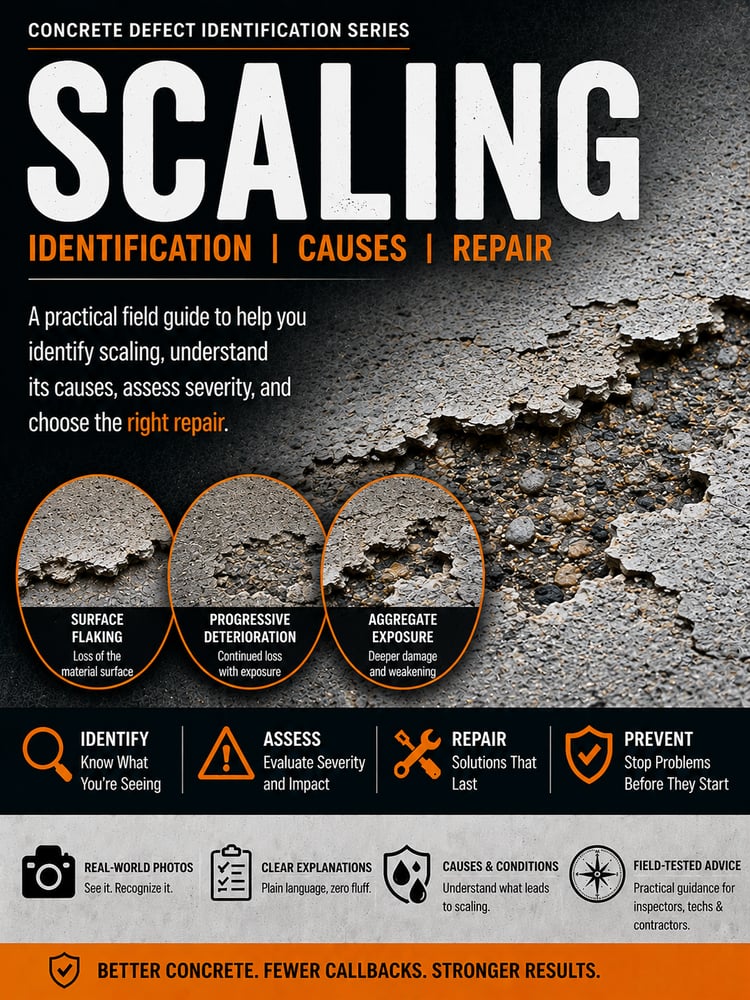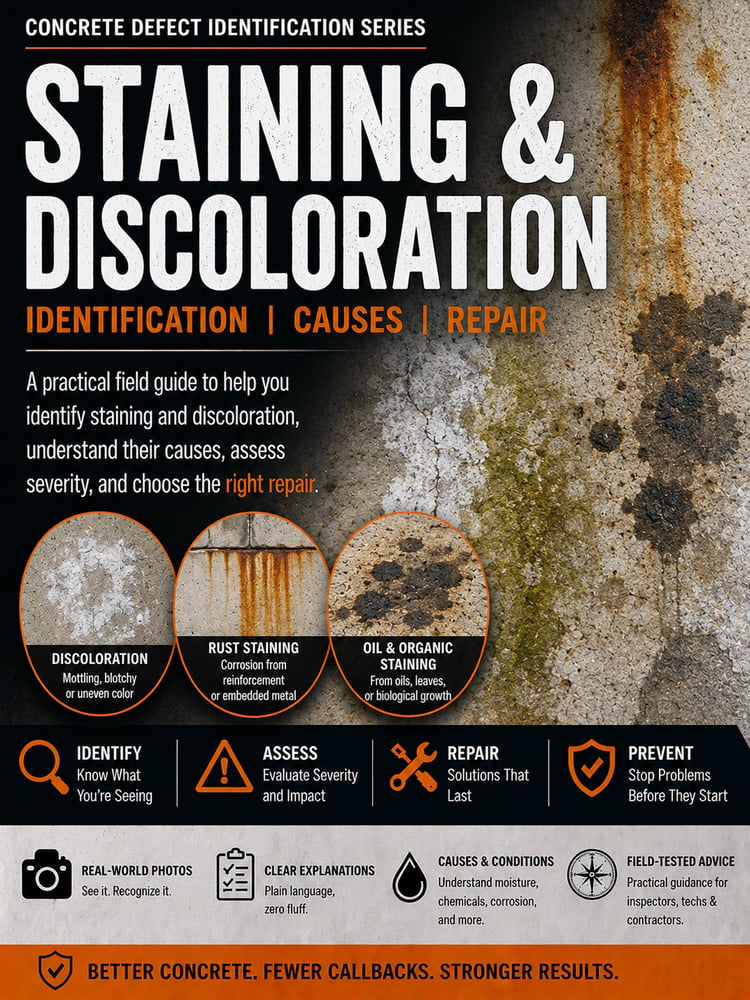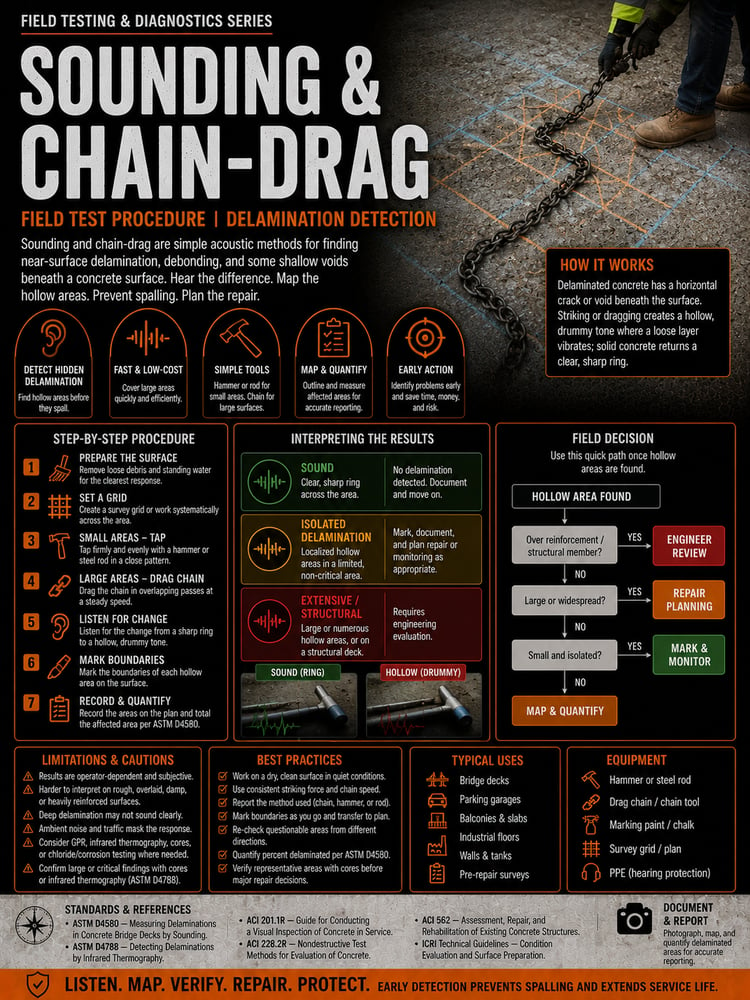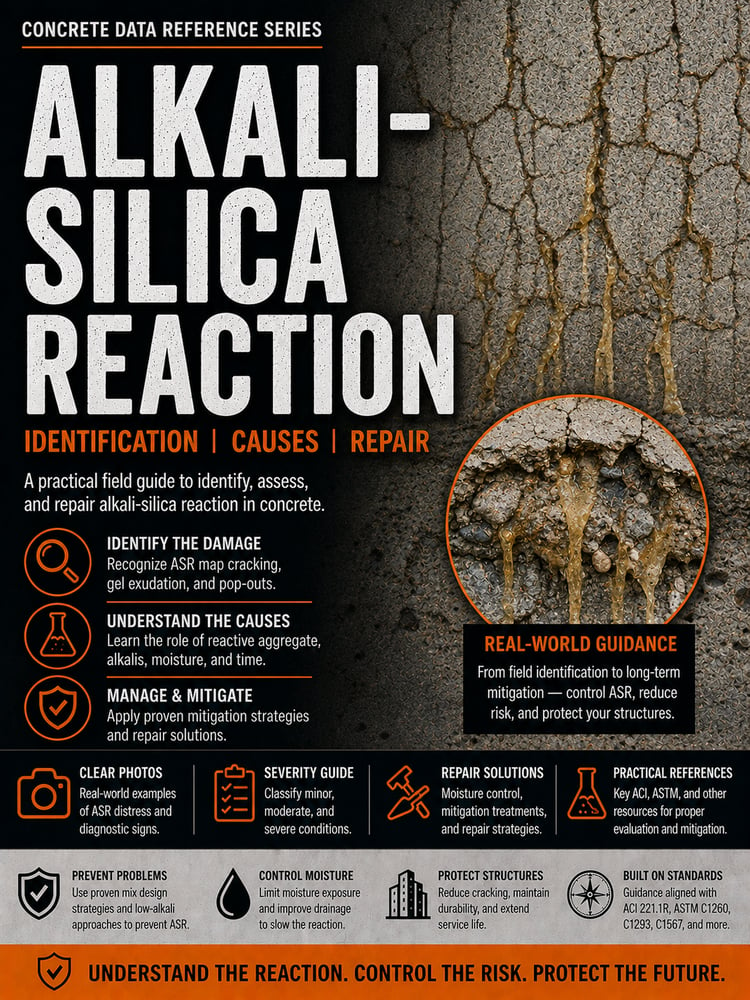

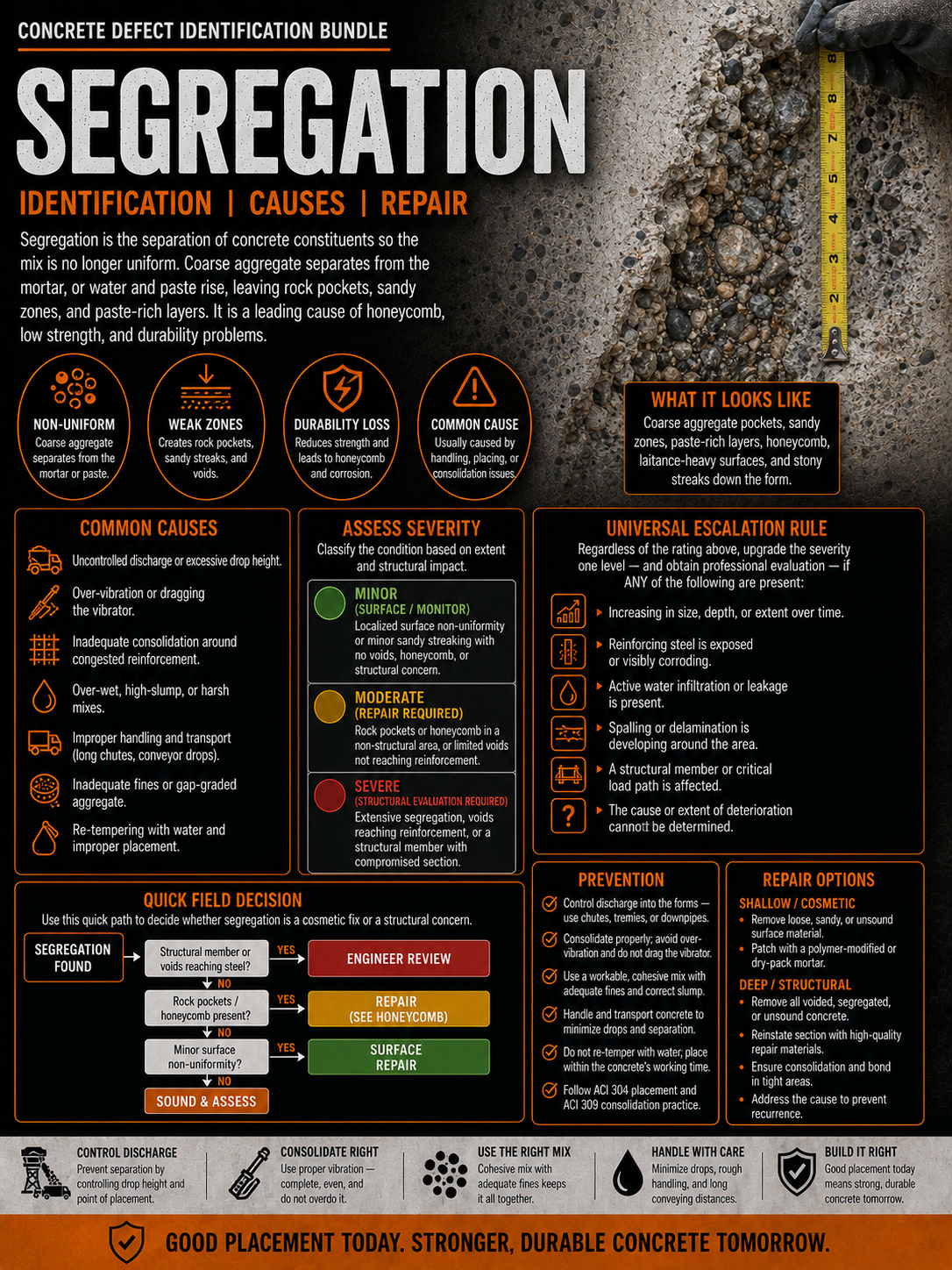
Concrete Defects - Segregation
Segregation Guide —
Identify segregation before rock pockets, honeycomb, weak zones, and repair problems get buried inside the concrete.
Concrete segregation happens when the mix separates and is no longer uniform. Coarse aggregate can settle or separate from the mortar, or paste and water can rise, leaving behind rock pockets, sandy zones, paste-rich layers, honeycomb, and weak porous areas. It usually traces back to handling, placing, consolidation, batching, or mix-design issues.
The Segregation Guide gives concrete professionals a practical, field-ready reference for recognizing segregation, understanding what caused it, judging severity, and choosing the right next step before the same issue happens again on the next pour.
This guide is built for inspectors, contractors, finishers, repair crews, QC professionals, batch plant personnel, ready-mix producers, field technicians, and anyone involved in concrete placement or troubleshooting.
Segregation is more than just an ugly surface problem. It can create weak, porous, low-strength zones, lead directly to honeycomb and voids, reduce durability, allow water and chlorides into the concrete, and produce inconsistent performance across the placement.
What’s Included
- Clear explanation of what concrete segregation is
- Field signs of segregation, including rock pockets, sandy streaks, paste-rich zones, laitance, honeycomb, and coarse aggregate concentration
- Common causes such as excessive free-fall, poor discharge control, over-vibration, harsh mixes, improper handling, inadequate fines, gap-graded aggregate, and re-tempering with water
- Minor / moderate / severe severity classification
- Guidance for inspecting lift bottoms, form faces, and suspect areas
- Sounding and probing recommendations
- Core testing guidance where strength, density, or internal voiding is in question
- Universal escalation rules for higher-risk conditions
- Quick field decision path for surface repair, honeycomb repair, or engineering review
- Prevention guidance for discharge control, consolidation, cohesive mix design, transport, placement, and working time
- Repair options for shallow / cosmetic and deep / structural segregation
- Engineering evaluation triggers
- Cost impact if segregation is left unrepaired
- ASTM / ACI / ICRI reference list
- At-a-glance action table
- Field inspection checklist
Built for Real Field Use
This guide helps answer the questions that matter after forms are stripped or a placement issue is found:
Is this just minor surface non-uniformity, or is it a deeper segregation problem?
Are there rock pockets, honeycomb, sandy streaks, or paste-rich zones?
Do the voids reach reinforcement?
Is a structural member affected?
Does this need surface repair, removal to sound concrete, core testing, or engineering evaluation?
The guide also reinforces one of the most important field lessons: segregation is the cause; honeycomb and rock pockets are often the result. Fixing the visible void without correcting the placement practice — free-fall, over-vibration, poor handling, or a harsh mix — can lead to the same defect on the next pour.
Best For
- Concrete inspectors
- Contractors and repair crews
- Ready-mix producers
- Batch plant and QC personnel
- Field technicians
- Finishers and placement crews
- Formwork and structural concrete crews
- Engineers and engineering support staff
- Anyone building a practical concrete defect reference library
Why This Guide Matters
Segregation can be easy to dismiss as a surface issue, but the visible area may not show the full internal problem. Voids and poorly consolidated zones can extend behind the surface, around reinforcement, or into critical sections of the placement. When segregation reaches reinforcement or affects a structural member, the concern moves beyond appearance and into durability, corrosion, strength, and repair reliability.
The Segregation Guide helps users document the condition, identify the likely placement cause, classify severity, and understand whether the repair should be cosmetic, partial-depth, structural, or professionally evaluated. It also helps prevent repeat problems by focusing on discharge control, proper consolidation, workable cohesive mixes, and correct placement practices.
Important Note
This guide supports field identification and decision-making. It does not replace project specifications, engineering judgment, laboratory testing, ASTM standards, ACI documents, or qualified structural evaluation. Final repair scope should be based on the actual depth, extent, location, reinforcement exposure, structural role of the member, and applicable standards.
Find the separation. Fix the cause. Prevent the repeat.