
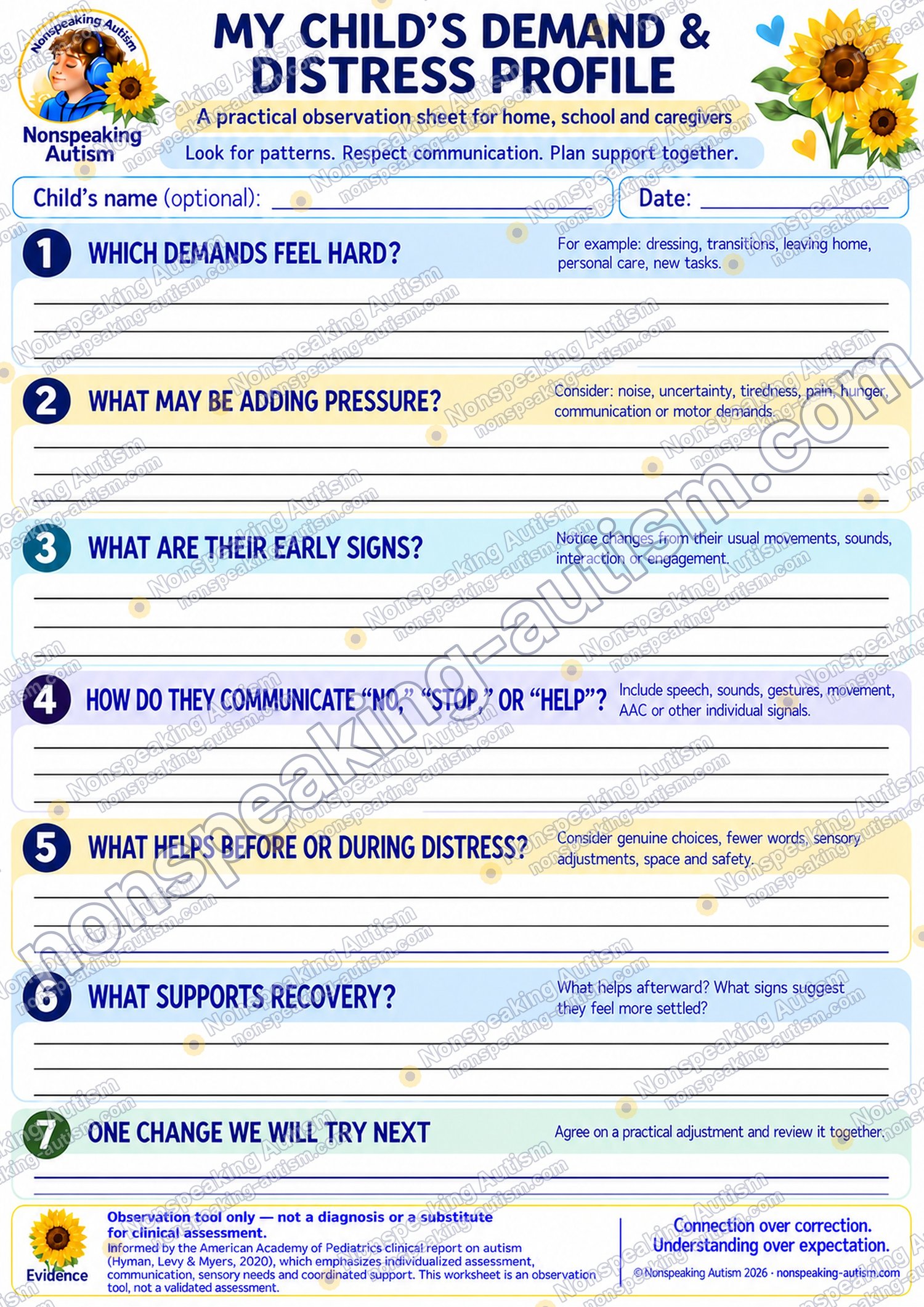
💙 MY CHILD’S DEMAND & DISTRESS PROFILE
💙 MY CHILD’S DEMAND & DISTRESS PROFILE
A Practical Observation Worksheet for Home, School, and Caregivers
🌻 FREE DIGITAL DOWNLOAD | U.S. EDITION
By Nonspeaking Autism
Look for patterns. Respect communication. Plan support together.
💛 ABOUT THIS FREE RESOURCE
When an autistic child struggles with an everyday demand, the difficulty may involve much more than the task itself.
Getting dressed, leaving the house, starting schoolwork, moving between activities, attending appointments, or following instructions may appear straightforward from an adult's perspective.
But for some autistic children, these situations can involve sensory discomfort, uncertainty, communication barriers, motor planning difficulties, anxiety, fatigue, physical discomfort, or several demands happening at once.
A child may become distressed, withdraw, resist an activity, move away, become quiet, or communicate that they cannot continue.
These responses should not automatically be interpreted as deliberate misbehavior, defiance, manipulation, or unwillingness to cooperate.
Sometimes the most useful question is not:
"How do we make this child complete the demand?"
It is:
"What is making this demand difficult, what is the child communicating, and what can we change to help?"
My Child’s Demand & Distress Profile is a free, printable observation worksheet created to help families, caregivers, educators, and support professionals explore those questions together.
Rather than focusing only on what a child does, the worksheet encourages adults to consider what may be happening around the child, what signs appear before distress increases, and which supports make everyday experiences more manageable.
It is designed to promote understanding, collaborative problem-solving, communication access, and individualized support.
💙 The goal is not to make every demand unavoidable or to remove every expectation. The goal is to recognize barriers, reduce unnecessary pressure, and support meaningful participation without overlooking distress.
🧠 WHAT THIS WORKSHEET EXPLORES
The worksheet is divided into seven practical observation and planning sections.
Each section includes space to record information about the individual child.
1️⃣ WHICH DEMANDS FEEL HARD?
The first section helps adults identify which activities, requests, expectations, or situations the child appears to find difficult.
Examples may include:
- Getting dressed or changing clothes.
- Bathing, brushing teeth, or other personal care.
- Leaving home.
- Arriving at or leaving school.
- Beginning homework or classroom tasks.
- Switching between activities.
- Trying unfamiliar foods.
- Attending appointments.
- Responding to questions.
- Completing activities within a time limit.
- Participating in group activities.
- Following multistep instructions.
- Managing unexpected changes.
An activity may be difficult because of its sensory, physical, emotional, communication, or cognitive demands.
The same child may manage an activity comfortably on one day but struggle with it on another.
The aim is to identify patterns, not label the child as difficult.
2️⃣ WHAT MAY BE ADDING PRESSURE?
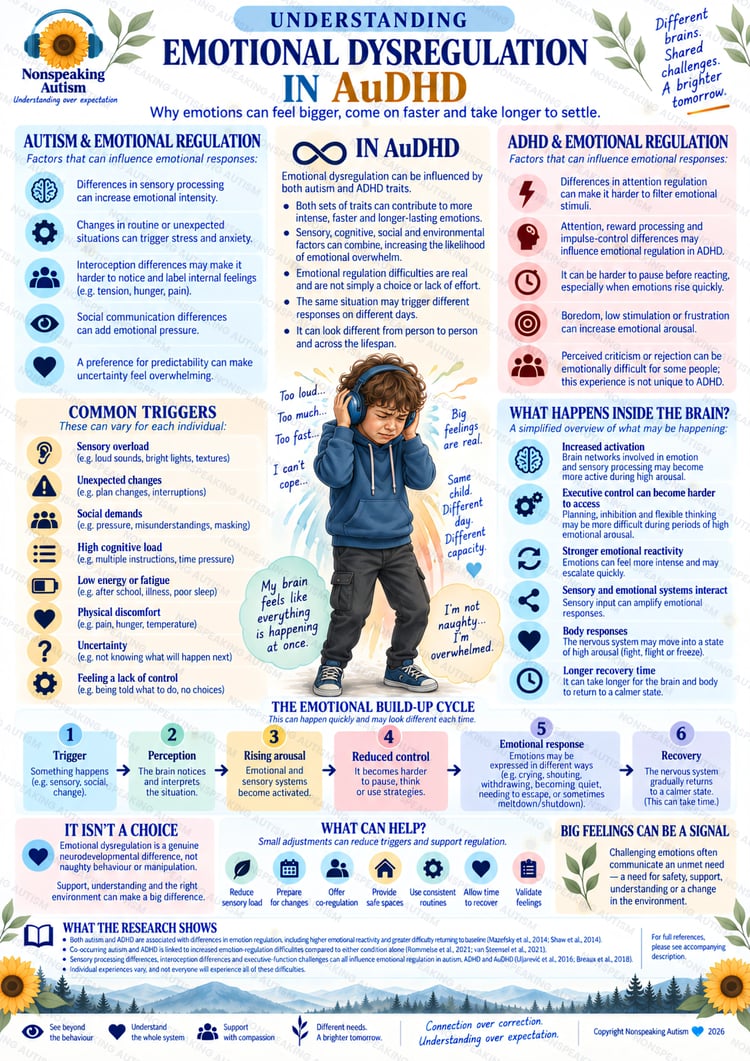
This section encourages adults to look beyond the immediate demand and consider other factors that may be contributing to distress.
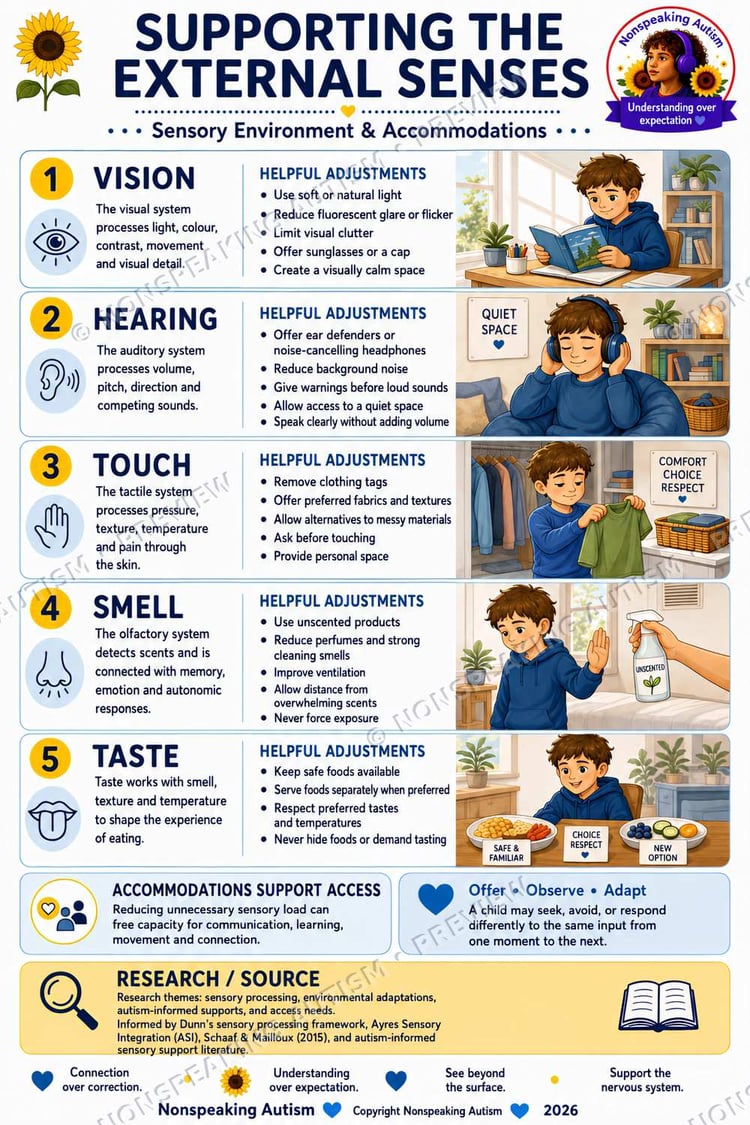
🔊 Sensory demands
Noise, bright lighting, touch, clothing textures, smells, crowded spaces, or multiple sources of sensory information may increase discomfort.
⏰ Uncertainty and transitions
Not knowing what will happen next, when something will finish, or whether plans will change may make a situation harder.
💤 Fatigue and accumulated demands
Poor sleep, tiredness, busy schedules, or sustained effort throughout the day may reduce a child's capacity to manage additional demands.
❤️ Pain and physical discomfort
Headaches, stomach discomfort, illness, hunger, thirst, constipation, or other unmet physical needs may contribute to distress.
💬 Communication demands
A child may struggle to understand an instruction, communicate a preference, request a break, or explain why something feels difficult.
Motor and planning demands
Activities involving coordination, sequencing, handwriting, dressing, or initiating movements may require substantial effort.
💜 Emotional pressure
Fear of mistakes, anxiety, previous difficult experiences, or concern about disappointing others may also play a role.
These are possible contributors, not a checklist of proven causes.
Several factors can overlap, and individual experiences vary.
3️⃣ WHAT ARE THEIR EARLY SIGNS?
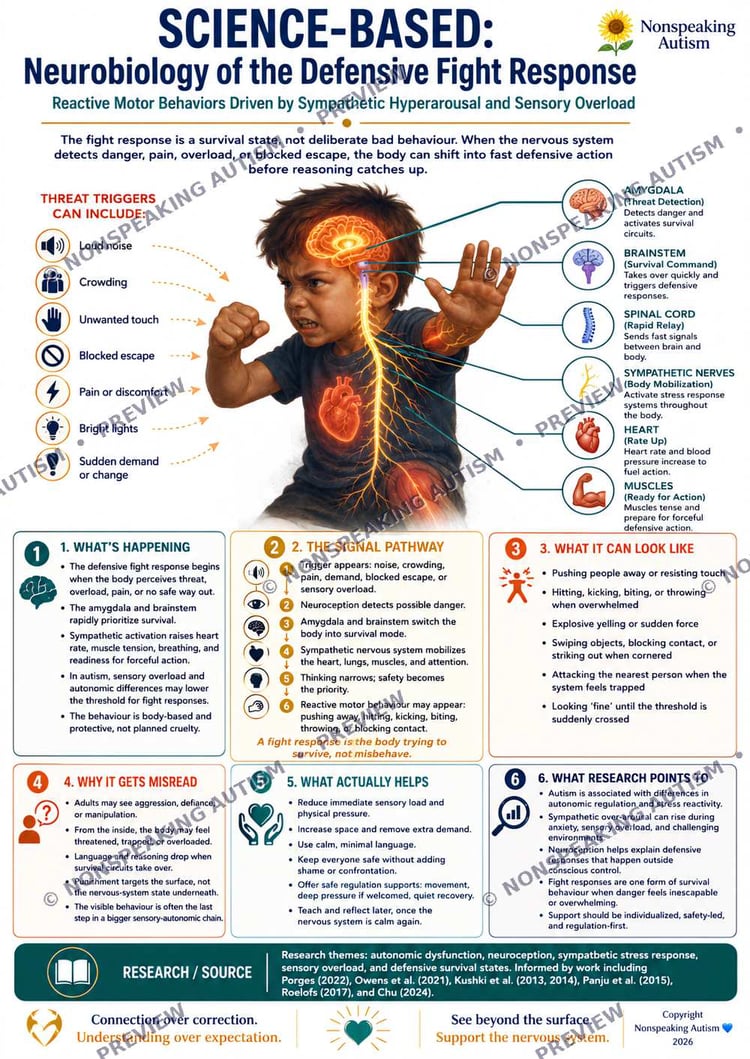
Distress may build before it becomes obvious to other people.
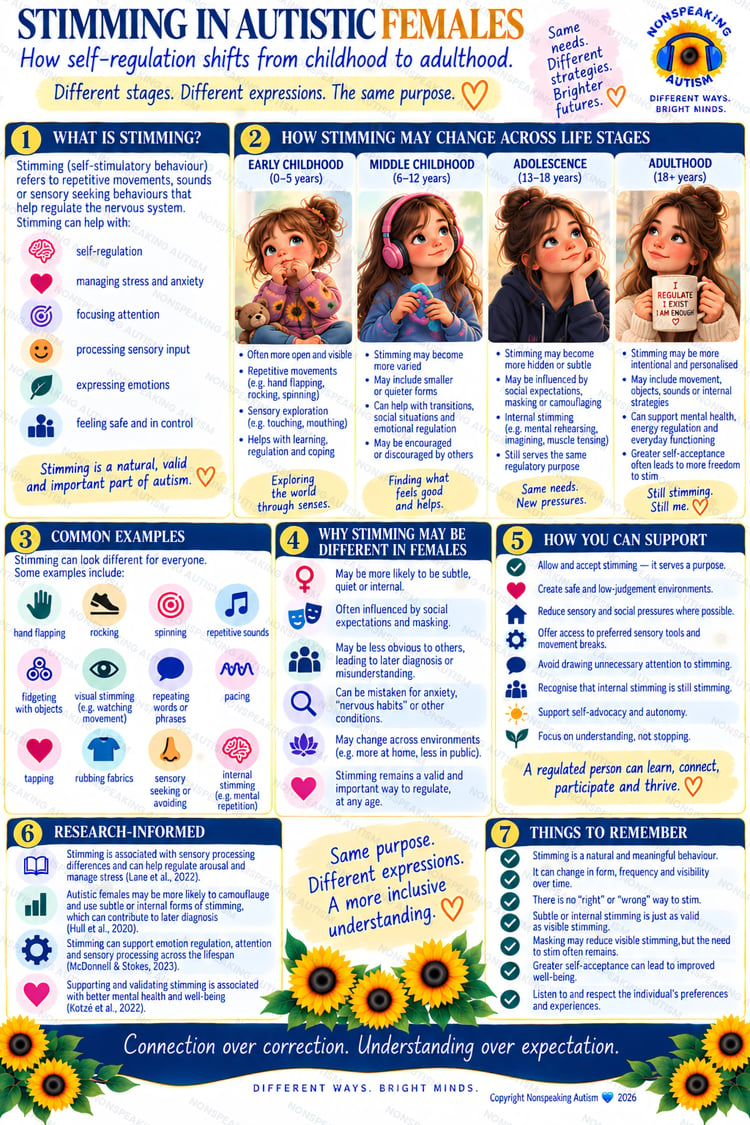
Some children show subtle changes in movement, communication, attention, or engagement.
Possible early signs may include:
- Pacing or moving more frequently.
- Increased or changed vocalizations.
- Becoming quieter than usual.
- Repeating questions or seeking reassurance.
- Moving away from an activity.
- Covering ears or eyes.
- Changes in facial expression or posture.
- Appearing unusually tense.
- Difficulty starting or continuing a task.
- Seeking a familiar person, place, or object.
- Increased need for predictability.
- Reduced interaction or engagement.
These behaviors are not necessarily signs of distress in every child.
For example, repetitive movement may be enjoyable, regulating, or part of a child's usual communication and should not automatically be treated as a warning sign.
The worksheet encourages adults to notice changes from the child's individual baseline.
Recognizing early signs may create opportunities to offer support before distress intensifies.
4️⃣ HOW DO THEY COMMUNICATE "NO," "STOP," OR "HELP"?
One of the most important sections of this worksheet focuses on communication.
Not every child communicates discomfort, refusal, or a request for help through spoken words.
Some children may use:
- Spoken language.
- Sounds or vocalizations.
- Gestures.
- Pointing.
- Facial expressions.
- Body movements.
- Signs.
- Pictures.
- Written communication.
- Communication boards.
- Speech-generating devices.
- Other augmentative and alternative communication (AAC).
- Moving away or pausing participation.
A child may understand far more than they can express through speech.
Adults should not assume that limited spoken language means limited understanding, preferences, or decision-making ability.
Likewise, an outward response should not automatically be assigned one meaning without considering the child's context and communication.
Communication access should remain available during distress, not only when a child is calm.
This section helps adults identify how the child expresses boundaries and what respectful responses may look like.
5️⃣ WHAT HELPS BEFORE OR DURING DISTRESS?
The fifth section focuses on practical support.
Instead of asking only how to stop an outward behavior, adults can explore what reduces the difficulty of the situation.
Possible supports include:
🌿 Sensory adjustments
Reducing background noise, adjusting lighting, providing a quieter space, changing uncomfortable clothing, or offering preferred sensory tools.
💙 Meaningful choices
Allowing the child to choose between acceptable options, communicate preferences, request a break, or decline nonessential activities.
💬 Accessible communication
Using fewer words when helpful, providing visual information, allowing processing time, and ensuring AAC remains accessible.
🤝 Co-regulation
Offering calm, predictable, supportive adult presence while respecting the child's preference for closeness or space.
⏳ Additional time
Allowing more time for transitions, task initiation, communication, and recovery.
🗓️ Predictability
Preparing for changes, using visual schedules where helpful, and explaining what will happen next.
Adjusting the demand
Breaking tasks into smaller steps, changing how an activity is presented, reducing unnecessary demands, or offering another way to participate.
No single approach is appropriate for every child.
Support should be individualized, respectful, and responsive to the child's preferences.
Sensory tools, touch, movement, and deep pressure should never be forced.
6️⃣ WHAT SUPPORTS RECOVERY?
Recovery is an important part of understanding distress.
A child may appear settled while still experiencing fatigue, sensory discomfort, anxiety, or difficulty processing what happened.
Recovery needs may include:
- Quiet time.
- Reduced expectations.
- Rest.
- Access to preferred activities.
- Familiar routines.
- Time outdoors or in a calmer environment.
- Sensory supports chosen by the child.
- Access to food, water, or other physical comforts.
- Reassurance without repeated questioning.
- Supportive connection when welcomed.
- Space and privacy when preferred.
Adults can use this section to record what seems helpful and what signs suggest the child is becoming more comfortable.
Recovery does not have to look the same for every child.
A child should not be pressured to explain, apologize, or discuss a difficult experience before they are ready.
7️⃣ ONE CHANGE WE WILL TRY NEXT
The final section turns observations into practical action.
Rather than introducing many changes at once, families and educators can agree on one manageable adjustment and review whether it helps.
Examples include:
- Offering advance notice before transitions.
- Providing a quieter arrival routine at school.
- Reducing the number of spoken instructions.
- Making AAC available throughout the day.
- Offering more flexible task-starting options.
- Allowing a break before distress increases.
- Adjusting an uncomfortable sensory environment.
- Checking physical needs before assuming a behavioral cause.
- Giving the child a clear, accessible way to request help.
The change can then be reviewed with the child wherever possible, using their preferred communication methods.
Observe. Adjust. Review. Learn.
The purpose is not to find one permanent solution but to develop a more accurate understanding of the child's changing needs.
🌻 UNDERSTANDING DEMAND-RELATED DISTRESS IN AUTISM
Demand-related distress does not have one universal explanation.
For some children, demands may become difficult because of anxiety or uncertainty.
For others, sensory discomfort, communication difficulties, motor planning demands, pain, fatigue, or reduced flexibility during periods of stress may contribute.
A child may also have experienced repeated situations in which their discomfort or communication was misunderstood.
These experiences can affect how they respond to similar situations in the future.
It is important not to assume that every instance of avoidance is caused by anxiety, that every refusal reflects sensory overload, or that all demand-related distress has the same neurological basis.
A pattern of avoiding or resisting demands is an observation, not a diagnosis in itself.
This worksheet is intended to help adults explore individual patterns without making assumptions about the child's motivation or internal experience.
💬 COMMUNICATION IS CENTRAL TO SUPPORT
For nonspeaking, minimally speaking, and speaking autistic children alike, access to communication is essential.
Communication may be more difficult during periods of stress, sensory overload, pain, or uncertainty.
Adults can help by:
- Making AAC consistently available.
- Respecting gestures, movement, and other communication methods.
- Allowing processing time.
- Offering accessible choices.
- Taking expressions of discomfort seriously.
- Avoiding pressure to speak.
- Checking understanding without repeated testing.
- Recognizing that communication can change across situations.
A child does not need to use spoken words to have their boundaries respected.
AAC is not a last resort or a reward for completing tasks.
It is a means of communication and should be available whenever it is needed.
🏫 USING THIS WORKSHEET IN U.S. SCHOOLS
This resource may help families and educational teams share observations and plan supportive adjustments.
It can be used to inform conversations about:
- Classroom demands.
- Sensory accessibility.
- Communication accommodations.
- School arrival and dismissal.
- Transitions between lessons.
- Participation in group activities.
- Task initiation and completion.
- Breaks and recovery opportunities.
- Home–school consistency.
- Emotional and physical safety.
📘 IEP TEAM DISCUSSIONS
For children receiving special education services, the worksheet may help families and staff describe situations that are difficult, communication needs, and accommodations worth considering.
Observations may contribute to discussions about:
- Communication and AAC access.
- Environmental adjustments.
- Transition supports.
- Individualized instruction.
- Sensory accommodations.
- Related services.
- Support during periods of distress.
- Participation and meaningful educational access.
📗 SECTION 504 ACCOMMODATIONS
Where relevant, observations may also help inform conversations about reasonable accommodations under Section 504.
Examples might include access to quiet spaces, alternative communication methods, flexible transitions, or adjustments to environmental barriers.
Important: This worksheet does not replace a formal school evaluation, Functional Behavioral Assessment (FBA), IEP, Section 504 plan, or other required educational process.
It is a supplementary tool for collaborative observation and planning.
🔬 RESEARCH & GUIDANCE-INFORMED
This resource is informed by clinical and educational guidance emphasizing individualized assessment, communication access, environmental context, and coordinated support for autistic children.
Research and clinical guidance recognize that autistic people may experience differences in sensory processing, communication, anxiety, attention, motor functioning, and adaptive skills.
However, these experiences vary considerably.
The same outward behavior may occur for different reasons, and a single observation cannot establish a child's internal state or the cause of their distress.
A supportive approach involves considering multiple explanations, listening to the child's communication, checking physical and environmental factors, and reviewing which adjustments actually help.
📚 SELECTED REFERENCES & PROFESSIONAL GUIDANCE
1. Hyman, S. L., Levy, S. E., & Myers, S. M. (2020).
Identification, Evaluation, and Management of Children With Autism Spectrum Disorder.
Pediatrics, 145(1), e20193447.
https://doi.org/10.1542/peds.2019-3447
This American Academy of Pediatrics clinical report emphasizes comprehensive, individualized care, including attention to communication, behavior, medical needs, development, and coordinated services.
2. American Speech-Language-Hearing Association (ASHA).
Augmentative and Alternative Communication (AAC).
https://www.asha.org/practice-portal/professional-issues/augmentative-and-alternative-communication/
Professional guidance concerning AAC assessment, communication access, and individualized support for people with complex communication needs.
3. National Joint Committee for the Communication Needs of Persons With Severe Disabilities. (2024).
Communication Bill of Rights (3rd ed.).
American Speech-Language-Hearing Association.
https://www.asha.org/njc/communication-bill-of-rights/
A rights-based framework emphasizing that people with significant communication needs have the right to communicate, express preferences, make choices, and access appropriate communication supports.
4. Centers for Disease Control and Prevention (CDC).
Autism Spectrum Disorder.
Public health information about autism, developmental differences, identification, and support.
Hyman, S. L., Levy, S. E., Myers, S. M., Council on Children with Disabilities, & Section on Developmental and Behavioral Pediatrics. (2020). Identification, evaluation, and management of children with autism spectrum disorder. Pediatrics, 145(1), e20193447. https://doi.org/10.1542/peds.2019-3447
Sources:
- AAP report PDF (University of Washington copy)
- Reading Rockets – Identification, Evaluation, and Management of Children With ASD
- PubMed record 31843864
Research Evidence Note
These references support the broader principles of individualized autism care and communication access.
They do not establish that this particular worksheet has been scientifically validated, nor do they prove that any single demand-related response has one specific cause.
The worksheet is an educational observation aid, not a standardized or diagnostic instrument.
👨👩👧 WHO IS THIS RESOURCE FOR?
This free worksheet may be useful for:
- Parents and caregivers of autistic children.
- Families of nonspeaking autistic children.
- Families of minimally speaking autistic children.
- Families of speaking autistic children.
- General education teachers.
- Special education teachers.
- Classroom aides and paraprofessionals.
- School counselors.
- School psychologists.
- Speech-language pathologists.
- Occupational therapists.
- Autism support professionals.
- IEP teams.
- Section 504 teams.
- Home–school support teams.
- Professionals supporting children with complex communication or sensory needs.
It may be especially helpful when adults are trying to understand recurring situations of distress, transitions, communication barriers, or difficulties with everyday expectations.
The worksheet can be revisited as the child's circumstances, preferences, and needs change.
📦 WHAT YOU RECEIVE
💙 1 FREE PRINTABLE WORKSHEET
My Child’s Demand & Distress Profile — U.S. Edition
The worksheet includes:
- A space for the child's name (optional).
- A date field.
- Seven guided observation and planning sections.
- Prompts about challenging demands.
- Space to consider contributing pressures.
- A section for early signs of distress.
- Questions about communication of "no," "stop," and "help."
- Space to identify support strategies.
- Recovery planning prompts.
- One practical change to try next.
- A research-informed educational note.
- Nonspeaking Autism branding.
💛 DOWNLOAD INFORMATION
- Price: FREE.
- Language: U.S. English.
- Format: Printable digital worksheet.
- Use: Home, classroom, and individual educational support.
- Delivery: Digital download through Payhip.
- Physical shipping: None.
The promotional listing preview may display a watermark. The actual downloadable file should be supplied clean and readable without promotional watermarks.
⚠️ IMPORTANT EDUCATIONAL DISCLAIMER
This worksheet is provided for general educational and observational purposes only.
It is not a diagnostic tool, validated assessment, clinical evaluation, Functional Behavioral Assessment, individualized treatment plan, or substitute for professional medical, psychological, educational, or therapeutic advice.
A child's distress may reflect multiple factors, including sensory experiences, communication barriers, anxiety, fatigue, pain, illness, environmental demands, or other needs.
Adults should not assume that all distress is caused by autism or demand avoidance.
If a child shows sudden, unexplained, persistent, or severe changes in behavior, communication, or physical well-being, seek appropriate professional assessment.
For urgent medical or safety concerns, contact local emergency services.
Use the worksheet with respect for the child's dignity, autonomy, communication, and individual preferences.
©️ COPYRIGHT & PERMITTED USE
Copyright © 2026 Nonspeaking Autism. All rights reserved.
This resource is offered as a free educational download.
Permitted use:
- Personal and family use.
- Printing for home use.
- Individual classroom use.
- School-based educational support.
- Individual professional use with children and families.
- Collaborative discussions between parents, caregivers, and educators.
Not permitted:
- Reselling the worksheet.
- Redistributing or sharing the downloadable digital file.
- Uploading it to other websites or file-sharing platforms.
- Removing or altering the copyright or branding.
- Repackaging it as another product.
- Including it in commercial resource bundles.
- Claiming the artwork or content as your own.
If you would like to recommend the resource to another family, school, or professional, please direct them to the original
Nonspeaking Autism Payhip listing so they can access their own free copy.
💛 THE MESSAGE BEHIND THIS RESOURCE
A child may be trying to tell us something long before they can explain it in words.
A difficult transition may reflect uncertainty.
A challenging task may involve motor planning demands.
A refusal may communicate discomfort, confusion, exhaustion, or a need for greater control.
A child who appears calm may still be working very hard to cope.
And a child who becomes distressed may need support, not more pressure.
Understanding does not mean assuming we know exactly what a child is feeling.
It means remaining curious, listening to their communication, and being willing to change the environment or our approach.
We do not need to wait for a crisis before making adjustments.
We can notice earlier.
We can ask different questions.
We can respect communication.
And we can work together to make everyday life more accessible.
🌻 Look for patterns. Respect communication. Plan support together.
💙 Connection over correction. Understanding over expectation.
Nonspeaking Autism © 2026
Different needs. Equal belonging.