
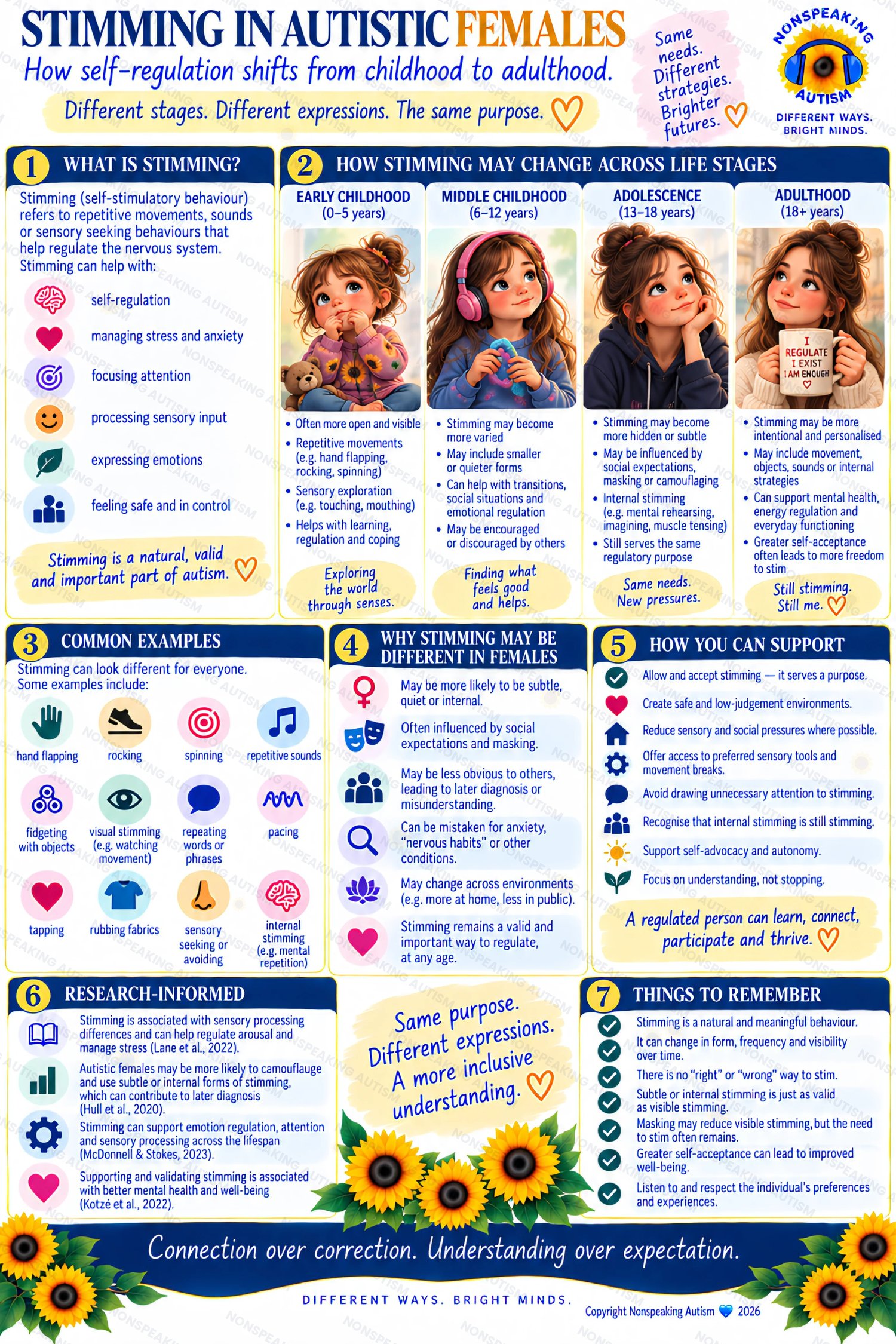
Stimming in Autistic Females
Stimming in Autistic Females
How self-regulation may shift from childhood to adulthood
Stimming can be one of the most visible — and sometimes one of the most misunderstood — aspects of autism.
Repetitive movements, sounds and sensory-seeking behaviours can serve important functions, including self-regulation, sensory processing, managing stress, focusing attention, expressing emotion and creating a sense of safety or control.
But stimming does not necessarily look the same throughout a person's life.
As autistic girls grow into adolescence and adulthood, the form, visibility and context of stimming may change. Some stims may become smaller, quieter, more personalised or more internal. Social expectations and masking may also influence whether a person feels able to stim openly.
Stimming in Autistic Females is a research-informed educational poster designed to help families, autistic people, educators and professionals understand these changes without assuming that less visible stimming means the underlying regulatory need has disappeared.
The central message is:
Different stages. Different expressions. The same purpose.
🧠 What This Poster Explores
This visual resource follows stimming across different stages of life and explores:
- What stimming is and why it may occur
- The regulatory functions stimming can serve
- How stimming may look during early childhood
- How its expression may change during middle childhood
- The influence of adolescence, social expectations and masking
- How adult stimming may become increasingly individualised
- Common visible, subtle and internal forms of stimming
- Why stimming may sometimes appear different in autistic females
- How environments can support safe, accepted self-regulation
- What current research tells us about stimming, sensory processing and camouflaging
The poster emphasises that these are possible patterns, not fixed developmental stages. Every autistic person's experience is individual.
♾️ What Is Stimming?
“Stimming” is commonly used to describe repetitive movements, sounds or sensory behaviours.
Examples can include hand movements, rocking, pacing, tapping, repetitive sounds, repeating words or phrases, rubbing particular fabrics, watching repetitive visual movement or seeking specific sensory experiences.
For autistic people, stimming may support:
Self-regulation — helping the nervous system manage arousal.
Stress and anxiety management — providing predictable sensory input during difficult situations.
Attention and concentration — helping some people remain engaged or organised.
Sensory processing — seeking, modifying or regulating sensory input.
Emotional expression — excitement, happiness, distress and other emotions may all be expressed through movement or sound.
Safety and control — predictable repetitive experiences can sometimes provide stability when the surrounding environment feels uncertain.
Stimming is not automatically a problem that needs to be eliminated.
It can be a natural, valid and meaningful part of autistic experience.
🌱 How Stimming May Change Across Life Stages
The poster provides a visual journey from early childhood through adulthood.
🧸 Early Childhood
Stimming may be more open and visible during early childhood.
Examples can include hand flapping, rocking, spinning, touching, mouthing or other forms of sensory exploration.
At this stage, stimming may support sensory exploration, learning, emotional regulation and coping.
🎧 Middle Childhood
As children grow, stimming may become more varied.
Some children may develop smaller or quieter forms of repetitive movement or find particular sensory strategies that help during transitions, social situations or periods of emotional intensity.
At the same time, responses from peers and adults can begin influencing how comfortable a child feels stimming openly.
🌻 Adolescence
During adolescence, social awareness and pressure to conform can increase.
For some autistic young people, this may mean that stimming becomes more subtle, private or internal, particularly in environments where visible autistic behaviour attracts unwanted attention.
The underlying regulatory purpose, however, may remain.
💙 Adulthood
Adult stimming can be highly individual.
It may involve movement, objects, sounds, repetitive activities or less visible internal strategies.
For some autistic adults, increasing self-understanding and acceptance can also bring greater freedom to use helpful forms of self-regulation without feeling they must constantly suppress them.
Still stimming. Still me.
🌻 What Stimming Can Look Like
Stimming is much broader than hand flapping.
The poster illustrates examples including:
- Hand flapping
- Rocking
- Spinning
- Repetitive sounds
- Fidgeting with objects
- Visual stimming, such as watching repetitive movement
- Repeating words or phrases
- Pacing
- Tapping
- Rubbing or touching particular fabrics
- Sensory seeking or sensory avoidance
- Internal stimming, such as mental repetition
Some forms are immediately noticeable. Others may be almost invisible to observers.
Subtle or internal stimming is still valid stimming.
♀️ Why Stimming May Appear Different in Autistic Females
Research into autistic females and camouflaging suggests that some autistic girls and women may be more likely to mask or camouflage aspects of their autistic presentation, although this is not universal and camouflaging occurs across genders. Research has found higher average self-reported camouflaging in autistic women than autistic men in some samples, with substantial individual variation.
This matters when thinking about stimming.
Camouflaging can include suppressing or controlling behaviours associated with autism, including visible repetitive behaviours and stimming. Autistic adults have also described replacing noticeable stims with subtler ways of meeting sensory or regulatory needs.
As a result, stimming in some autistic females may:
- Become quieter or less noticeable
- Move towards more socially accepted forms
- Be suppressed in public but expressed more freely in private
- Change depending on the environment
- Be mistaken for anxiety, nervous habits or ordinary fidgeting
- Become partly internal rather than externally visible
Camouflaging has also been associated with poorer mental-health outcomes in autistic adults, although the relationships are complex and research continues to develop.
This does not mean all autistic females mask, that females always stim differently from males, or that a particular type of stimming identifies autism.
💙 How You Can Support
Support should focus on understanding the purpose and safety of the behaviour, rather than making somebody appear less autistic.
Helpful principles include:
Allow and accept safe stimming
If a stim is safe, there may be no reason to stop it simply because it looks different.
Create low-judgement environments
Feeling watched or criticised can create additional pressure around natural regulation.
Reduce sensory and social pressures
Consider whether the environment itself is increasing the person's need for regulation.
Offer access to preferred sensory tools and movement
Choice matters. Different people regulate in different ways.
Avoid drawing unnecessary attention to stimming
Constantly commenting on a person's movements can make self-regulation feel socially unsafe.
Recognise internal and subtle stimming
A person does not need to display stereotypical movements for their regulatory needs to be genuine.
Support autonomy and self-advocacy
Autistic people should be involved in decisions about their own sensory and regulatory needs.
Focus on understanding, not stopping.
🔬 Research-Informed
This poster is informed by research concerning autistic repetitive behaviour, sensory processing, self-regulation, female autistic presentation and camouflaging.
Research on autistic females and camouflaging indicates that autism may sometimes be less readily recognised when characteristics are concealed, compensated for or expressed in ways that do not match traditional expectations.
Studies of autistic adults have also documented the suppression of visible autistic behaviours, including stimming, as part of camouflaging.
An important limitation is that the evidence does not establish one universal developmental pathway for stimming in autistic females. The childhood-to-adulthood stages shown on this poster should therefore be understood as an educational illustration of ways stimming may change, rather than a prediction of how every autistic girl or woman will develop.
Individual differences remain central.
👨👩👧 Who Is This Resource For?
This poster may be useful for:
- Autistic girls, women and their families
- Parents and carers
- Autistic adults exploring their own experiences
- Teachers and teaching assistants
- SENCOs and SEND teams
- Mainstream and specialist schools
- Autism and inclusion teams
- Occupational therapists
- Speech and language professionals
- Psychologists and other relevant professionals
- Support workers
- Social-care professionals
- Family-support organisations
- Autism training and staff-development sessions
It can be displayed at home, in classrooms, SEND spaces, therapy rooms, clinics and professional settings, or used as a visual starting point for conversations about stimming, masking, sensory regulation and autistic self-acceptance.
📦 What You Receive
Your purchase includes:
1 × Stimming in Autistic Females — How Self-Regulation Shifts from Childhood to Adulthood
This is a digital educational poster from Nonspeaking Autism, supplied as a PDF file.
The purchased version is supplied clear and without the promotional preview watermark. Watermarks visible on Payhip listing images are used for preview and copyright-protection purposes.
Digital download only — no physical product will be shipped.
⚠️ Important Disclaimer
This resource is provided for educational and informational purposes only.
It is not a diagnostic tool, medical advice, therapy or a substitute for individual assessment or guidance from an appropriately qualified professional.
Stimming varies considerably between autistic people and across situations. Not every autistic person stims in the same way, and differences described between females and males represent patterns reported in some research rather than rules that apply to every individual.
Sex, gender, development, environment, sensory needs, learning history, social expectations and individual preferences may all influence how regulation is expressed.
Safe and non-harmful stimming should not automatically be treated as behaviour that needs to be stopped. Where a behaviour is causing injury, significant distress or another genuine safety concern, support should focus on understanding its function and the person's underlying needs while seeking appropriate individual guidance where necessary.
💛 The Message Behind the Resource
Stimming can change without disappearing.
The little girl who openly rocks, spins or flaps may grow into a teenager who regulates through smaller movements, and later an adult whose strategies are highly personal or barely visible to anybody else.
But less visible does not necessarily mean less needed.
When autistic people are given environments where safe regulation does not need to be hidden, the goal is not to make them look less autistic.
It is to give them greater freedom to understand and support their own nervous system.
Same purpose. Different expressions. A more inclusive understanding.
Different stages. Different expressions. The same purpose.
Connection over correction.
Understanding over expectation.
© Nonspeaking Autism 2026. All rights reserved.