
Understanding Demand Avoidance in Autism
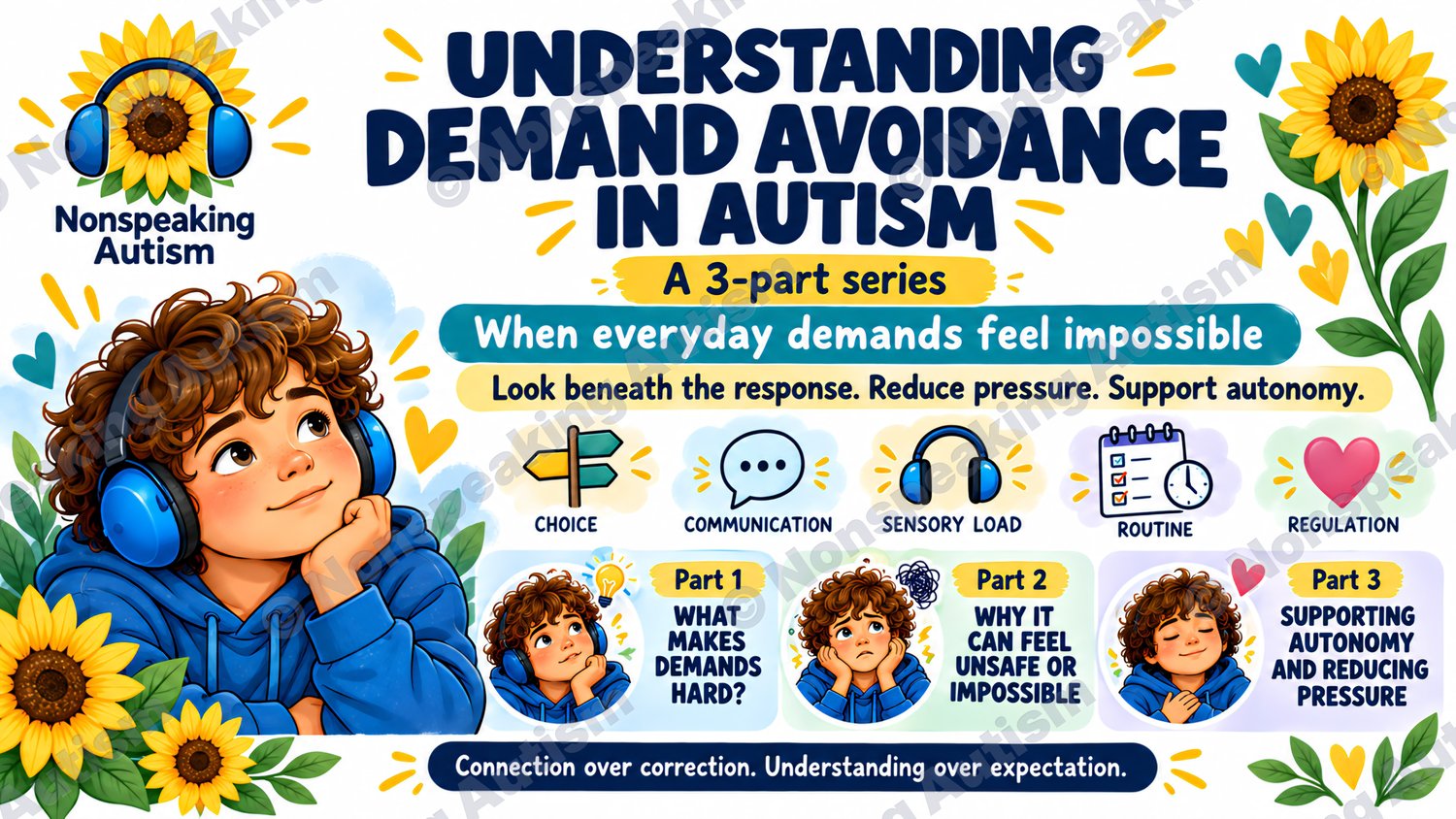
Understanding Demand Avoidance in Autism
A FREE three-part poster collection
When everyday demands feel impossible
Look beneath the response. Reduce pressure. Support autonomy.
This illustrated educational collection explores why everyday demands may feel difficult, overwhelming or impossible for some autistic people, including nonspeaking individuals.
Rather than assuming that someone is simply refusing, these posters encourage a more compassionate question:
“What is making this demand hard right now?”
The series considers how anxiety, uncertainty, sensory distress, communication demands, motor initiation difficulties, pain and fatigue may affect a person’s ability to engage. It encourages understanding, collaboration and support that respects the individual.
🌻 What This Collection Explores
Part 1 — What Makes Demands Hard?
An introduction to demand avoidance and the different factors that may sit beneath it.
This poster explores:
- Anxiety, uncertainty and sensory overload.
- Loss of control or autonomy.
- Communication and processing demands.
- Difficulty initiating movement or starting tasks.
- Pain, fatigue, hunger or illness.
- Why one behaviour cannot tell us its cause.
- Why demand avoidance should not automatically be interpreted as defiance or labelled PDA.
Part 2 — Why Some Demands Can Feel Unsafe or Impossible
A closer look at why a task that appears simple to someone else may feel overwhelming to the person being asked.
This poster considers:
- Unpredictability and fear of getting things wrong.
- Pressure building around everyday expectations.
- The difference between wanting to do something and being able to start.
- Communication becoming harder during distress.
- Responses such as delaying, leaving, going quiet, becoming stuck, meltdown or shutdown.
- How adults may misunderstand distress as unwillingness.
Part 3 — Supporting Autonomy and Reducing Pressure
Practical ideas for creating more manageable everyday experiences.
Topics include:
- Reducing unnecessary demands and sensory overload.
- Offering meaningful, accessible choices.
- Adapting routines and allowing extra processing time.
- Breaking tasks into smaller steps.
- Supporting essential care with compassion.
- Using calm, respectful language.
- Supporting communication, including augmentative and alternative communication (AAC).
- Making space for regulation, rest and recovery.
- Building trust and respecting individual preferences.
The central message: safety, trust and connection matter more than compliance.
📚 Research-Informed, With Important Limitations
The collection introduces research themes concerning demand avoidance, anxiety, uncertainty and sensory experiences, while acknowledging that definitions and explanations remain debated.
Demand avoidance does not have one explanation, and these posters are not a diagnostic checklist. They encourage individualised support rather than assumptions based on a label.
Research references and limitations are included within the posters for further reading.
Part 1: Understanding Demand Avoidance in Autism
FURTHER RESOURCES
- PDA Society – information and support on demand avoidance: https://www.pdasociety.org.uk/
- National Autistic Society – Autism and sensory processing: https://www.autism.org.uk/advice-and-guidance/topics/sensory-differences/sensory-differences/all-audiences
RESEARCH & REFERENCES
What may make demands hard (anxiety, uncertainty, sensory load)
- Rai, A., Gutierrez, R., Rishworth, B., & Ludlow, A. (2026). Sensory reactivity and intolerance to uncertainty: What characterises demand avoidance behaviours in children and adolescents with pathological demand avoidance? Research in Autism, 131, 202816. https://doi.org/10.1016/j.reia.2026.202816
- Stuart, L., Grahame, V., Honey, E., & Freeston, M. (2020). Intolerance of uncertainty and anxiety as explanatory frameworks for extreme demand avoidance in children and adolescents. Child and Adolescent Mental Health, 25(2), 59–67. https://doi.org/10.1111/camh.12336
What research suggests (definitions still debated)
- Rotella, J.-A. (2026). A systematic review of pathological demand avoidance (PDA): A veritable diagnosis or a case of circular logic? Journal of Autism and Developmental Disorders. https://doi.org/10.1007/s10803-026-07432-y
- Kildahl, A. N., Helverschou, S. B., Rysstad, A. L., Wigaard, E., Hellerud, J. M. A., Ludvigsen, L. B., & Howlin, P. (2021). Pathological demand avoidance in children and adolescents: A systematic review. Autism, 25(8), 2162–2176. https://doi.org/10.1177/13623613211034382
Families' experiences
- Nawaz, S., & Speer, S. A. (2025). What are the experiences and support needs of families of autistic children with extreme (or 'pathological') demand avoidance (E/PDA) behaviours? Research in Autism Spectrum Disorders, 119, 102515. https://doi.org/10.1016/j.rasd.2024.102515
Foundational references printed on the poster: Rotella (2026); Rai et al. (2026); Nawaz & Speer (2025).
Part 2: Why Some Demands Can Feel Unsafe or Impossible
FURTHER RESOURCES
- PDA Society – information and support on demand avoidance: https://www.pdasociety.org.uk/
- National Autistic Society – Meltdowns: a guide for all audiences: https://www.autism.org.uk/advice-and-guidance/topics/behaviour/meltdowns/all-audiences
RESEARCH & REFERENCES
What can sit underneath it (anxiety, intolerance of uncertainty, sensory reactivity)
- Stuart, L., Grahame, V., Honey, E., & Freeston, M. (2020). Intolerance of uncertainty and anxiety as explanatory frameworks for extreme demand avoidance in children and adolescents. Child and Adolescent Mental Health, 25(2), 59–67. https://doi.org/10.1111/camh.12336
- Rai, A., Gutierrez, R., Rishworth, B., & Ludlow, A. (2026). Sensory reactivity and intolerance to uncertainty: What characterises demand avoidance behaviours in children and adolescents with pathological demand avoidance? Research in Autism, 131, 202816. https://doi.org/10.1016/j.reia.2026.202816
Meltdown or shutdown if pressure builds
- Soden, P. A., Bhat, A., Anderson, A. K., & Friston, K. J. (2025). The meltdown pathway: A multidisciplinary account of autistic meltdowns. Psychological Review, 132(5), 1209–1240. https://doi.org/10.1037/rev0000543
What research suggests (not one settled construct)
- Rotella, J.-A. (2026). A systematic review of pathological demand avoidance (PDA): A veritable diagnosis or a case of circular logic? Journal of Autism and Developmental Disorders. https://doi.org/10.1007/s10803-026-07432-y
- Green, J., Absoud, M., Grahame, V., Malik, O., Simonoff, E., Le Couteur, A., & Baird, G. (2018). Pathological demand avoidance: Symptoms but not a syndrome. The Lancet Child & Adolescent Health, 2(6), 455–464. https://doi.org/10.1016/S2352-4642(18)30044-0
Part 3: Supporting Autonomy, Reducing Pressure
FURTHER RESOURCES
- PDA Society – information and support on demand avoidance: https://www.pdasociety.org.uk/
- National Autistic Society – Autism and sensory processing: https://www.autism.org.uk/advice-and-guidance/topics/sensory-differences/sensory-differences/all-audiences
RESEARCH & REFERENCES
Family experiences and support needs (Build trust, Every individual is unique)
- Nawaz, S., & Speer, S. A. (2025). What are the experiences and support needs of families of autistic children with extreme (or 'pathological') demand avoidance (E/PDA) behaviours? Research in Autism Spectrum Disorders, 119, 102515. https://doi.org/10.1016/j.rasd.2024.102515
- Curtis, S., & Izett, E. (2025). The experience of mothers of autistic children with a pathological demand avoidance profile: An interpretative phenomenological analysis. Discover Mental Health, 5(1). https://doi.org/10.1007/s44192-025-00127-3
Reducing sensory load and supporting regulation
- Rai, A., Gutierrez, R., Rishworth, B., & Ludlow, A. (2026). Sensory reactivity and intolerance to uncertainty: What characterises demand avoidance behaviours in children and adolescents with pathological demand avoidance? Research in Autism, 131, 202816. https://doi.org/10.1016/j.reia.2026.202816
- Piller, A., McHugh Conlin, J., Glennon, T. J., Andelin, L., Auld-Wright, K., Teng, K., & Tarver, T. (2025). Systematic review of sensory-based interventions for children and youth (2015–2024). Frontiers in Pediatrics, 13, 1720179. https://doi.org/10.3389/fped.2025.1720179
Research limitations
- Rotella, J.-A. (2026). A systematic review of pathological demand avoidance (PDA): A veritable diagnosis or a case of circular logic? Journal of Autism and Developmental Disorders. https://doi.org/10.1007/s10803-026-07432-y
- Kildahl, A. N., Helverschou, S. B., Rysstad, A. L., Wigaard, E., Hellerud, J. M. A., Ludvigsen, L. B., & Howlin, P. (2021). Pathological demand avoidance in children and adolescents: A systematic review. Autism, 25(8), 2162–2176. https://doi.org/10.1177/13623613211034382
Foundational references printed on the poster: Rotella (2026); Rai et al. (2026); Nawaz & Speer (2025).
Sources:
- University of Manchester: Green et al. (2018)
- Edith Cowan University: Curtis & Izett (2025)
- PDA Society: Nawaz & Speer (2025)
- PDA Society
💛 Who Is This Resource For?
This free collection may be useful for:
- Parents, carers and family members.
- Teachers, teaching assistants and SENCOs.
- Support workers and care teams.
- Professionals supporting autistic people.
- Anyone seeking a more compassionate understanding of demand avoidance.
Use it for personal learning, staff discussion, awareness displays or conversations about adapting support.
📦 What You Receive
- Three illustrated digital posters, covering Parts 1–3.
- PNG image files for download.
- Clear, unwatermarked poster artwork.
- A free educational resource — no payment required.
The watermarked collection cover is a preview image used to protect the artwork.
Digital download only. No physical product will be sent. Print quality and suitable print size depend on each file’s resolution and your printer settings.
🌿 Educational Disclaimer
This resource provides general educational information. It does not diagnose autism, PDA or any other condition, and does not replace individual assessment or advice from an appropriately qualified professional.
Every person’s needs, communication and circumstances are different. Adapt support collaboratively and seek individual advice when needed.
© Copyright and Permitted Use
© Nonspeaking Autism 2026. All rights reserved.
You may download and print these posters for personal use or educational display within your own classroom or support setting.
Please retain the copyright and branding. Do not resell, alter, redistribute the digital files or upload them elsewhere. To share this free resource, please share the Payhip product link.
Connection over correction. Understanding over expectation. 💛