
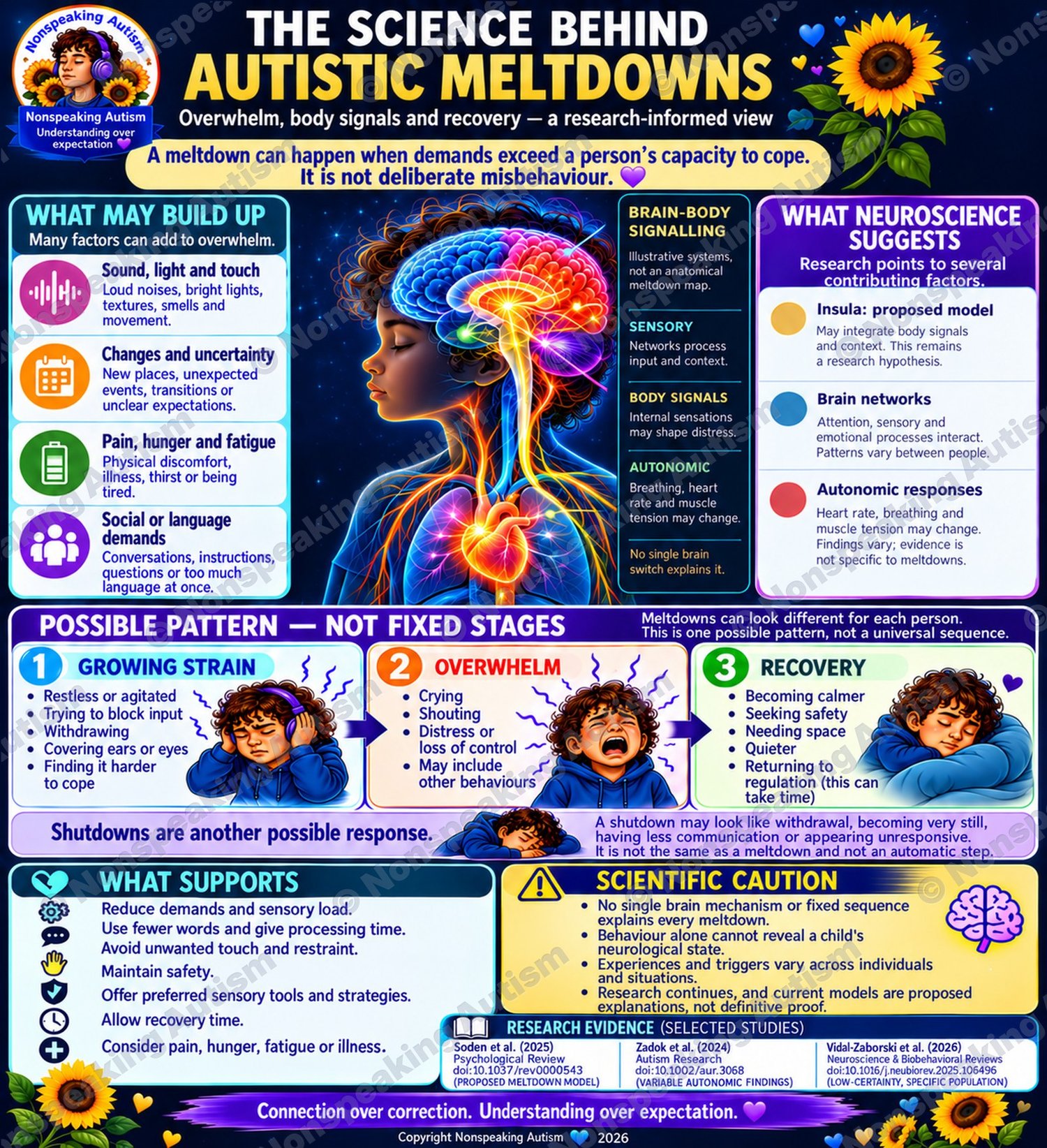
💙 THE SCIENCE BEHIND AUTISTIC MELTDOWNS
💙 THE SCIENCE BEHIND AUTISTIC MELTDOWNS
Overwhelm, Body Signals & Recovery — A Research-Informed View
UK Edition | Autism & SEND Educational Poster | Nonspeaking Autism
🌻 A meltdown can happen when demands exceed a person's capacity to cope. It is not deliberate misbehaviour.
When an autistic child cries, shouts, becomes visibly distressed or appears to lose control, the response may be misunderstood as a tantrum, defiance or deliberate disruption.
But an autistic meltdown is commonly described as an intense, involuntary response to overwhelming demands or distress.
The experience may involve sensory input, uncertainty, physical discomfort, emotional stress, communication demands or several factors occurring together.
And while meltdowns can be very visible, the experience behind them is not always understood.
The Science Behind Autistic Meltdowns is an illustrated, research-informed educational poster designed to help parents, carers, teachers, SENCOs and professionals explore what may contribute to overwhelm, how brain and body processes may be involved, and what compassionate support can look like.
Rather than presenting one simple neurological explanation, this poster recognises that research is still developing and that autistic meltdowns vary between individuals.
The central message:
Connection over correction. Understanding over expectation.
🧠 WHAT IS AN AUTISTIC MELTDOWN?
An autistic meltdown is a commonly used descriptive term for an episode of intense distress or overwhelm that may involve reduced ability to regulate responses in the moment.
It is not a formal diagnosis or a behaviour that can be identified from one outward sign alone.
During a meltdown, a person may experience:
- Crying or shouting
- Visible distress
- Agitation or restlessness
- Difficulty processing speech or instructions
- Reduced access to usual communication
- A strong need to escape overwhelming input
- Changes in movement or behaviour
- Significant exhaustion afterwards
Not every autistic person experiences meltdowns.
Not every meltdown looks the same.
And not every episode of distress in an autistic person is necessarily a meltdown.
The person's experience, communication and circumstances matter more than the outward appearance alone.
🌈 WHAT THIS POSTER EXPLORES
1. WHAT MAY BUILD UP BEFORE A MELTDOWN?
Many factors can contribute to overwhelm.
The poster explores four broad areas.
Sensory input
Sounds, lighting, touch, textures, smells and movement may become uncomfortable or difficult to manage.
A busy classroom, unexpected noise or several sensory demands occurring together may contribute to distress.
Changes and uncertainty
Unfamiliar places, unexpected events, transitions and unclear expectations may increase stress for some autistic people.
Pain, hunger and fatigue
Physical discomfort, illness, thirst, hunger, poor sleep and exhaustion can affect a person's ability to cope with additional demands.
Social and language demands
Conversations, repeated questions, instructions, social expectations and too much spoken language at once may become difficult to process.
These factors can overlap and accumulate.
A meltdown may reflect the combined effect of several demands rather than one obvious trigger.
🔬 WHAT DOES NEUROSCIENCE SUGGEST?
The poster introduces several areas of scientific interest while making an important distinction between established knowledge and developing hypotheses.
Brain–Body Signalling
The brain and body continuously exchange information relating to sensory experiences, internal bodily states, attention and emotional responses.
These systems may influence how a person experiences and responds to distress.
However, the illustration on the poster is a simplified educational representation.
It is not an anatomical map of a meltdown or proof of a particular neurological mechanism.
Insula — A Proposed Model
The insula is a brain region involved in processes associated with internal bodily awareness and integration of information.
Some researchers have proposed models in which interoception and the insula may contribute to understanding experiences of overwhelm.
These remain research hypotheses.
It would be inaccurate to claim that the insula has been established as the cause of autistic meltdowns.
Brain Networks
Attention, sensory processing and emotional processes involve interacting brain networks.
Research suggests these systems can function differently across individuals.
However, brain network findings should not be used to assume what is happening in one person's brain during a meltdown.
Autonomic Responses
The autonomic nervous system contributes to processes such as heart rate, breathing and aspects of physical arousal.
Changes in these processes may accompany distress.
Research findings vary, and autonomic measurements are not specific tests for autistic meltdowns.
There is no single established “meltdown switch” in the brain.
💛 POSSIBLE PATTERN — NOT FIXED STAGES
The poster illustrates one possible sequence of growing strain, overwhelm and recovery.
This is a helpful educational example, not a universal neurological pathway.
1. GROWING STRAIN
A person may become:
- Restless or agitated
- More sensitive to sensory input
- Withdrawn
- More likely to cover their ears or eyes
- Less able to cope with additional demands
Some people notice early warning signs, while others do not.
2. OVERWHELM
During a period of intense distress, a person may:
- Cry
- Shout
- Experience difficulty regulating their responses
- Struggle to process information
- Find communication more difficult
- Display other individual responses to overwhelm
The priority should be safety and reducing unnecessary demands.
3. RECOVERY
As distress reduces, the person may:
- Become quieter
- Seek safety or familiar support
- Need personal space
- Require rest
- Gradually return to usual activities
- Continue to experience fatigue or sensory sensitivity
Recovery may take time.
These stages are illustrative. Some meltdowns may develop rapidly, fluctuate or follow a completely different pattern.
MELTDOWN AND SHUTDOWN ARE NOT THE SAME
The poster also explains that shutdown can be another possible response to overwhelm.
A shutdown-like experience may involve:
- Withdrawal
- Becoming unusually still
- Reduced communication
- Reduced responsiveness
- Difficulty continuing activities
- A need for quiet or recovery
A meltdown may involve more outwardly visible distress.
However, the distinction is not always straightforward, and individuals may describe or experience these responses differently.
Shutdown is not an automatic stage after meltdown.
Some autistic people experience meltdowns, some experience shutdowns, some experience both, and others experience neither.
Neither term should be used to dismiss medical symptoms or assume a person's internal state.
💙 WHAT SUPPORTS SOMEONE DURING A MELTDOWN?
The poster highlights practical, compassionate approaches that may help.
Reduce Demands and Sensory Load
Where possible, reduce unnecessary noise, bright lighting, questions, instructions and environmental demands.
Use Fewer Words
During intense distress, spoken language may be difficult to process.
Use calm, brief communication when appropriate and allow processing time.
Avoid Unwanted Touch and Restraint
Respect the person's physical boundaries and communication.
Do not force hugs, deep pressure or physical contact.
Any immediate safety intervention should follow applicable safeguarding requirements and use the least restrictive appropriate response.
Maintain Safety
Reduce environmental hazards and protect the person's safety and dignity.
Avoid escalating the situation through confrontation, punishment or unnecessary demands.
Offer Preferred Supports
Some individuals may find familiar sensory tools, comfort items, quiet spaces or preferred communication methods helpful.
Others may need space and reduced interaction.
Follow the person's preferences wherever possible.
Allow Recovery Time
Do not assume that visible calm means the person is ready to return immediately to demanding activities.
Rest, reduced expectations and access to familiar support may be important.
Consider Physical Needs
Check whether pain, hunger, thirst, fatigue, illness or another physical concern may be contributing to distress.
Support should be individualised, consent-aware and focused on safety rather than compliance.
🏫 USING THIS RESOURCE IN UK SCHOOLS & SEND SETTINGS
This poster may support discussions about preventing avoidable overload and responding appropriately to distress.
It can help teachers, teaching assistants, SENCOs and other professionals consider:
- Sensory accessibility
- Communication differences and AAC access
- Predictable transitions
- Processing time
- Reduced unnecessary demands
- Physical wellbeing
- Individual warning signs
- Calm spaces and recovery
- Reasonable adjustments
- Support planning after episodes of distress
For some pupils, difficulties may arise when the combined demands of the school environment exceed what they can manage at that time.
The poster can support collaborative conversations between families, schools and relevant professionals.
Where appropriate, observations may contribute to individual SEND support planning or an Education, Health and Care Plan (EHCP) in England.
The aim is to reduce barriers, recognise distress and support meaningful participation.
📚 RESEARCH & SCIENTIFIC EVIDENCE
This poster references recent research examining proposed neurological models, autonomic findings and descriptions of autistic meltdowns.
It is important to distinguish research hypotheses from established clinical conclusions.
Research Cited on the Poster
Soden et al. (2025)
Psychological Review.
DOI: 10.1037/rev0000543
Presented on the poster in relation to a proposed meltdown model.
Zadok et al. (2024)
Autism Research.
DOI: 10.1002/aur.3068
Presented on the poster in relation to variable autonomic findings.
Vidal-Zaborski et al. (2026)
Neuroscience & Biobehavioral Reviews.
DOI: 10.1016/j.neubiorev.2025.106496
- Soden, P. A., Bhat, A., Anderson, A. K., & Friston, K. J. (2025). The meltdown pathway: A multidisciplinary account of autistic meltdowns. Psychological Review, 132(5), 1209–1240. https://doi.org/10.1037/rev0000543
- Zadok, E., Golan, O., Lavidor, M., & Gordon, I. (2024). Autonomic nervous system responses to social stimuli among autistic individuals: A systematic review and meta-analysis. Autism Research, 17(3), 497–511. https://doi.org/10.1002/aur.3068
- Vidal-Zaborski, O., Merino, D., Fernandez, A., et al. (2026). Autonomic and hormonal biomarkers in individuals with autism spectrum disorders and developmental or intellectual delay: A systematic PRISMA review. Neuroscience & Biobehavioral Reviews, 180, 106496. https://doi.org/10.1016/j.neubiorev.2025.106496
Presented on the poster in relation to research involving a specific population and low-certainty evidence.
Important reference note: These citation details have been transcribed from the supplied poster. Their exact article titles, authorship, publication details and relevance have not been independently verified for this description.
FURTHER RESOURCES
- National Autistic Society – Meltdowns: a guide for all audiences: https://www.autism.org.uk/advice-and-guidance/topics/behaviour/meltdowns/all-audiences
- NHS Scotland Right Decisions – Autistic meltdowns and shutdowns: https://rightdecisions.scot.nhs.uk/autism-meeting-the-needs-of-autistic-people/autistic-meltdownsshutdowns
- Reframing Autism – All About Autistic Shutdowns: A Guide for Allies: https://reframingautism.org.au/?p=3947
RESEARCH & REFERENCES
Proposed meltdown model, brain–body signalling (What Neuroscience Suggests)
- Soden, P. A., Bhat, A., Anderson, A. K., & Friston, K. J. (2025). The meltdown pathway: A multidisciplinary account of autistic meltdowns. Psychological Review, 132(5), 1209–1240. https://doi.org/10.1037/rev0000543
Autonomic responses (heart rate, breathing, muscle tension)
- Zadok, E., Golan, O., Lavidor, M., & Gordon, I. (2024). Autonomic nervous system responses to social stimuli among autistic individuals: A systematic review and meta-analysis. Autism Research, 17(3), 497–511. https://doi.org/10.1002/aur.3068
- Vidal-Zaborski, O., Merino, D., Fernandez, A., et al. (2026). Autonomic and hormonal biomarkers in individuals with autism spectrum disorders and developmental or intellectual delay: A systematic PRISMA review. Neuroscience & Biobehavioral Reviews, 180, 106496. https://doi.org/10.1016/j.neubiorev.2025.106496
Sensory reactivity and overwhelm (What May Build Up)
- Tavassoli, T., Marco, E. J., & Puts, N. (2026). Sensory reactivity in autism: Integrating behavioural, affective, physiological, and neural dimensions. Current Psychiatry Reports, 28, 36. https://doi.org/10.1007/s11920-026-01682-4
Shutdowns (Shutdowns are another possible response)
- Paris, Lodestone, Houser & Lewis (2025). "Shutdowns are like you're stuck on the blue screen of death": A metaphor analysis of autistic shutdowns. Autism in Adulthood, 8(4), 687–697. https://doi.org/10.1089/aut.2024.0193
Foundational references printed on the poster: Soden et al. (2025); Zadok et al. (2024); Vidal-Zaborski et al. (2026).
Scientific Evidence Note
Current research does not establish a single neurological cause, fixed sequence or definitive brain mechanism for every autistic meltdown.
The poster's brain and nervous-system illustration is educational rather than diagnostic.
The proposed involvement of the insula, brain networks and autonomic processes should not be interpreted as a confirmed explanation for any individual episode.
Sources:
- National Autistic Society: Meltdowns
- NHS Scotland Right Decisions: Autistic meltdowns and shutdowns
- Reframing Autism: All About Autistic Shutdowns
A person's behaviour alone cannot reveal their precise neurological state.
👨👩👧 WHO IS THIS RESOURCE FOR?
This educational poster may be useful for:
- Parents and carers of autistic children
- Autistic young people and adults
- Teachers and teaching assistants
- SENCOs and SEND teams
- Occupational therapists
- Speech and language therapists
- Educational psychologists
- Paediatric and healthcare professionals
- Family support workers
- Early years practitioners
- Professionals supporting communication and sensory accessibility
- Anyone seeking a more compassionate understanding of autistic distress
It may be displayed in homes, classrooms, SEND support areas, therapy rooms, staff training spaces and other educational environments.
📦 WHAT YOU RECEIVE
PAID DIGITAL DOWNLOAD — INDIVIDUAL POSTER
Your purchase includes:
1 × The Science Behind Autistic Meltdowns — Educational Poster
The poster features:
- Factors that may contribute to overwhelm
- Brain–body signalling explanations
- Proposed neuroscience models
- Sensory and internal body signals
- Autonomic responses
- One possible pattern of growing strain, overwhelm and recovery
- Meltdown and shutdown distinctions
- Practical support strategies
- Scientific caution and research references
- Nonspeaking Autism illustrated design
The image displayed in this listing contains promotional preview watermarks.
The purchased printable version should be supplied without the promotional watermark.
Digital download only — no physical poster will be posted.
Exact print dimensions and resolution should be confirmed against the final downloadable file.
⚠️ IMPORTANT DISCLAIMER
This poster is intended for educational and informational purposes only.
It does not provide a medical diagnosis, neurological assessment, psychological assessment, occupational therapy assessment or individualised treatment plan.
Autistic meltdowns are complex experiences, and the terms and models discussed are not universally defined clinical measures.
Distress may be influenced by sensory experiences, pain, illness, emotional factors, communication barriers, physical needs and environmental demands.
Do not assume that every episode of intense distress is an autistic meltdown.
Sudden, severe or unusual changes in consciousness, responsiveness, movement, breathing or physical wellbeing may require urgent medical assessment.
In the UK, call 999 or 112 for a medical emergency.
Support should prioritise safety, dignity, communication access and individual needs.
©️ COPYRIGHT & PERMITTED USE
Copyright © 2026 Nonspeaking Autism. All rights reserved.
Purchase permits personal, family, classroom, school and individual professional educational use.
You may print the poster for these purposes.
You may not:
- Resell the poster or digital file
- Redistribute the purchased file
- Upload the original file to another website or digital platform
- Remove branding and claim the artwork as your own
- Reproduce the artwork commercially
- Include it in another product for resale without permission
Please share the original Payhip product link rather than distributing the purchased digital file.
💛 THE MESSAGE BEHIND THIS RESOURCE
A child who cries or shouts may be overwhelmed.
A child who struggles to follow instructions may have reached their capacity in that moment.
A child who cannot communicate as usual may still understand and have important needs.
And a child who becomes quiet afterwards may need recovery rather than more demands.
A meltdown is not an invitation to increase pressure.
It is a reason to consider what may be overwhelming, uncomfortable or inaccessible.
We can reduce sensory barriers.
We can make communication available.
We can check physical needs.
We can respond calmly.
And we can allow recovery without punishment or shame.
The goal is not simply to stop the outward response.
The goal is to understand the distress and provide meaningful support.
Reduce the load. Maintain safety. Protect recovery.
🌻 Connection over correction. Understanding over expectation. 💙
Nonspeaking Autism © 2026