The VO2max Guide - for coaches and ambitious athletes (EN)
VO₂max is in all likelihood the best-known measure in endurance sport, yet rarely the one that decides the race. What does make the difference, and how you can gauge and estimate it without a lab, is among the things you will find in this extensive, science-based guide.
Line up ten trained runners who all sit around the same (relative) VO₂max, and you still know nothing about their finishing order over 10 km. And that is hardly surprising: within a homogeneous, well-trained group, maximal oxygen uptake simply explains very little of the differences. Yet it remains the value athletes keep coming back to, and the one watches invent a figure and a trend for.
This guide sets that straight without dismissing VO₂max. It remains a useful and interesting value, and the first seven chapters treat it thoroughly:
what it actually is, why a plateau in a standard test is the exception rather than the rule, and why the same volume of oxygen yields three different figures depending on how it is divided.
From there, the discriminating work shifts to two other quantities.
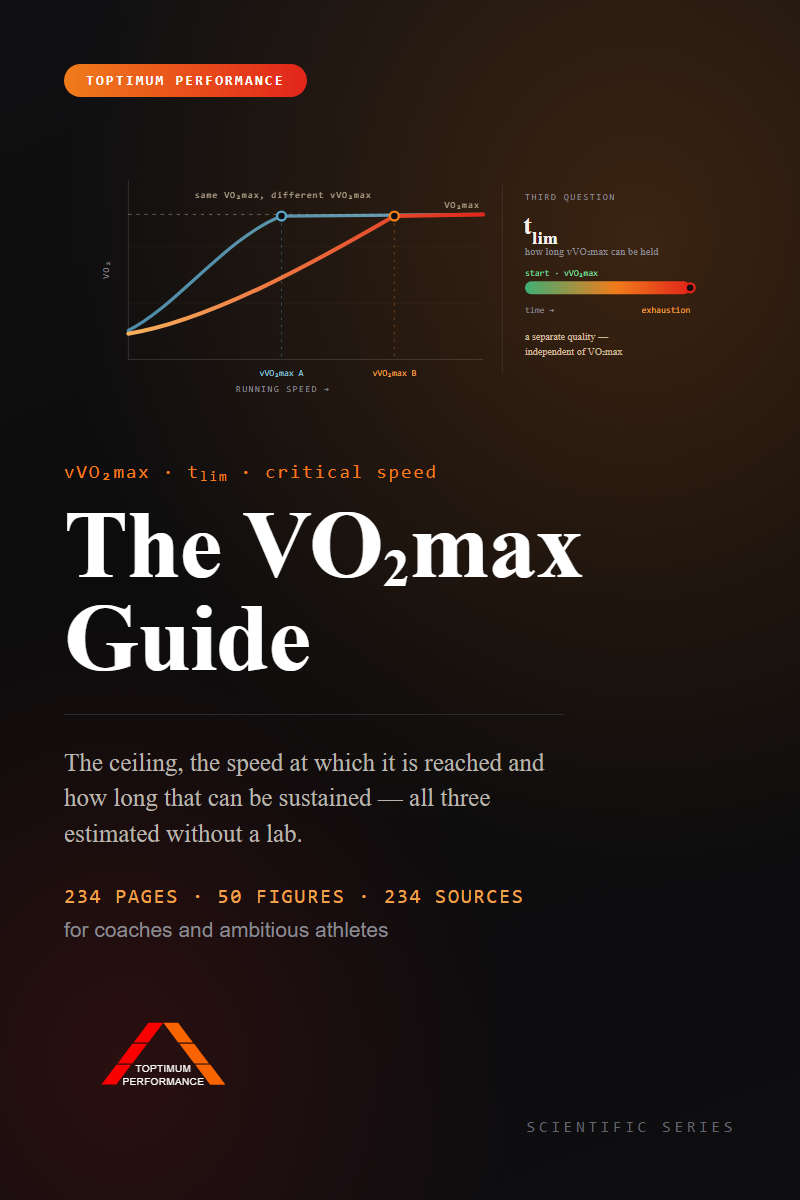
The speed at which VO₂max is reached — vVO₂max, or maximal aerobic speed (MAS) — because it brings the ceiling and running economy together in a single measure.
And its sustainability (t_lim at vVO₂max): how long a runner holds that speed, and what fraction of the ceiling can be sustained over the race distance.
The guide also sets out what a coach can do without gas analysis: estimating vVO₂max and MAS from a track test, measuring time to exhaustion, and determining critical speed from time trials. The Toptimum P.A.C.E. calculator can come in very useful here as well. Have a look at www.toptimumperformance.be
In the guide, with the protocols included, and with an honest analysis of how reliable each figure is.
**What you will find inside**
What VO₂max actually is — the plateau criterion, VO₂peak, and why the protocol shifts the figure.
Absolute, relative or allometric — why the same measurement tells three stories, and which denominator fits when.
The inherited VO₂max — high without training, and why that is not yet speed.
Reference values by distance and level — and why they fall silent within a group.
vVO₂max and running economy — the composite speed, and which of the five common methods of calculation is to be preferred.
- The determinant model — what VO₂max genuinely explains in trained runners, and what it does not.
- Sex differences in the female runner, with an honest account of what the evidence supports.
- Where the ceiling lies — central supply against peripheral utilisation, and the debate around it presented fairly.
- Kinetics, the slow component, t_lim at vVO₂max, and what post-exercise oxygen consumption is worth.
- Trainability — interval formats side by side, the Billat method, responders and ceilings.
- Field protocols for vVO₂max, MAS, t_lim and critical speed.
- What a watch-derived VO₂max does and does not tell you — and why the error grows precisely in the better runner.
- From test to training pace — VDOT, critical speed and zones.
- Plus a glossary in which every technical term is briefly explained.
**How this guide relates to Durability**
Both deal with what happens along the way, but not with the same thing. Here the subject is the sustainability of an intensity: what fraction of the ceiling remains standing over the distance, and how long a runner holds their vVO₂max. In Durability the subject is resistance to decline: how the entire physiological profile shifts as a race wears on. They complement one another; this guide refers to it in several places.
**Who it is for**
Coaches and ambitious athletes who want to go beyond a single figure on a test report, and who want to know what they can train and determine on the track without access to a laboratory.
**Extent**
234 pages · 25 chapters across 7 parts · 50 figures · 25 tables · 25 practice boxes · glossary of 70 terms · 234 unique scientific sources, with 223 references carrying a DOI
*Every claim in this guide has been checked against the original publication: authors, year, population and the figure itself. Where a finding comes from cycling research, from a small sample or from an all-male group, that is stated explicitly.