


The Life of Csoma de Kőrös — The Hungarian Who Walked East to Find His Ancestors, 1784–1842 (PDF + EPUB)
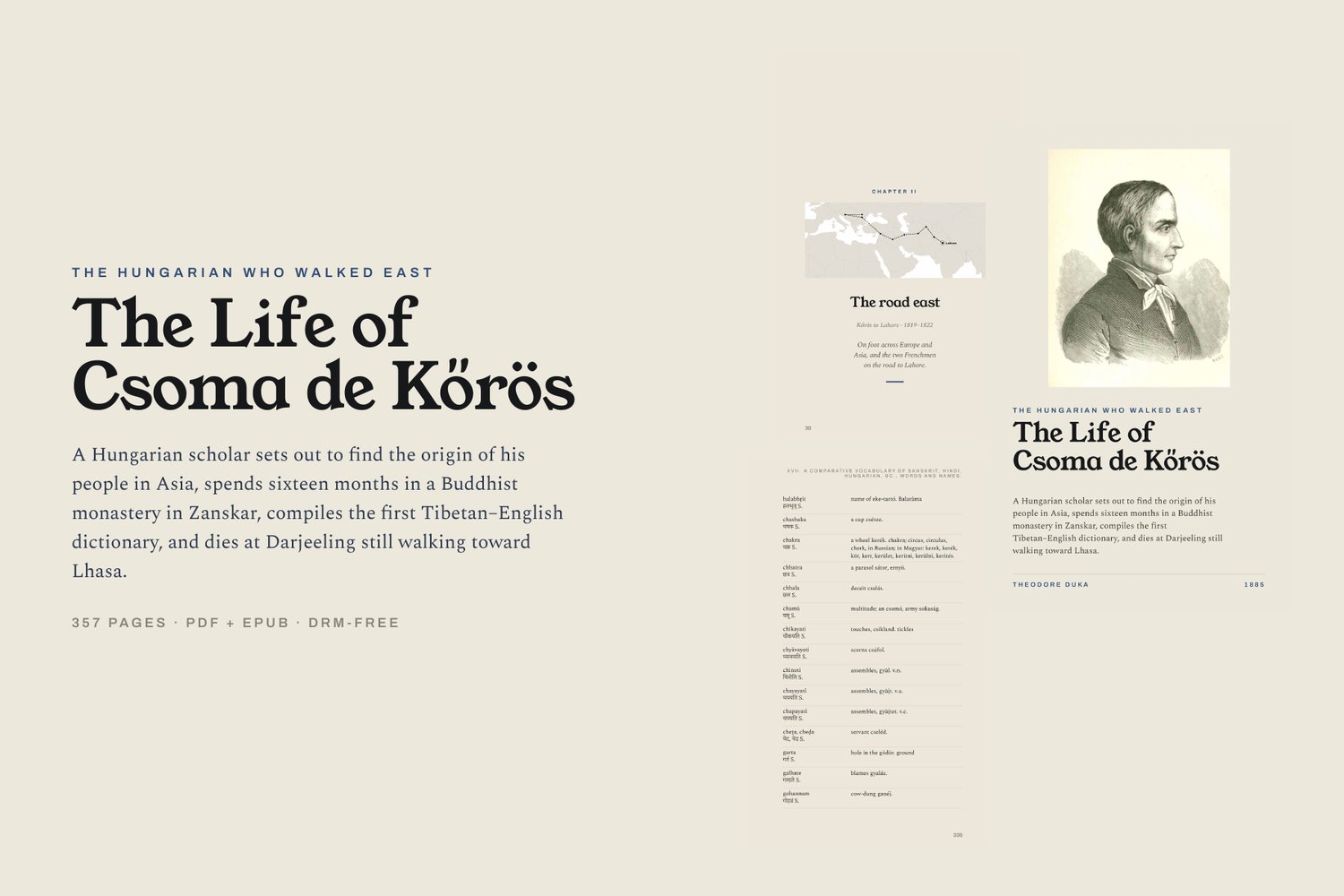
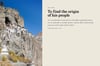
In 1819 a poor Székely student left a village in Transylvania on foot, with about two hundred florins and a promise of a hundred a year, to find the origin of the Hungarian people. He had made the vow at school, twelve years earlier, with two classmates. He believed the answer lay in Asia.
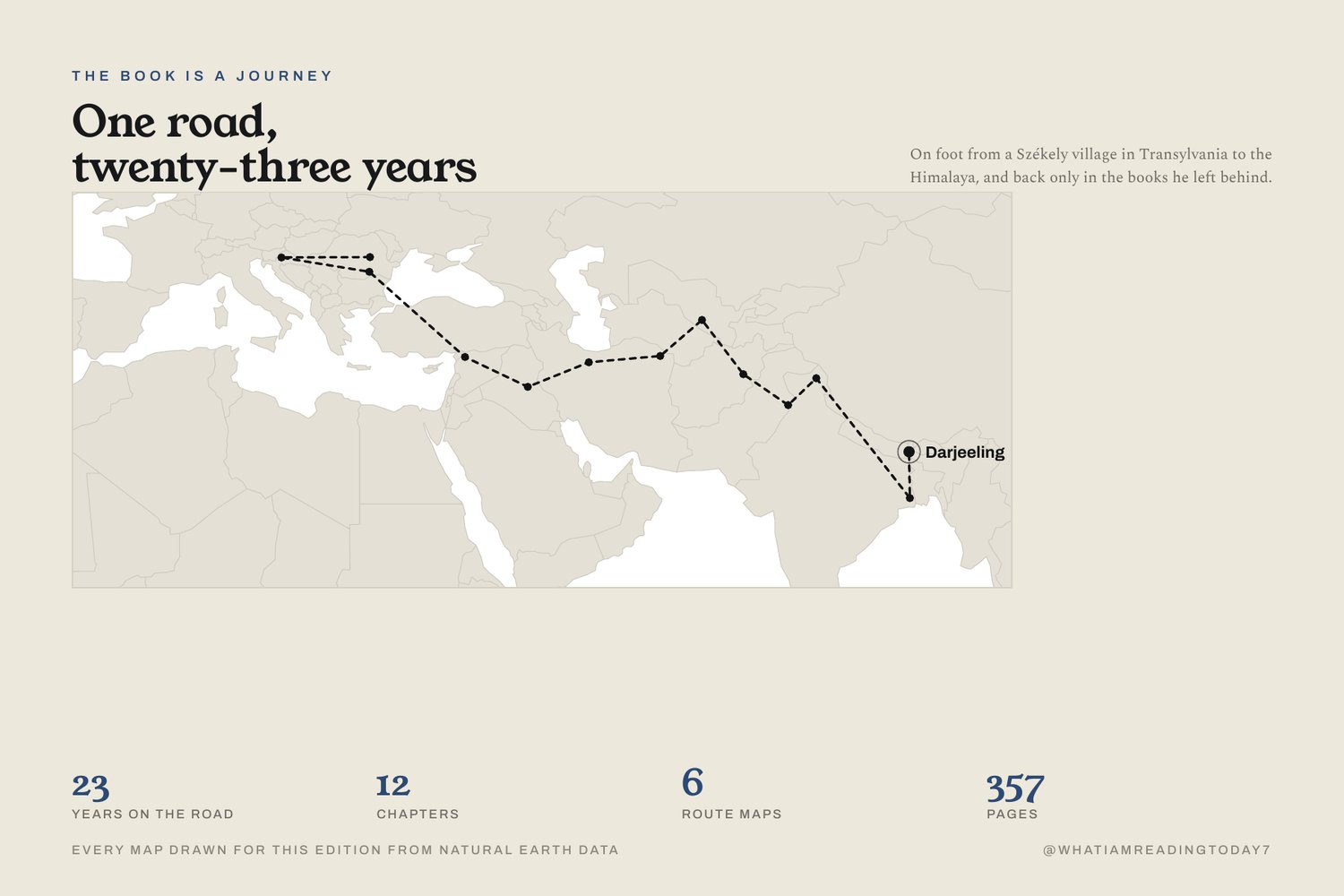
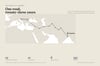
It took him twenty-three years and most of the way across it. He learned Slavonic in Croatia, Arabic in Göttingen, and walked through Bucharest, Constantinople and Alexandria, across Persia to Bukhara and Kabul. At Daka, in January 1822, he fell in with two French officers of Ranjit Singh's army and rode with them to Lahore. In Kashmir he met the explorer William Moorcroft, who lent him Giorgi's *Alphabetum Tibetanum* and wrote him letters of introduction to the lama of Zanskar.
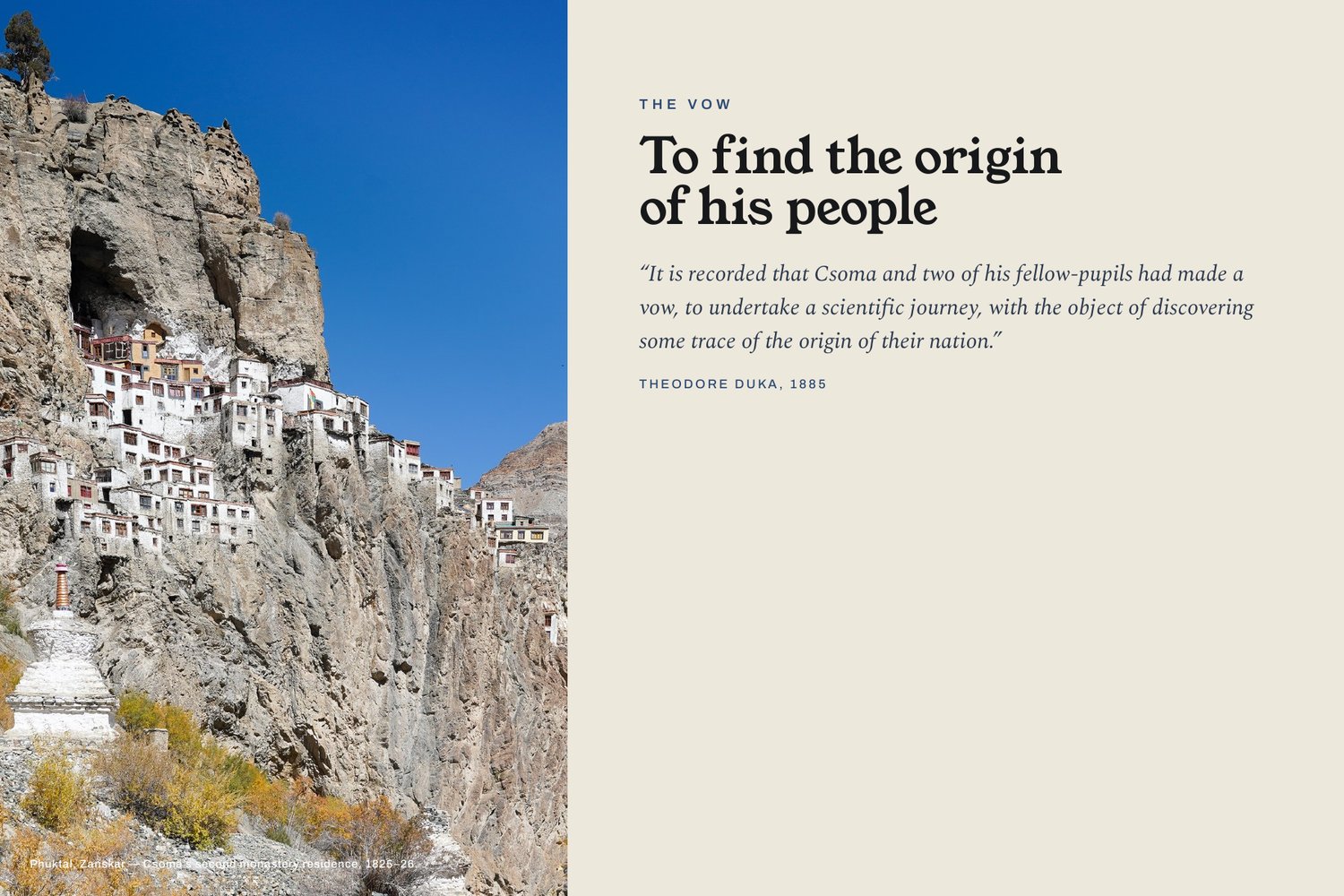
Then the vow turned into something else. He spent sixteen months in the monastery at Yangla, in Zanskar, the first European in the valley, and a second winter at Pukdal. Detained at Subathu as a suspected spy, he was cleared and sent on. From 1827 to 1830 he lived at Kanum, in Upper Bashahr, at nine and a half thousand feet, reading through forty-four volumes and collecting forty thousand words. The dictionary he wanted to compile turned out to be the first Tibetan–English dictionary ever made. It was published at Government expense in Calcutta in 1834, 588 pages, and it made him the founder of Tibetology.
He never reached Lhasa. In 1842, at fifty-eight, he left Calcutta for the last time and got as far as Darjeeling, where the fever took him on the morning of 11 April. The monument over his grave was voted by the Asiatic Society of Bengal; it is still there.
Theodore Duka, an army surgeon and fellow Hungarian, wrote this life in 1885 from Csoma's own letters and papers and from the reports of the men who knew him. It is the standard biography, and it has never been set for a reader.
This edition
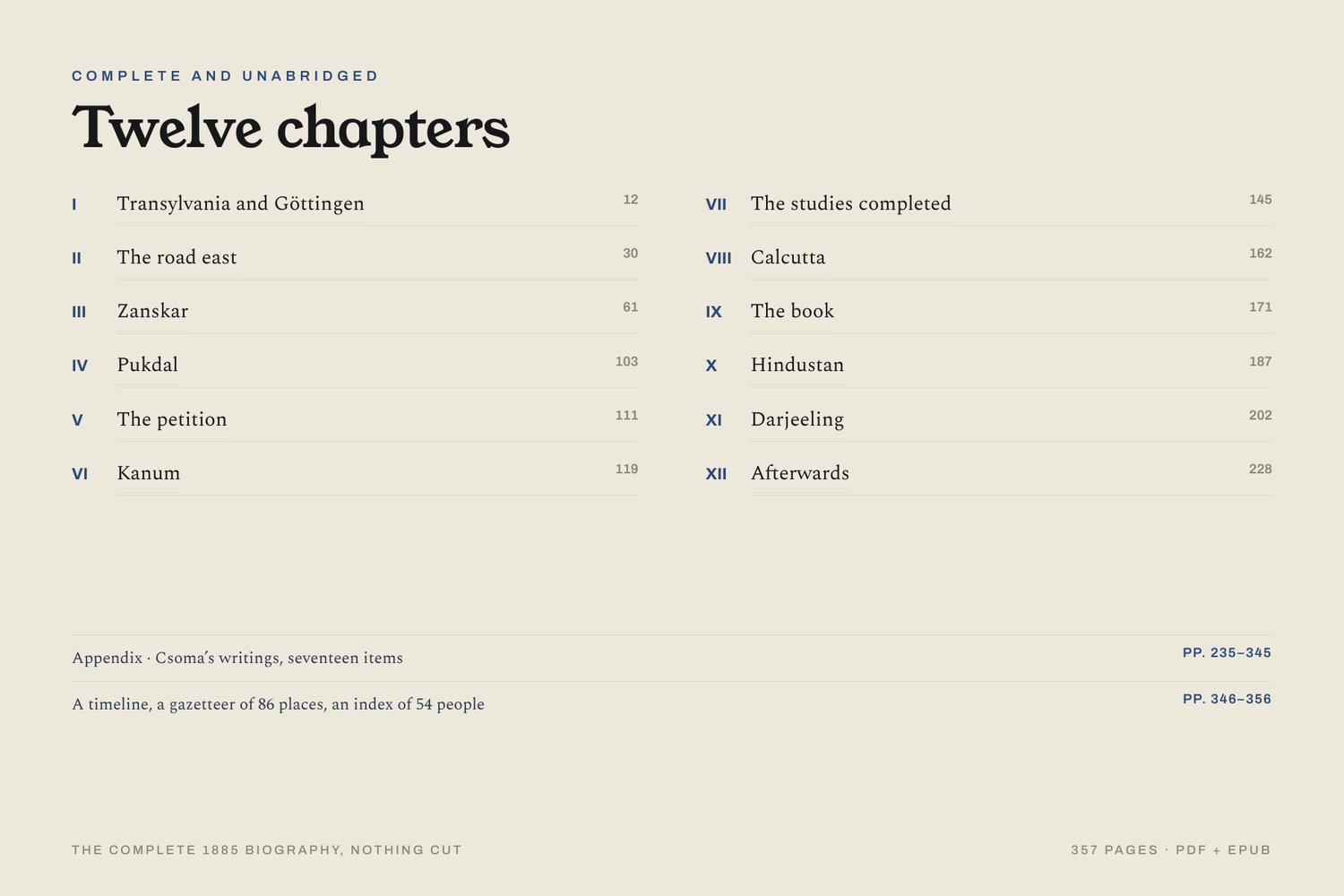
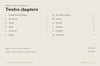
- the complete 1885 text of Theodore Duka's Life and Works of Alexander Csoma de Körös, all twelve chapters, unabridged;
- all seventeen of Csoma's own appendix items, including the index of 273 Sanskrit and Tibetan titles and the comparative vocabulary of Sanskrit, Hindi and Hungarian, restored as proper tables;
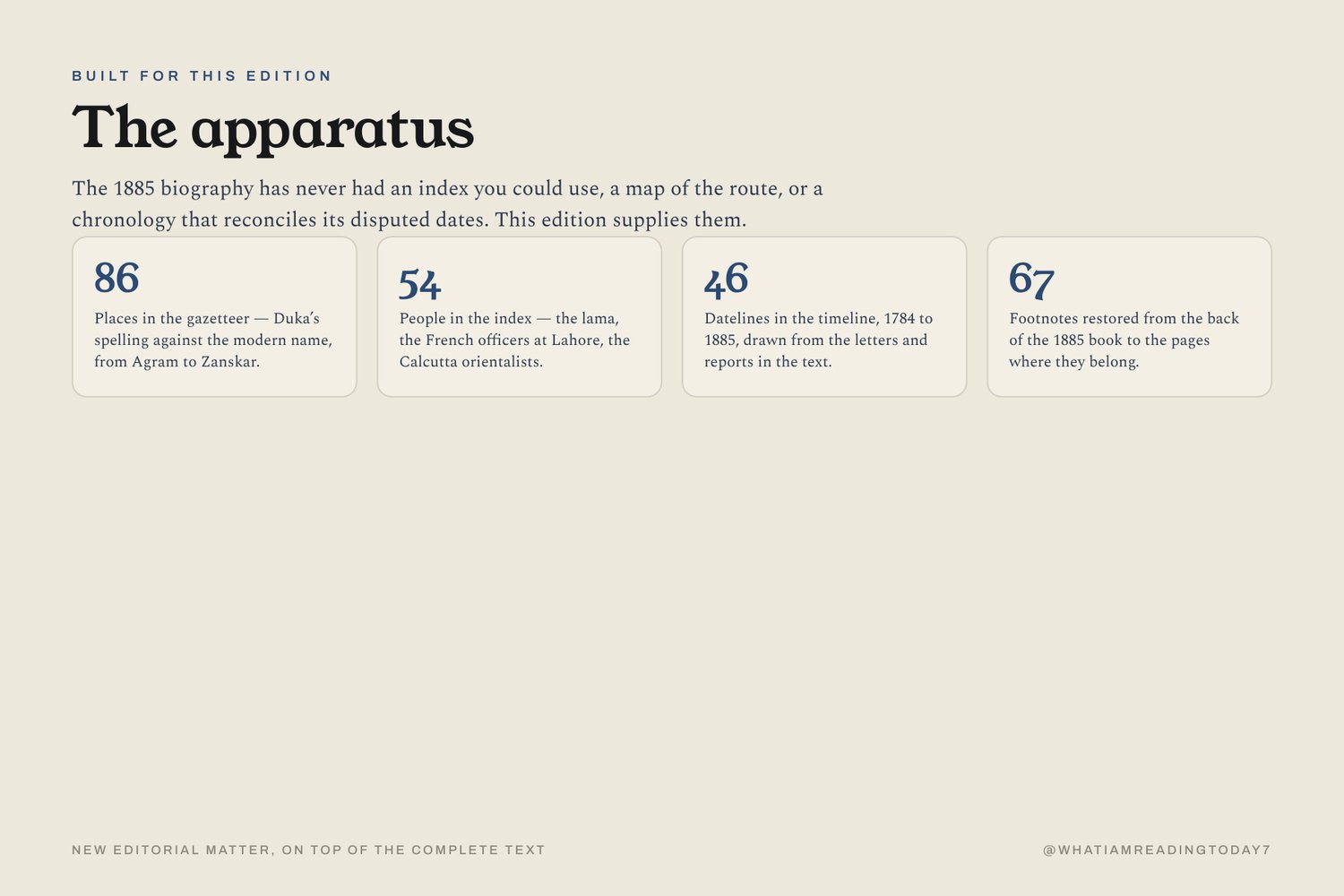
- Duka's 67 footnotes moved back from the back of the book to the foot of the page where each reference falls;
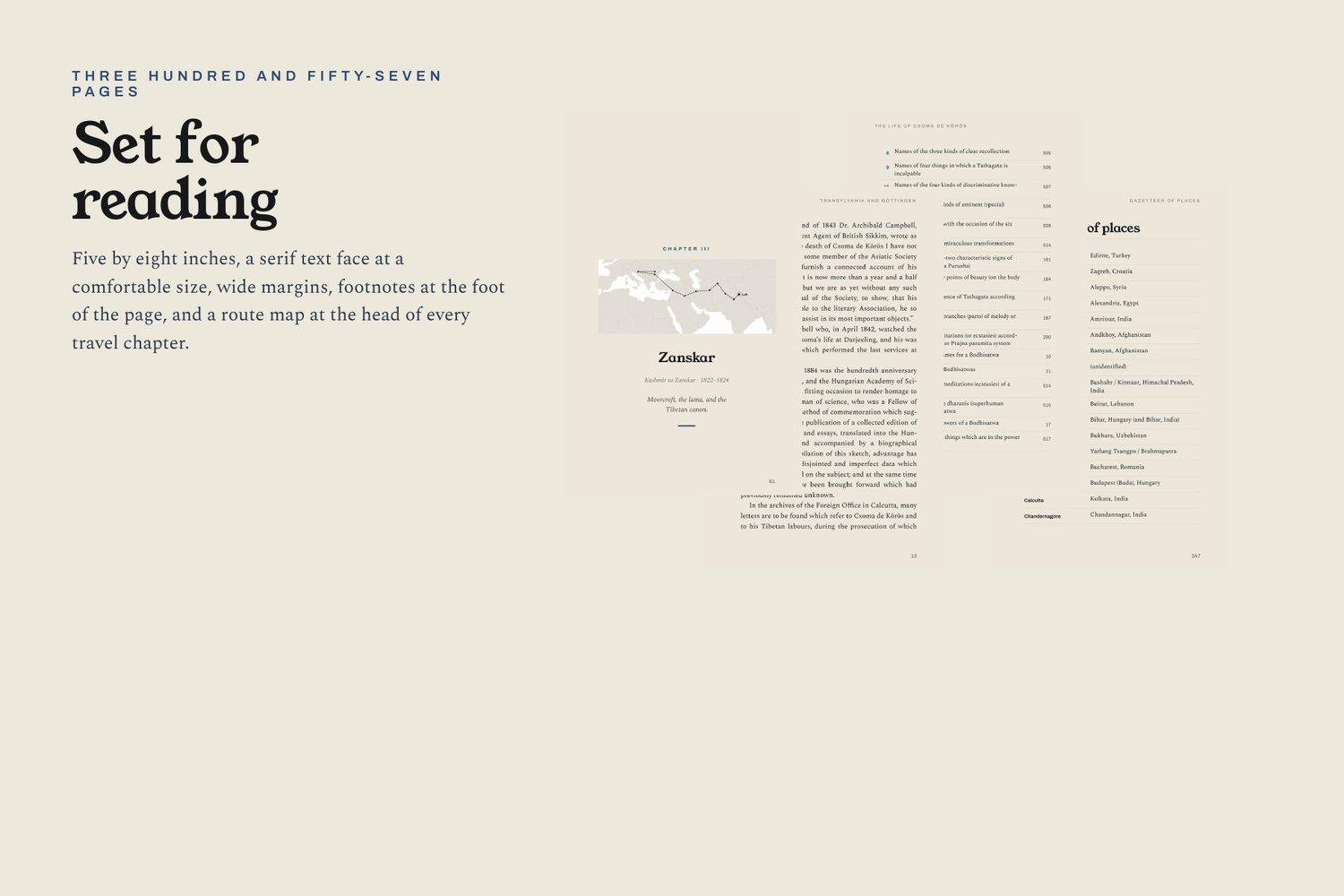
- a route map at the head of every travel chapter, drawn from the itinerary in the text and advancing station by station;
- a gazetteer of 86 places, Duka's spelling against the modern name;
- an index of 54 people, a chronology of 46 datelines, and the 1885 frontispiece portrait and Darjeeling monument as plates;
- the Greek epigraph, the Tibetan and Persian quotations and the Devanagari of the vocabularies set in faces that carry them.
On the text
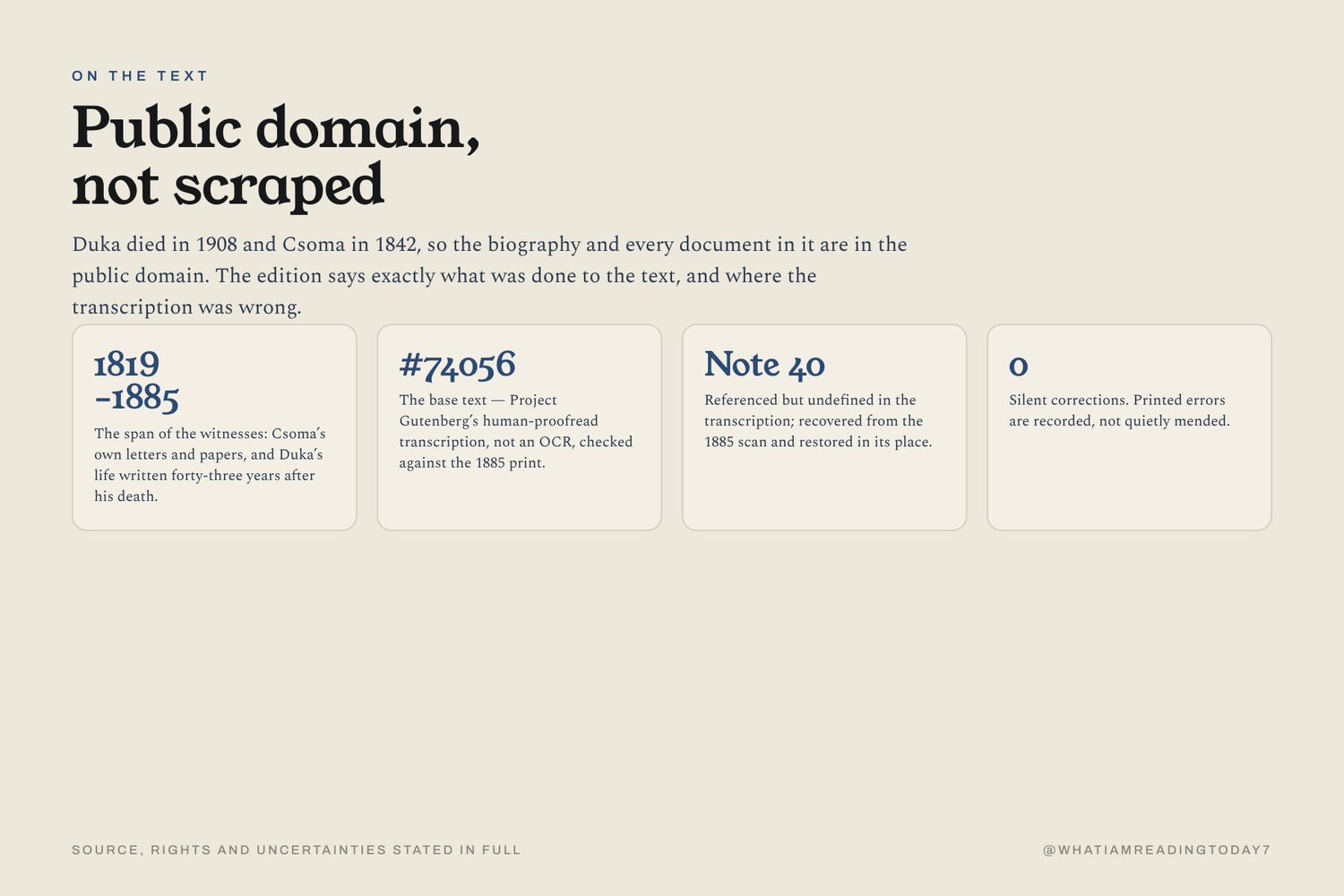
Set from Project Gutenberg's human-proofread transcription (eBook #74056) against the Internet Archive scan of the 1885 Trübner print as witness. The base is a transcription, not an OCR, so the correction load was light; what was corrected is recorded in the textual audit that accompanies the edition. Where the transcription is wrong it is mended and logged, and where Duka or his printer is unusual it is left as printed. Duka died in 1908 and Csoma in 1842, so the whole book is in the public domain.
You receive
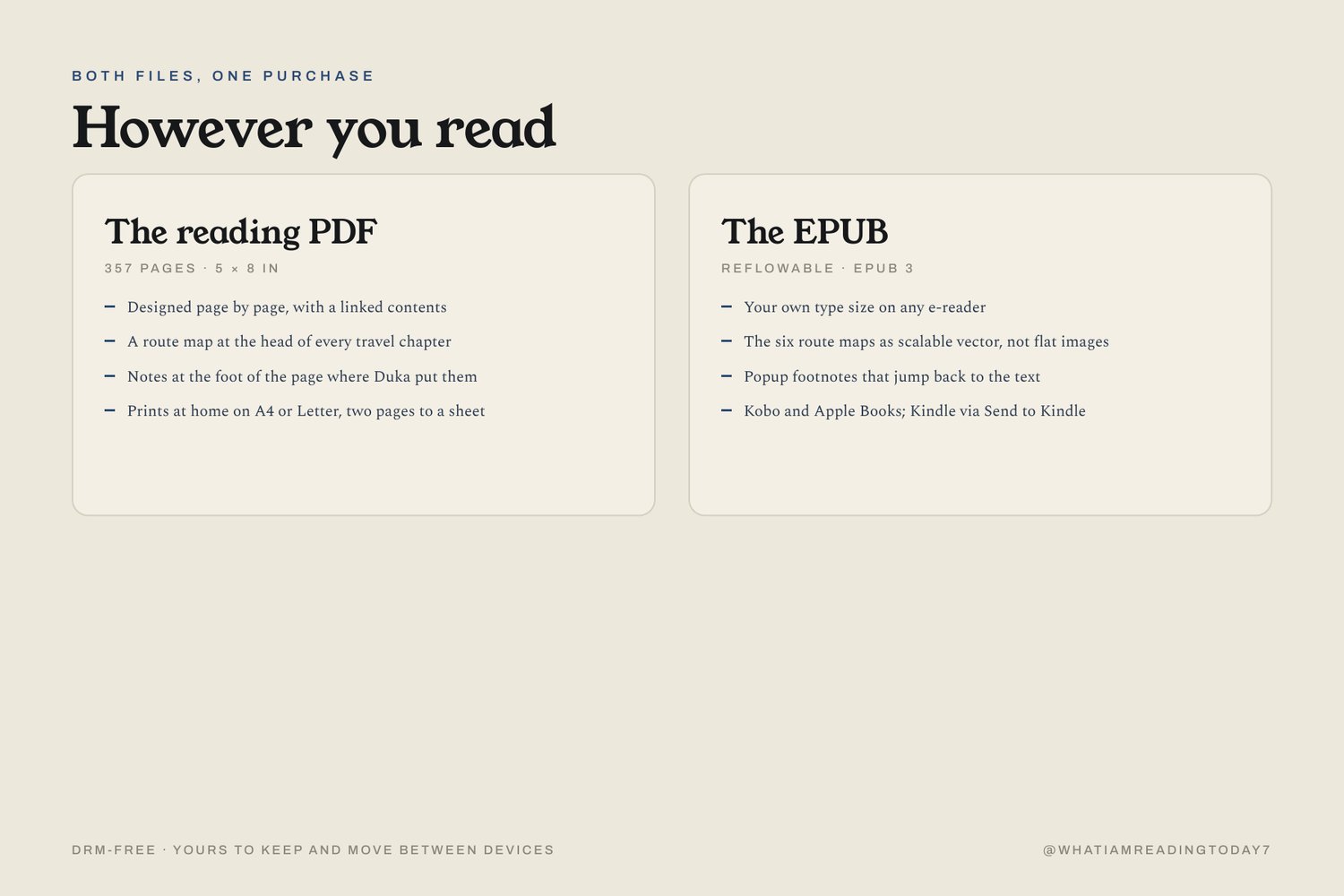
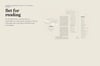
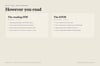
- a 357-page designed PDF at 5 × 8 inches, for screen reading or printing at home;
- a reflowable EPUB with popup footnotes, for Kobo, Apple Books and most e-readers; Kindle readers can use Amazon's Send to Kindle;
- DRM-free files that are yours to keep and move between devices.
Newly set and edited by Vishal T · @whatiamreadingtoday7