
💙 FREE — My Choice, My Photo
💙 FREE — My Choice, My Photo
Personalised Visual Communication Board
Autism • AAC • Choice-Making • Communication Access • Home & School
FREE PRINTABLE RESOURCE | Nonspeaking Autism 2026
Every child deserves opportunities to communicate their preferences, express choices and participate in decisions that affect them.
For some children, spoken questions can be difficult to process or answer. Others may communicate more comfortably through pictures, pointing, gestures, AAC or other forms of communication.
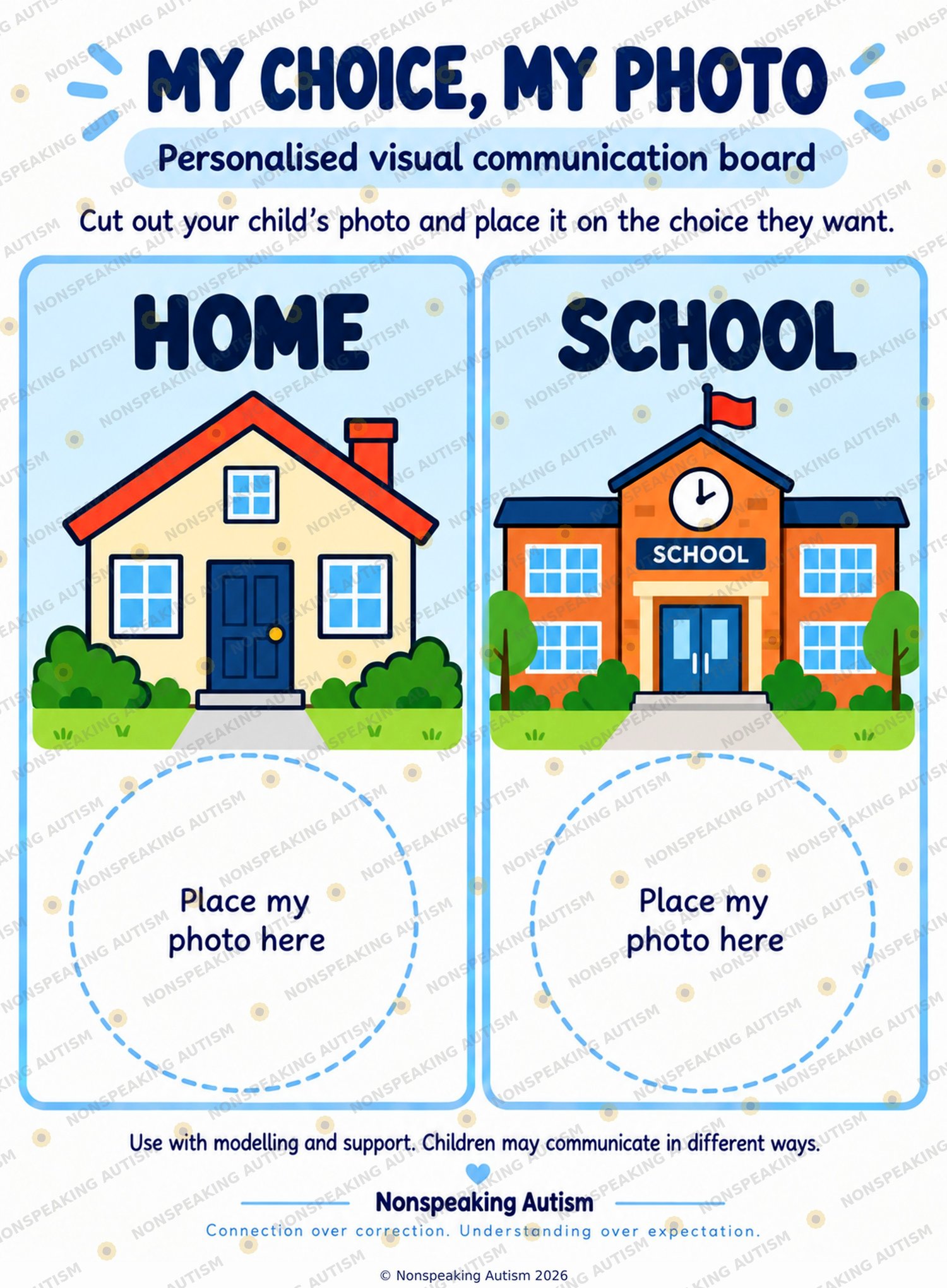
My Choice, My Photo is a free personalised visual communication board from Nonspeaking Autism, designed to make choosing between HOME and SCHOOL more visual, familiar and accessible.
The resource uses clear illustrations and dedicated spaces for a child's photograph, creating a simple, personalised way to explore and communicate preferences.
💛 The Key Message
Communication does not have to be spoken to be meaningful. Every child's choices deserve to be respected.
🧠 What Is a Visual Communication Board?
A visual communication board uses pictures, symbols, photographs or written words to support understanding and expression.
Visual supports may help some children:
- Understand available choices
- Recognise familiar places
- Express preferences
- Participate in conversations
- Communicate without relying entirely on speech
- Develop familiarity with visual communication
- Experience greater involvement in everyday decisions
A visual board can be used alongside spoken language, gestures, signing, AAC devices and other communication methods.
Visual communication is not a replacement for a child's existing communication system. It is another way to support access.
🏠🏫 What This Resource Includes
🏠 HOME
A colourful illustration of a house, clearly labelled HOME, with a dedicated space for the child's photograph.
This can help support communication about home as a familiar place or preferred destination.
🏫 SCHOOL
A colourful illustration of a school, clearly labelled SCHOOL, with a matching photograph space.
This provides a second visual option for conversations about school, routines, transitions and preferences.
📸 Personalised Photograph Spaces
Each choice includes a large dotted circle labelled:
“Place my photo here.”
A printed photograph can be placed on the chosen option to make the activity more personal and interactive.
The photograph can also be attached temporarily so that it can be moved between choices and reused.
✂️ How to Use My Choice, My Photo
1. Print the communication board.
Print the resource at a size that is comfortable and accessible for the child.
2. Prepare a photograph.
Use a printed photograph of the child, with their agreement where appropriate, or another familiar marker they prefer.
3. Introduce the choices.
Show the HOME and SCHOOL pictures and explain what each represents using simple, familiar language.
4. Model the activity.
Demonstrate how a photograph can be placed on one of the options without requiring the child to copy immediately.
5. Invite a choice.
Allow the child to point, look, gesture, use AAC, move the photograph or communicate in another accessible way.
6. Respect the response.
Acknowledge the child's choice, even when circumstances mean it cannot immediately be provided.
7. Revisit when useful.
The board can support ongoing discussions about preferences, feelings, routines and transitions.
💙 Important
The child does not need to place the photograph independently for their communication to count.
Adults can help position the photograph when requested or when this is the child's preferred access method.
💬 Supporting Different Communication Styles
This resource may be useful for children who communicate through:
- Speech
- AAC devices
- Picture-based communication
- Pointing
- Gestures
- Eye gaze
- Signing
- Assisted selection
- Other individual communication methods
Some children may need additional time, modelling, physical accessibility adjustments or support to understand the activity.
Do not force a response, demand eye contact or require speech before acknowledging a choice.
🌻 Supporting Choice, Autonomy & Self-Advocacy
Choice-making is about more than selecting a picture.
It involves recognising that the child has preferences, feelings and opinions that deserve consideration.
This resource may help adults explore questions such as:
- Where would you prefer to be?
- Are you thinking about home or school?
- Which place would you like to talk about?
- Is there something about school that feels difficult?
- Is there something about home that feels comforting?
The child's selection should be explored in context.
Choosing HOME does not automatically mean the child dislikes school.
Choosing SCHOOL does not automatically mean the child dislikes home.
A selection may reflect a preference, a wish to discuss a place, an immediate need or the child's understanding of the question.
Ask, listen and avoid assuming meaning.
🤝 Using the Board at Home or School
The board may support:
- Home-to-school conversations
- Discussions about familiar places
- Choice-making activities
- Communication practice
- Supported transitions
- Parent–teacher collaboration
- Exploring preferences
- Developing personalised visual supports
It can be used as a starting point for creating additional visual choices relevant to the individual child.
A choice board should offer meaningful communication opportunities, not be used to test obedience or force acceptance of an unwanted situation.
🔬 Research & Guidance-Informed
Visual supports and augmentative and alternative communication (AAC) are established approaches for supporting communication access for people with a range of communication needs.
Appropriate AAC and visual supports can complement speech and other communication methods.
The effectiveness of any individual board depends on the person's understanding, preferences, access needs, communication abilities and the way the support is introduced.
This particular worksheet has not been independently evaluated as a validated intervention.
📚 Useful Professional Guidance
American Speech-Language-Hearing Association (ASHA). Augmentative and Alternative Communication (AAC). Practice Portal.
National Institute for Health and Care Excellence (NICE). Autism spectrum disorder in under 19s: Support and management (CG170).
These sources support broader principles of accessible communication, individualised support and appropriate visual communication strategies.
Evidence Note
The references support the general use of communication supports. They do not establish that this specific two-choice worksheet will be appropriate or effective for every child.
👨👩👧 Who Is This Resource For?
Suitable for:
- Autistic children
- Nonspeaking and minimally speaking children
- Children with communication differences
- Children who benefit from visual supports
- Parents and carers
- Teachers and teaching assistants
- SENCOs and SEND teams
- Mainstream and specialist schools
- Speech and language therapists
- Occupational therapists
- Support workers
- Early-years professionals
The board can be adapted to suit individual communication needs and preferences.
📦 What You Receive
💛 FREE DIGITAL DOWNLOAD
1 × My Choice, My Photo — Personalised Visual Communication Board
Featuring:
- HOME visual choice
- SCHOOL visual choice
- Two dedicated photograph spaces
- Clear, colourful illustrations
- Simple written labels
- Nonspeaking Autism branding
This is a free printable resource.
You can print it for personal, home, classroom or individual professional educational use.
For repeated use, you may wish to laminate the board and attach a photograph using a removable fastening method.
Digital download only — no physical product will be shipped.
⚠️ Important Disclaimer
This resource is provided for educational and communication-support
It is not a diagnostic assessment, standardised AAC assessment, speech and language therapy programme or substitute for individualised professional advice.
A two-choice board does not provide a complete communication system.
Children should continue to have access to their established communication methods, including robust AAC where appropriate.
Adults should not assume that a child's selection always represents a fixed preference or that the child understands the options in the way the adult intended.
Where attendance or travel decisions are outside the child's immediate control, their communication should still be acknowledged and responded to respectfully.
©️ Copyright & Permitted Use
Copyright © 2026 Nonspeaking Autism. All rights reserved.
This resource is provided FREE through Payhip.
You may:
- Download for personal or family use
- Print for use at home
- Use in your own classroom or educational setting
- Use in your own clinic or individual professional practice
- Personalise the designated photograph spaces
- Laminate for repeated use
Please do not:
- Resell the resource
- Redistribute the original digital file
- Upload it to other websites or marketplaces
- Remove the copyright or branding
- Reproduce it as part of another commercial product
Please direct others to the original Nonspeaking Autism Payhip listing for their own free copy.
💛 The Message Behind the Resource
A child should not need to speak to have a preference.
They should not need to give a lengthy explanation before their choice is acknowledged.
And they should not need to communicate in one particular way to be included.
Sometimes communication begins with a photograph.
Sometimes it begins with a point, a gesture or a look.
What matters is that somebody is listening.
MY CHOICE. MY COMMUNICATION. MY VOICE.
Different ways to communicate. Equal right to be heard.
Connection over correction. Understanding over expectation. 🌻💙
© Nonspeaking Autism 2026