
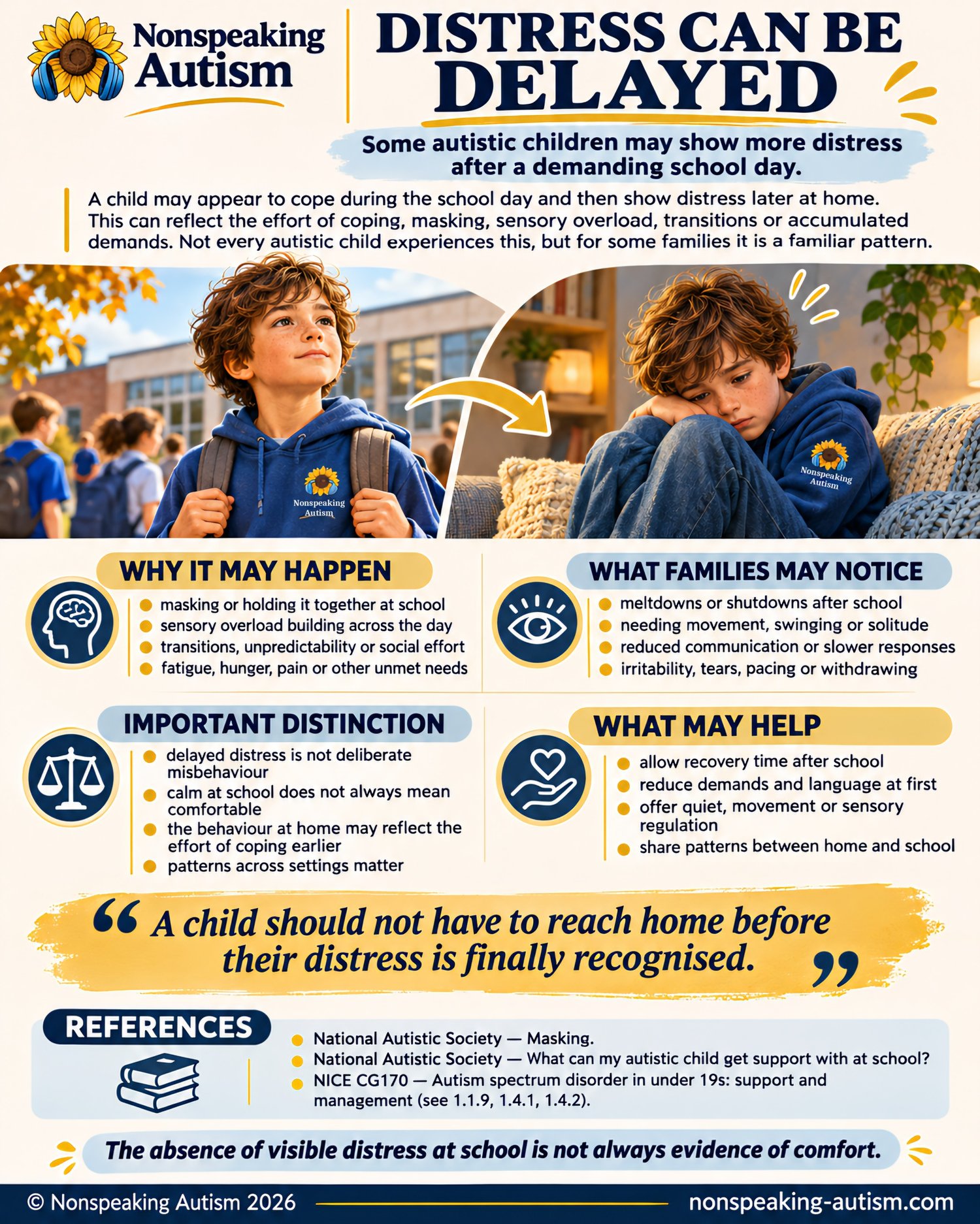
🌻 DISTRESS CAN BE DELAYED
🌻 DISTRESS CAN BE DELAYED
Understanding Why Some Autistic Children Show More Distress After School
💛 FREE EDUCATIONAL RESOURCE | UK EDITION | NO WATERMARK
A child can appear to cope throughout the school day and still arrive home overwhelmed, exhausted or distressed.
For some autistic children, the demands of school can require considerable effort. Managing sensory input, navigating transitions, processing instructions, communicating needs and meeting social expectations may all contribute to fatigue and accumulated stress.
Some children may also mask or suppress signs of distress during the school day, with their difficulties becoming more noticeable once they reach a familiar environment.
This can mean that a child appears calm or engaged at school but experiences a meltdown, shutdown, irritability, withdrawal or a greater need for movement and recovery at home.
This pattern is sometimes described as after-school restraint collapse, although this is a descriptive term rather than a formal clinical diagnosis.
Distress Can Be Delayed is a free, illustrated educational poster designed to help parents, carers, teachers and professionals recognise that visible distress does not always occur at the moment when demands are greatest.
The resource encourages understanding, early recognition, communication between home and school, and individualised support.
The central message:
The absence of visible distress at school is not always evidence of comfort.
🧠 WHAT THIS POSTER EXPLORES
🌿 1. Why Distress May Appear Later
The poster identifies several possible contributing factors.
Masking or holding it together at school
Some autistic children may consciously or unconsciously suppress certain responses, adapt their behaviour or work hard to meet expectations.
This effort may contribute to fatigue or stress.
Sensory overload building across the day
Classrooms, corridors, playgrounds, dining halls and school transport can involve changing levels of noise, lighting, movement and social activity.
For some children, repeated sensory demands may become increasingly difficult to manage.
Transitions, unpredictability and social effort
Moving between activities, understanding instructions, adjusting to changes and navigating interactions may require considerable effort.
Fatigue, hunger, pain or other unmet needs
Physical discomfort, tiredness, hunger, thirst or illness can also affect a child's capacity to manage demands.
These factors may interact. Not every child experiences delayed distress, and there is no single explanation that applies to every situation.
🏡 2. What Families May Notice After School
Some families may observe changes such as:
- Meltdowns or shutdowns.
- Increased need for movement or swinging.
- Seeking solitude or reduced interaction.
- Reduced communication or slower responses.
- Irritability, crying or pacing.
- Withdrawal or a greater need for familiar comforts.
These responses should not automatically be interpreted as deliberate misbehaviour.
They may indicate that a child needs recovery, additional communication support, a reduction in demands or investigation of another unmet need.
Equally, distress at home does not prove that masking or sensory overload occurred at school.
The child's individual patterns and circumstances matter.
💙 3. Calm at School Does Not Always Mean Comfortable
A child may follow instructions, complete activities and appear settled during the school day.
However, outward compliance or quietness does not necessarily establish that the child feels comfortable.
Some children may find it difficult to communicate discomfort in a busy environment.
Others may show subtle signs of increasing strain that are easily overlooked.
This is why it is important for adults to notice changes in:
- Communication and interaction.
- Facial expression and body language.
- Movement and energy.
- Participation.
- Sensory preferences.
- Recovery needs.
Support should not depend entirely on a child reaching a visible crisis.
🌻 4. Why Home May Look Different
Home and school involve different expectations, environments and relationships.
A child may feel more comfortable expressing distress at home, or the effects of accumulated demands may become more noticeable after school.
However, it should not be assumed that every child feels safer at home or that every episode of distress is caused by school.
Possible influences include the journey home, hunger, fatigue, pain, changes in routine and demands occurring after arrival.
Understanding these differences requires listening to the child and considering observations across settings.
❤️ WHAT MAY HELP?
1. Allow Recovery Time After School
Some children may benefit from a predictable period with fewer demands.
This could involve quiet time, preferred activities, movement, rest or access to familiar comforts.
2. Reduce Demands and Language Initially
Avoid immediately asking numerous questions or expecting the child to begin another demanding activity.
Allow additional processing time where needed.
3. Offer Individual Sensory Supports
Depending on the child's preferences, this may include:
- A quieter environment.
- Ear defenders.
- Preferred movement or swinging.
- Familiar sensory items.
- Comfortable clothing.
- Reduced lighting.
- Time alone or with a trusted adult.
Sensory supports should be optional, safe and individualised.
4. Keep Communication Accessible
Maintain access to AAC, pictures, gestures and other preferred communication methods.
A child may need more time or different support to communicate when tired or distressed.
5. Consider Physical Needs
Check whether the child may be hungry, thirsty, tired, unwell or experiencing pain.
Do not assume that every episode of after-school distress has a sensory or emotional explanation.
6. Share Patterns Between Home and School
Families and school staff can work together to explore:
- When difficulties are most noticeable.
- Which activities or transitions are demanding.
- Whether subtle signs of distress appear at school.
- What helps the child recover.
- Whether reasonable adjustments could reduce demands earlier in the day.
The aim is to improve the child's experience, not simply to reduce distress that adults can see.
🏫 SUPPORTING CHILDREN IN SCHOOL
Schools can help by considering whether the child's current environment and expectations are accessible.
Possible adjustments include:
- Predictable routines.
- Clear communication.
- Access to AAC throughout the day.
- Sensory accommodations.
- Flexible transitions.
- Opportunities for movement or rest.
- Reduced unnecessary demands.
- A trusted adult or agreed support arrangement.
- Regular communication with parents and carers.
Reasonable adjustments should be guided by the child's individual needs and reviewed collaboratively.
A child should not have to become visibly distressed before their support needs are taken seriously.
💬 WHY THIS MATTERS FOR NONSPEAKING CHILDREN
Nonspeaking and minimally speaking children may communicate their experiences through AAC, gestures, movement, facial expressions and other individual methods.
Some may find it difficult to explain how demanding the school day has been.
Others may understand what is happening but struggle to access their usual communication methods during distress or exhaustion.
Adults should avoid assuming that quietness means comfort or that reduced communication means the child has nothing to say.
Communication access, observation and respectful support remain essential.
Every child deserves to be listened to, including when their communication does not involve speech.
🔬 RESEARCH & GUIDANCE-INFORMED
This poster draws on autism guidance concerning masking, sensory differences, communication needs, environmental demands and individualised support.
Research on autistic camouflaging suggests that some autistic people experience emotional or psychological costs associated with adapting or concealing aspects of their autistic presentation.
However, the research does not establish that all after-school distress is caused by masking.
NICE guidance recommends considering sensory sensitivities, physical health, communication needs, environmental factors and changes in routine when understanding distress and behaviour that challenges.
The National Autistic Society also provides information about masking and educational support.
📚 SELECTED RESEARCH AND GUIDANCE
1. National Autistic Society.
Masking.
Information about autistic masking and its possible impact.
2. National Autistic Society.
What can my autistic child get support with at school?
Information about educational support and individual needs.
3. National Institute for Health and Care Excellence (NICE). (2013; updated 2021).
Autism spectrum disorder in under 19s: support and management.
Clinical guideline CG170.
https://www.nice.org.uk/guidance/cg170
4. Hull, L., et al. (2017).
“Putting on My Best Normal”: Social Camouflaging in Adults with Autism Spectrum Conditions.
Journal of Autism and Developmental Disorders, 47, 2519–2534.
https://doi.org/10.1007/s10803-017-3166-5
Further Resources
- National Autistic Society – Masking: https://www.autism.org.uk/advice-and-guidance/behaviour/masking
- National Autistic Society – Autistic people and masking: https://www.autism.org.uk/learn/knowledge-hub/professional-practice/autistic-masking
- National Autistic Society – What can my autistic child get support with at school?: https://www.autism.org.uk/advice-and-guidance/education/extra-help-at-school/what-can-my-autistic-child-get-support-with-at-school
- NICE CG170 – Autism spectrum disorder in under 19s: support and management: https://www.nice.org.uk/guidance/cg170
Sources:
- NAS – Masking
- NAS – Autistic people and masking
- NAS – What can my autistic child get support with at school?
- NICE QS51, Quality statement 7
📖 IMPORTANT RESEARCH LIMITATION
Delayed distress is a descriptive pattern, not a diagnosis or a single established neurological mechanism.
The evidence does not demonstrate that all autistic children mask at school or experience distress later at home.
Individual circumstances, physical health, communication, environment and other factors should be considered.
The illustrations are educational examples and should not be used to identify the cause of distress in an individual child.
👨👩👧 WHO IS THIS FREE RESOURCE FOR?
This poster may be helpful for:
- Parents and carers of autistic children.
- Families of nonspeaking and minimally speaking children.
- Teachers and teaching assistants.
- SENCOs and SEND teams.
- Mainstream and specialist schools.
- Speech and language therapists.
- Occupational therapists.
- Educational psychologists.
- School pastoral and inclusion teams.
- Autism support workers.
- Parent and carer support groups.
- Professionals involved in EHCP planning and reviews in England.
- Staff training and professional development.
🏡 HOW TO USE THIS RESOURCE
At home: To support conversations about after-school recovery and individual needs.
At school: To encourage staff to recognise that visible behaviour may not fully reflect a child's experience.
During SEND meetings: To explore possible adjustments and share observations across environments.
In professional training: To discuss masking, sensory demands, accumulated stress and communication access.
In parent and carer groups: To help families understand that different patterns of behaviour across settings deserve thoughtful consideration rather than blame.
📦 WHAT YOU RECEIVE — FREE DOWNLOAD 💛
1 × Distress Can Be Delayed — UK Educational Poster
The resource includes:
- An illustrated school-to-home example.
- Possible reasons distress may become noticeable later.
- Signs families may observe after school.
- Important distinctions about visible behaviour.
- Practical recovery and support strategies.
- Guidance for home–school collaboration.
- Selected research and UK guidance references.
- Original Nonspeaking Autism artwork and branding.
💛 YOUR FREE RESOURCE
✅ 100% FREE — £0.00
✅ NO WATERMARK
✅ UK English spelling and terminology.
✅ Suitable for home, school and educational settings.
✅ Printable digital resource.
Format: Digital PNG poster.
Print note: A2 print readiness and resolution should be confirmed separately before advertising the resource as a high-resolution A2 printable.
Digital download only — no physical product will be shipped.
⚠️ IMPORTANT EDUCATIONAL DISCLAIMER
This resource is for educational and informational purposes only.
It is not a diagnostic tool, clinical assessment, behavioural assessment or substitute for professional medical, psychological or educational advice.
Distress after school may have many possible contributing factors, including physical health concerns.
New, persistent, severe or unexplained changes in behaviour should prompt consideration of appropriate professional or medical assessment.
The strategies described are general suggestions and should be adapted to the child's individual needs, preferences, communication and safety.
©️ COPYRIGHT & PERMITTED USE
Copyright © 2026 Nonspeaking Autism. All rights reserved.
This educational poster is provided free of charge.
You may download, print and display it for personal, family, educational, clinical, workplace, community and training purposes.
Redistribution, resale, public uploading, sharing the digital file with third parties, editing or rebranding the artwork, or including it in commercial products is not permitted without prior written permission.
Please direct others to the original Payhip listing to obtain their own free copy.
💛 THE MESSAGE BEHIND THIS RESOURCE
A child may appear calm at school.
They may complete their work.
They may follow instructions.
They may not visibly show how much effort the day has required.
Then, at home, their need for recovery may become more apparent.
This does not automatically mean that anyone has done something wrong.
It means we need to remain curious about the child's experiences, recognise individual patterns and work together to reduce unnecessary demands.
A child should not have to reach home before their distress is finally recognised.
🌻 Connection over correction. Understanding over expectation.
Nonspeaking Autism © 2026