

TRADE BASED FINANCIAL CRIME - beyond TBML (VOL 1)
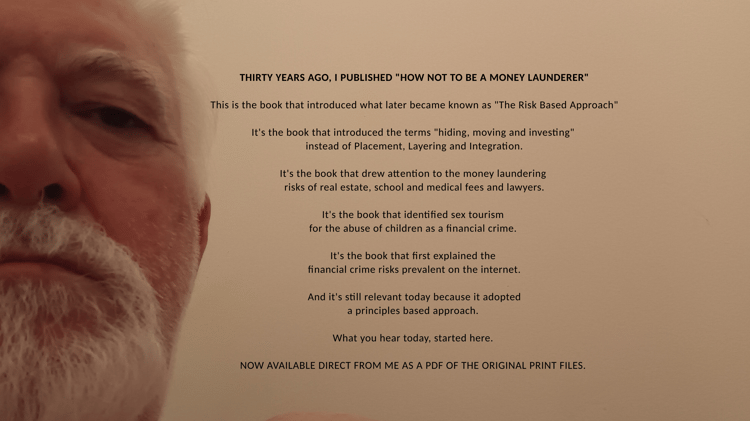
When Nigel Morris-Cotterill wrote How not to be a money launderer in 1996, (https://payhip.com/b/BrUki) he wrote about the use of commerce as a vehicle for money laundering, fraud and terrorist financing.
Later, someone else invented the term "Trade-Based Money Laundering" and limited how people look at the wider aspects of financial crime within commerce and industry.
It also suited those who view the world as current and does not consider today as a product of, or in the context of the history of financial crime. That history is important because it reveals principles that, when applied to the present, give reliable indicators of the future.
Risk doesn't happen in isolation: it happens as a consequence of many factors, some of which are the same as thousands of years ago.
Morris-Cotterill considers the present in the light of the past.
Do you know when the first free trade zone was created, why and what effect it had and how today's free trade zones are far from the lawless places their detractors say?
Do you know four basic types of conduct at the core of financial crime offences in commerce and industry, trade and professions?
Do you know that a wide range of environmental crimes are financial crimes?
These and many other questions are asked and answered in Trade Based Financial Crime Volume 1.
FULL CONTENTS:
Contents
CAVEAT 1
COPYRIGHT 1
REPRODUCTION 1
Chapter One. What is financial crime in trade, commerce and industry? 7
1.1. Defining trade, commerce, industry and professions. 7
1.2 The four basic types of conduct at the core of financial crime offences in commerce and industry, trade and professions. 8
1.3 The argument against micro-classification of offences. 9
1.4. The Umbrella Principle. 12
1.5 In the beginning (or perhaps before it) 14
1.6 When the past and the present meet but don’t collide. 16
Chapter Two. Borders 19
2.1 The origins of the term ″trade-based money laundering″ and why we should not use it. 19
2.2 Plastic toilet seats: the surprising game-changer. 20
2.3 Fluid definitions and legal (un)certainty. 22
2.4 Uncertain borders 28
2.5 Invisible borders, visible enforcement. 32
2.6 Can we define ″the border″? 34
2.7 Further Reading 35
Chapter Three: Free Trade Zones. 36
3.1 Five points to remember 36
3.2 Old wine in new bottles. 38
3.3 Are tax havens and duty free zones the same thing? 47
3.4 Relevant concepts you are familiar with – in your personal life. 48
3.5 Crossing the fiscal barrier. 51
3.6 ″The Free Trade Zone fad″. 53
3.7 Who uses free trade zones? 55
3.8 Goods in a free port behave just like money in a bank. 56
3.9 Long division and the value of cigarettes 57
3.10. What law applies in Free Trade Zones? 60
3.11 Sample law setting up a free trade zone. 63
3.12 "You said it was what?" 68
3.13 Permits and Permissions 70
3.14 Free trade zones and the evasion of sanctions and embargoes. 75
3.15 By any other name…. 76
Chapter 4. The application of domestic law to global operations. 81
4.1 Reducing the need for extra-territorial application of laws. 81
4.2 Classifying "dirty money." 83
4.3 Money Laundering 85
4.4 Free trade zones and sanctions evasion. 90
Chapter 5. Free Trade Zones: additional topics. 92
5.1 Quantifying financial crime through free trade zones. 92
5.2 Attempts to combat risk of financial crime in free trade zones. 96
5.3 CASE STUDY: the free-port fallacy. 109
5.4 Further Reading 112
CHAPTER 6 Smuggling, etc. 115
6. Smuggling 115
Chapter 7. Commercially motivated environmental crime 140
7.1 Overview. 140
Available in paperback and hardback through Amazon group websites. See www.vortexcentrum.com.
For information about Nigel Morris-Cotterill see www.countermoneylaundering.com
For information about online training from a critical thinking, risk-forward, perspective see www.financialcrimetraining.com.