Inventory Planner Pack
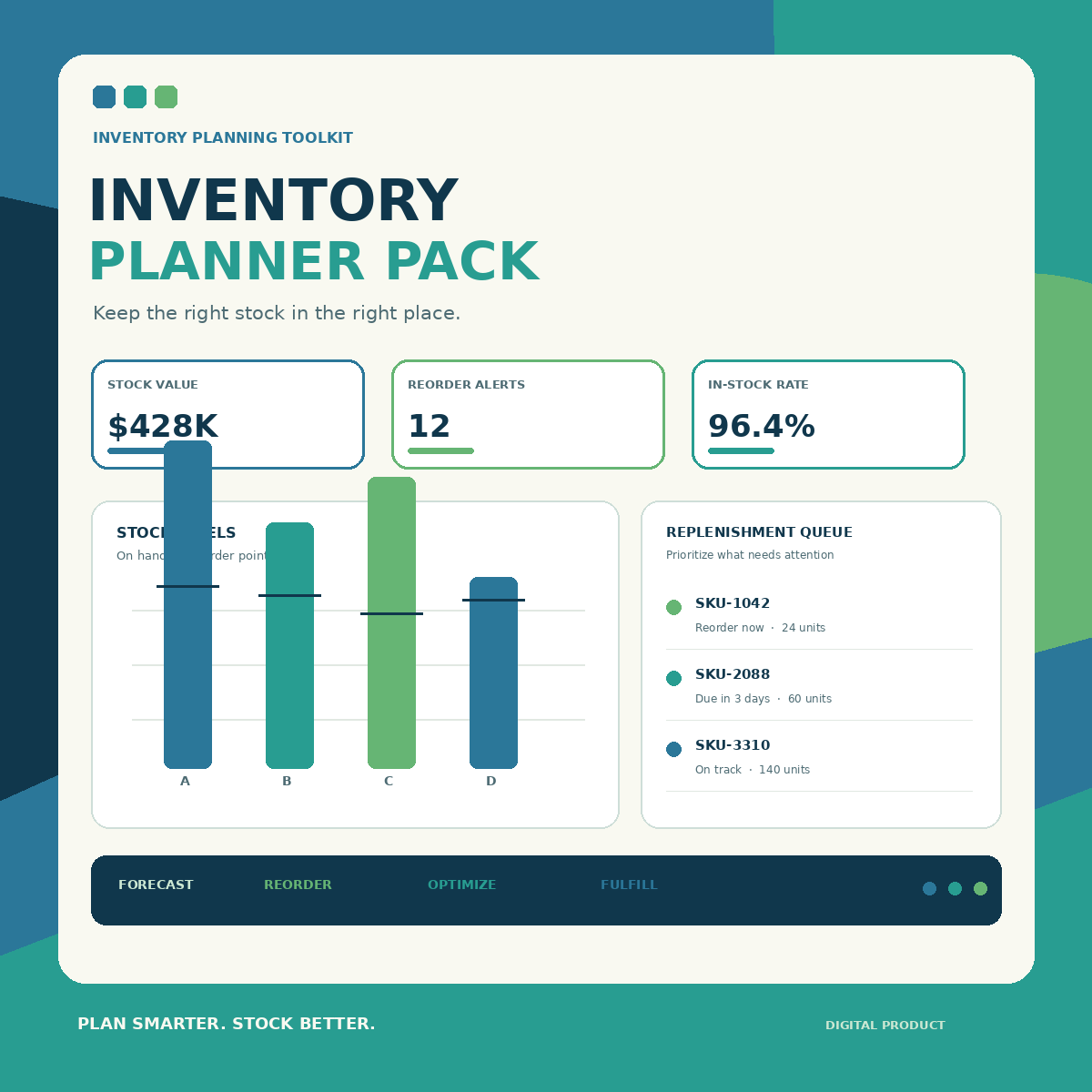
INVENTORY PLANNER PACK
Set Inventory Buffers with Numbers — Not Guesswork.
Too much inventory ties up valuable working capital. Too little inventory exposes your business to stockouts, lost sales and service failures.
And when demand fluctuates, supplier lead times vary and replenishment becomes unpredictable, deciding how much safety stock to maintain can be challenging.
The Inventory Planner Pack is a practical inventory decision-support toolkit featuring 12 interactive calculators and a playbook designed to help you analyze safety stock, service levels, supplier reliability, inventory costs and reorder points.
Whether you are determining the right safety-stock level, evaluating supplier lead-time variability, reviewing working-capital requirements or exploring inventory reduction opportunities, this toolkit helps you put numbers behind your inventory decisions.
No complicated spreadsheets. No recurring subscriptions. Just practical tools to support better inventory planning.
WHAT YOU'LL BE ABLE TO DO
With the Inventory Planner Pack, you can:
- Calculate Safety Stock: Determine buffer requirements using demand variability and target service levels.
- Analyze Lead-Time Variability: Understand how inconsistent supplier delivery times influence inventory buffers.
- Evaluate Forecast Accuracy: Translate forecast errors into safety-stock requirements using statistical approaches.
- Understand Inventory Carrying Costs: Estimate how much working capital is tied up in inventory and what it costs to maintain.
- Identify Inventory Reduction Savings: Compare existing and proposed safety-stock levels and estimate potential savings and payback.
- Evaluate Stockout Risk: Explore stockout probabilities using normal and Poisson-based approaches.
- Measure Supplier Reliability: Examine how supplier OTIF (On Time In Full) performance affects inventory planning and potential costs.
- Balance MOQ and Safety Stock: Understand the relationship between minimum order quantities, economic order quantities and safety-stock requirements.
- Plan for Seasonal Demand: Adjust inventory buffers using monthly seasonal demand indices.
- Evaluate Existing Buffers: Estimate the service level implied by your current safety-stock policy.
- Analyze Multiple Suppliers: Explore blended lead-time variability when sourcing from multiple suppliers.
- Optimize Reorder Points: Examine cost-based service-level decisions and the relationship between reorder points, safety stock and inventory costs.
WHAT'S INCLUDED?
Your Inventory Planner Pack includes 12 interactive HTML calculators and a practical playbook.
1. Safety Stock by Service Level Calculator
Calculate safety-stock requirements using statistical z-values and demand variability.
Explore how different target service levels influence the amount of buffer inventory required.
Includes a clickable z-table for convenient reference.
2. Lead-Time Variability Safety Stock Calculator
Analyze how variations in supplier lead times affect your safety-stock requirements.
Explore the relationship between demand, replenishment time and delivery uncertainty.
3. Forecast Error Safety Stock Calculator
Translate forecast errors into inventory buffer requirements.
Work through MAD-to-standard-deviation calculations and use the WMAPE gate to evaluate forecast quality assumptions.
4. Working Capital Cost Calculator
Estimate the amount of cash tied up in inventory and calculate the associated inventory carrying costs.
Understand the financial implications of holding excess stock.
5. Safety Stock Reduction Savings Calculator
Evaluate the potential financial benefits of reducing existing safety-stock levels.
Compare before-and-after scenarios, estimate potential savings and explore the payback period.
6. Stockout Risk Calculator
Explore potential stockout risks using normal and Poisson-based risk models.
Understand how different inventory buffer assumptions can influence stockout exposure.
7. Supplier Reliability Calculator
Evaluate supplier delivery performance and examine the financial implications of OTIF shortfalls.
Put a cost perspective on supplier reliability and its influence on inventory planning.
8. MOQ vs. Safety Stock Calculator
Analyze the relationship between minimum order quantities, safety stock and economic order quantity considerations.
Explore purchasing scenarios without unnecessarily double-counting inventory buffers.
9. Seasonal Safety Stock Calculator
Evaluate inventory requirements under seasonal demand conditions.
Use monthly seasonal indices to explore how changing demand patterns influence inventory buffers.
10. Safety Stock to Service Level Calculator
Work backwards from your existing safety-stock levels to estimate the service level they imply.
A useful tool for reviewing whether current inventory policies align with service expectations.
11. Multi-Supplier Safety Stock Calculator
Analyze blended lead-time calculations when inventory is sourced from multiple suppliers.
Explore how supplier combinations and lead-time assumptions influence overall buffer requirements.
12. ROP & Safety Stock Optimizer
Explore reorder point and safety-stock decisions through a cost-based service-level approach.
Evaluate the relationship between inventory holding costs, stockout considerations, reorder points and service-level assumptions.
A COMPLETE INVENTORY PLANNING WORKFLOW
The real value of this toolkit is how the calculators work together.
Instead of treating safety stock, supplier reliability and working capital as isolated activities, you can approach inventory planning through five connected decision stages.
STAGE 1 – UNDERSTAND DEMAND
Build a clearer picture of demand uncertainty.
- Analyze forecast errors.
- Evaluate demand variability.
- Examine seasonal patterns.
- Understand service-level assumptions.
STAGE 2 – CALCULATE INVENTORY BUFFERS
Determine how much additional inventory may be required.
- Calculate safety stock.
- Analyze lead-time variability.
- Evaluate multiple supplier scenarios.
- Explore service-level implications.
STAGE 3 – EVALUATE SUPPLIERS
Understand how supplier performance affects inventory requirements.
- Evaluate OTIF performance.
- Examine supplier lead-time reliability.
- Explore blended supplier lead times.
- Assess the potential cost of delivery shortfalls.
STAGE 4 – CONTROL INVENTORY COSTS
Understand the financial consequences of inventory decisions.
- Estimate working-capital requirements.
- Calculate inventory carrying costs.
- Evaluate MOQ and EOQ considerations.
- Estimate potential savings from inventory reduction.
STAGE 5 – OPTIMIZE REPLENISHMENT
Connect inventory buffers with purchasing and replenishment decisions.
- Calculate reorder points.
- Evaluate existing safety-stock policies.
- Explore cost-based service-level decisions.
- Compare alternative inventory scenarios.
WHO IS THIS TOOLKIT FOR?
The Inventory Planner Pack is designed for:
- Inventory planners and inventory controllers.
- Supply chain managers and analysts.
- Procurement and purchasing professionals.
- Warehouse and distribution managers.
- Demand planning professionals.
- Materials planning executives.
- Operations managers.
- Retail and wholesale inventory managers.
- Manufacturing planning professionals.
- Students and aspiring supply chain professionals.
Whether you manage inventory across multiple suppliers or are responsible for maintaining service levels while controlling stockholding costs, this toolkit provides practical support for your planning decisions.
HOW IT WORKS
Getting started is simple.
STEP 1 – PURCHASE AND DOWNLOAD
Purchase the Inventory Planner Pack and receive instant access to the 12 calculator files and playbook.
STEP 2 – OPEN IN YOUR BROWSER
Open the downloaded HTML calculators using a modern web browser.
No specialized software installation is required.
STEP 3 – ENTER YOUR INVENTORY DATA
Enter your demand assumptions, forecast errors, lead times, supplier performance, inventory costs, service-level targets and other relevant inputs.
STEP 4 – EXPLORE DIFFERENT SCENARIOS
Review safety-stock requirements, stockout risk, working-capital costs, reorder points and potential inventory savings.
STEP 5 – MAKE BETTER-INFORMED DECISIONS
Use the results to support inventory reviews, replenishment planning, supplier discussions and working-capital improvement initiatives.
WHY CHOOSE THE INVENTORY PLANNER PACK?
12 Dedicated Inventory Calculators
A collection of tools covering safety stock, service levels, demand variability, supplier reliability, working capital and replenishment optimization.
Includes a Practical Playbook
Get an additional reference resource to support your inventory planning activities.
100% Offline Access
Download the HTML calculators and use them without an ongoing internet connection.
Browser-Based Convenience
Open the calculators directly in a modern browser without installing specialized applications.
No Subscription
Pay once and access your purchased digital files.
Practical Decision Support
Use your own business data and assumptions to evaluate different inventory scenarios.
THE REAL VALUE: BALANCING INVENTORY, SERVICE AND CASH FLOW
Inventory planning is ultimately about managing competing business objectives.
You want enough stock to meet customer demand, but not so much that unnecessary capital remains locked in warehouses.
You need reliable suppliers, but also need to understand the inventory consequences when delivery performance varies.
You want to reduce excess stock, but not at the expense of customer service.
The Inventory Planner Pack helps you examine these trade-offs through practical calculations.
You can develop a clearer understanding of:
- How much safety stock your assumptions may require.
- How demand and lead-time variability influence inventory buffers.
- What service level your current inventory policy implies.
- How supplier reliability affects replenishment decisions.
- How much working capital is tied up in inventory.
- What potential savings a safety-stock reduction could generate.
- How MOQ, EOQ and reorder points interact.
- How to balance inventory costs against stockout exposure.
The objective is simple: make inventory decisions based on measurable assumptions rather than guesswork.
READY TO MAKE BETTER INVENTORY DECISIONS?
Stop relying on arbitrary safety-stock levels and disconnected inventory calculations.
Bring demand variability, supplier reliability, service levels, working capital and replenishment decisions together in one practical toolkit.
Get the Inventory Planner Pack and start putting numbers behind your inventory planning decisions.
GET INSTANT ACCESS – $12.99
12 Interactive HTML Calculators + Playbook | 100% Offline | No Subscription | Instant Digital Download
IMPORTANT NOTE
The calculators are intended for educational, analytical and decision-support purposes.
Results depend on the input data, statistical assumptions and calculation methods used. Actual inventory requirements will vary depending on business conditions, demand patterns, supplier performance, replenishment policies and operational constraints.
Statistical models should be validated against historical data and the specific characteristics of your supply chain before implementing inventory policy changes.
The calculators do not guarantee a particular service level, eliminate stockout risk or replace professional supply chain planning judgment.