


Flask Production Pitfalls: 36 Bugs Interviewers Love to Ask About
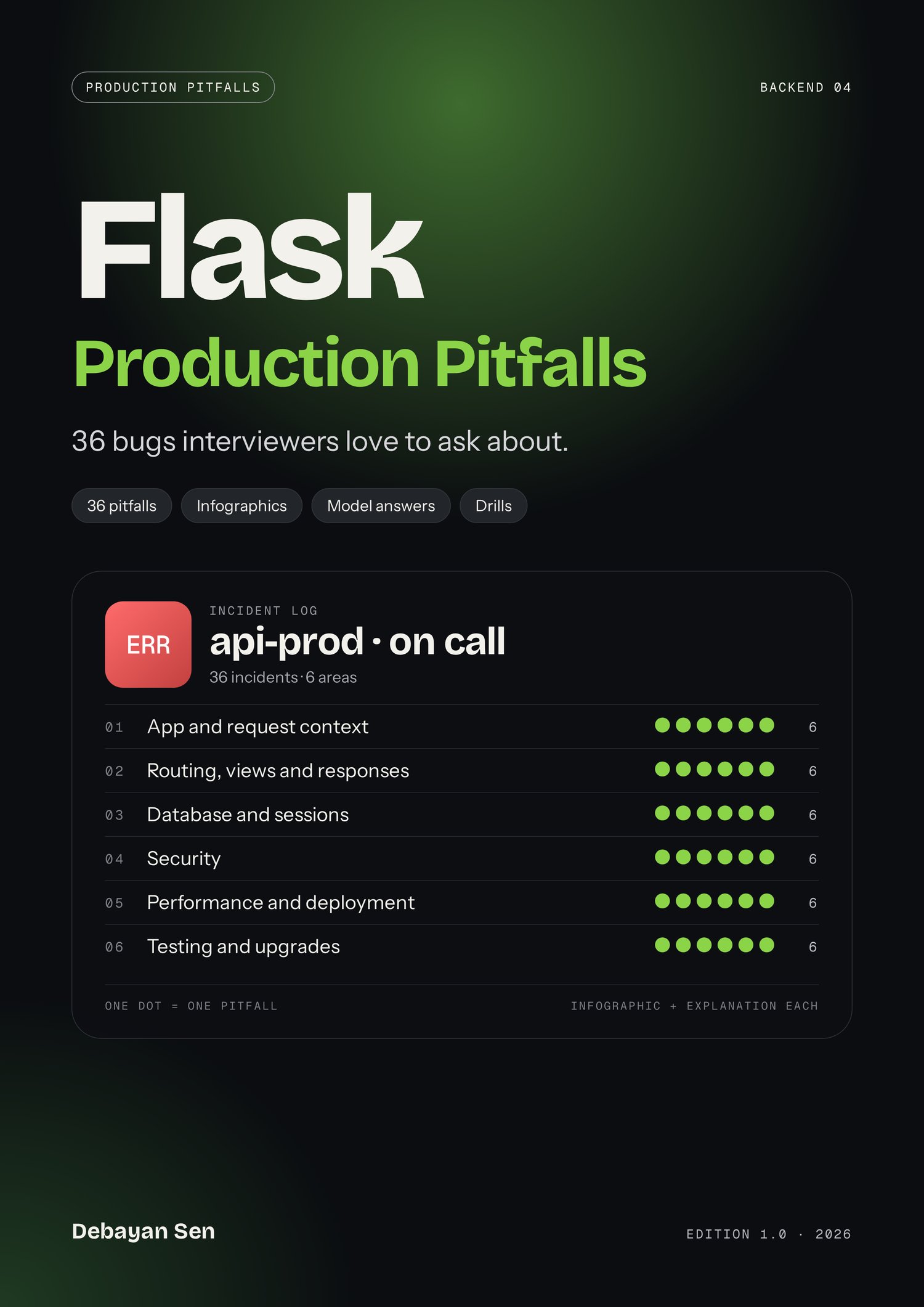
Flask gets you to a working app in minutes and to a production incident just as fast. These are the 36 Flask and SQLAlchemy mistakes that break real deployments, and the follow-up questions interviewers ask about them.
What's inside
• 36 real production pitfalls in 6 areas, 85 pages
• Every pitfall gets two pages: an infographic of what breaks, why it happens, the fix, the follow-up question an interviewer asks next, and a fillable drill to answer in your own words
• A 36-item tracker so you can tick off each pitfall as you master it
The 6 areas
1. App and request context — working outside application context, request data in module globals, threads that lose the context
2. Routing, views and responses — the debugger enabled in production, trailing slashes that drop a POST, wrong scheme and IP behind a proxy
3. Database and sessions — sessions never removed, N+1 queries from templates, db.create_all() instead of migrations
4. Security — a weak SECRET_KEY, secrets in the session cookie, |safe on user content, forms without CSRF
5. Performance and deployment — sync workers stuck on slow upstreams, long work inside the request, a scheduler running in every worker
6. Testing and upgrades — tests that share database state, autogenerated migrations shipped unread, upgrading to Flask 3 blind
Who it's for
Backend developers preparing for mid-level and senior interviews, and anyone who wants to stop shipping these bugs. Pairs with the Flask Interview Workbook (100+ questions with model answers and follow-ups).
Versions
This book targets Flask 3.1 with Werkzeug 3, Flask-SQLAlchemy 3.1 and SQLAlchemy 2.0, and notes where Flask 2 behaves differently.
Format
PDF, 85 pages, with fillable fields. Fill it in on screen in any PDF reader that supports forms (Adobe Acrobat Reader, browser PDF viewers) or print it.
This copy is licensed to the purchaser for their personal use only. Do not share, resell or redistribute it, in whole or in part, without the prior written permission of the author.