
Body Signals Map
💛 FREE Body Signals Map
An Interoception Sheet
Autism • Body Awareness • Communication • Sensory Needs • Self-Advocacy
FREE DIGITAL DOWNLOAD
What is my body trying to tell me?
Sometimes recognising, understanding or communicating what is happening inside the body can be difficult.
A child may feel uncomfortable without knowing whether they are hungry, thirsty, tired, too hot, overwhelmed or in need of the toilet.
Other children may recognise these feelings but find it difficult to explain them to someone else.
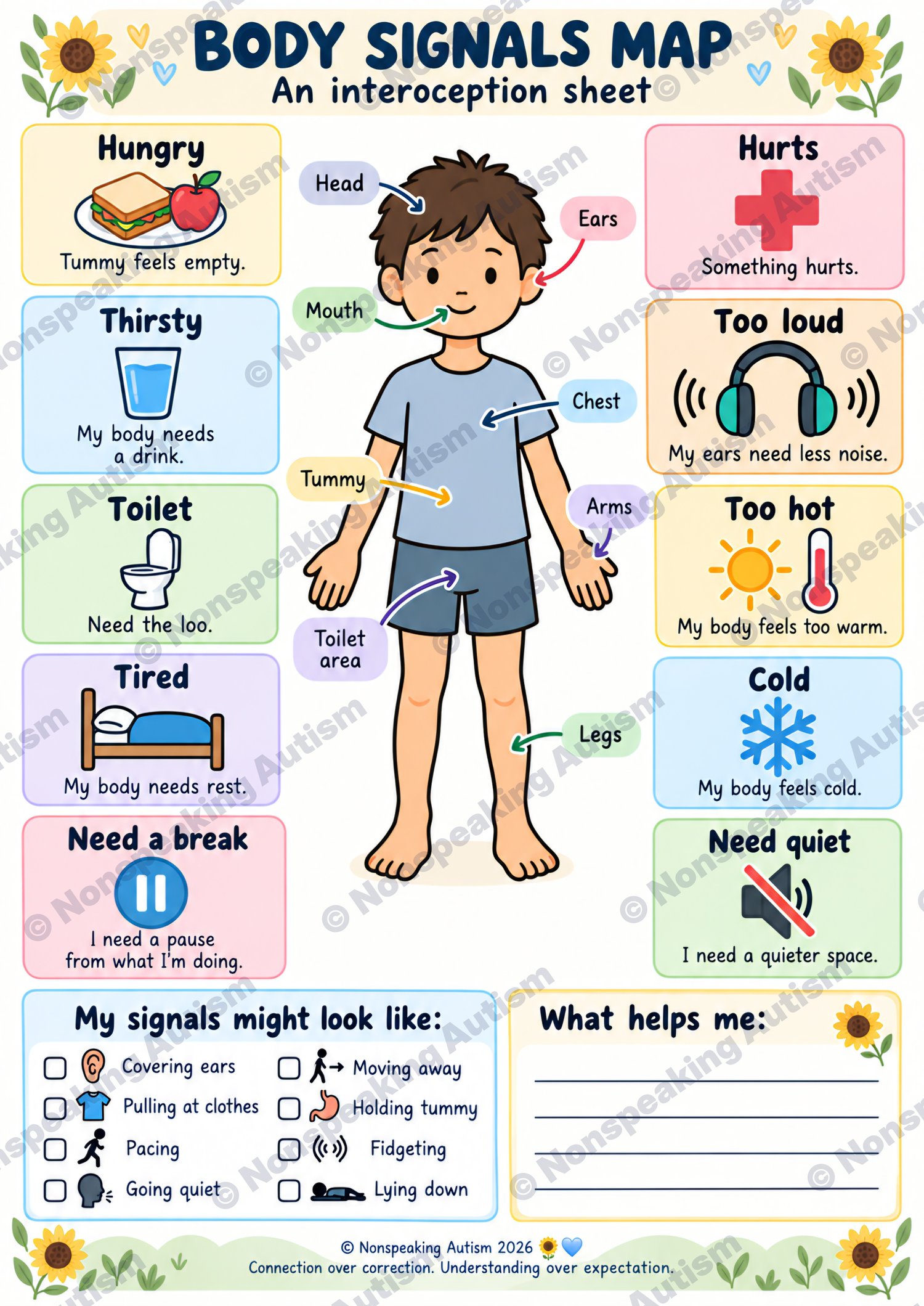
Body Signals Map — An Interoception Sheet is a free, accessible visual resource from Nonspeaking Autism, designed to support conversations about body awareness, physical needs, sensory experiences and communication.
Using clear illustrations, simple language and practical prompts, this printable worksheet helps children and their supporters explore how different body signals might feel, what others might notice and what could help.
🌻 The Key Message
Every body communicates differently. Understanding body signals should lead to support, not pressure.
🧠 What Is Interoception?
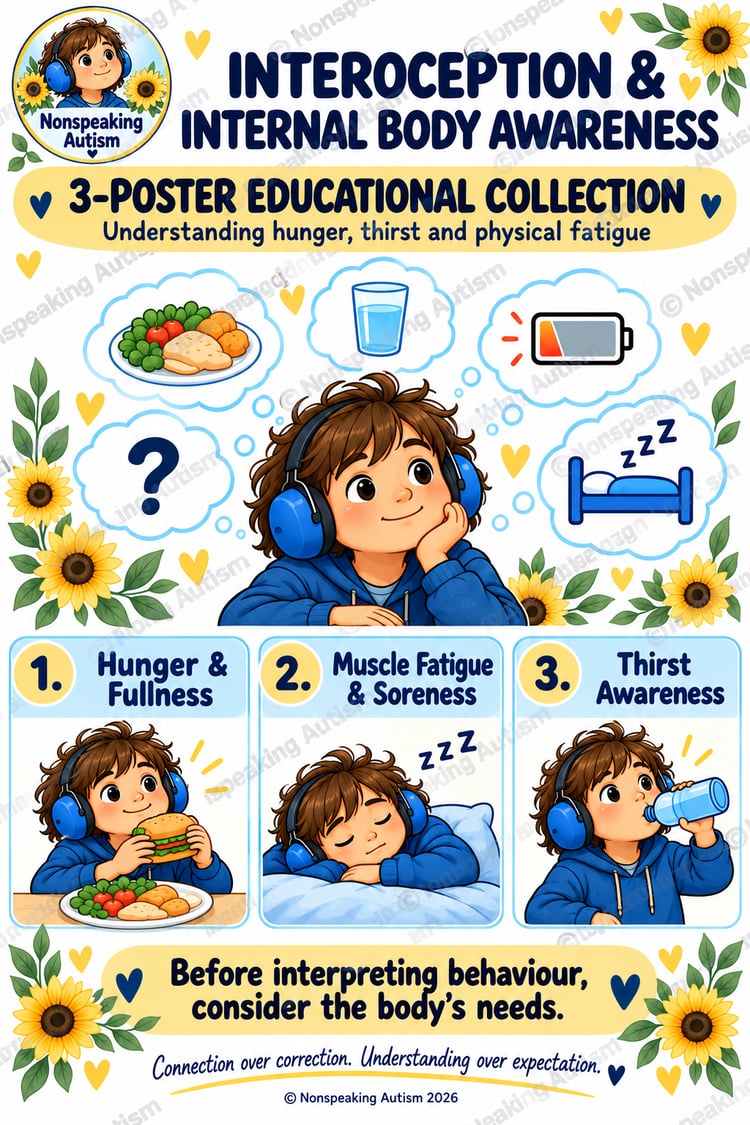
Interoception involves sensing and interpreting signals from inside the body.
These can include sensations associated with:
- Hunger and fullness
- Thirst
- Toileting needs
- Temperature
- Pain or discomfort
- Tiredness
- Internal changes associated with emotions and physical arousal
Some autistic people experience differences in how they notice, interpret or communicate internal body sensations.
However, there is no single autistic interoception profile. Experiences vary between individuals and can also change depending on stress, fatigue, illness and the environment.
This worksheet also includes sensory and environmental needs, such as noise and quiet spaces, which are related to comfort and regulation but are not all strictly interoceptive sensations.
🌈 What This Worksheet Includes

Recognising Body Needs
Visual prompts for hunger, thirst, toileting, tiredness, pain, feeling too hot or cold, needing quiet and needing a break.

Body Signals Map
A central body illustration identifying areas such as the head, ears, mouth, chest, tummy, arms and legs, encouraging children to explore where they notice sensations.

My Signals Might Look Like
A checklist of possible observable responses, including covering ears, moving away, pulling at clothes, holding the tummy, pacing, fidgeting, going quiet or lying down.

What Helps Me?
Space to record preferred supports, accommodations, comfort strategies and ways to communicate needs.
💬 Communication Comes First
Children do not need to use spoken language to benefit from this resource.
They may communicate by:
- Pointing to a picture
- Using AAC or a communication device
- Selecting symbols
- Gesturing
- Typing or writing
- Using yes/no responses
- Showing a trusted adult
- Choosing not to respond
The worksheet should support communication, not become a test of body awareness.
A child should never be required to identify an internal sensation correctly before receiving food, water, toileting access, rest, pain relief or sensory accommodations.
🤝 How to Use the Body Signals Map
Use the worksheet during a calm, comfortable moment, rather than waiting until a child is distressed.
An adult can explore the pictures together with the child, introduce one or two body signals at a time, and offer different ways to respond.
For example, a child may select “Too loud” to communicate that the environment needs changing, or “Need a break” to request time away from an activity.
The “What Helps Me?” section can be completed collaboratively and revisited as needs change.
There are no correct answers, scores or expectations that every child should experience sensations in the same way.
🔬 Research & Guidance-Informed
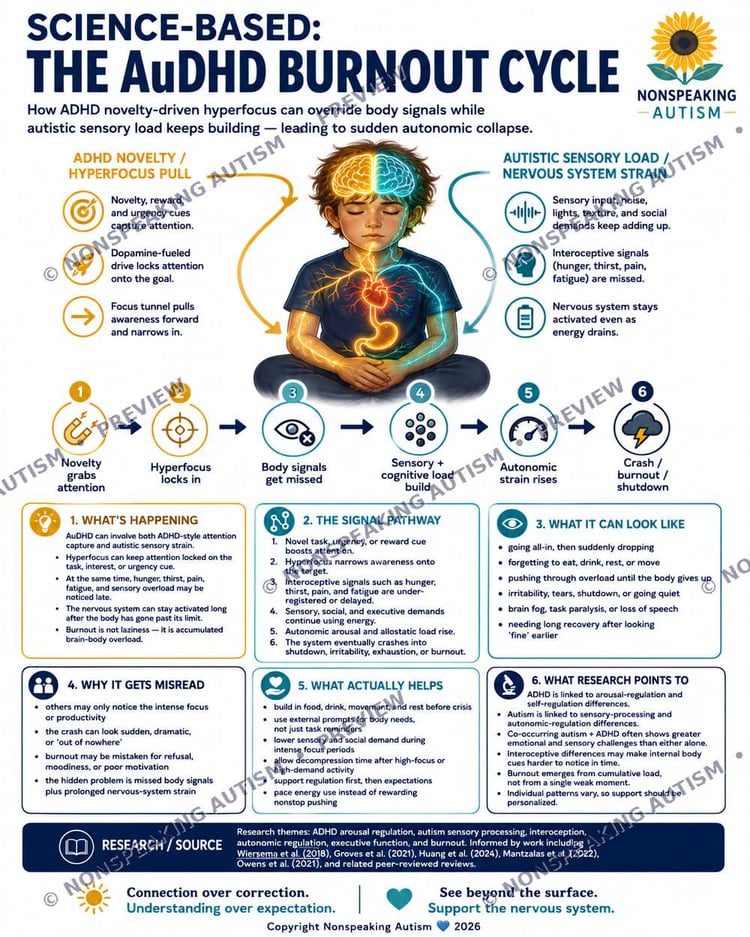
Research suggests that interoceptive processing can differ among autistic individuals, although findings vary according to the aspect of interoception being measured.
Interoception is also distinct from external sensory processing, and observable behaviour alone cannot reliably identify an internal sensation.
Useful foundational research includes:
Garfinkel, S. N., et al. (2016). Discrepancies between dimensions of interoception in autism: Implications for emotion and anxiety. Biological Psychology, 114, 117–126.
Kinnaird, E., Stewart, C., & Tchanturia, K. (2019). Investigating alexithymia in autism: A systematic review and meta-analysis. European Psychiatry, 55, 80–89.
Klein, M., Witthöft, M., & Jungmann, S. M. (2025). Interoception in individuals with autism spectrum disorder: A systematic literature review and meta-analysis. Frontiers in Psychiatry, 16, 1573263. DOI: 10.3389/fpsyt.2025.1573263.
Evidence Note
These references support the broader educational concepts. They do not establish this worksheet as a validated interoception assessment or prove that a particular action, such as pacing or going quiet, has one specific cause.
Research & References
Interoception-based support (closest to this resource):
- Mahler, K., Hample, K., Jones, C., Sensenig, J., Thomasco, P., & Hilton, C. (2022). Impact of an interoception-based program on emotion regulation in autistic children. Occupational Therapy International, 2022, 9328967. https://doi.org/10.1155/2022/9328967
- Hample, K., Mahler, K., & Amspacher, A. (2020). An interoception-based intervention for children with autism spectrum disorder: A pilot study. Journal of Occupational Therapy, Schools, & Early Intervention, 13(4), 339–352.
Interoception in autism:
- Loureiro, F., Ringold, S. M., & Aziz-Zadeh, L. (2024). Interoception in autism: A narrative review of behavioral and neurobiological data. Psychology Research and Behavior Management, 17, 1841–1853. https://doi.org/10.2147/PRBM.S410605
- Klein, Witthöft & Jungmann (2025). Interoception in individuals with autism spectrum disorder: A systematic literature review and meta-analysis. Frontiers in Psychiatry, 16, 1573263. https://doi.org/10.3389/fpsyt.2025.1573263
- Adams, K., Smith, J., Brown, M., Bird, G., & Waite, P. (2025). Experiences of interoception and anxiety in autistic adolescents: A reflexive thematic analysis. Autism. https://doi.org/10.1177/13623613251314595
- Fiene, L., & Brownlow, C. (2015). Investigating interoception and body awareness in adults with and without autism spectrum disorder. Autism Research, 8(6), 709–716. https://doi.org/10.1002/aur.1486
Pain and body signals (supports the “Hurts” box):
- Johnson, M., van Zijl, A., & Kuyler, A. (2023). Pain communication in children with autism spectrum disorder: A scoping review. Paediatric and Neonatal Pain, 5(4), 127–141. https://doi.org/10.1002/pne2.12115
Sources:
👨👩👧 Who Is This Resource For?
This free printable may be useful for autistic children, nonspeaking and minimally speaking children, children with communication differences, parents and carers, teachers, teaching assistants, SENCOs, SEND teams, occupational therapists, speech and language therapists and support workers.
It can be used at home, in school, in specialist educational settings and during individualized support conversations.
📦 What You Receive
💛 FREE DIGITAL DOWNLOAD
- 1 × Body Signals Map — An Interoception Sheet
- 1 × printable educational worksheet
- Body-awareness illustrations and prompts
- Observable-signals checklist
- Space to record individual support needs
The downloadable resource is intended to be supplied without the promotional PREVIEW watermark shown in the listing image.
Digital download only — no physical product will be shipped.
⚠️ Important Disclaimer
This is a research-informed educational and communication resource, not a diagnostic tool, standardized interoception assessment, medical assessment or replacement for individualized professional advice.
The illustrated body sensations are examples, not universal experiences. A child may feel hunger, pain, thirst or other needs differently from the descriptions shown.
Never withhold essential care or support because a child cannot identify or communicate a body signal.
New, persistent, severe or unexplained pain, changes in toileting, appetite, thirst, behaviour or physical wellbeing may require appropriate medical assessment.
©️ Copyright & Permitted Use
Copyright © 2026 Nonspeaking Autism. All rights reserved.
This resource is provided free of charge through Payhip.
You may download and print it for personal, home, classroom, school, clinic or individual professional educational use.
Please do not resell, redistribute the digital file, upload it to other platforms, remove copyright information or incorporate it into commercial products.
Direct others to the original Nonspeaking Autism Payhip listing to obtain their own free copy.
💛 The Message Behind the Resource
A child should not have to find the perfect words to communicate discomfort.
Sometimes communication begins with a picture.
Sometimes it begins with pointing.
Sometimes it begins with a movement, a gesture or a change in behaviour that invites us to look more closely.
Notice the signals. Respect the communication. Meet the need.
Connection over correction. Understanding over expectation. 🌻💙
© Nonspeaking Autism 2026