
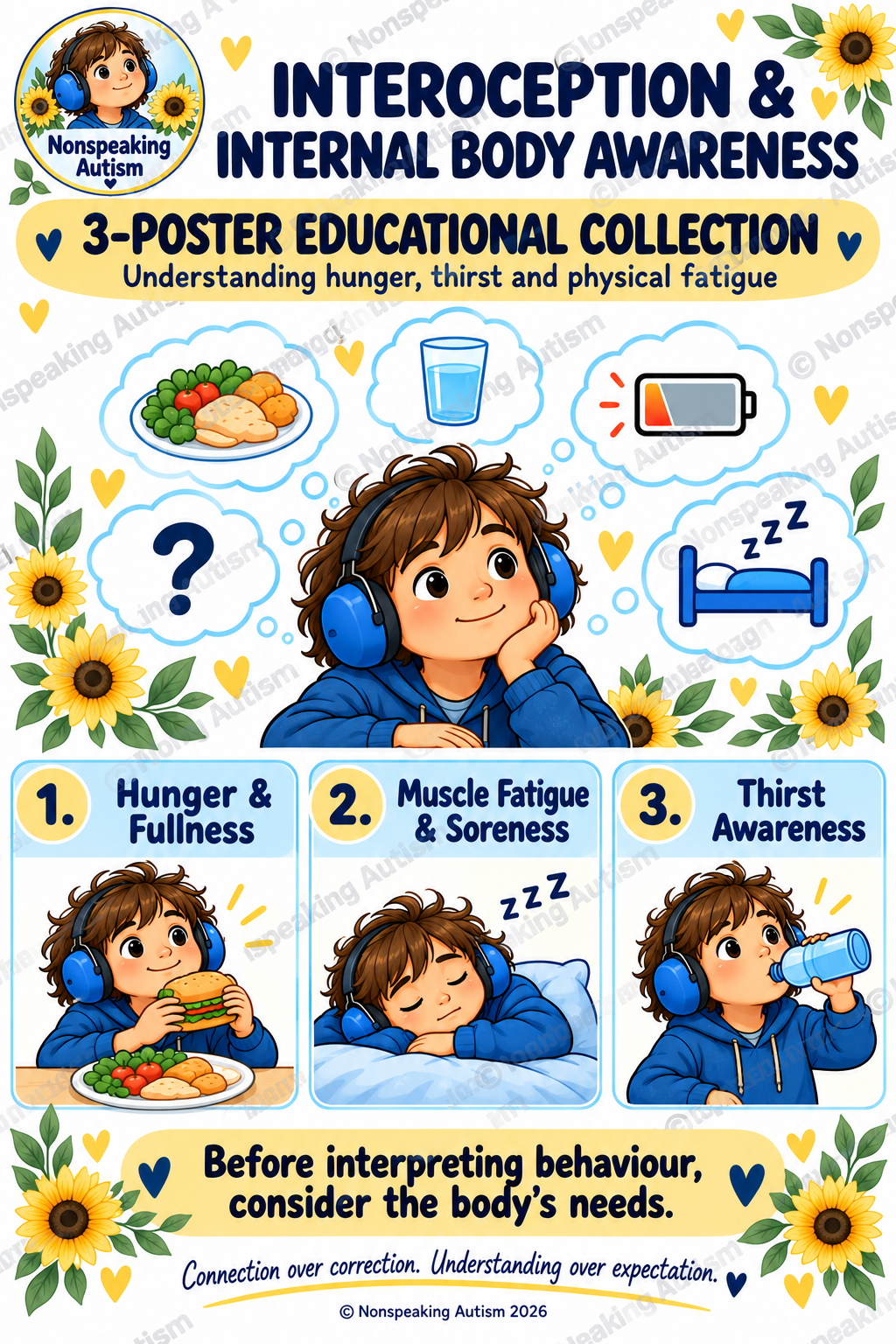
INTEROCEPTION & INTERNAL BODY AWARENESS
INTEROCEPTION & INTERNAL BODY AWARENESS
Complete 3-Poster Educational Collection
Understanding Hunger, Thirst and Physical Fatigue in Autism
UK Edition | Research-Informed Autism Resources | Nonspeaking Autism
💛 Before interpreting behaviour, consider the body's needs.
What if a child who appears to be refusing an activity is actually physically exhausted?
What if irritability or difficulty concentrating is connected to hunger that the child cannot easily recognise or communicate?
What if a child seems dysregulated, but thirst, dehydration or another physical need is contributing to their distress?
Our bodies constantly send internal signals. However, recognising, interpreting and responding to those signals is not always straightforward.
For some autistic people, internal body sensations may be difficult to notice, distinguish, describe or act upon. Others may experience certain sensations very intensely.
This is where interoception — our perception of internal bodily signals — becomes particularly important.
The Interoception & Internal Body Awareness collection brings together three illustrated, research-informed educational posters exploring hunger and fullness, muscle fatigue and soreness, and thirst awareness.
Designed for parents, carers, teachers, SENCOs, occupational therapists and other professionals, this collection encourages a more compassionate approach to understanding distress, participation and everyday support.
The central message is simple:
A child's behaviour may tell us something is difficult. It does not automatically tell us why.
🧠 WHAT IS INTEROCEPTION?
Interoception involves sensing and interpreting signals from inside the body.
These signals contribute to experiences such as:
- Hunger and fullness
- Thirst
- Pain and discomfort
- Temperature
- Breathing and heartbeat
- Nausea and digestive sensations
- Physical effort and fatigue
Interoception works alongside other sensory, emotional and cognitive processes.
For some autistic individuals, certain internal signals may be subtle, confusing, delayed in recognition or difficult to describe.
A child may experience a sensation without knowing what it means. They may recognise a need but find it difficult to communicate. They may also know what they need but encounter sensory, motor or environmental barriers to meeting that need.
Noticing a body signal, understanding it, communicating it and responding to it are related — but different — skills and experiences.
This collection explores those distinctions through three everyday physical needs.
📚 WHAT IS INCLUDED IN THE COLLECTION?
💛 POSTER 1 — HUNGER & FULLNESS
Why hunger and fullness cues may feel unclear, delayed or difficult to interpret
“Hunger may not always feel like ‘I'm hungry’.”
For some autistic children and adults, hunger may not be experienced or communicated in an easily recognisable way.
Possible signs that prompt further investigation may include:
- A sudden drop in energy
- Irritability or increased distress
- Difficulty concentrating
- Restlessness
- Seeking food
- Nausea or abdominal discomfort
- Eating urgently when hunger becomes intense
These signs do not prove hunger. They can also occur with pain, illness, anxiety, fatigue or sensory overload.
What this poster explains
The poster explores why hunger signals may be difficult to notice, identify or interpret, and why recognising hunger does not necessarily make eating easy.
It also considers how food texture, smell, temperature, predictability, gastrointestinal symptoms and environmental demands may influence eating.
Practical support strategies
- Offer predictable opportunities for food and drinks.
- Observe individual patterns before significant changes in energy or distress.
- Use visual communication or AAC for food, drink, more, stop and discomfort.
- Keep familiar and accepted foods accessible where appropriate.
- Reduce unnecessary sensory pressure around meals.
- Consider pain, constipation, nausea, illness and fatigue.
Key message:
The question is not only:
“Can they feel hunger?”
It is also:
“Can they notice it, make sense of it, communicate it and access food?”
💙 POSTER 2 — MUSCLE FATIGUE & SORENESS
When physical tiredness may be mistaken for refusal
“What looks like refusal may sometimes be the body saying: ‘This is too tiring, too sore, or too hard right now.’”
Physical effort, soreness and exhaustion can influence participation in everyday activities.
Some autistic children also experience motor coordination differences, which may make particular movements or tasks more physically demanding.
A child who stops walking, avoids stairs or struggles to continue an activity may need support rather than additional pressure.
What this poster explores
Possible signs include:
- Stopping suddenly
- Sitting or lying down
- Slower movement
- Appearing physically floppy or exhausted
- Avoiding stairs, walking, PE or handwriting
- Distress during movement-based activities
- Asking to be carried or requesting less movement
These are possible clues, not proof of muscle fatigue.
Understanding possible contributors
The poster explores how:
- Motor tasks may require greater effort for some children.
- Muscles may become tired or sore after physical activity.
- Pain may be difficult to describe clearly.
- Poor sleep may reduce physical stamina.
- Physical fatigue and sensory or emotional overload may occur together.
Practical support strategies
- Offer rest and recovery time.
- Reduce physical demands when needed.
- Notice patterns after school, outings, walking or PE.
- Support communication using words, visuals or AAC such as tired, rest, stop, hurt or carry.
- Check for pain, illness, sleep difficulties, hydration and food needs.
- Adapt activities and plan breaks according to the individual's abilities and preferences.
Key message:
Before assuming refusal, consider whether the body is tired, sore, overloaded or struggling with the physical effort of the task.
💧 POSTER 3 — THIRST AWARENESS
When dehydration may look like dysregulation
“Thirst may not always feel like ‘I'm thirsty’.”
Some autistic individuals may find thirst sensations difficult to notice, identify or act upon.
A person may also recognise thirst but have difficulty accessing a preferred drink, tolerating its temperature or taste, or communicating their need.
What this poster explores
Possible signs that warrant checking hydration and other physical needs include:
- Irritability or distress
- Reduced energy
- Difficulty concentrating
- Headaches
- Dry mouth or lips
- Drinking a large amount after a long gap
- Appearing less engaged than usual
These signs are not specific to dehydration and must not be used to diagnose it.
Hydration and sensory regulation can overlap
A child may be thirsty and sensory overloaded at the same time.
Similarly, an apparent change in behaviour may relate to illness, anxiety, fatigue, pain or environmental demands rather than hydration.
Practical support strategies
- Offer regular, predictable opportunities to drink.
- Keep preferred drinks and suitable cups accessible.
- Use visual supports or AAC to request drinks or communicate discomfort.
- Offer drinks alongside familiar routines.
- Consider whether taste, temperature or drinking equipment affects access.
- Notice individual patterns, especially during hot weather, illness or physical activity.
- Reduce unnecessary sensory and communication demands.
Key message:
Before assuming a change in behaviour is purely emotional or sensory, check physical needs too.
🌻 THE CONNECTION BETWEEN ALL THREE POSTERS
Hunger, thirst and physical fatigue can influence comfort, concentration, participation and wellbeing.
However, the same outward signs may occur for many different reasons.
For example, a child who becomes quiet and withdrawn after school might be:
- Physically exhausted
- Hungry or thirsty
- Experiencing sensory overload
- Anxious or emotionally distressed
- In pain or becoming unwell
- Experiencing several of these factors together
No single behaviour establishes which explanation is correct.
This collection encourages adults to consider the whole person, their environment, their communication and patterns over time.
Observe the pattern. Check the body. Reduce unnecessary pressure. Support communication.
🏫 PRACTICAL USE IN UK SCHOOLS AND SEND SETTINGS
These posters can support discussions about reasonable adjustments, communication access and everyday physical needs.
They may help school staff consider whether a pupil needs:
- Predictable food and drink opportunities
- Access to drinking water
- Movement breaks or physical rest
- Adapted PE or physically demanding activities
- Additional processing time
- Accessible ways to communicate pain, tiredness, hunger or thirst
- Reduced sensory demands
- A quieter recovery space
- Collaboration between home and school
The posters may be useful during conversations with a SENCO, class teacher, teaching assistant, occupational therapist, speech and language therapist or other relevant professional.
They can also help families share observations about a child's needs without treating those observations as a diagnosis.
The goal is access, comfort and meaningful participation — not forcing a child to push through distress.
🔬 RESEARCH-INFORMED EDUCATIONAL CONTENT
This collection draws on research concerning interoception, sensory processing, autism, motor differences and everyday functioning.
Research indicates that interoceptive experiences can differ between individuals, including autistic people. However, findings are mixed and should not be interpreted as evidence that all autistic individuals experience hunger, thirst or fatigue in the same way.
Research concerning autism-specific hunger, fullness and thirst awareness is still developing.
Motor coordination differences and fatigue may also affect daily activities, but these experiences vary considerably.
📚 Selected Research & Guidance
Fiene, L., & Brownlow, C. (2015). Investigating interoception and body awareness in adults with and without autism spectrum disorder. Autism Research, 8(6), 709–716.
Kinnaird, E., Stewart, C., & Tchanturia, K. (2019). Investigating alexithymia in autism: A systematic review and meta-analysis. European Psychiatry, 55, 80–89.
Chen, Y., et al. (2024). A systematic review and meta-analysis of the relationship between sensory processing differences and internalising/externalising problems in autism. Clinical Psychology Review, 114, 102516.
https://doi.org/10.1016/j.cpr.2024.102516
Blank, R., et al. (2019). International clinical practice recommendations on the definition, diagnosis, assessment, intervention, and psychosocial aspects of developmental coordination disorder. Developmental Medicine & Child Neurology, 61(3), 242–285.
NICE (2013). Autism spectrum disorder in under 19s: Support and management (CG170).
https://www.nice.org.uk/guidance/cg170
Evidence Note
These sources support the broader educational themes of interoception, sensory differences, motor coordination and individualised support.
They do not validate every example or support strategy in the posters as a specific clinical intervention.
The posters are educational resources, not standardised interoception assessments, diagnostic tools or validated measures of dehydration, fatigue or hunger awareness.
FURTHER RESOURCES
- National Autistic Society – Autism and sensory processing (includes interoception): https://www.autism.org.uk/advice-and-guidance/topics/sensory-differences/sensory-differences/all-audiences
- Kelly Mahler – What is interoception?: https://www.kelly-mahler.com/what-is-interoception/
- PEACE Pathway – eating difficulties and autism: https://www.peacepathway.org/
RESEARCH & REFERENCES
Hunger poster
Interoception in autism (Sections 1 & 2)
- Loureiro, F., Ringold, S. M., & Aziz-Zadeh, L. (2024). Interoception in autism: A narrative review of behavioral and neurobiological data. Psychology Research and Behavior Management, 17, 1841–1853. https://doi.org/10.2147/PRBM.S410605
- Klein, Witthöft & Jungmann (2025). Interoception in individuals with autism spectrum disorder: A systematic literature review and meta-analysis. Frontiers in Psychiatry, 16, 1573263. https://doi.org/10.3389/fpsyt.2025.1573263
Interoception, alexithymia and eating (Section 2, "Knowing you are hungry…")
- Westwood, H., Mandy, W., & Brewer, R. (2025). The relationship between interoception, alexithymia, autistic traits and eating pathology in autistic adults. Journal of Autism and Developmental Disorders, 56(7), 2574–2587. https://doi.org/10.1007/s10803-024-06708-5
Sensory processing and eating (Section 2 & How to Support)
- Nimbley, E., Golds, L., Sharpe, H., Gillespie-Smith, K., & Duffy, F. (2022). Sensory processing and eating behaviours in autism: A systematic review. European Eating Disorders Review, 30(5), 538–559. https://doi.org/10.1002/erv.2920
Sensory reactivity and wellbeing (Important Reminder)
- Chen, Y., Xi, Z., Saunders, R., Simmons, D., Totsika, V., & Mandy, W. (2024). A systematic review and meta-analysis of the relationship between sensory processing differences and internalising/externalising problems in autism. Clinical Psychology Review, 114, 102516. https://doi.org/10.1016/j.cpr.2024.102516
- Tavassoli, T., Marco, E. J., & Puts, N. (2026). Sensory reactivity in autism: Integrating behavioural, affective, physiological, and neural dimensions. Current Psychiatry Reports, 28, 36. https://doi.org/10.1007/s11920-026-01682-4
Muscle Fatigue & Soreness poster
FURTHER RESOURCES
- National Autistic Society – Autism and sensory processing: https://www.autism.org.uk/advice-and-guidance/topics/sensory-differences/sensory-differences/all-audiences
- National Autistic Society – Sleep and autism: https://www.autism.org.uk/advice-and-guidance/topics/physical-health/sleep
- Kelly Mahler – What is interoception?: https://www.kelly-mahler.com/what-is-interoception/
RESEARCH & REFERENCES
Motor differences (Section 2, "Motor tasks may take more effort")
- Kangarani-Farahani, M., Malik, M. A., & Zwicker, J. G. (2024). Motor impairments in children with autism spectrum disorder: A systematic review and meta-analysis. Journal of Autism and Developmental Disorders, 54(5), 1977–1997. https://doi.org/10.1007/s10803-023-05948-1
Pain and communication (Section 2, "Pain is not always communicated clearly")
- Johnson, M., van Zijl, A., & Kuyler, A. (2023). Pain communication in children with autism spectrum disorder: A scoping review. Paediatric and Neonatal Pain, 5(4), 127–141. https://doi.org/10.1002/pne2.12115
- Han, G. T., Heavner, H. S., Rains, T. R., Hoang, A. H., & Stone, A. L. (2024). Chronic pain in autistic youth: Clinical prevalence and reflections on tailoring evidence-based interventions from an interdisciplinary treatment team. Children, 11(3), 312. https://doi.org/10.3390/children11030312
Sleep (Section 2, "Poor sleep reduces stamina")
- Estes, A., Hillman, A., & Chen, M. L. (2024). Sleep and autism: Current research, clinical assessment, and treatment strategies. Focus, 22(2), 162–169. https://doi.org/10.1176/appi.focus.20230028
Interoception (Research Note)
- Loureiro, F., Ringold, S. M., & Aziz-Zadeh, L. (2024). Interoception in autism: A narrative review of behavioral and neurobiological data. Psychology Research and Behavior Management, 17, 1841–1853. https://doi.org/10.2147/PRBM.S410605
- Klein, Witthöft & Jungmann (2025). Interoception in individuals with autism spectrum disorder: A systematic literature review and meta-analysis. Frontiers in Psychiatry, 16, 1573263. https://doi.org/10.3389/fpsyt.2025.1573263
- Adams, K., Smith, J., Brown, M., Waite, P., & Bird, G. (2025). Experiences of interoception and anxiety in autistic adolescents: A reflexive thematic analysis. Autism. https://doi.org/10.1177/13623613251314595
Thirst Awareness poster
FURTHER RESOURCES
- National Autistic Society – Autism and sensory processing (covers interoception, including thirst): https://www.autism.org.uk/advice-and-guidance/topics/sensory-differences/sensory-differences/all-audiences
- NHS – Dehydration (signs and what to do): https://www.nhs.uk/conditions/dehydration/
- ERIC, The Children's Bowel & Bladder Charity – drinking, toileting and constipation: https://www.eric.org.uk/
- Kelly Mahler – What is interoception?: https://www.kelly-mahler.com/what-is-interoception/
RESEARCH & REFERENCES
Thirst and body awareness in autism (Section 2 & Research Note)
- Fiene, L., & Brownlow, C. (2015). Investigating interoception and body awareness in adults with and without autism spectrum disorder. Autism Research, 8(6), 709–716. https://doi.org/10.1002/aur.1486
Interoception in autism (Section 2, "Interoceptive differences are mixed and individual")
- Loureiro, F., Ringold, S. M., & Aziz-Zadeh, L. (2024). Interoception in autism: A narrative review of behavioral and neurobiological data. Psychology Research and Behavior Management, 17, 1841–1853. https://doi.org/10.2147/PRBM.S410605
- Klein, Witthöft & Jungmann (2025). Interoception in individuals with autism spectrum disorder: A systematic literature review and meta-analysis. Frontiers in Psychiatry, 16, 1573263. https://doi.org/10.3389/fpsyt.2025.1573263
- Palser, E. R., Lawson, W. B., Goodall, E., & Pellicano, E. (2026). Interoception in autism, pitfalls, and promise: A participatory research perspective. Autism in Adulthood (in press). https://doi.org/10.1177/25739581251414545
Interoception, anxiety and eating/drinking (Section 3, "They can overlap")
- Adams, K., Smith, J., Brown, M., Waite, P., & Bird, G. (2025). Experiences of interoception and anxiety in autistic adolescents: A reflexive thematic analysis. Autism. https://doi.org/10.1177/13623613251314595
- Westwood, H., Mandy, W., & Brewer, R. (2025). The relationship between interoception, alexithymia, autistic traits and eating pathology in autistic adults. Journal of Autism and Developmental Disorders, 56(7), 2574–2587. https://doi.org/10.1007/s10803-024-06708-5
Sources:
- OpenAlex
- Oxford Experimental Psychology – Adams et al. (2025)
- UCL Discovery – Palser et al. (2026)
- PsychiatryOnline – Estes et al. (2024)
👨👩👧 WHO IS THIS COLLECTION FOR?
This collection may be useful for:
- Parents and carers
- Autistic children and young people, with appropriate support
- Autistic adults exploring their experiences
- Teachers and teaching assistants
- SENCOs and SEND teams
- Occupational therapists
- Speech and language therapists
- Educational psychologists
- Paediatric and healthcare professionals
- Family support workers
- Anyone supporting communication, regulation and everyday participation
The resources are suitable for educational discussions at home, in schools, therapy settings and professional learning environments.
📦 WHAT YOU RECEIVE
Your digital collection includes four PDF files:
1. Hunger & Fullness
An educational poster exploring hunger signals, fullness, possible signs and practical support.
2. Muscle Fatigue & Soreness
An educational poster exploring physical tiredness, soreness, motor effort and the risk of interpreting physical difficulty as refusal.
3. Thirst Awareness
An educational poster exploring thirst recognition, hydration-related clues and accessible drinking support.
4. Interoception & Internal Body Awareness — Collection Cover
A coordinating cover bringing the complete three-poster series together.
File Information
- 3 individual educational posters
- 1 coordinating collection cover
- High-resolution printable digital PDF files
- Designed for home, school and educational display
- Purchased files supplied without promotional preview watermarks
Digital download only — no physical posters will be posted.
⚠️ IMPORTANT DISCLAIMER
This collection is provided for educational and informational purposes only.
It is not a substitute for medical advice, clinical assessment, occupational therapy assessment, nutritional assessment or an individualised support plan.
Changes in behaviour, energy, movement, eating or drinking may have many possible causes.
Persistent or significant pain, unusual fatigue, eating or drinking difficulties, unexplained weight changes or concerns about hydration should be discussed with an appropriate healthcare professional.
Seek urgent medical assistance for serious symptoms such as marked drowsiness, confusion, collapse or signs of severe dehydration.
Do not assume that physical symptoms are caused by autism, interoception differences or sensory processing.
Support strategies should be individualised, safe and responsive to the person's needs and preferences.
©️ COPYRIGHT & PERMITTED USE
Copyright © 2026 Nonspeaking Autism. All rights reserved.
Purchase permits personal, home, classroom, school and individual professional educational use.
You may print the posters for use within these settings.
You may not:
- Resell or redistribute the digital files
- Upload the original files to other websites or platforms
- Share purchased files publicly
- Reproduce the artwork for commercial purposes
- Include the posters in another product or digital resource for resale
Promotional preview watermarks protect the original artwork and are not included in the purchased printable versions.
💛 THE MESSAGE BEHIND THIS COLLECTION
A child who suddenly stops walking may need rest.
A child who becomes irritable may be hungry, thirsty, overwhelmed or uncomfortable.
A child who struggles to explain what is wrong may still be experiencing a genuine physical need.
Not every difficulty is refusal.
Not every change in behaviour is sensory overload.
Not every unmet need can be communicated clearly.
Before asking:
“Why won't they do it?”
Consider:
“Could their body be telling us that something is difficult, uncomfortable or missing?”
Because understanding the body's needs can help us respond with greater compassion, flexibility and respect.
Before interpreting behaviour, consider the body's needs.
🌻 Connection over correction. Understanding over expectation. 💙
Nonspeaking Autism © 2026