
Global Legal Pleadings Compendium
What Is This Work?
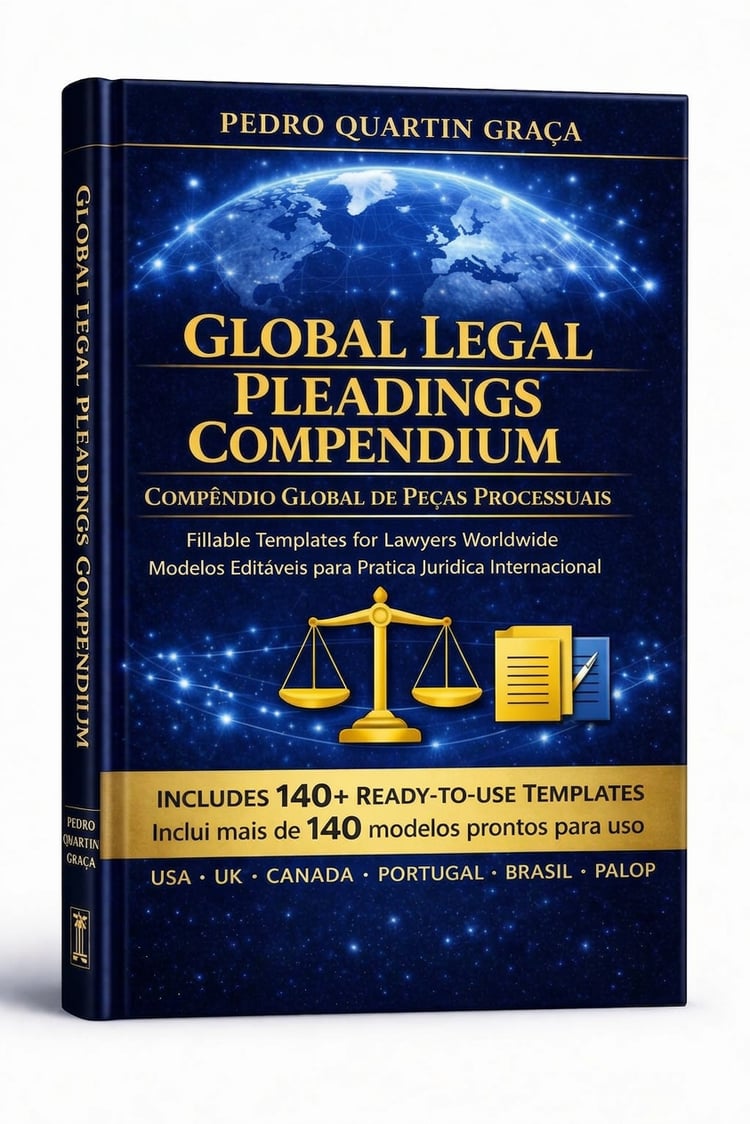
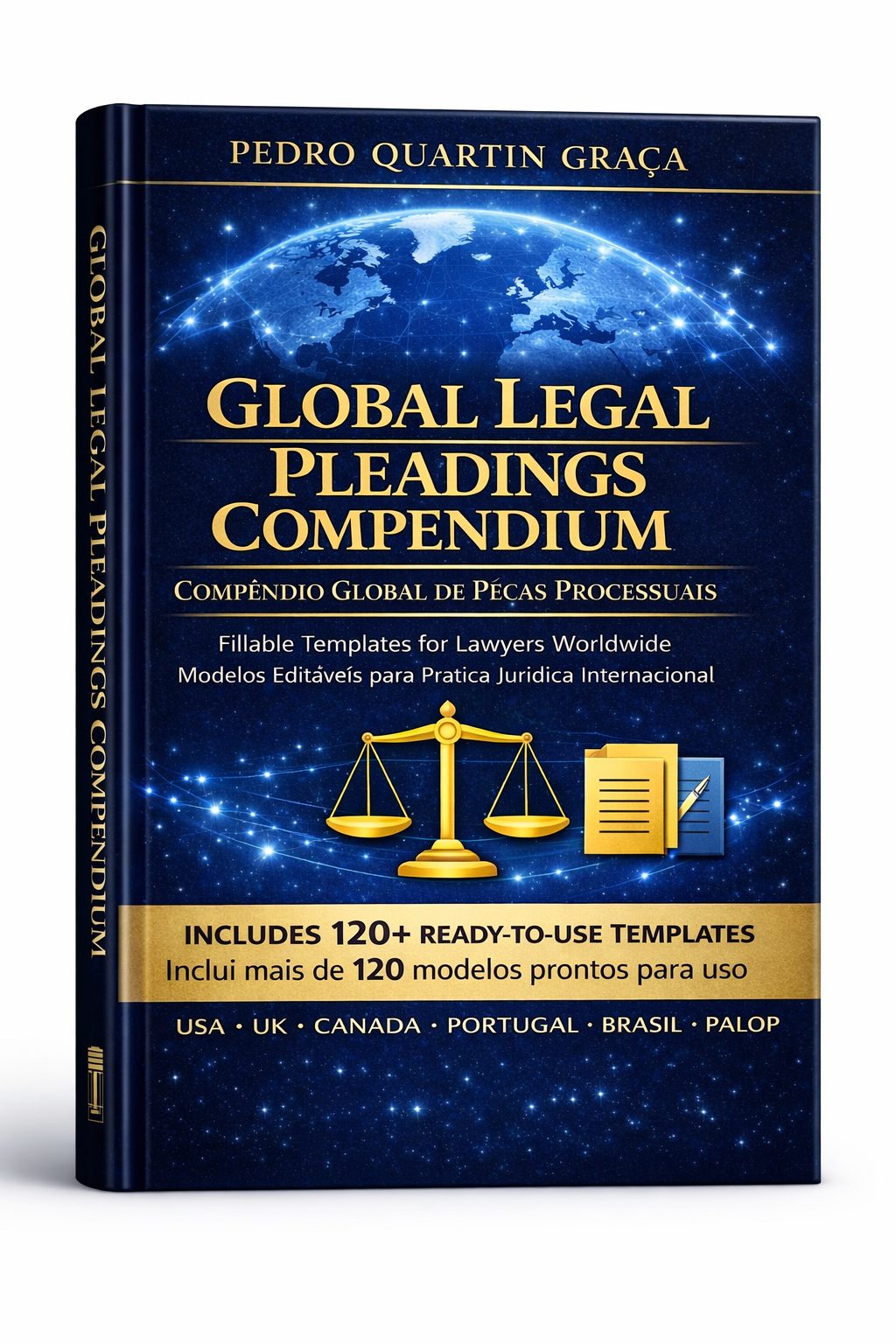
The Global Legal Pleadings Compendium is the most comprehensive bilingual collection of ready-to-use legal pleading templates ever assembled in a single reference volume. It bridges the two great legal traditions of the world — the civil-law (Romano-Germanic) tradition of Portugal, Brazil, and the Portuguese-speaking African countries (PALOP), and the common-law tradition of the United States, the United Kingdom, Canada, Australia, New Zealand, Hong Kong, South Africa, India, and Singapore — placing them side by side for the first time in one practical, fillable compendium.
Each of the 120 templates in this edition has been individually drafted to conform to the procedural rules, legislative references, and professional conventions of its jurisdiction. Templates are presented as fillable forms: blank fields are marked with continuous underlines, instructional notes appear in italics, and alternative wordings are separated by a vertical bar. Every template can be used immediately, adapted to the facts of the case, and filed.
Who Is This Work For?
This compendium is designed for practitioners who work across multiple jurisdictions or who need a reliable, immediately usable starting point for an unfamiliar type of proceeding. Its primary audience includes:
● Lawyers and solicitors in private practice who handle cross-border matters involving civil-law and common-law jurisdictions simultaneously.
● In-house legal counsel at multinational corporations who need to instruct local counsel or review pleadings filed in foreign courts.
● Barristers, advocates, and trial attorneys who need to verify form, structure, and mandatory content requirements quickly.
● Legal academics and researchers engaged in comparative procedural law.
● Law students preparing for practice in international or multi-jurisdictional settings.
● Legal translators and interpreters who require precise terminology equivalents across systems.
● Notaries and registrars dealing with cross-border estate, family, or commercial matters.
Jurisdictional and Subject-Matter Coverage
Civil-Law Jurisdictions (Lusophone System)
The civil-law section covers Portugal, Brazil, Angola, Mozambique, Cape Verde, Guinea-Bissau, and São Tomé and Príncipe. Templates span civil and procedural law, criminal procedure, labour law, administrative and tax law, family and succession law, insolvency, and constitutional law. All Portuguese-language templates reflect the applicable codes in force as of 2026, including the Código de Processo Civil (Lei n.º 41/2013 as amended), the Brazilian CPC/2015, the Angolan Lei Geral do Trabalho (Lei n.º 7/15), and the reformed Brazilian improbidade statute (Lei n.º 14.230/2021).
Common-Law Jurisdictions
The common-law section covers the United States (federal and state practice), the United Kingdom (England and Wales), Canada (federal and Ontario/provincial), Australia (federal and NSW), New Zealand, Hong Kong, South Africa, India, and Singapore. Templates reflect current rules, including the US Federal Rules of Civil Procedure and Federal Rules of Appellate Procedure, the UK Civil Procedure Rules 1998 (as amended), Canada's post-2022 Court of King's Bench nomenclature, India's Bharatiya Nagarik Suraksha Sanhita 2023 (in force from 1 July 2024), and Singapore's Rules of Court 2021.
Key Features
● 120 fully drafted, fillable templates across 16 jurisdictions and 8 areas of law.
● Bilingual presentation: Portuguese-language templates and English-language templates in dedicated sections, with cross-referenced equivalents.
● Up-to-date legislative citations: every template references the applicable statute, rule, or regulation in force as of the 2nd Edition (2026).
● Unique alphanumeric reference codes (e.g. PT-CIVIL-001, US-CIV-003, UK-CIV-005) enabling instant cross-referencing between the six indices and any template.
● Six comprehensive indices: General Table of Contents · Index by Jurisdiction · Index by Area of Law · Alphabetical Index · Cross-Jurisdictional Equivalents Index · Model Codes Index.
● Cross-jurisdictional equivalents tables mapping procedurally equivalent documents across legal systems (e.g. Providência Cautelar ↔ TRO / Preliminary Injunction ↔ Mareva Injunction).
● Instructional notes embedded in every template explaining mandatory content, time limits, court fees, word or page limits, and filing mechanics.
● Comparative tables identifying procedural equivalents across civil-law and common-law systems.
● Legislative reference annex listing the principal statutes and rules for each jurisdiction.
● Fully editable Word format: all fields are ready to be completed and the document can be adapted without formatting constraints.
Areas of Law Covered
Civil and Procedural Law
Initiating pleadings, defences, replies, counterclaims, interlocutory applications, injunctions, provisional and protective measures, appeals, cassation, evidence motions, class actions, discovery, subpoenas, service of process, case management.
Criminal Procedure
Complaints, indictment challenges, suppression motions, bail applications, defence statements, sentencing memoranda, plea agreements, habeas corpus, alibi notices, publicly funded counsel applications.
Employment and Labour Law
Wrongful dismissal, unfair dismissal, discrimination charges, employment tribunal claims, provisional suspension of dismissal.
Administrative and Public Law
Judicial review (pre-action and substantive), administrative challenges, suspension of administrative acts, compulsory-act claims, tax assessment challenges, notices of objection.
Family and Succession Law
Divorce (consensual and contested), dissolution of marriage, parental responsibility, maintenance and child support, divorce petitions, estate inventory and partition, heirship.
Commercial, Insolvency, and Intellectual Property
Insolvency petitions, opposition to insolvency, proof of claim, Chapter 7 and Chapter 11 (including Disclosure Statement), winding-up petitions, unfair prejudice petitions, patent/trademark/copyright infringement complaints, freezing injunctions.
Constitutional and Fundamental Rights
Writs of mandamus (mandado de segurança), popular action, improbidade administrativa, consumer rights claims, Charter applications, Rowbotham applications.