Reference List Checker (App Maxxing, early release)
EARLY RELEASE: PLEASE READ BEFORE BUYING
- This app needs your own OpenAI API key. It will not run without one, and a ChatGPT subscription does not include one.
- It is an early release that still needs further testing. So far each app has passed our own offline tests, and has been run on its built-in sample against the live service on both models (October 2026). It has not yet been tried on a wide range of real files of different kinds and sizes. You may meet faults.
- Please tell us what you find after you buy: email kit376351@gmail.com with the subject "Maxxing feedback". Every report is read, and fixes are sent to buyers free.
- If we cannot get it running for you, email us within 14 days for a refund of the app price.
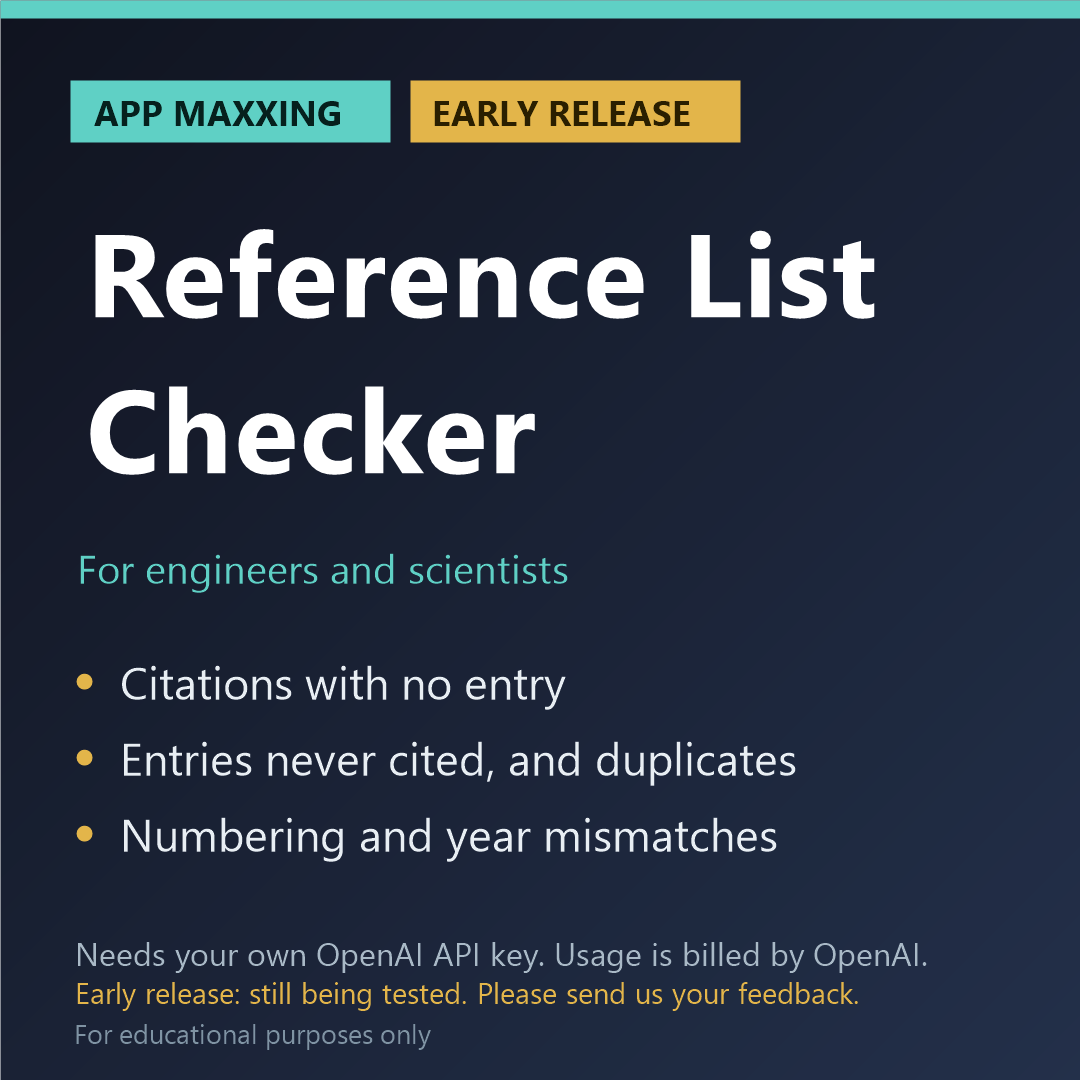
Tie the citations the app can read in your own manuscript to their entries in the reference list, and see the loose ends.
WHAT IT DOES
Add your own manuscript as a Word file or as a PDF with a text layer (one whose text you can select and copy). The app reads it on your computer and finds, in code, your reference list and every citation in the text: numbers in square brackets such as [3], [3-5] and [3, 7], superscript numbers, and author-and-year citations such as (Okafor and Lind, 2021) and Okafor et al. (2021). It ties each citation to its entry and lists the loose ends: a citation with no entry, an entry that is never cited, a year or an author name that differs between the text and the list, an entry listed twice, a gap in the numbering, numbers first cited out of order, and entries with no year, no pages or no DOI, or written differently from the rest of the list. Every finding shows the exact sentence or entry and where it is. The manuscript file itself is not uploaded, and the rest of its text is sent only if you tick the box for that. The model is given your reference list and the sentences that carry a citation, and the button 'See exactly what will be sent' shows every word. The model splits each entry into title and source, and may point at a sentence whose words do not seem to fit the title of the entry it cites, marked 'worth a look' (it sees only the title, never the cited work). The app looks each of those up in your file. You get a count of what was checked and what was not, a two-column view of every citation beside its entry with the loose ends in red, an Excel file and a Word report. For educational purposes only.
HOW IT IS BUILT
- The app's own code does the finding, the arithmetic and the unit conversions. The AI is used only for what code cannot do, and what it says is checked against your file.
- Anything the app cannot find in your file is marked "not found in the file", not trusted.
- The cost is shown before each run and after it, with a limit you set for one run.
- No verdicts: the app never says pass, fail or compliant. It shows you what it found and where.
WHAT YOU NEED
- Windows, Mac or Linux, and free Node.js 18 or newer
- Your own OpenAI account with API access and a key (platform.openai.com). This is separate from a ChatGPT subscription.
- You pay OpenAI for what you use, on top of the price of the app. In our own tests on a short sample file, a run of this app cost about 3 cents. Longer files cost more.
- The app uses OpenAI's GPT-6.1 Sol model by default, the cheaper of the two it supports. In Settings you can switch to GPT-6 Astra, at about five times the price.
- About ten minutes of setup. A step-by-step guide is included.
HONEST LIMITS
Nothing is looked up anywhere: the app does not know whether a reference exists, whether its details are right, or whether it says what your sentence says, and it never suggests another reference. It works on names, years and numbers as they are written, so a citation in a style it does not know is missed: footnotes, numbers without brackets, and author-and-year citations with no brackets are not read, and the counts cover only what was found. Superscript numbers are read from Word files and from text that keeps them as superscript characters; a PDF usually loses them. In a PDF, page headers, footnotes and text set in columns can break a sentence or an entry in the wrong place. The 'worth a look' remarks come from the model, which sees only the entries of your list, never the cited works. A blank findings list does not mean the document is correct. Use it on your own manuscript only, never on one you are reviewing or marking for someone else, and follow the rules of your journal and funder on the use of AI.
For educational purposes only, and for your own research and your own documents. The app points things out for you to check: it does not certify, approve or sign off anything, what the AI writes can be wrong, and it is not a substitute for review by a qualified person. You are asked to accept this when you first open the app.
PRIVACY
The app runs on your computer. It says before each run exactly what will be sent to OpenAI, under OpenAI's terms, and what stays on your computer; nothing is sent to us. Use it only with documents you are allowed to send to an AI service: not an employer's or customer's confidential documents, not export-controlled material, and not someone else's unpublished work. Your key is stored only on your computer and is sent only to OpenAI.
WHAT IS INCLUDED
The app (a zip file), start files for Windows, Mac and Linux, a sample to try, a setup guide and a README. Kitson Workshop is not affiliated with or endorsed by OpenAI.
REFUNDS
Digital download. If we cannot get it running for you, email kit376351@gmail.com within 14 days for a refund of the app price. Credit you bought from OpenAI is theirs to refund or not.
FEEDBACK AND IDEAS
Email kit376351@gmail.com with the subject "Maxxing feedback" to report a fault or tell us what worked. For a new app idea, use the subject "Kitson idea".