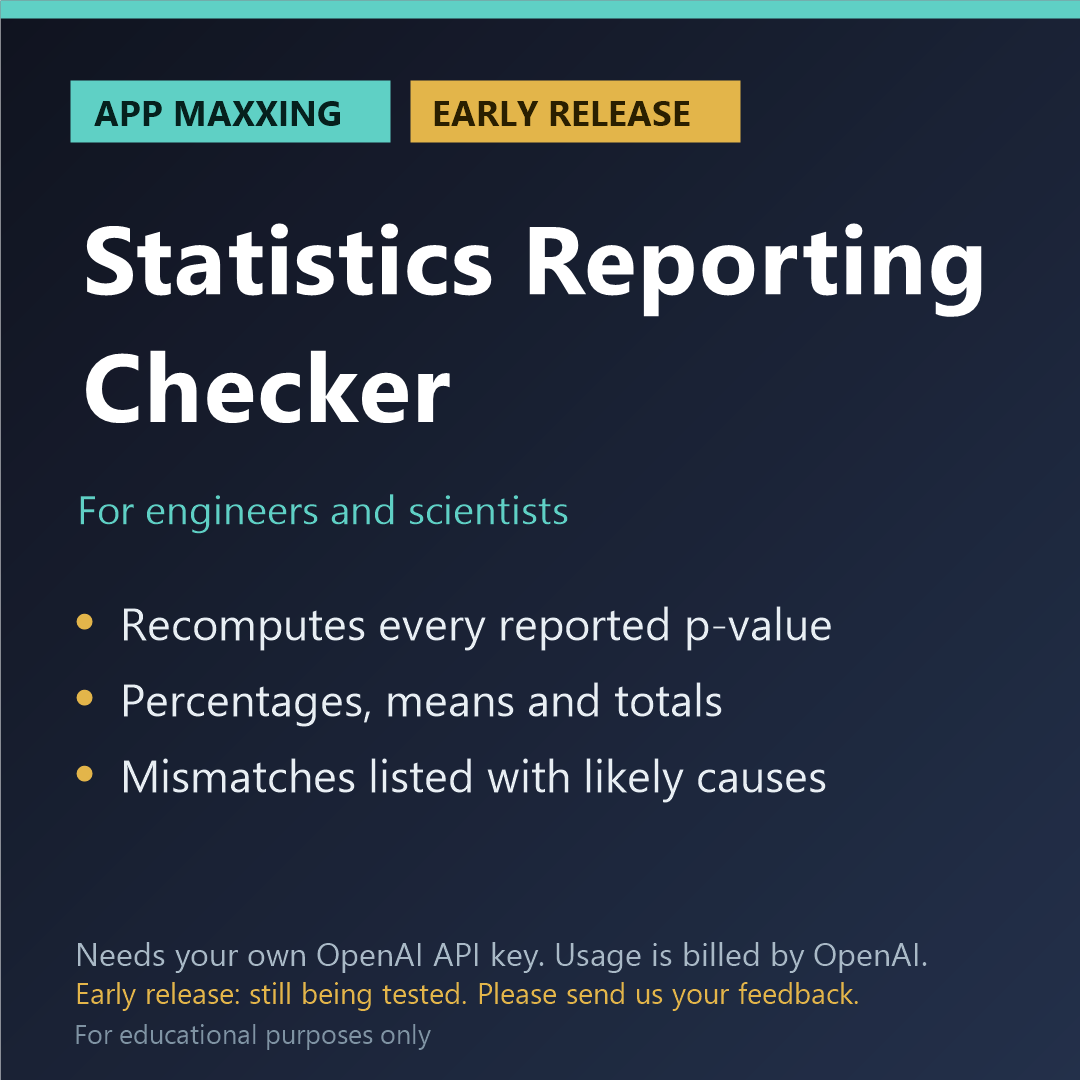
Statistics Reporting Checker (App Maxxing, early release)
EARLY RELEASE: PLEASE READ BEFORE BUYING
- This app needs your own OpenAI API key. It will not run without one, and a ChatGPT subscription does not include one.
- It is an early release that still needs further testing. So far each app has passed our own offline tests, and has been run on its built-in sample against the live service on both models (October 2026). It has not yet been tried on a wide range of real files of different kinds and sizes. You may meet faults.
- Please tell us what you find after you buy: email kit376351@gmail.com with the subject "Maxxing feedback". Every report is read, and fixes are sent to buyers free.
- If we cannot get it running for you, email us within 14 days for a refund of the app price.
Check that the statistics in your own manuscript agree with each other: p-values reported with a t, F, chi-square, r or z statistic are re-computed in code.
WHAT IT DOES
Add your own manuscript, or only its results section: what you add is sent to OpenAI. The app first reads, by itself and in code, every result written in the usual forms, such as t(28) = 2.31, p = .028, F(2, 57) = 4.10, p < .05, chi-square(1, N = 120) = 5.2, p = .02, r(48) = .31, p = .03 and z = 2.1, p = .04, and every percentage written beside its counts. The model is then asked to read only what those patterns miss: results written out in a sentence or a table, means on rating scales, totals, and the sample size a result is based on. Each thing the model read is shown to you with its sentence, as a short reading you can correct, and nothing is worked out from it until you confirm it. All the arithmetic is the app's own: the p-value is re-computed from the statistic and its degrees of freedom and compared with the reported one, allowing for the rounding of both; a percentage is compared with its counts; a mean is tested against the number of whole-number answers behind it; a total against its parts; and degrees of freedom against the sample size in simple designs. You get a count of what was checked and what was not, the re-computed p beside each reported one with the working shown, a separate list of the cases where the two fall on different sides of 0.05 (a convention, used here only to sort the list), an Excel file and a Word report. The marks are 'arithmetic agrees', 'inconsistent as reported' and 'could not check'. For educational purposes only.
HOW IT IS BUILT
- The app's own code does the finding, the arithmetic and the unit conversions. The AI is used only for what code cannot do, and what it says is checked against your file.
- Anything the app cannot find in your file is marked "not found in the file", not trusted.
- The cost is shown before each run and after it, with a limit you set for one run.
- No verdicts: the app never says pass, fail or compliant. It shows you what it found and where.
WHAT YOU NEED
- Windows, Mac or Linux, and free Node.js 18 or newer
- Your own OpenAI account with API access and a key (platform.openai.com). This is separate from a ChatGPT subscription.
- You pay OpenAI for what you use, on top of the price of the app. In our own tests on a short sample file, a run of this app cost about 26 cents. Longer files cost more.
- The app uses OpenAI's GPT-6 Astra model. In Settings you can switch to a cheaper model at about a fifth of the price.
- About ten minutes of setup. A step-by-step guide is included.
HONEST LIMITS
An inconsistency means that two reported figures do not agree with each other. It does not say which one needs correcting, and the usual causes are innocent: rounding, a one-tailed test, a typo, or a correction that is not mentioned beside the result. The app takes every test as two-tailed unless the sentence of the result says one-tailed, so one-tailed tests and corrections for several comparisons or unequal variances cause false alarms. It does not judge whether the right test was used, whether its assumptions hold, or whether the conclusions follow. It reads t, F, chi-square, r and z results; other statistics, results shown only in graphs or pictures, numbers with a decimal comma, and supplementary files are not read. The app's own reader and the model can both misread or miss a result, so a blank findings list does not mean the manuscript is correct. Use it on your own work only: never on a manuscript, thesis or proposal you are reviewing or marking for someone else. Journals and funders have rules on the use and disclosure of AI: follow yours.
For educational purposes only, and for your own research and your own documents. The app points things out for you to check: it does not certify, approve or sign off anything, what the AI writes can be wrong, and it is not a substitute for review by a qualified person. You are asked to accept this when you first open the app.
PRIVACY
The app runs on your computer. It says before each run exactly what will be sent to OpenAI, under OpenAI's terms, and what stays on your computer; nothing is sent to us. Use it only with documents you are allowed to send to an AI service: not an employer's or customer's confidential documents, not export-controlled material, and not someone else's unpublished work. Your key is stored only on your computer and is sent only to OpenAI.
WHAT IS INCLUDED
The app (a zip file), start files for Windows, Mac and Linux, a sample to try, a setup guide and a README. Kitson Workshop is not affiliated with or endorsed by OpenAI.
REFUNDS
Digital download. If we cannot get it running for you, email kit376351@gmail.com within 14 days for a refund of the app price. Credit you bought from OpenAI is theirs to refund or not.
FEEDBACK AND IDEAS
Email kit376351@gmail.com with the subject "Maxxing feedback" to report a fault or tell us what worked. For a new app idea, use the subject "Kitson idea".