

Doe Assist Pro APP – 1-Year License
DoE Assist Pro™ APP – 1-Year License
Design of Experiments for HPLC and UHPLC method development. Build the design, run the
worksheet, fit and diagnose the model, optimize every response at once, and export a
report you can put in a development file. Runs in your browser - nothing to install.
Stop changing one factor at a time.
Change organic modifier, then pH, then temperature, one at a time and you will find a setting that works. You will not find the interaction that decides whether your method survives a column change, the curvature that puts the true optimum between the levels you tested, or the range around your setpoint where every requirement still holds.
Twenty one-factor-at-a-time runs answer one question at a time. Nineteen designed runs answer all of them at once, and tell you how confident you are in each answer.
DoE Assist Pro is a complete DoE workbench built for chromatographer, not a general statistics package you have to translate into chromatography yourself.
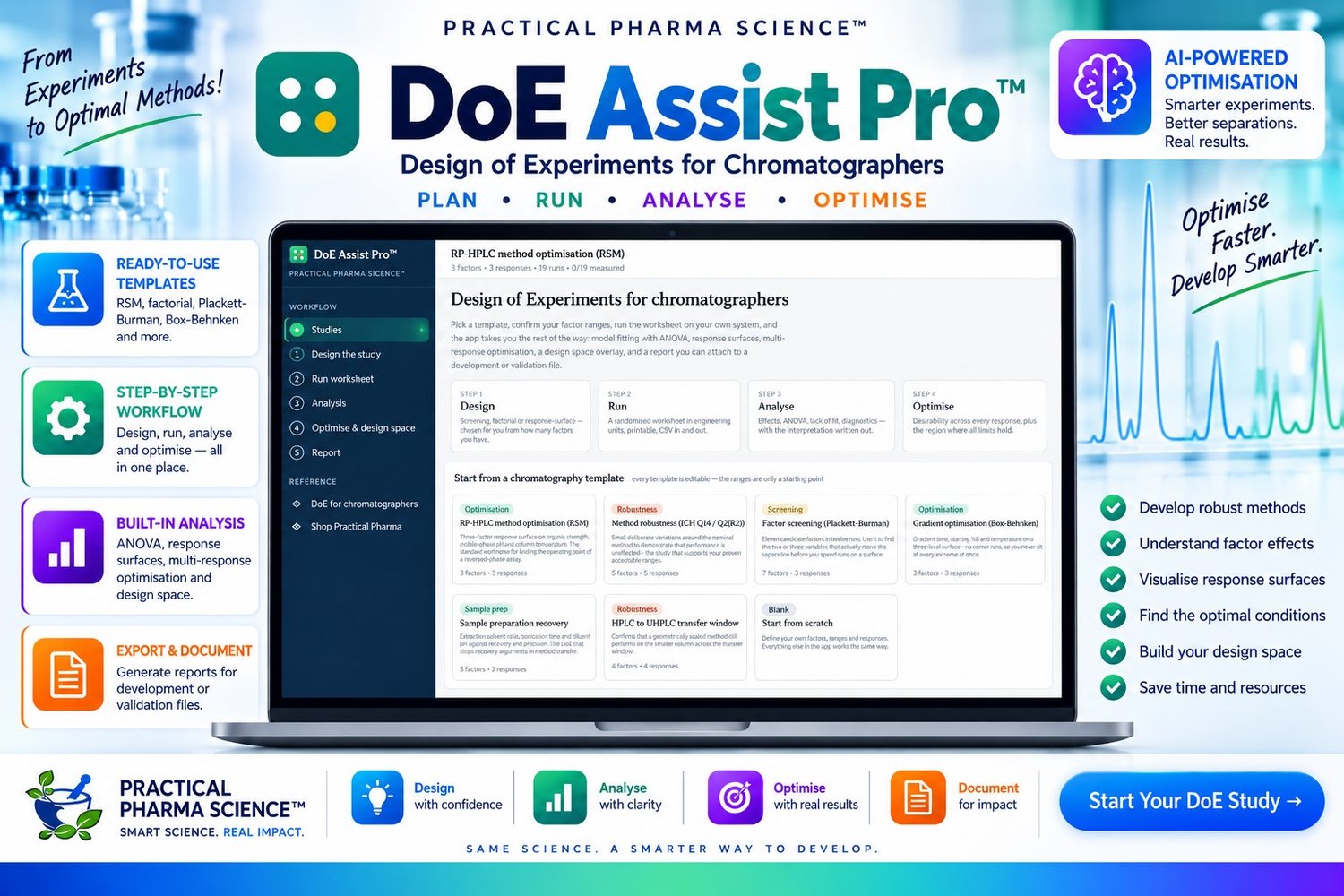
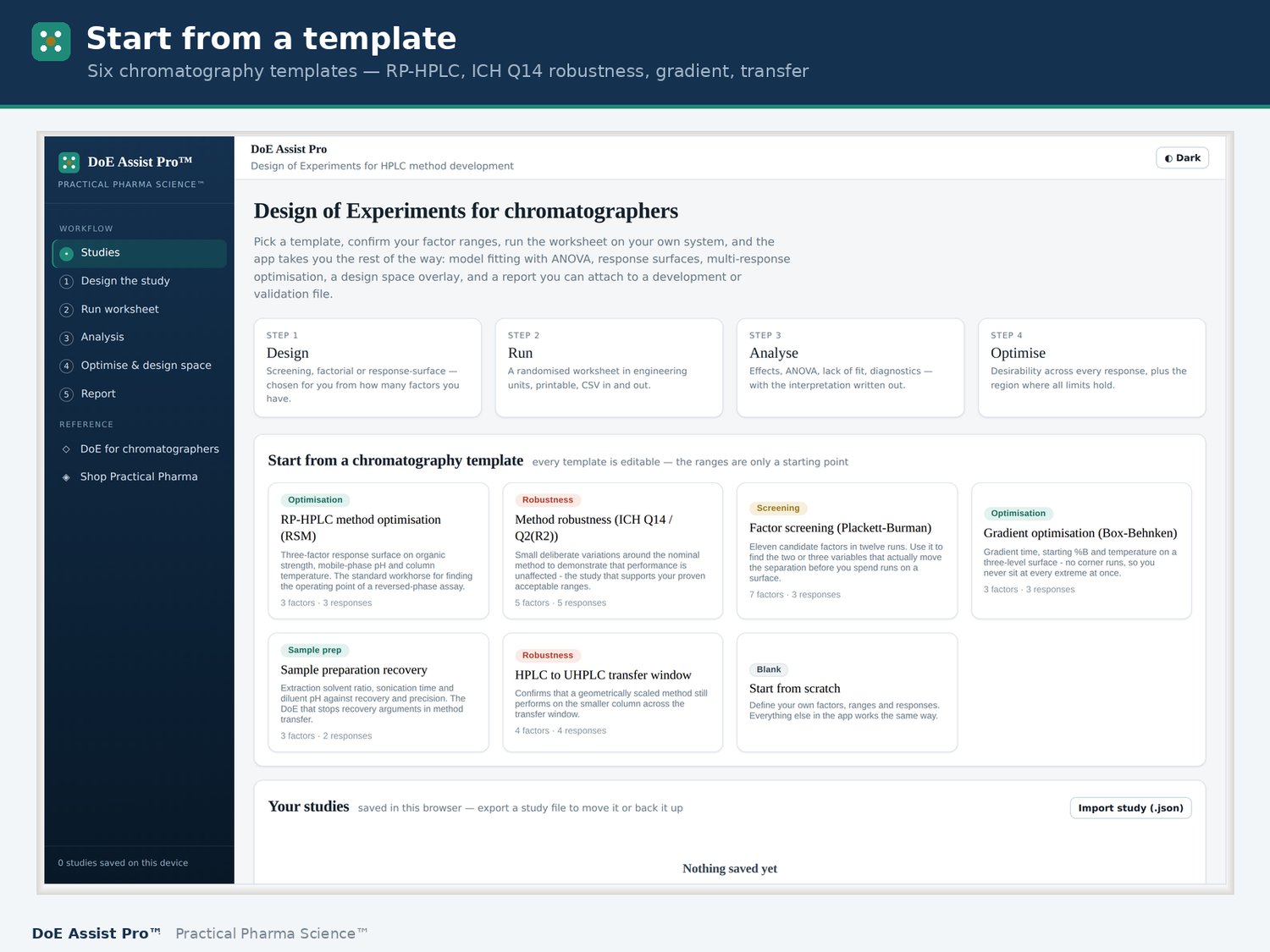
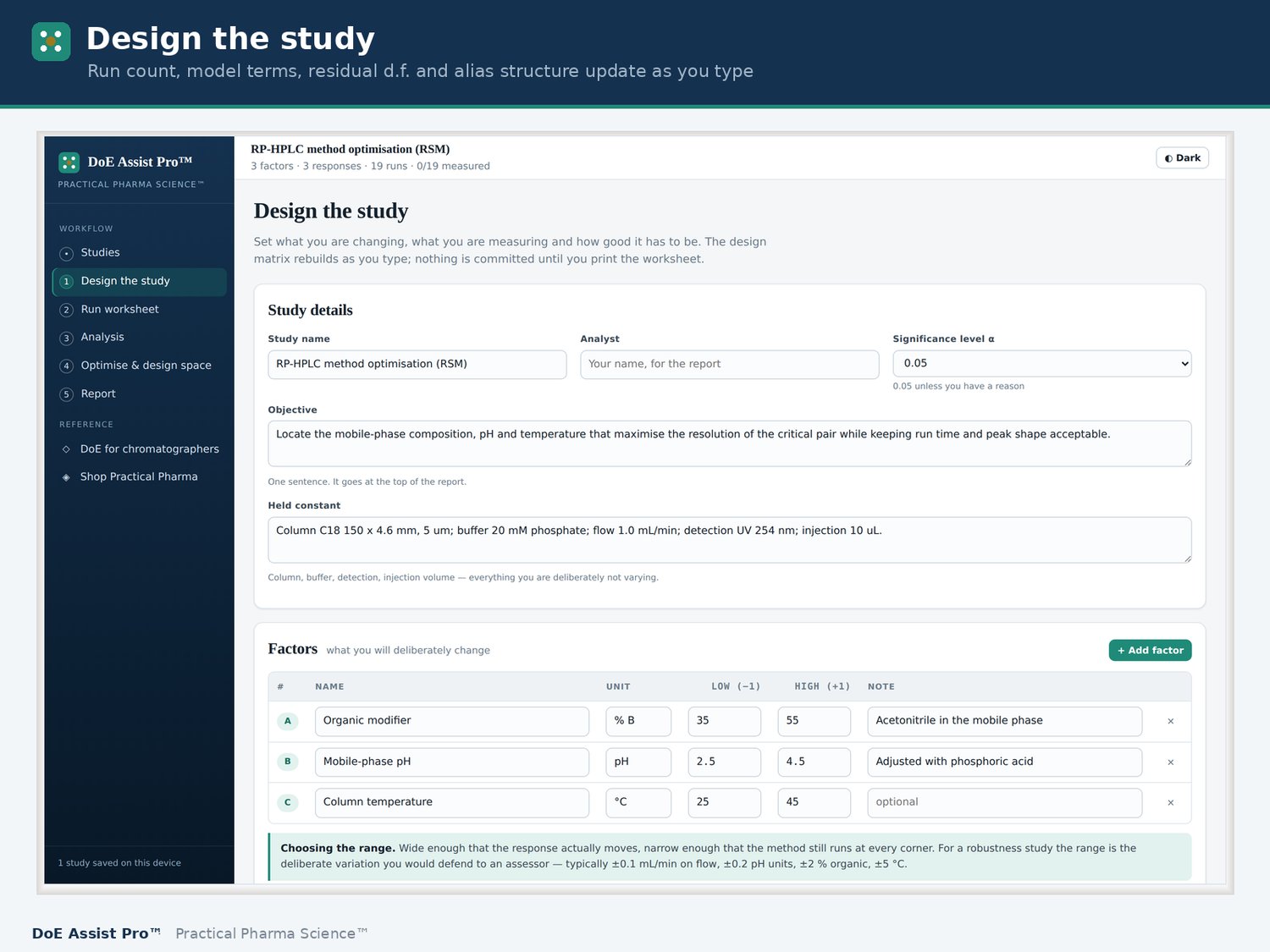
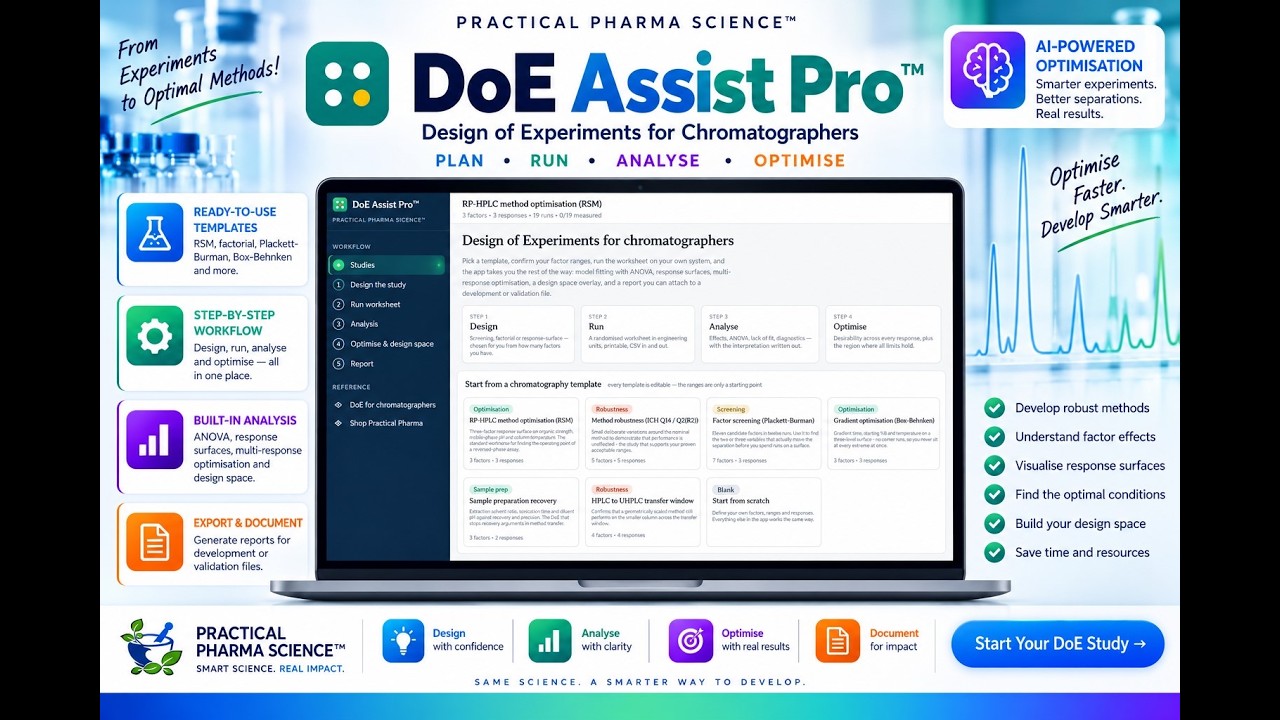
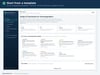
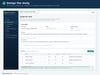
1 · Design - Plackett-Burman, fractional and full factorial, Box-Behnken and central composite, with the trade-offs written out. Run count, model terms, residual degrees of freedom and the alias structure update as you type, so you see what a smaller design costs you before you commit instrument time. Six chromatography templates to start from: RP-HPLC optimisation, ICH Q14 robustness, Plackett-Burman screening, gradient optimisation, sample-preparation recovery, HPLC-to-UHPLC transfer.
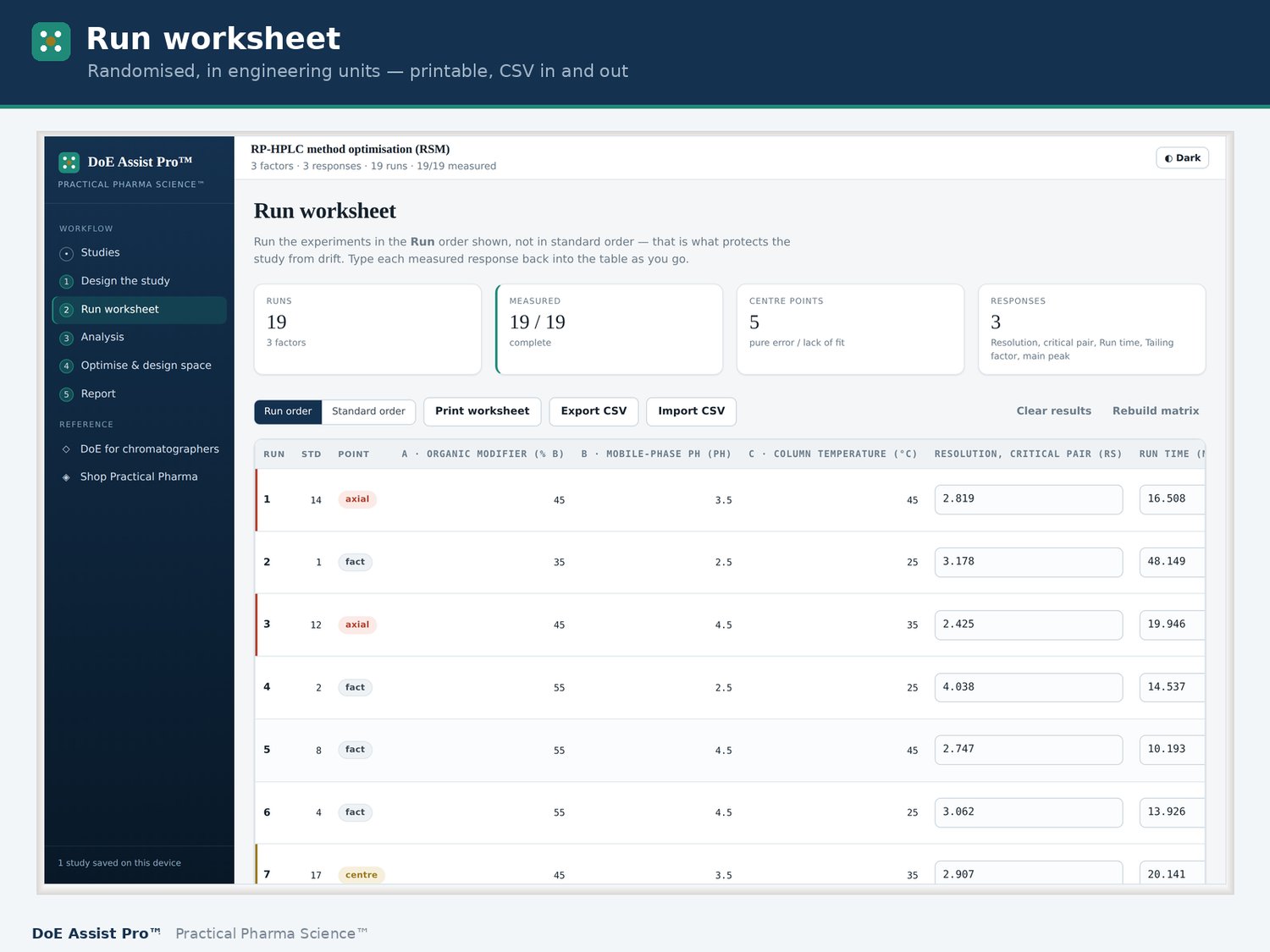
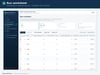
2 · Run - A randomised worksheet in engineering units. Printable, CSV in and out, per-run exclusion, and a predicted chromatogram for any run. A built-in chromatographic simulator fills every response from a first-principles model, so you can rehearse an entire study and learn the workflow before booking a single injection.
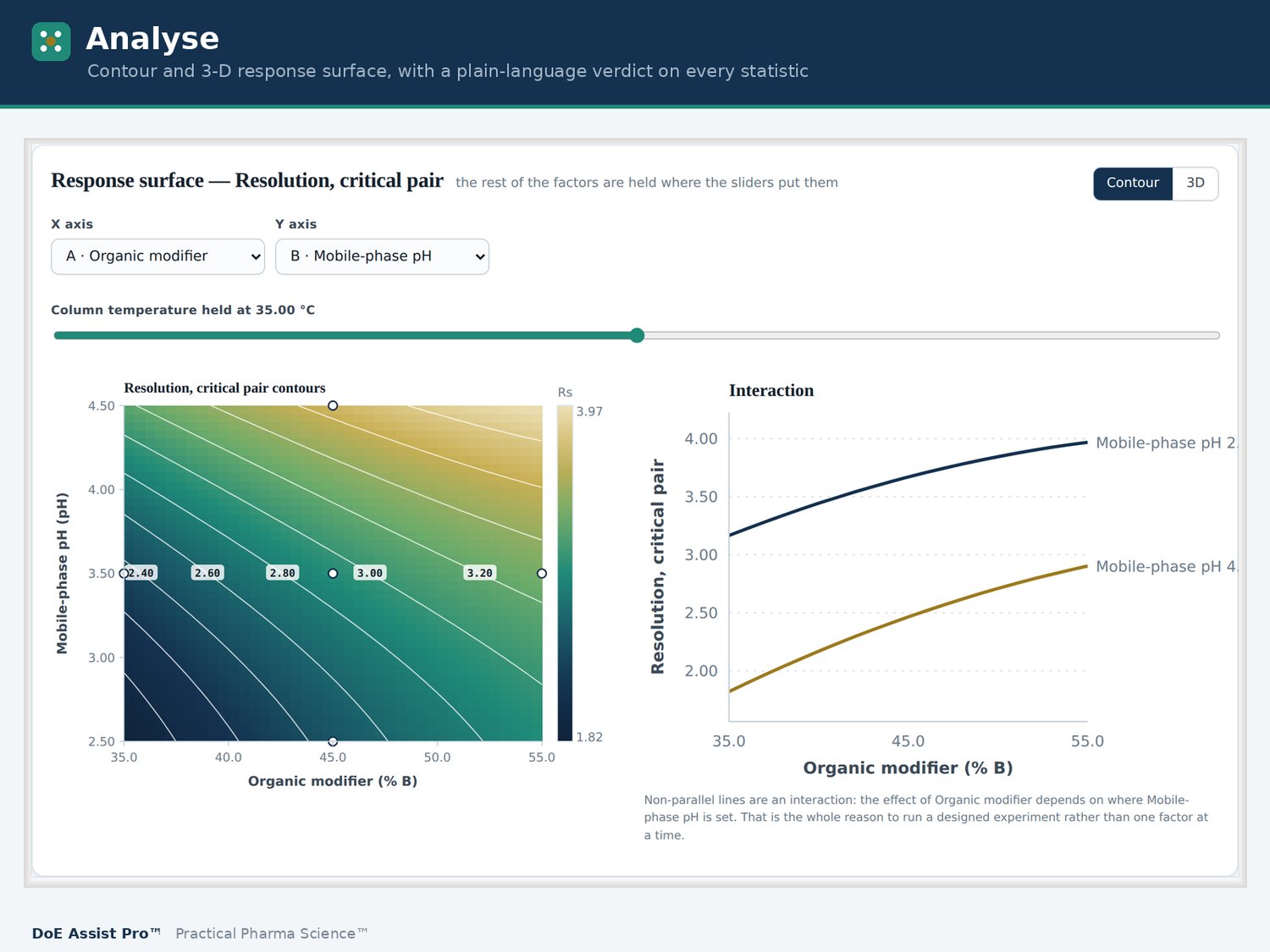
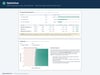
3 · Analyse - Least-squares fit in coded units with coefficients, standard errors, 95 % confidence intervals, t, p and VIF; ANOVA with Type III sums of squares; R², adjusted R², predicted R² from leave-one-out PRESS, adequate precision and CV; pure-error lack-of-fit from replicated centre points; Pareto and half-normal plots; contour, interactive 3-D surface and interaction plots; predicted-vs-actual, residuals-vs-fitted, normal plot and residuals in run order; click-to-drop model reduction.
Every statistic comes with a plain-language verdict - what the number means, whether you can act on it, and what to do when the answer is no. Including when the answer is no.
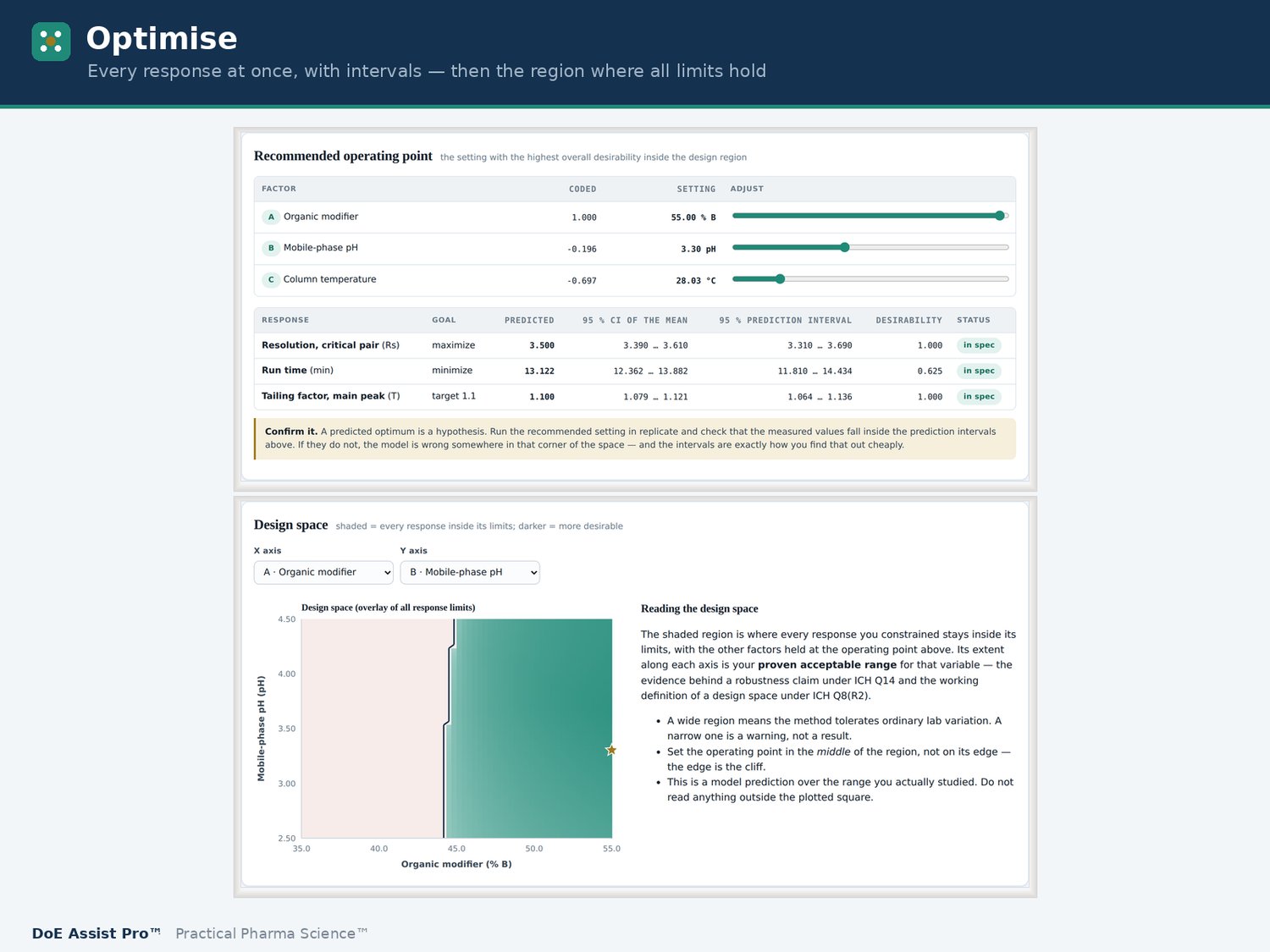
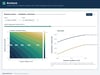
4 · Optimise - Derringer-Suich desirability across every response, weighted by the importance you set, with confidence and prediction intervals at the optimum. A design space overlay shows every setting where all your limits hold at once, the proven acceptable ranges behind an ICH Q14 robustness claim.
5 · Confirm - Lock the recommended setting, run it in replicate, type the measured values back in. Each response is tested against the prediction interval for the mean of n future runs, with a per-response verdict and a plain statement of what a failure means.
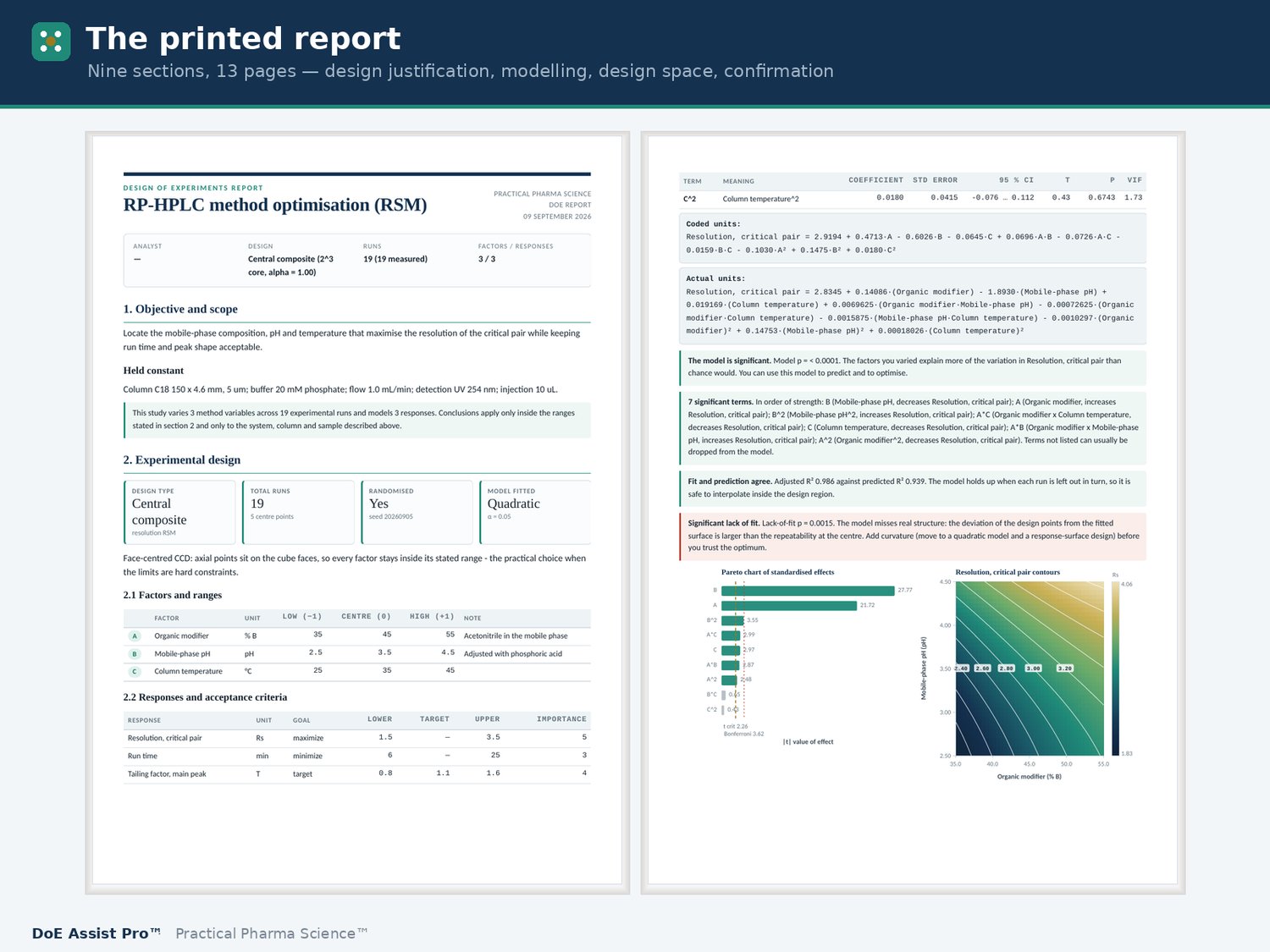
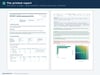
6 · Report - A branded, print-to-PDF development report in nine sections: objective and scope, experimental design and justification, run matrix, statistical modelling per response, optimisation with intervals, design space, confirmation, conclusions, and a scope-and-limitations section naming the statistical methods used.
Plus a built-in reference guide, DoE for chromatographers - design choice, sensible factor ranges for HPLC variables, how to read every statistic, and the eight mistakes that ruin DoE studies.
The numbers are checked.
The statistics engine is dependency-free and was cross-checked against statsmodels OLS on a 19-run face-centred central composite design with a full quadratic model. Coefficients, standard errors, t statistics, p values, R², adjusted R², model F, model p, residual mean square and Type III term sums of squares all agree to within 4 × 10⁻¹⁴. Distribution functions were checked against published critical values and scipy.stats. The hat-matrix PRESS matches brute-force leave-one-out refitting, the pure-error sum of squares matches the centre-point replicates directly, and the optimiser recovers the analytic stationary point of a known quadratic to within 5 × 10⁻³ in coded units.
Your data stays on your machine.
Studies are saved in your own browser, on your own computer. Nothing is uploaded, nothing is visible to anyone else, and there is no account to create. Any study exports to a single .doe.json file - design, results, model choices and confirmation runs and imports on another machine.
What you get
- DoE Assist Pro, in your browser - nothing to install, works in Chrome, Edge, Firefox and Safari
- A 1-year licence from the date of purchase
- A 16-page Professional User Guide (PDF and Word)
- A Welcome & Access sheet with your app address and setup steps
- A 13-page sample development report, so you can see the output before you run a study
Licence terms
Licensed per user. Your key activates on two devices, a lab PC and a laptop, say one at a time. Both stay unlocked and you re-enter nothing when you move between them; if both are open at once, the second offers to take over and the first is signed out. You can hand a slot back yourself from the machine holding it, at any time.
Who this is for
Analytical chemists and method-development scientists in pharma QC, CRO and generic development who already understand chromatography and want the experimental design and the statistics handled properly, without an instrument-vendor licence, a CDS, or a procurement cycle.
Who this is not for
If you need a validated computerised system or a controlled GxP record, this is not that, and no amount of configuration will make it that. See the scope statement below.
Scope
DoE Assist Pro is a scientific decision-support tool. It is not a validated computerised system, it does not create a controlled GxP record, and it is not a system of record. Every method it proposes must be confirmed experimentally on your own instrument and assessed under your own quality system. The built-in simulator produces modelled values, never measured ones, and the report marks them as such.
Guarantee
If it does not do what this page says, reply to your purchase email within 30 days and I will refund you in full.
Buying for your lab or company?
Pay by card or PayPal and download a PDF invoice with your company name and VAT/tax number from your receipt. Need an invoice before you pay, a purchase-order reference, or licences for 5 or 10 analysts? Email practicalpharma.science@yahoo.com with your company name, billing contact and number of users, and you'll receive a quote within one business day.
HPLC, LCMS & GCMS Apps Suite Presentation
👉 https://pps-app-suite.vercel.app/
You tube
👉 https://www.youtube.com/@PracticalPharmaScience
FREE App - HPLC Method Optimizer
👉 https://hplc-method-optimizer.vercel.app/
DoE Assist Pro™ · Mirela Gorjanu · Practical Pharma Science™ Questions: practicalpharma.science@yahoo.com