

Across the Lifespan: Autistic Girls & Women
Across the Lifespan: Autistic Girls & Women
How autistic traits and support needs may shift from childhood to adulthood
Autism does not stop changing shape when childhood ends.
As autistic girls grow into teenagers and women, their environment, responsibilities, relationships, bodies, expectations and understanding of themselves can change considerably. Traits that were noticeable in childhood may become less visible, while needs that were previously manageable may become more significant as demands increase.
Some autistic girls and women also learn to mask or camouflage aspects of their autistic experience. This can make difficulties less apparent to other people and may contribute to delayed recognition and support.
Across the Lifespan: Autistic Girls & Women is a research-informed educational poster designed to provide a broader picture of how autistic experiences and support needs may evolve from childhood through adolescence, emerging adulthood, adulthood, midlife and later life.
Rather than presenting one fixed picture of autism, the resource emphasises diversity, individual development and the importance of support that changes with the person.
The central message is:
Same person. Different seasons. A full life.
🧠 What This Poster Explores
This visual resource follows autistic girls and women across five broad life stages and explores:
- How autistic traits may be expressed differently across the lifespan
- Characteristics that may be visible to other people
- Experiences and support needs that may be missed
- Changing social and environmental expectations
- Masking and camouflaging
- Sensory and social overload
- Executive-function demands
- Anxiety, burnout and emotional wellbeing
- Identity and self-understanding
- Relationships, education, employment and independence
- The possible impact of hormonal and life-stage changes
- Recognition and diagnosis later in life
- Practical support at different stages
- Why support should remain individualised throughout life
The poster does not suggest that every autistic girl or woman follows the same developmental pathway.
Instead, it encourages us to understand autism as a lifelong neurodevelopmental difference experienced within an ever-changing environment.
🌱 Childhood — 0 to 11 Years
Autistic traits can be present from early childhood without always being recognised.
Some girls may appear quiet or compliant, prefer solitary or parallel play, develop deep interests or experience significant sensory sensitivities.
At the same time, difficulties may be less obvious.
Sensory overload, social confusion, literal processing, anxiety, distress or the effort involved in pleasing adults may not always be recognised as signs that additional support is needed.
What May Help
Support during childhood may include:
- Attentive and responsive adults
- Sensory-friendly environments
- Acceptance of differences
- Play-based approaches
- Recognising the whole child rather than relying on stereotypes
A child who appears to be coping may still be working extremely hard internally.
Curious minds often see the world differently.
🌻 Adolescence — 12 to 18 Years
The teenage years can bring a sharp increase in social, academic and emotional expectations.
Some autistic girls may work increasingly hard to fit in, achieve highly, develop friendships and manage growing expectations for independence.
What may be less visible is the effort involved.
Camouflaging, sensory overload, anxiety and distress can occur alongside an outward appearance of capability. Changes, transitions and the increasing complexity of social life may become particularly demanding.
What May Help
Helpful support may include:
- Non-judgemental understanding
- Safe spaces where the young person does not need to perform or mask
- Flexible educational approaches
- Appropriate mental-health support
- Validation of lived experience
- Support with identity and self-acceptance
Fitting in can be exhausting when you see the world differently.
💙 Emerging Adulthood — 18 to 25 Years
Leaving school and moving towards university, employment, training or greater independence can introduce an entirely new level of demand.
An autistic young woman may appear independent, motivated and capable while simultaneously experiencing considerable executive-function, sensory and social strain.
Studying, employment, finances, relationships, independent living, appointments, travel, self-care and decision-making can all compete for the same limited resources.
Some difficulties may therefore become more noticeable when external structure decreases and expectations increase.
These may include:
- Executive-function difficulties
- Sensory and social overload
- Exhaustion or burnout
- Anxiety or depression
- Previously unmet support needs
- Internal struggles to maintain daily life
What May Help
Support might include flexible education or employment arrangements, sensory and social accommodations, executive-function support, access to appropriate healthcare, encouragement to unmask safely and practical assistance during major transitions.
Capability does not mean it is easy.
🌿 Adulthood — 26 to 49 Years
Adult life can involve multiple overlapping roles.
Employment, relationships, parenting, caring responsibilities, running a household, healthcare and social expectations can magnify both strengths and hidden strain.
An autistic woman may demonstrate strong problem-solving skills, specialist knowledge, advocacy and competence while also experiencing chronic stress, masking, sensory overload or difficulty sustaining the demands expected of her.
Hormonal changes and changing life circumstances may also interact with existing sensory, emotional and regulatory needs.
What May Help
Support can include:
- Understanding and flexibility in the workplace
- Sensory and environmental adjustments
- Appropriate mental and physical healthcare
- Respect for boundaries and available energy
- Support during major life changes
- Recognition and validation of lived experience
Strength can exist alongside struggle.
🌸 Midlife & Later Life — 50+ Years
For some women, later life brings a new period of self-understanding.
An autism diagnosis or recognition of autistic identity may occur only after decades of feeling different without understanding why.
Midlife and later life may bring greater self-awareness, acceptance, meaningful interests and a reframing of past experiences.
At the same time, menopause and hormonal changes, chronic health conditions, changing relationships, social isolation, reduced support or the long-term impact of masking may introduce new challenges.
What May Help
Depending on the individual, support may include:
- Access to appropriate diagnostic assessment
- Recognition of hormonal and life-stage needs
- Community and peer support
- Recognition of lifelong challenges
- Celebrating strengths and resilience
- Inclusive services that remain available beyond childhood and young adulthood
Understanding yourself later in life is still meaningful.
It is never too late for greater understanding.
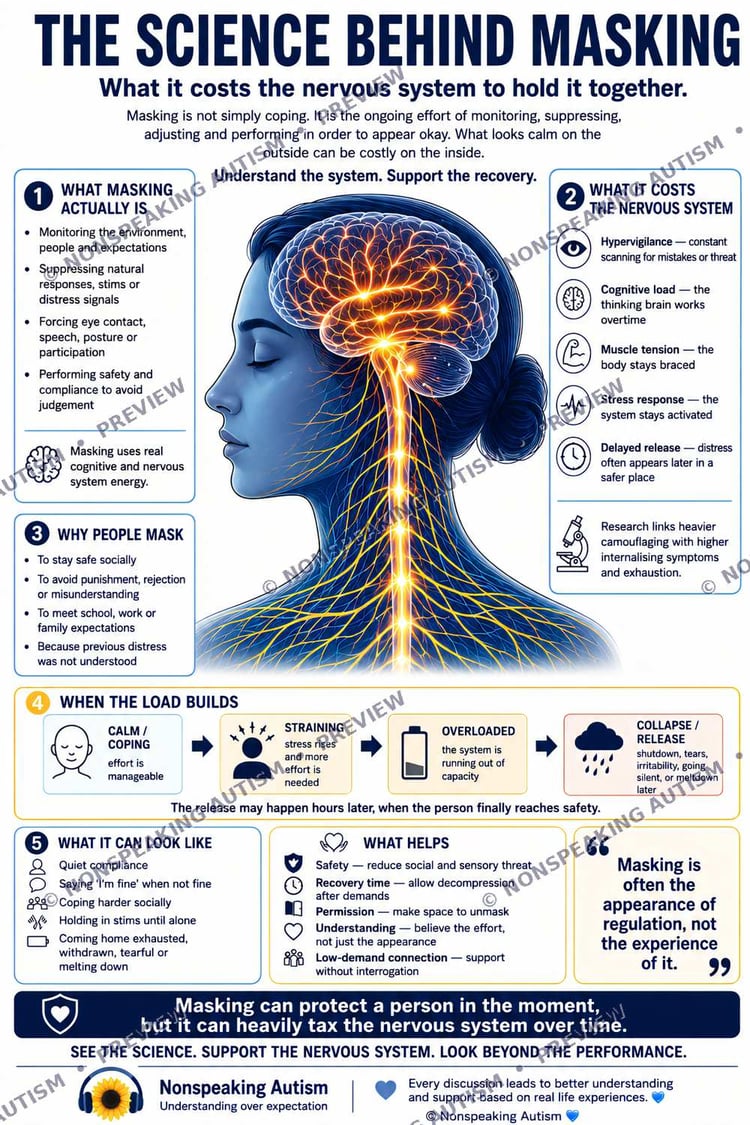
🎭 Masking, Camouflaging & Hidden Support Needs
One of the central themes of this resource is the difference between appearing capable and experiencing something as easy.
Some autistic people consciously or unconsciously modify, suppress or compensate for autistic characteristics in social situations.
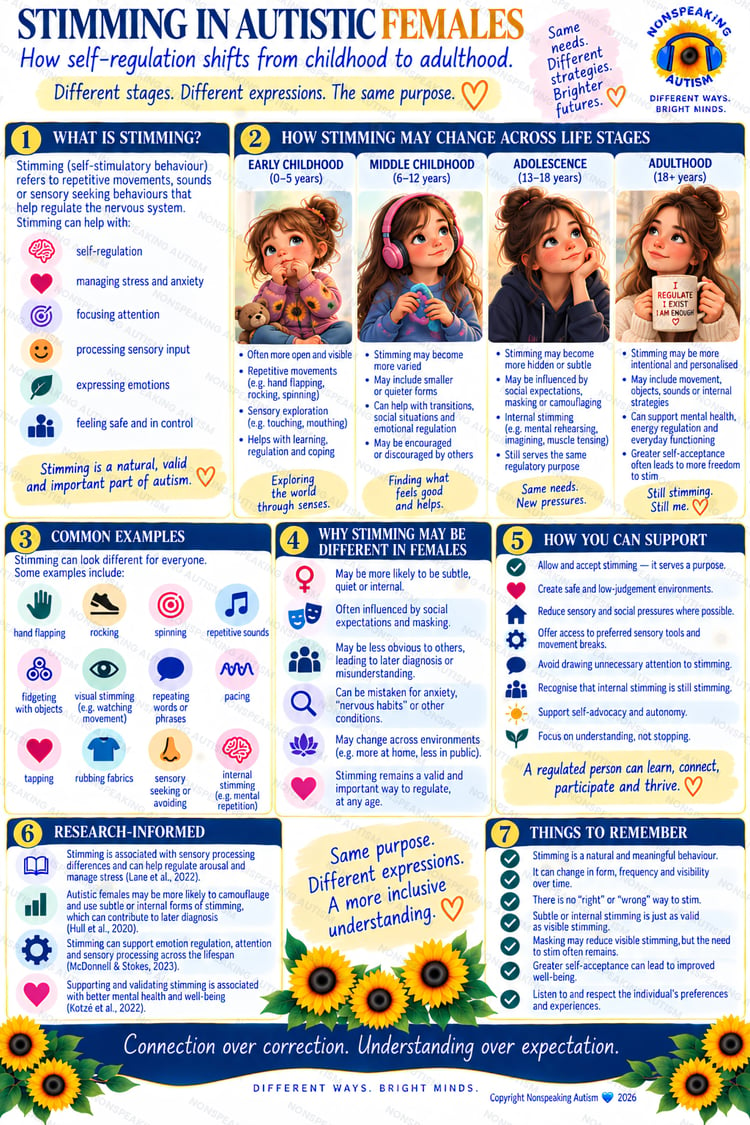
This may include monitoring social behaviour, suppressing stimming, rehearsing conversations, copying other people's behaviour or working intensely to meet expected social norms.
Masking and camouflaging are not exclusive to females, and not every autistic woman masks.
However, research concerning autistic females has helped highlight how camouflaging and gendered expectations may contribute to some autistic girls and women being overlooked or recognised later.
Support should therefore consider internal experience as well as outward presentation.
📈 Illustrative Patterns Across the Lifespan
The poster includes a visual graph exploring possible changes in:
Social expectations — which may increase substantially through adolescence and adulthood.
Masking/camouflaging — which may increase or decrease depending on the individual, environment and growing self-understanding.
Risk of anxiety, burnout or mental-health difficulties — which may fluctuate across different life stages.
Self-awareness and acceptance — which may increase as some autistic people develop a clearer understanding of themselves.
Importantly, this graph shows illustrative patterns — not precise statistics or a predicted developmental pathway.
Real lives are rarely linear.
Experiences may increase, decrease, fluctuate or change form depending on health, environment, relationships, responsibilities, support and individual circumstances.
🔬 Research-Informed
This poster draws on research examining autistic females, camouflaging, recognition and diagnosis, mental health and lived experience across different stages of life.
Selected evidence highlighted on the resource includes:
Lai et al. (2015) — research examining sex/gender differences and autism.
Bargiela et al. (2016) — qualitative research exploring the experiences of women diagnosed with autism in adulthood and the potential consequences of missed recognition.
Corbett et al. (2020) — research relevant to autistic development and experiences during adolescence.
Lockwood Estrin et al. (2021) — research contributing to understanding autism and sex/gender-related differences.
Tubío-Fungueiriño et al. (2021) — a systematic review examining camouflaging in autistic females.
Research suggests that some autistic girls and women may be under-recognised when their presentation differs from traditional or historically male-influenced expectations, and that camouflaging and social pressures can contribute to delayed recognition and exhaustion.
However, autism is highly heterogeneous. Evidence about group-level patterns should never be treated as a rule for an individual woman or girl.
💛 Key Messages
Autistic girls and women are diverse.
There is no single female autistic experience.
Traits and support needs can change in visibility or expression as development, hormones, environment, relationships and social expectations change.
A person may learn to mask or camouflage, making their needs less obvious without making those needs less real.
Support requirements can evolve at different stages of life.
Affirming, flexible and individualised support can help autistic girls and women participate, connect and thrive without requiring them to hide who they are.
And listening to lived experience gives us a fuller and more compassionate understanding of autism.
Different experiences. Equal value. A fuller picture.
👩👧 Who Is This Resource For?
This poster may be useful for:
- Autistic girls and women
- People exploring a possible late autistic identification
- Parents and carers
- Families and partners
- Teachers and teaching assistants
- SENCOs and SEND teams
- Mainstream and specialist schools
- Colleges and universities
- Autism and inclusion teams
- Occupational therapists
- Speech and language professionals
- Psychologists and other relevant professionals
- Healthcare and social-care professionals
- Employers and workplace-support teams
- Family-support and community organisations
- Autism training and professional-development settings
It can be used at home, in educational settings, clinics, therapy spaces, workplaces, community organisations or professional training as a visual starting point for conversations about lifelong autistic experience and changing support needs.
📦 What You Receive
Your purchase includes:
1 × Across the Lifespan: Autistic Girls & Women — Educational Poster
1 × high-quality digital PDF
This is a digital educational resource from Nonspeaking Autism.
The purchased PDF is supplied clear and without the promotional preview watermark. Watermarks visible on Payhip listing images are used for preview and copyright-protection purposes only.
Digital download only — no physical product will be shipped.
⚠️ Important Disclaimer
This resource is provided for educational and informational purposes only.
It is not medical advice, a diagnostic tool, psychological treatment or a substitute for individual assessment or guidance from an appropriately qualified healthcare, educational or other professional.
The lifespan stages and experiences shown are illustrative rather than predictive. They should not be interpreted as milestones, diagnostic criteria or a pathway that every autistic girl or woman will follow.
Autistic girls and women are highly diverse. Their communication, sensory experiences, mental and physical health, relationships, strengths, challenges and support needs can vary substantially both between individuals and throughout one person's life.
Sex and gender research in autism is also continually developing. Group-level research findings should not be used to make assumptions about an individual.
Where there are concerns about physical health, mental health, development or significant changes in functioning, appropriate professional assessment should be sought.
Support should always be individualised, collaborative and informed by the person's own lived experience.
💙 The Message Behind the Resource
An autistic girl does not grow out of autism when she becomes an autistic woman.
What can change is the environment around her, the demands placed upon her, the way her traits are expressed, the strategies she develops and the support she needs.
A quiet child may become a highly capable-looking teenager. A successful young woman may privately be using enormous amounts of energy to maintain daily life. A woman in midlife may finally discover a framework that makes decades of experiences understandable.
None of these stages tells the whole story on its own.
A lifespan perspective allows us to see something much richer:
The same person moving through different seasons of life.
Same person. Different seasons. A full life.
Different stages. Same strengths. Brighter futures.
Connection over correction.
Understanding over expectation.
© Nonspeaking Autism 2026. All rights reserved.