

THE SCIENCE BEHIND: SENSORY DISTRESS vs ANXIETY
THE SCIENCE BEHIND: SENSORY DISTRESS vs ANXIETY
Part 1 of 3 — Where They Overlap, Where They Differ, and Why One May Amplify the Other
UK Edition | Research-Informed Autism Educational Poster | Nonspeaking Autism
💛 Understanding the difference can change how we respond.
When an autistic child covers their ears, withdraws from a busy environment, becomes distressed or struggles to communicate, it can be difficult to know what is happening.
Is the child experiencing sensory distress? Anxiety? Or a combination of both?
Although sensory distress and anxiety can look similar from the outside, they are not necessarily the same experience.
This research-informed educational poster helps parents, carers, teachers, SENCOs and professionals understand possible differences, recognise overlapping signs and consider what may be contributing to a child's distress.
The aim is not to label every response. It is to encourage greater understanding, reduce assumptions and support more individualised, compassionate responses.
🧠 WHAT THIS POSTER EXPLORES
1. What Is Sensory Distress?
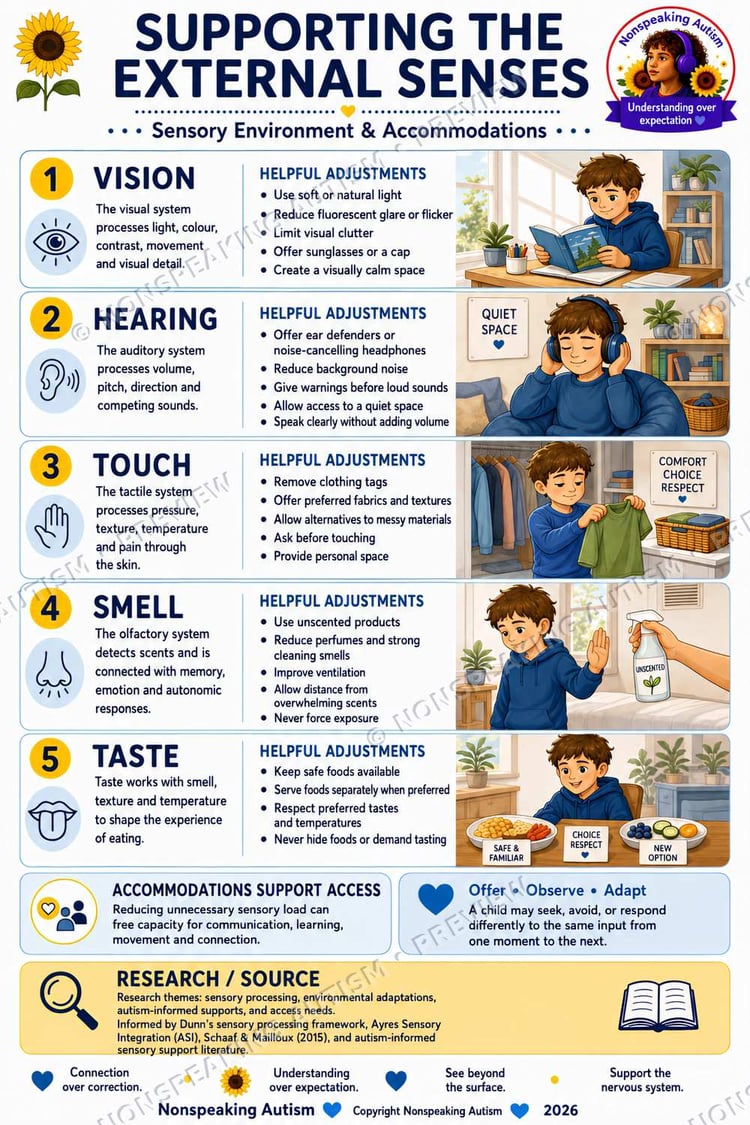
Sensory distress may occur when sensory input feels overwhelming, aversive, painful, unpredictable or difficult to process.
Possible triggers include:
- Loud, repetitive or competing sounds
- Bright or flickering lighting
- Unexpected touch or uncomfortable textures
- Movement or crowded environments
- Strong smells and tastes
- Temperature differences
- Internal body sensations
Sensory distress may happen rapidly and does not necessarily involve anxiety.
Some individuals may feel more comfortable when sensory input is reduced, the environment changes or preferred sensory supports become available.
Important: Sensory distress is a descriptive term, not a formal medical or psychiatric diagnosis.
2. What Is Anxiety?
Anxiety may involve fear, worry, uncertainty or anticipation of something difficult or threatening.
For autistic children and young people, possible sources of anxiety may include:
- Unpredictable situations
- Changes in routine
- Social expectations
- Transitions
- Unfamiliar environments
- Previous distressing experiences
- Worry about future sensory discomfort
Anxiety can arise before a sensory experience, during it or independently of an immediate sensory trigger.
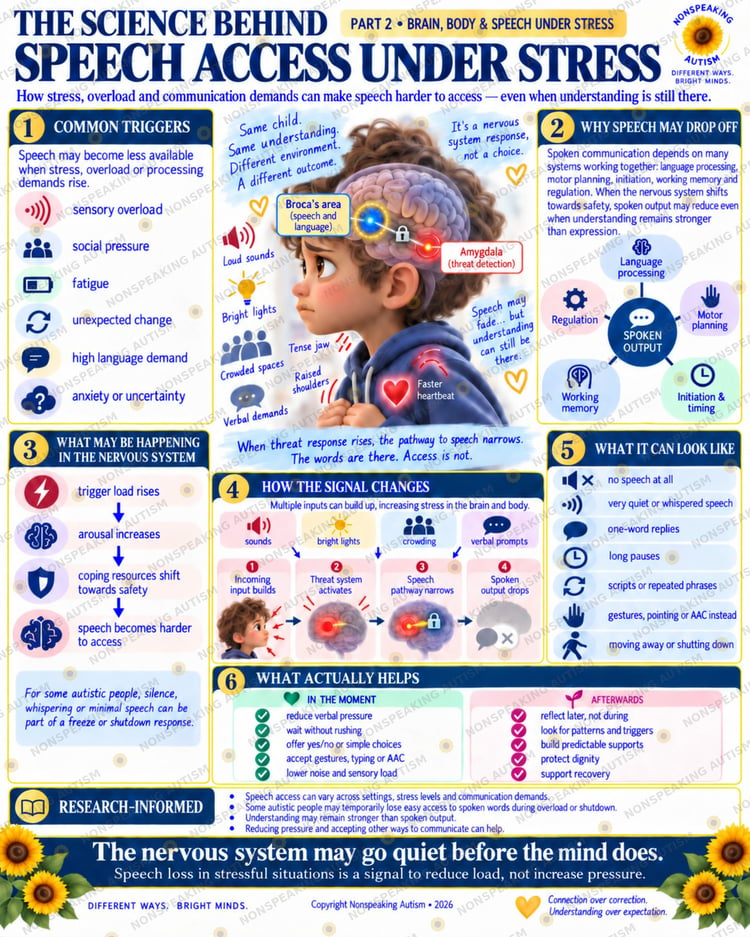
A child may become anxious about entering a busy room because they remember finding the noise overwhelming on a previous occasion.
Sensory distress can occur without anxiety, and anxiety can occur without immediate sensory overload.
3. Why Sensory Distress and Anxiety Can Look Similar
Both experiences may involve:
- Covering ears or eyes
- Moving away or avoiding situations
- Crying or becoming upset
- Pacing or increased movement
- Physical tension
- Reduced speech or communication
- Freezing or shutdown-like withdrawal
- Difficulty concentrating or thinking clearly
These outward responses do not establish a single cause.
A child who avoids a busy classroom may be responding to uncomfortable sensory input, anxiety about the situation, or both.
The same behaviour can have different explanations.
4. Why Understanding the Cause Matters
When adults interpret distress as deliberate refusal, misbehaviour or unwillingness to cooperate, important support needs may be overlooked.
Instead of immediately asking a child to tolerate the situation, it may be more useful to consider:
- What changed in the environment?
- Was there an unexpected sound, touch or transition?
- Is the child anticipating something difficult?
- Could sensory input be overwhelming?
- Could pain, illness, hunger or fatigue be involved?
- What has helped this child previously?
Understanding possible contributing factors can help adults choose more appropriate support.
🌻 SENSORY DISTRESS AND ANXIETY CAN OCCUR TOGETHER
Sensory experiences and anxiety are not always separate.
For example, an unpredictable noise may cause immediate sensory discomfort. After repeated difficult experiences, a child may also become anxious about when the noise will happen again.
Equally, feeling anxious or exhausted may make an already challenging sensory environment harder to manage.
These relationships vary between individuals.
There is no single response pattern that applies to every autistic person.
💙 PRACTICAL WAYS TO SUPPORT A CHILD
Helpful approaches may include:
- Reducing unnecessary noise, lighting or other sensory demands
- Offering access to a quieter space
- Making transitions more predictable
- Explaining changes using accessible communication
- Allowing extra processing and recovery time
- Keeping AAC, visual supports and alternative communication available
- Offering choices and opportunities for control
- Respecting preferred sensory supports
- Responding calmly without forcing eye contact or speech
- Considering physical health and other possible causes of distress
Support should be based on the individual's needs, preferences and circumstances rather than assumptions about what their behaviour means.
The goal is not simply to make distress less visible. It is to help the person feel safer, more comfortable and better supported.
🔬 RESEARCH & GUIDANCE-INFORMED
This poster draws on research examining sensory processing differences, anxiety, emotional distress and their possible relationships in autism.
Research suggests that sensory processing differences and anxiety can be associated, but the nature of that relationship is complex.
Sensory distress does not always cause anxiety, and anxiety should not automatically be assumed whenever a person experiences sensory overload.
📚 Selected Research & UK Guidance
Chen, Y., et al. (2024). A systematic review and meta-analysis of the relationship between sensory processing differences and internalising/externalising problems in autism. Clinical Psychology Review, 114, 102516.
https://doi.org/10.1016/j.cpr.2024.102516
Jenkinson, R., Milne, E., & Thompson, A. (2020). The relationship between intolerance of uncertainty and anxiety in autism: A systematic literature review and meta-analysis. Autism, 24(8), 1933–1944.
National Institute for Health and Care Excellence (NICE). Autism spectrum disorder in under 19s: Support and management (CG170).
https://www.nice.org.uk/guidance/cg170
National Institute for Health and Care Excellence (NICE). Autism spectrum disorder in adults: Diagnosis and management (CG142).
https://www.nice.org.uk/guidance/cg142
Evidence note: These references support the broader educational concepts discussed in this resource. They do not establish that any particular outward behaviour proves sensory distress, anxiety or a specific neurological mechanism. This poster is not a validated screening or diagnostic tool.
👨👩👧 WHO IS THIS RESOURCE FOR?
This educational poster may be useful for:
- Parents and carers of autistic children
- Autistic young people and adults exploring their own experiences
- Teachers and teaching assistants
- SENCOs and school inclusion teams
- SEND professionals
- Occupational therapists
- Speech and language therapists
- Educational psychologists
- Healthcare and social care professionals
- Anyone seeking a more compassionate understanding of sensory distress and anxiety
It may be displayed at home, in classrooms, SEN support areas, therapy rooms, staff training spaces or other educational settings.
📦 WHAT YOU RECEIVE
Your digital download includes:
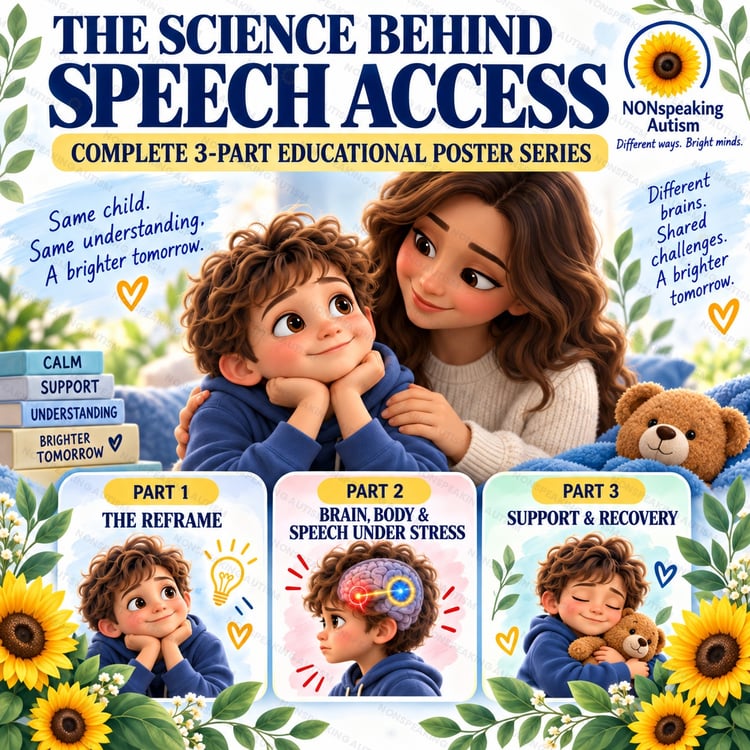
- 1 × The Science Behind: Sensory Distress vs Anxiety — Part 1 of 3
- 1 × high-resolution printable PDF poster
- A clear educational layout with illustrations, explanations and selected research
- The purchased/downloaded PDF without the promotional preview watermark
This listing is for Part 1 only. Parts 2 and 3 are not included.
Digital download only — no physical product will be posted.
⚠️ IMPORTANT DISCLAIMER
This is a research-informed educational resource and is not intended to provide a medical diagnosis, psychological assessment, sensory assessment or individual treatment plan.
Sensory distress and anxiety can overlap with other experiences, including pain, illness, fatigue, communication difficulties and environmental stressors.
The examples shown are possible patterns, not diagnostic rules.
If distress is persistent, severe, significantly affecting daily life or represents a sudden change, seek appropriate professional advice. In the UK, this may include a GP, paediatrician or relevant specialist.
Support should always be individualised and respectful of the person's communication, preferences, safety and autonomy.
©️ COPYRIGHT & PERMITTED USE
Copyright © 2026 Nonspeaking Autism. All rights reserved.
This resource is intended for personal, home, classroom, school and individual professional educational use.
You may print and use the resource in these settings.
You may not resell, redistribute, share the original digital file publicly, upload it to another platform, reproduce it commercially or include it in another product without permission.
Preview watermarks are used to protect the original artwork.
💛 THE MESSAGE BEHIND THIS RESOURCE
A child covering their ears is not automatically anxious.
A child avoiding a busy environment is not automatically being difficult.
A child becoming quiet or withdrawn is not necessarily refusing to communicate.
The same outward response may have different underlying reasons.
Rather than asking only:
“Is this sensory distress or anxiety?”
Ask:
“What is driving the distress right now — and what would help this person feel safer?”
Because understanding the experience matters more than judging the response.
Connection over correction. Understanding over expectation. 💛
Nonspeaking Autism © 2026 🌻💙