
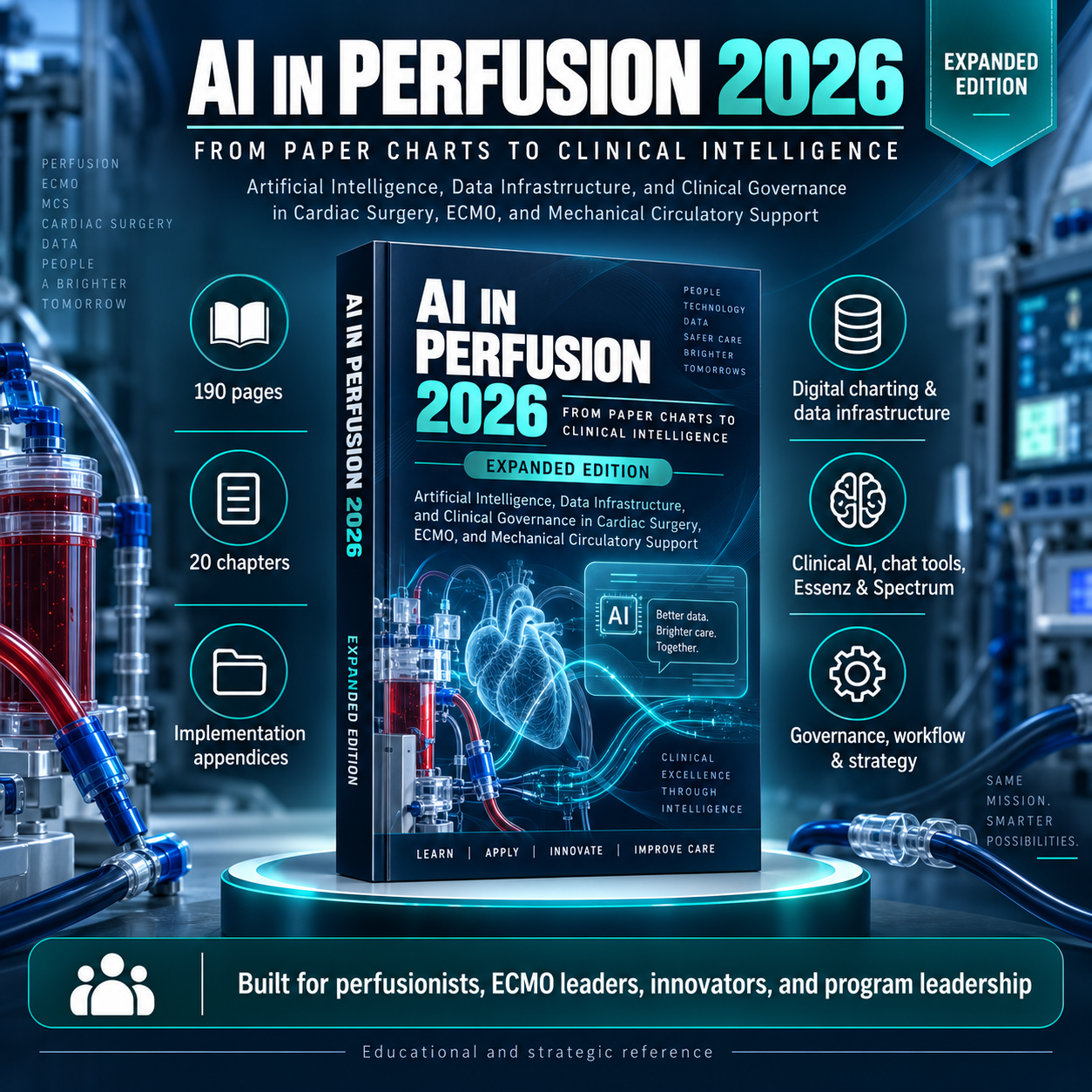
AI in Perfusion, Surgery and Critical Care
From Paper Charts to Clinical Intelligence
Artificial Intelligence, Data Infrastructure, and Clinical Governance in Cardiac Surgery, ECMO, and Mechanical Circulatory Support
Perfusion is one of the most data-intensive specialties in medicine.
Every case produces flow, pressure, blood gases, oxygen delivery, temperature, anticoagulation, transfusion, alarms, interventions, and changes in physiology.
Yet in many programs, much of that information is still manually charted, fragmented across systems, or reduced to a static document after the case.
At the same time, artificial intelligence is moving rapidly into healthcare.
That creates the central question behind this book:
How do we build meaningful clinical AI when the underlying clinical data infrastructure is still incomplete?
Written from the perspective of a Certified Clinical Perfusionist with more than two decades of clinical experience across cardiac surgery, ECMO, mechanical circulatory support, transplant, and extracorporeal medicine, AI in Perfusion 2026 examines AI not as a technology trend, but as a clinical, operational, governance, and business problem.
This expanded edition connects:
Artificial intelligence
Digital perfusion records
Device connectivity
Clinical data
Privacy
Documentation
Patient safety
Clinical governance
Workflow design
Industry strategy
and the future of high-acuity medicine
What’s inside
PART I — UNDERSTANDING THE TECHNOLOGY
How AI actually works
Large language models, machine learning, retrieval, training data, hallucinations, confidence, and why fluent output is not the same as clinical accuracy.
What AI is trained on
Knowledge limitations, dataset bias, model cutoffs, and why the newest clinical evidence may not exist inside the model you are using.
The data you are giving away
Clinical queries, privacy, de-identification, vendor data handling, cloud infrastructure, retention, secondary use, and what clinicians should know before putting patient information into an AI system.
HIPAA and clinical AI
Where existing privacy frameworks fit—and where emerging AI workflows create new governance questions.
PART II — AI IN HIGH-ACUITY CLINICAL CARE
AI at the pump and in the OR
A practical Red / Yellow / Green framework for separating reasonable AI-assisted workflows from uses that require stronger validation, institutional approval, or should remain prohibited.
Hallucinations, anchoring, and clinical risk
Why fabricated citations and plausible-sounding errors matter differently when the clinician is managing bypass, ECMO, MCS, anticoagulation, or organ perfusion.
Bias in the machine
How underrepresentation and data quality affect AI performance in vulnerable and high-risk populations.
AI and the clinical record
Documentation liability, traceability, verification, clinician attestation, audit trails, and what happens when AI-generated information enters the permanent medical record.
PART III — BUILDING GOVERNANCE BEFORE SOMETHING GOES WRONG
Institutional AI governance
How hospitals can structure:
- tool approval
- acceptable-use policies
- vendor review
- privacy and information security
- human verification
- prohibited uses
- incident reporting
- model/version control
- ongoing surveillance
- accountability
What acceptable AI use actually looks like
Practical guidance for clinicians using AI for research, documentation, education, quality review, case preparation, and clinical decision support.
The ECMO-specific AI problem
Why extracorporeal support is one of the most difficult environments in which to deploy AI safely.
NEW IN THE EXPANDED 2026 EDITION
FROM PAPER CHARTS TO CLINICAL INTELLIGENCE
The book now addresses the problem beneath clinical AI:
You cannot build useful AI on data you never captured.
It follows the evolution from:
Paper chart
→ Electronic record
→ Structured clinical data
→ Integrated device data
→ Analytics
→ Governed clinical intelligence
The chapter explores what an AI-ready perfusion record should contain and why converting a paper form into a PDF does not create a usable clinical dataset.
THE DIGITAL PERFUSION TECHNOLOGY STACK
A current look at how perfusion technology is evolving beyond the heart-lung machine.
Topics include:
- Spectrum Medical VIPER / VISION
- Spectrum Quantum informatics architecture
- LivaNova Essenz
- connected perfusion analytics
- EHR integration
- device-generated data
- specialty chat-based perfusion tools
- clinical knowledge assistants
- predictive analytics
- AI-supported documentation
- program dashboards
The important question is no longer whether perfusion will become digital.
It is who will own the data layer and what we will do with it.
WHY PERFUSION TECHNOLOGY HAS LAGGED
One of the new chapters examines why a technologically sophisticated specialty still has relatively limited investment in software and AI.
The book looks at:
- small specialty economics
- fragmented hospital purchasing
- clinician versus buyer misalignment
- lack of direct reimbursement for better data
- difficult EHR integration
- cybersecurity
- medical-device regulation
- poor data standardization
- proprietary versus vendor-neutral ecosystems
- the economics of disposables versus software
And then asks a larger business question:
What if the market is not “software for perfusionists”?
What if the real opportunity is:
High-acuity extracorporeal clinical intelligence
across:
Cardiopulmonary bypass
ECMO
ECPR
Mechanical circulatory support
Shock systems
NRP
Transplant
Machine perfusion
and advanced extracorporeal care
THE CLINICIAN–PRODUCT TRANSLATOR
Technology companies need more than engineers.
They need clinicians who understand what happens when a device, workflow, alarm, data field, or interface meets real clinical care.
The book examines the emerging role of experienced clinicians in:
- product strategy
- workflow design
- clinical validation
- advisory work
- medical affairs
- education
- implementation
- product-market translation
CURRENT CLINICAL AI EVIDENCE
The expanded edition also examines emerging work in cardiac surgery involving:
- machine-learning prediction of acute kidney injury
- perioperative risk modeling
- explainable AI
- dynamic time-series models
- large-language-model approaches
- EHR-based prediction
- external validation
- limitations in generalizability
A major lesson is already becoming clear:
A model that performs well at one hospital may not perform the same way at another.
Local data, workflow, population, documentation, and device configuration matter.
IMPLEMENTATION TOOLS INCLUDED
Appendix A
AI Risk Taxonomy for Perfusion and MCS
Appendix B
BAA & Vendor Due-Diligence Checklist
Appendix C
Institutional AI Governance Policy Template
Appendix D
Minimum Data Set for an AI-Ready Perfusion Record
Appendix E
Perfusion Technology & AI Vendor Scorecard
Appendix F
90-Day Clinical AI Pilot Charter
These tools are designed to move the conversation from:
“Should we use AI?”
to:
“How do we evaluate it, govern it, validate it, and implement it responsibly?”
Who this book is for
Certified Clinical Perfusionists
Chief Perfusionists
ECMO and MCS leaders
Cardiac surgeons
Cardiac anesthesiologists
Critical-care clinicians
Hospital administrators
CMIOs and CIO teams
Clinical informatics teams
Quality leaders
Compliance and privacy teams
AI governance committees
Medical-device companies
Clinical technology companies
Professional societies
Healthcare innovators
Why this book is different
This is not another book telling clinicians that AI is coming.
AI is already here.
The harder question is whether our data, infrastructure, policies, and professional standards are ready for it.
The book argues that the next major advancement in perfusion may not be another pump.
It may be the ability to finally use the enormous amount of clinical information we already generate.
Better data.
Better infrastructure.
Better governance.
Better clinical intelligence.
And experienced clinicians should help build it.
190 pages
20 chapters
6 implementation appendices
Expanded 2026 edition
Digital download.
Institutional licensing, consulting, speaking, product-development, and industry collaboration inquiries:
centralcoastperfusion@gmail.com
AI Clinician: aiclinician.netlify.app
Central Coast Integration: centralcoastintegration.netlify.app
© 2026 Central Coast Perfusion LLC
Educational and strategic reference only. Not medical, legal, compliance, cybersecurity, or regulatory advice. Vendor capabilities, laws, regulations, product configurations, and clinical evidence change rapidly and should be independently verified before institutional application.