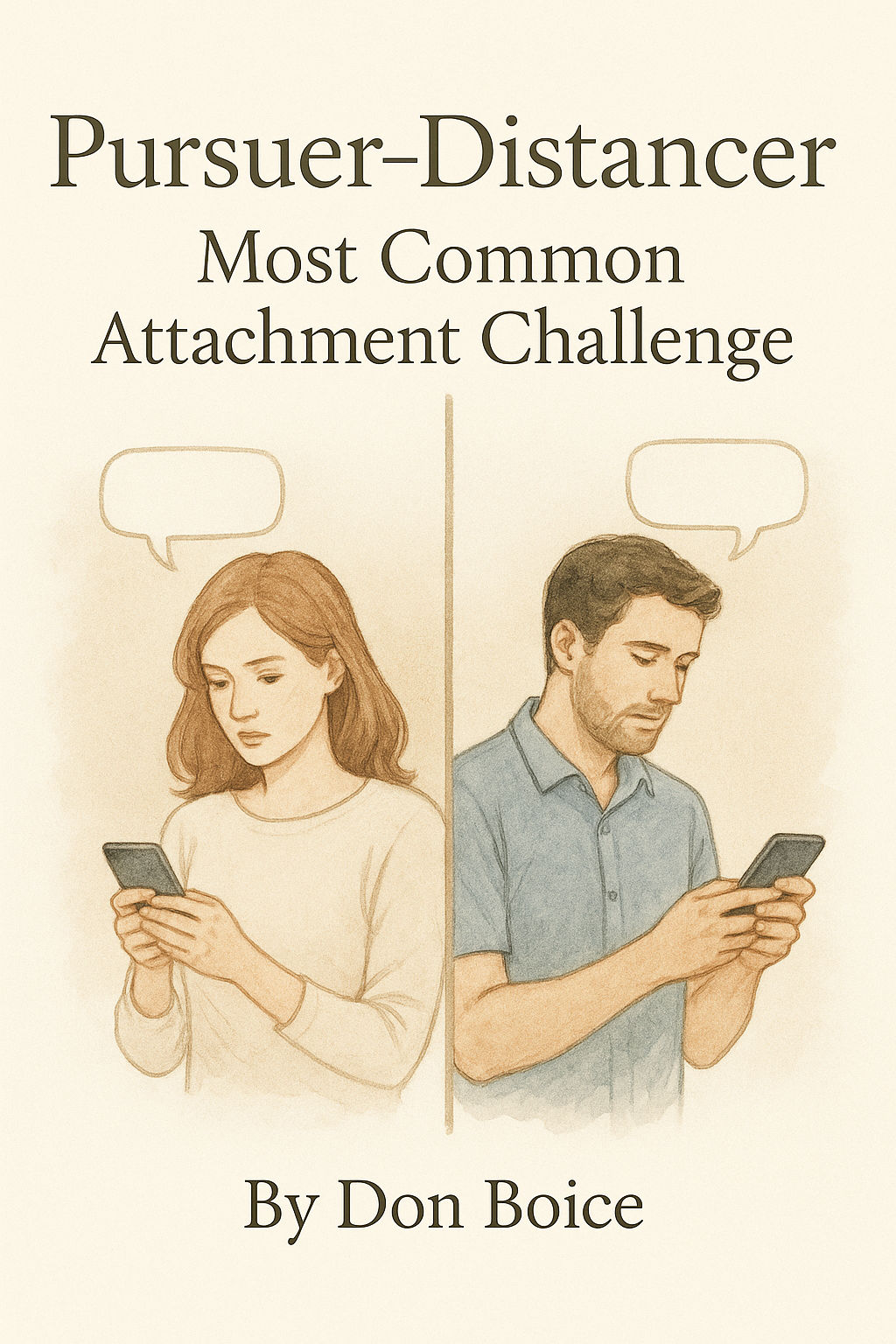
Pursuer- Distancer: The Most Common Attachment Challenge
Attachment refers to how you attach to people, almost always going back to how you were raised. That was your template and you have to keep healing throughout your life. Let your partner help you. How? When you notice a button was pushed or you feel triggered, they are helping you find a trigger that reveals where more work needs to be done.
Using the example of texting, I walk you through exercises, prompts, questions, workbooks of how to do the work to heal from attachment challenges in romantic relationships.
This would help clients build core regulation and self-awareness practices that reduce reactivity and increase connection.
It’s especially valuable for couples stuck in anxious-avoidant loops. I use texting as an example. It might not be texting, but there is a part of the relationship that feels off and where the pursuer-distancer dynamic reveals itself.
Let me set the stage. He is anxious in his attachment style and he is with someone who has avoidant attachment. Just knowing this, we can make some safe assumptions. He will pursue her and be frustrated by the distance. Many of their disagreements will be when he wants to spend time and get serious and take it to the next level. He might feel like he has to earn her love or convince her. She wonders why he keeps pursuing her and simultaneously complains. She is not intentionally distancing herself, she is seeking comfort. Her comfort zone and his comfort zone are not the same. Once they know this, there is a way to not take it personally. Her distance has nothing to do with you. It is about her comfort.
Just like you getting into her space has nothing to do with her. Each person brought baggage and gifts.
Let’s slow this down, because your intuition matters. And I believe several perspectives are true:
• Yes, your frustration is real—(speaking to the person with anxious attachment) it sounds like by the time this part of the exchange is unfolding, you’re running on fumes. You’re depleted, emotionally checked out, and texting feels like a tether fraying instead of a bridge building. (Imagine pursuing her in person is challenging, now you don’t see each other every day. Pursue someone who has avoidant tendencies via text… ummm)
• And yes, there may be a moment in this specific thread where your tone appeared flatter or more reactive—not because you don’t care, but because the emotional cost of continued effort felt too high. The anxious one starts to wonder if the amount of work is worth it. This confuses the other person, who has been pursuing their comfort zone. It was fine until you started complaining, they mention to the anxious attachment person.
So let’s untangle this with care.
These might be true:
You initiate most of the vulnerable contact.
• You make the effort to stay in dialogue, even when you’re unsure.
• You stretch to respond to her cues and flirtation—even when not reciprocated with the depth you’d like.
• You’re trying to be emotionally fair, but it often feels lopsided and draining.
• You’re showing up not to win, but to keep the relationship real and honest—yet that honesty often feels isolating.
Try that on. How does that feel or how might it feel if that was you?
💡That’s not invisible labor. That’s visible, unpaid emotional work. And I hear the burnout in your words. I hope I would say something like that. Acknowledge the felt experience. Agreeing or disagreeing is not the point.
Example:
If we’ve reached the fourth “how are you” in a text this week- with little depth in return—or the sixth thread without an offer of genuine presence—it makes perfect sense that you’ve gone emotionally numb and begun to emotionally exit the exchange.
We can rationalize and justify many different ways, but it hits. It lands like rejection or being dismissed, which is common for avoidant/anxious attached couples.
Before you react or end it or start complaining, think about the other person’s perspective. Blindspot? Maybe.
Here’s What Might Actually Be Happening:
You’re not checked out because you don’t care.
You’re checked out because you care and feel unmet.
This doesn’t come across as a blind spot to me.
It comes across as:
• A gap in timing and energy investment—you show up early and often, and she shows up later and lighter.
• A natural progression of text fatigue—especially when texting is the only place the relationship seems to be playing out.
In other words, when someone finally starts “matching” energy after you’ve already climbed the mountain and descended the other side… you don’t feel seen—you feel spent. What happens next is vital.
He told me that she now reaches out to him and expects him to be emotionally available. He experiences that as being at her beck and call (rather insulting) when she doesn’t even answer “How was your day?” texts.
(150+ pages)
Next attachment
"Doing the work" in attachment theory- There is work to do to heal from childhood. Let's not bring all our emotional baggage with us into the next relationship. Heal as much as possible before you start the next relationship. If you are in a relationship now, it is not too late to heal. Include your partner in your efforts to heal.
Next Written attachment: Let's work on what words to use and polish that...
Teamwork across Attachment Styles is the next one (55 pages of workbook and guidance)