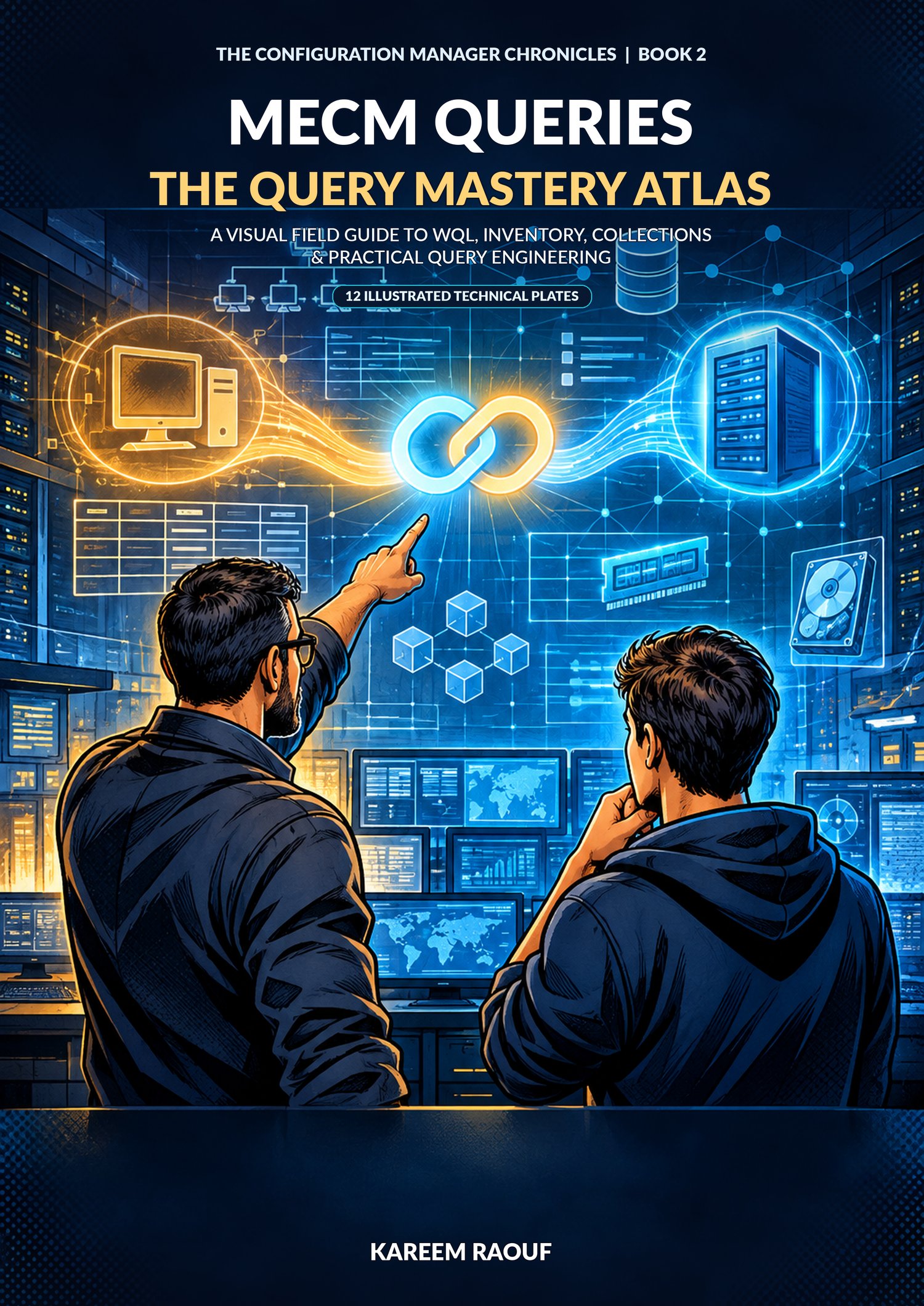
MECM Queries: The Query Mastery Atlas
Why did your Configuration Manager query return zero devices when you know those machines exist on your network?
In enterprise endpoint management, a syntactically valid WQL query can still ask the wrong data source, compare the wrong unit, or silently exclude uninventoried endpoints through an INNER JOIN. Worse, once that query becomes a collection membership rule, an unvalidated filter turns directly into a high-risk production deployment target.
MECM Queries: The Query Mastery Atlas (Book 2 of The Configuration Manager Chronicles) is a 41-page visual field guide and query-engineering playbook built for systems administrators, endpoint engineers, and IT operations teams running Microsoft Configuration Manager (Current Branch 2609 baseline).
Combining a practical mentor-and-learner narrative (Senior Admin Marcus Silva and Endpoint Engineer Jordan Hayes) with 14 Ultra-HD visual teaching plates and a copy-ready WQL and PowerShell library, this atlas walks you step by step from raw discovery records to defensible, production-safe collections.
What You Will Master Inside:
• Two Data Universes (Discovery vs. Inventory): Separate SMS_R_System discovery records from SMS_G_System hardware/software inventory classes, understand why Client = 1 only proves installation (not health or reporting), and distinguish SMS_R_System.Active, ClientActiveStatus, and the Client Health Dashboard.
• Extended WQL vs. SQL Server: Learn what the SMS Provider supports (DISTINCT, COUNT, JOIN, SUBSTRING, ORDER BY, GetDate(), DateDiff(), DateAdd()), why COUNT and DISTINCT cannot be combined, and why ResourceID is the standard resource-to-inventory correlation key.
• Hardware, RAM & OS Build Queries: Avoid unit-conversion traps by querying TotalVisibleMemorySize in kilobytes (8 GiB = 8,388,608 KiB) vs. per-DIMM CIM_PhysicalMemory in bytes, and target Windows 10 (through 21H2 / 22H2 LTSC) and Windows 11 (23H2, 24H2, 25H2, and 26H2 build 10.0.26300) accurately using Caption, Version, and BuildNumber.
• Software Discovery Across Three Paths: Keep SMS_G_System_ADD_REMOVE_PROGRAMS (Hardware Inventory), SMS_G_System_INSTALLED_SOFTWARE (Asset Intelligence), and file-based Software Inventory separate when hunting legacy estates like Office 2016.
• Time-Based & Disk-Space Thresholds: Identify endpoints with LastBootUpTime older than 30 days using DateDiff(day, ..., GetDate()) > 30 and query Win32_LogicalDisk.FreeSpace in exact bytes (10 GiB = 10,737,418,240 bytes on DeviceID = "C:").
• Prompted Queries, Limiting Collections & RBAC: Build interactive console queries safely, understand how limiting collections and colleval.log evaluation graphs work, apply Microsoft’s 200 incremental-collection guideline, and separate collection limiting from RBAC security scopes.
• Single-Line PowerShell Query Engineering: Automate query creation, retrieval, and ad-hoc execution with copy-ready, single-line PowerShell commands (New-CMQuery, Get-CMQuery, Invoke-CMQuery, and Invoke-CMWmiQuery) compatible with Windows PowerShell 5.1 and PowerShell 7.
• Production Query Review Card & 31 Dated References: Includes a complete Appendix A Corrected Query Library, a ConfigMgr 2609 Compatibility Snapshot, a pre-deployment validation checklist, and a 31-source Microsoft Learn research register verified through November 2026.