

Understanding Sensory Meltdowns: When the Cup Overflows
When the Cup Overflows: Understanding Sensory Meltdowns
When the world is too much for your child’s nervous system.
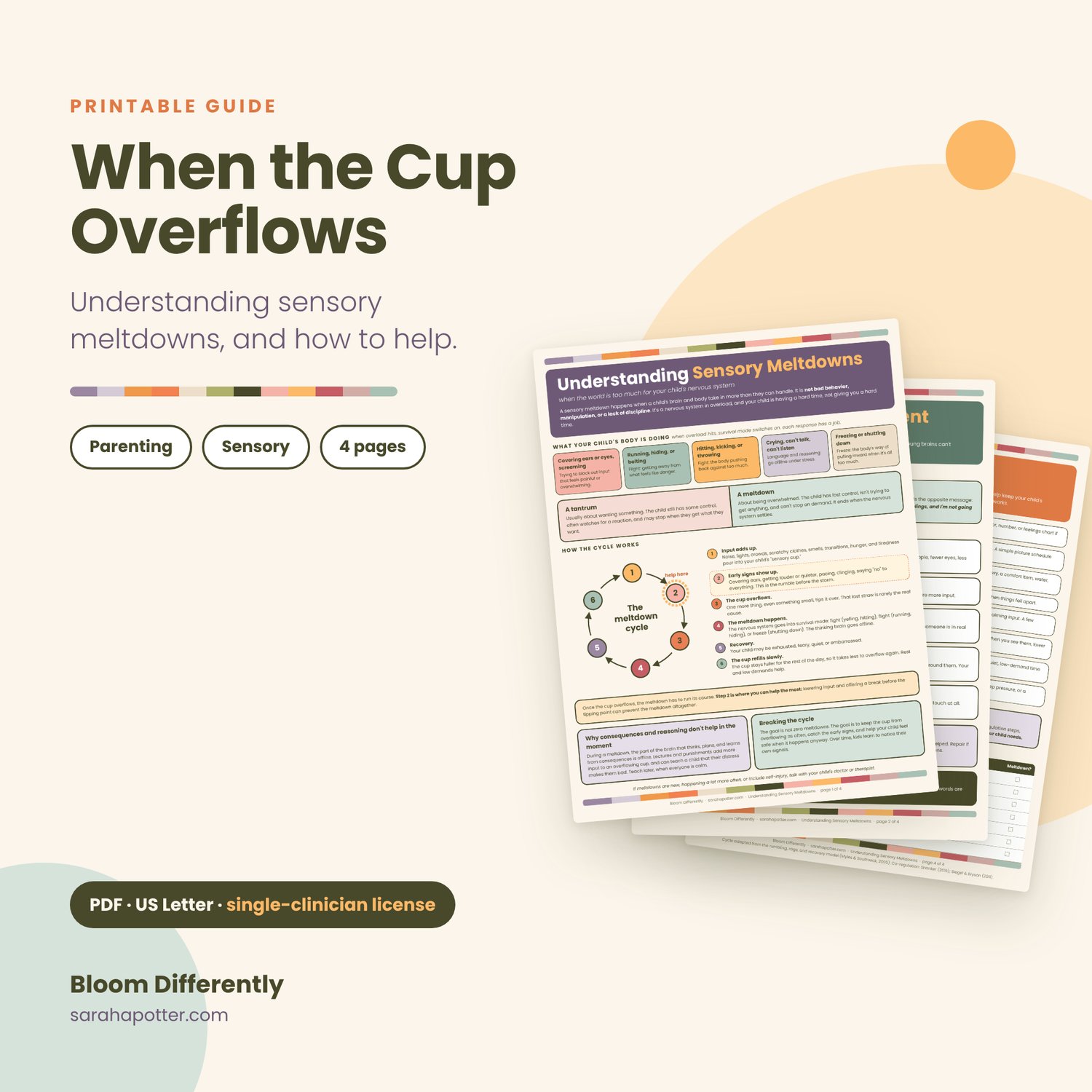
A sensory meltdown is not bad behavior, manipulation or a lack of discipline. It’s a nervous system in overload, and your child is having a hard time, not giving you a hard time. This four-page parent guide explains what’s happening, how to help in the moment, and how to keep your child’s “sensory cup” from overflowing in the first place.
What’s inside
Page 1: Understanding sensory meltdowns
- What your child’s body is doing: covering ears, bolting, hitting, crying and shutting down, each explained as fight, flight or freeze.
- Tantrum vs. meltdown: a clear side-by-side comparison.
- The six-step meltdown cycle, from input adding up to the cup slowly refilling. It highlights the early-signs step, where parents can help the most.
- Why consequences and reasoning don’t help in the moment, and what breaking the cycle really means.
Page 2: Co-regulation in the moment
- Controlling it vs. co-regulating.
- Five steps: lower the input, use fewer words, keep everyone safe, be the calm anchor, and offer comfort on their terms.
- What to do during recovery and later, including repair.
Page 3: Words that help
- Short, calm phrases for during and after a meltdown, and before hard outings.
- Phrases for you, the grown-up (“This is not my fault, and it’s not my child’s fault”).
- Phrases kids can say to themselves.
- Space to write your family’s own words.
Page 4: A sensory-friendly day
- Eight prevention habits from morning to bedtime: body check-ins, previewing the day, packing a sensory kit, breaks, heavy work, early-sign watching, after-school decompression and wind-down.
- A weekly sensory tracker to spot patterns and bring to session.
Who it’s for
Parents and caregivers of autistic, ADHD and sensory-sensitive kids, plus the therapists, OTs, teachers and school staff who support them.
Ways to use it
- Use page 1 as psychoeducation for parents who think meltdowns are misbehavior.
- Role-play the co-regulation steps and phrases in parent coaching.
- Build a sensory-friendly day plan with a family.
- Have parents fill out the tracker to find their child’s triggers and early signs.
Why it’s different
It’s fully neurodivergent-affirming and shame-free, for both kids and parents. It never calls for consequences or compliance, it only allows restraint for real danger, it respects each child’s touch preferences, and it reminds parents that a meltdown doesn’t mean anyone failed.
What you get
A four-page printable PDF, US Letter, available as an instant download. It’s adapted from the rumbling, rage and recovery model (Myles & Southwick, 2005), with co-regulation from Shanker (2016) and Siegel & Bryson (2011). Single-clinician license included.
Pairs well with: Coaching Your Child Through Big Feelings, My Coping Toolbox, Being Autistic: Understanding Your Kiddo Beyond the Diagnosis