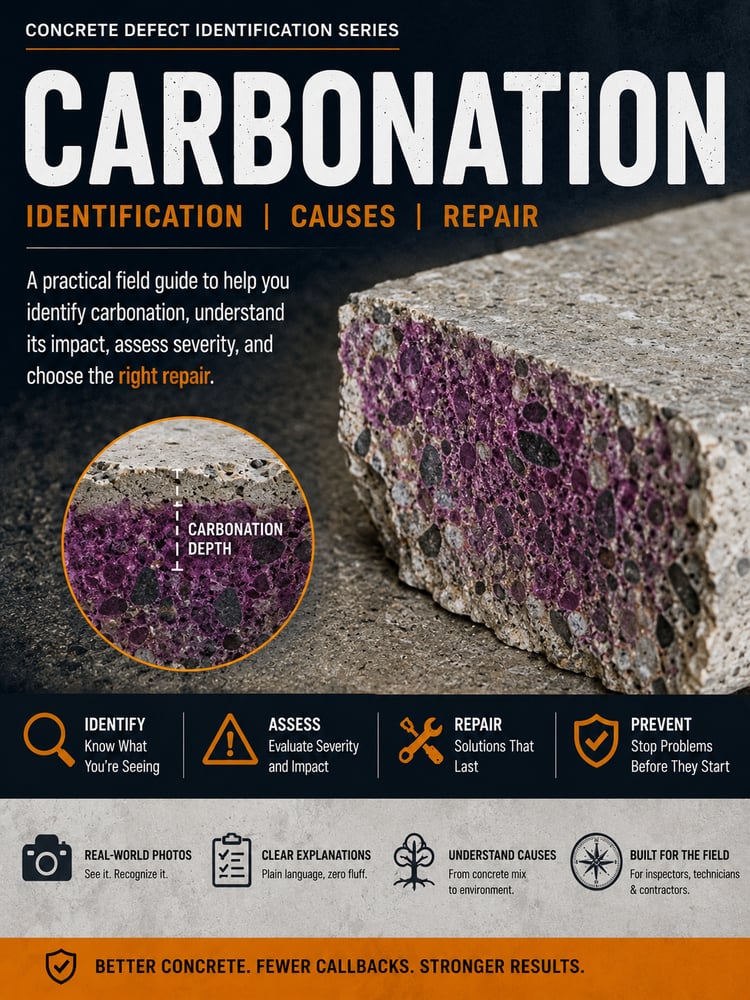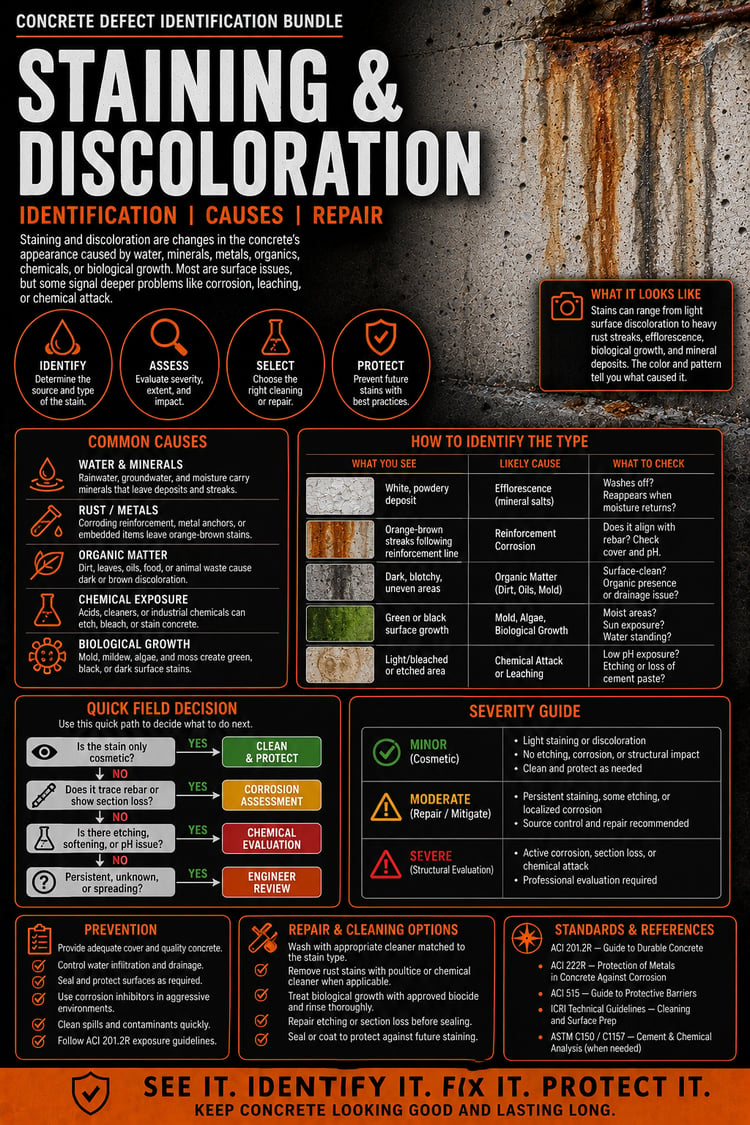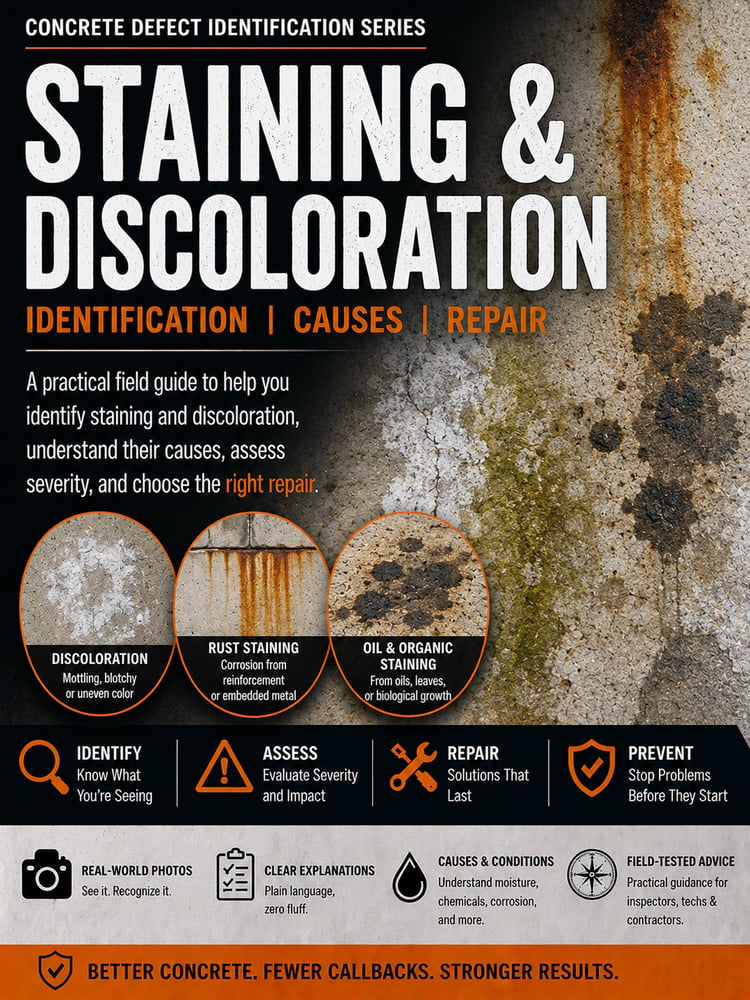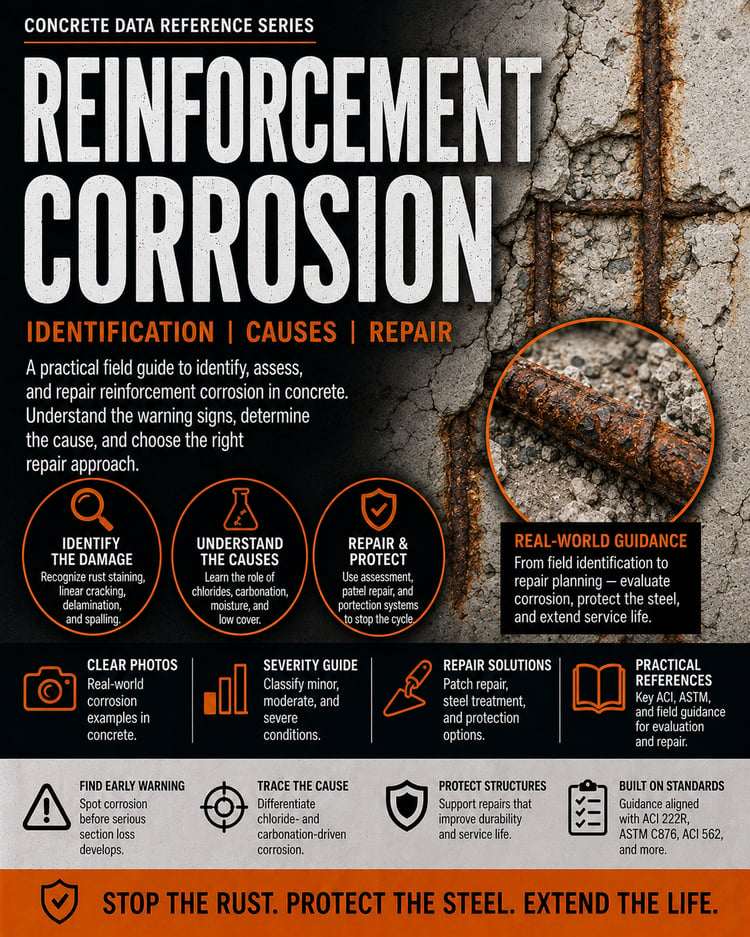

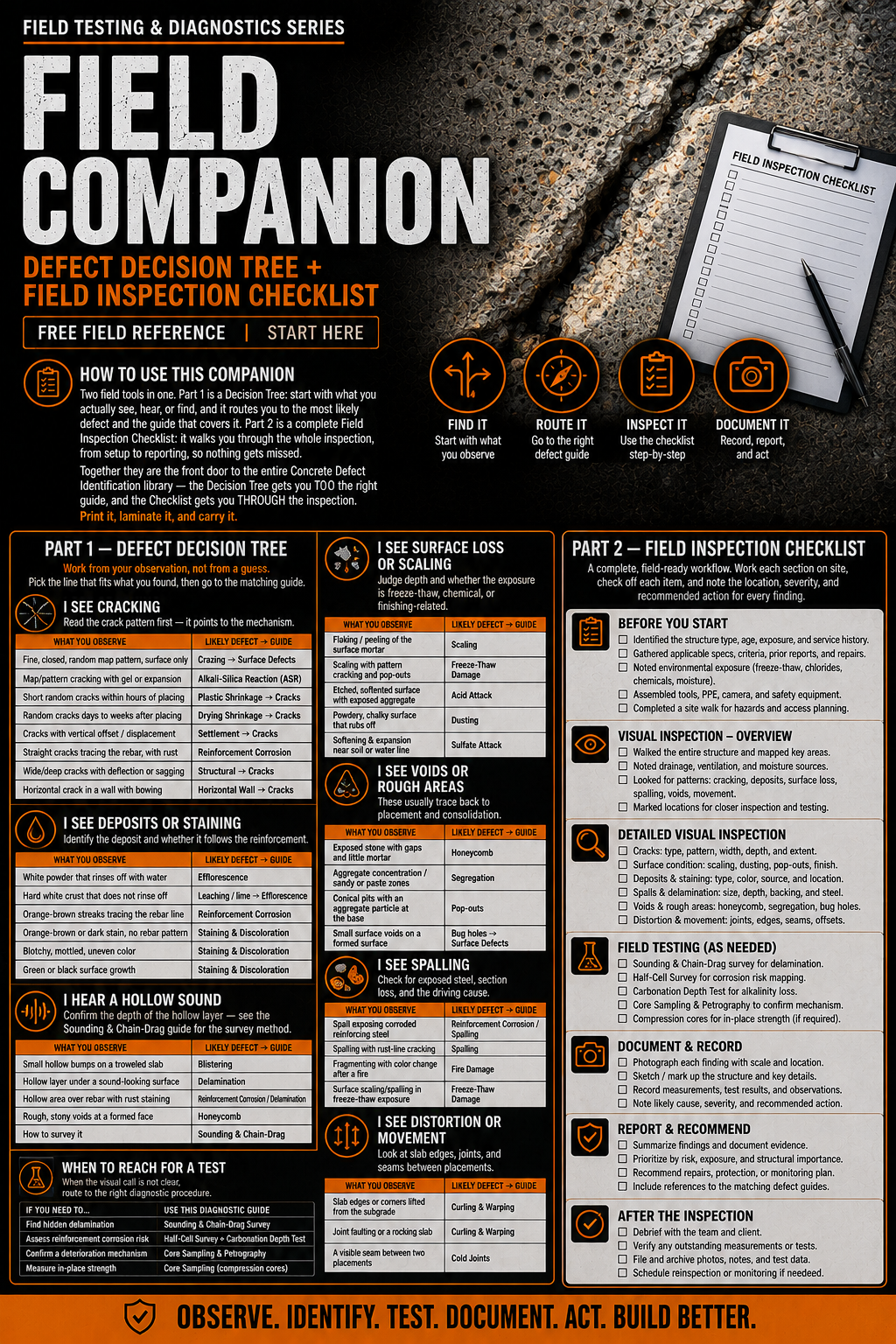
Concrete Inspection Field Companion
$$$ FREE! Concrete Field Companion Guide —
Start every concrete defect inspection with a clear path instead of a guess.
The Concrete Field Companion Guide is a practical, field-ready reference designed to help inspectors, contractors, technicians, producers, and concrete professionals identify common concrete defects and document inspections with confidence.
This guide brings two powerful tools together in one simple reference:
Part 1 — Defect Decision Tree
Start with what you actually see, hear, or find in the field, then follow the decision tree to the most likely defect and the guide that covers it.
Part 2 — Field Inspection Checklist
Work through a complete inspection workflow from setup to reporting, so important observations, measurements, safety concerns, and follow-up actions do not get missed.
The guide is designed to be the “front door” to the full Concrete Defect Identification library. The decision tree gets you to the right defect category, and the checklist helps you move through the inspection in an organized, professional way.
What’s Included
- Concrete defect decision tree organized by field observation
- Cracking identification path
- Deposits and staining identification path
- Hollow-sound / delamination guidance
- Surface loss and scaling guide path
- Voids, rough areas, and placement defect guide path
- Spalling, distortion, movement, and cold joint guidance
- Diagnostic testing guide references
- Master guide index for the defect library
- Complete field inspection checklist
- Pre-inspection setup checklist
- General condition survey checklist
- Cracking checklist
- Surface and finishing defect checklist
- Voids and placement defect checklist
- Structural and corrosion defect checklist
- Chemical and environmental defect checklist
- Field testing and diagnostics checklist
- Severity and escalation rules
- Documentation and reporting checklist
- Quick severity matrix
- Standards and reference list
Built for Real Field Inspections
This guide helps answer the first questions every inspection needs to solve:
What am I looking at?
Which defect category does it most likely fit?
What should I measure, photograph, test, or document?
When does the condition require escalation or engineering review?
Instead of starting with a guess, the guide starts with field observations: cracking patterns, staining, deposits, hollow sounds, scaling, voids, spalling, distortion, movement, corrosion signs, chemical attack, and moisture-related distress. From there, it routes the user toward the most likely defect and the next diagnostic step.
Field Inspection Checklist
The checklist section gives users a full inspection workflow, including:
- Structure type, age, exposure, and service history
- Project specifications and prior repair history
- Environmental exposure conditions
- Tool setup and safety planning
- Photo documentation with scale
- Defect location, size, severity, and extent
- Crack width measurement and pattern documentation
- Sounding and chain-drag mapping
- Cover measurement and corrosion screening
- Carbonation depth, chloride testing, half-cell survey, and core sampling considerations
- Severity classification and escalation triggers
- Final reporting and documentation steps
This makes the guide useful not only for identifying defects, but also for producing better inspection notes, cleaner reports, and more consistent field documentation.
Best For
- Concrete inspectors
- Field technicians
- Contractors
- Repair crews
- Ready-mix and QC professionals
- Engineers and engineering support staff
- Facility maintenance teams
- DOT, bridge, pavement, and parking structure inspectors
- Anyone using the Concrete Defect Identification Bundle
Why This Guide Matters
Concrete inspections can get messy fast. Cracks, staining, hollow areas, surface loss, spalling, corrosion, chemical attack, and moisture problems can overlap. This guide helps organize the inspection process so the user can slow down, document properly, and route the problem to the correct defect category.
The Concrete Field Companion Guide is especially valuable because it works as both a quick reference and a complete field checklist. It helps users identify what they are seeing, decide what to inspect next, know when testing may be needed, and recognize conditions that should be escalated.
Important Note
This guide supports field identification and inspection documentation. It is not a replacement for engineering judgment, laboratory testing, project specifications, or governing standards. It is a practical starting point to help identify the likely defect, document the condition, and determine the appropriate next step.
See the defect. Follow the path. Document it right.