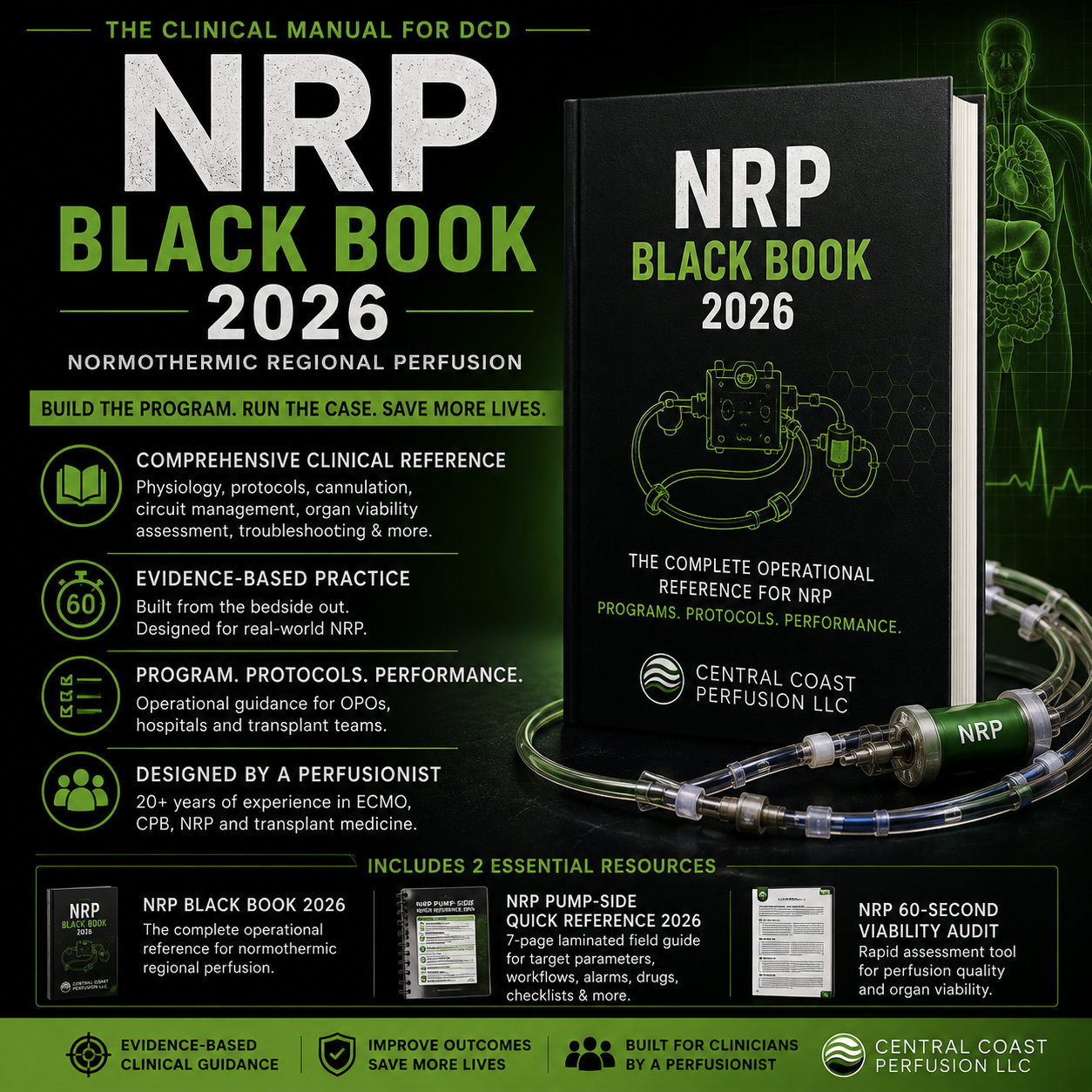
NRP Black Book 2026: The clinical manual for DCD & TA-NRP Organ Recovery
A field-focused clinical and operational reference for normothermic regional perfusion in DCD organ recovery.
The NRP Black Book 2026 was developed for perfusionists, DCD coordinators, transplant professionals, OPO teams, and program leaders who need to understand not only how NRP works, but how physiology, circuit management, organ viability, procedural safeguards, documentation, and clinical governance intersect during a high-stakes recovery.
Built from the bedside out, the book translates current literature, professional-society recommendations, and U.S. NRP safety guidance into a practical clinical reference.
Designed to address critical failure points including:
— Recognition and interpretation of warm-ischemia exposure
— Cerebral-exclusion safeguards and documentation during TA-NRP
— Interpretation of lactate and metabolic trends during reperfusion
— Communication and procedural coordination across multidisciplinary recovery teams
— Program-level documentation, governance, and compliance considerations
— Translation of rapidly evolving NRP evidence into bedside practice
Inside the NRP Black Book
— A-NRP and TA-NRP physiology, workflow, and circuit management
— Warm-ischemia concepts and organ-specific viability considerations
— Agonal-phase physiology and interpretation
— Lactate clearance and multiparameter viability assessment
— Oxygen-delivery and perfusion optimization principles
— DCD cardiac-recovery strategies, including TA-NRP and alternative recovery pathways
— Cerebral-exclusion techniques and safeguards during TA-NRP
— Anticoagulation, reperfusion, troubleshooting, and transition to organ preservation
— Program-development and documentation considerations
— Pediatric NRP circuit considerations
— Regulatory and professional-guidance timeline
Updated U.S. NRP Safety Guidance
The 2026 edition addresses the evolving U.S. approach to prevention of unintended cerebral reperfusion.
ASTS recommends occlusion and venting of the aortic arch vessels during TA-NRP while additional evidence develops.
HRSA/OPTN subsequently refined its recommendations in May 2026, including securing the brachiocephalic, left common carotid, and left subclavian arteries near their origins and individually transecting and venting them to atmosphere or suction before perfusion, with documentation of the time the final vessel is transected and vented. HRSA/OPTN states these recommendations are the most current guidance while also noting that they are not currently formalized in OPTN policy.
Included With Your Purchase
NRP 60-Second Viability Audit
A rapid-reference tool designed to organize key physiologic and perfusion variables during assessment of an NRP run.
NRP Program Compliance / Implementation Resources
Where included in this edition, supporting material for programs evaluating procedural readiness, documentation, and implementation.
Who This Is For
Certified Clinical Perfusionists • ECMO/MCS Specialists • Transplant Surgery Teams • DCD Coordinators • OPO Professionals • Transplant and Perfusion Educators • Program Leadership
NRP Black Book 2026
Tom Ferry, B.S., CCP
Central Coast Perfusion LLC
Professional digital reference | Instant download
For professional education and clinical reference. This publication does not replace institutional protocols, applicable OPTN policy, current HRSA/OPTN guidance, professional-society recommendations, device IFUs, medical leadership, or independent clinical judgment.