DNA-V Activity Generator for Behaviour Analysts and SEND Professionals
You know DNA-V works. Turning it into something a particular young person can actually do, this week, with their interests, their communication and their support needs, is the hard part. Generic mindfulness scripts don’t land. Worksheets assume a level of language many young people don’t have. And adapting everything from scratch takes time you don’t have between sessions.
The DNA-V Activity Generator does that translation with you. Set it up in under a minute and get an experiential activity that fits the person in front of you.
How it works
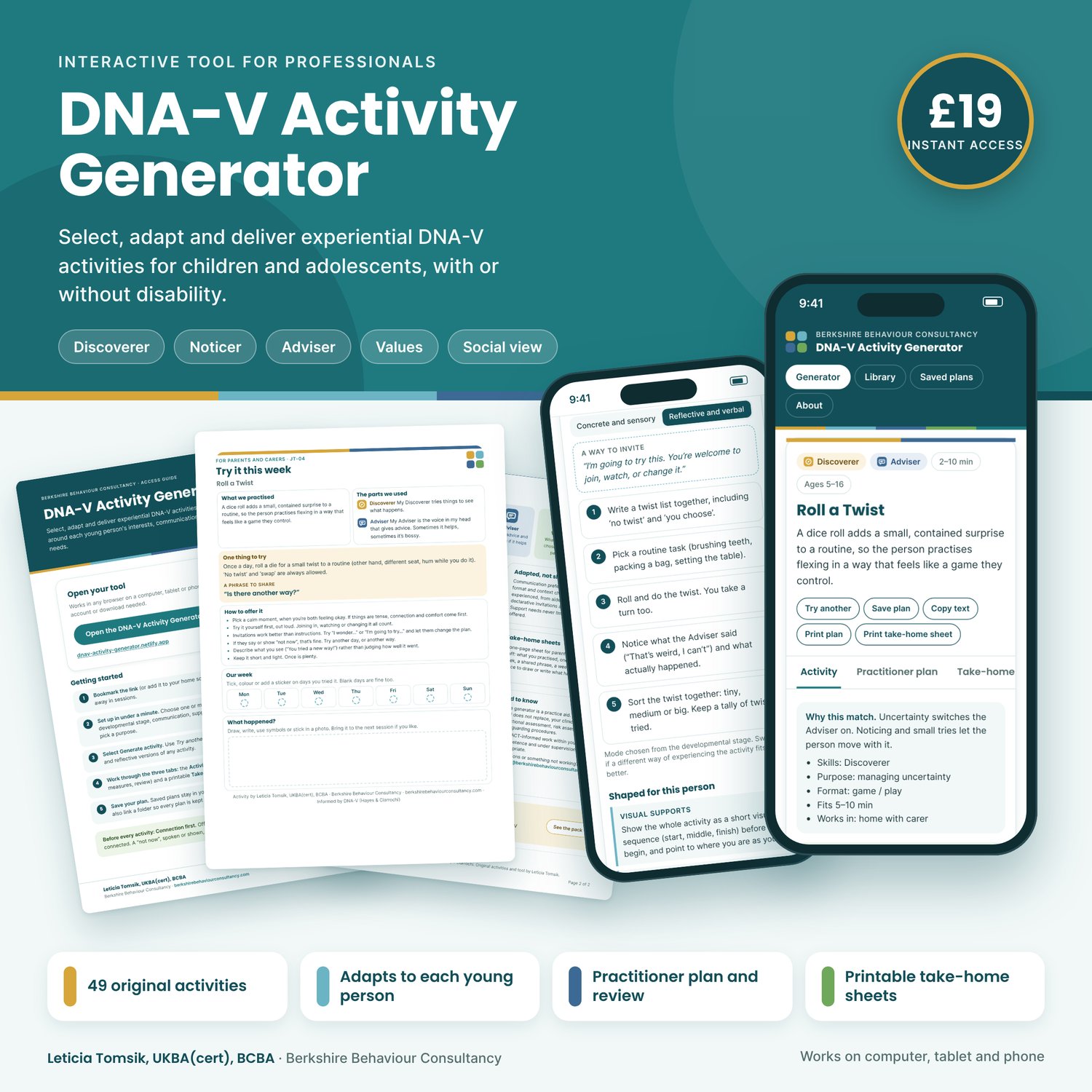
Choose one or more DNA-V skills: Discoverer, Noticer, Adviser, Values or Social view. Describe the person: age, developmental stage, communication preferences, support needs, preferred format, time available, context and interests. Pick a purpose, from noticing body sensations and managing uncertainty to self-advocacy, building relationships or recovering after overwhelm. Then generate.
What you get
- 49 original activities across all five processes, plus activities that use the whole model. Each one is built around a real experience, not a talk-through.
- Adapted, not shortened. Every activity has two complete versions, concrete and sensory or reflective and verbal. Communication preferences, support needs, format and context then change how it is offered: AAC vocabulary to load in advance, low-demand invitations, low-arousal set-ups, movement-based responses and more.
- Each process kept true to its function. Every activity shows what keeps it a Noticer, Adviser, Discoverer, Values or Social view activity, and what drift looks like, such as noticing turning into a calm-down strategy.
- Interests built in. The young person’s favourite game, show or hobby is written into the activity itself.
- Practitioner plan. Link the activity to the hypothesised function, set an observable outcome that accepts any communication mode, choose observation measures and record a review. An assent log is always included and kept separate from skill data.
- Printable take-home sheets for parents, carers or school staff: one thing to try this week, a shared phrase, a weekly tracker and space to draw or write what happened.
- Saved plans, kept private. Everything stays in your browser and is never sent anywhere. In Chrome or Edge on a computer, you can also link a folder so plans save to your computer, with a readable copy of each one.
Built on clear principles
The generator is strengths-based and neurodiversity-affirming. Support needs shape how an activity is offered, never which activities or goals are available. It is a practice aid that supports your clinical judgement and sits alongside function-based intervention, not in place of it.
What you’ll receive
A PDF access guide with your link, a QR code and setup steps. The tool works in any browser on a computer, tablet or phone, with no account or download needed.
Want ready-to-deliver sessions as well?
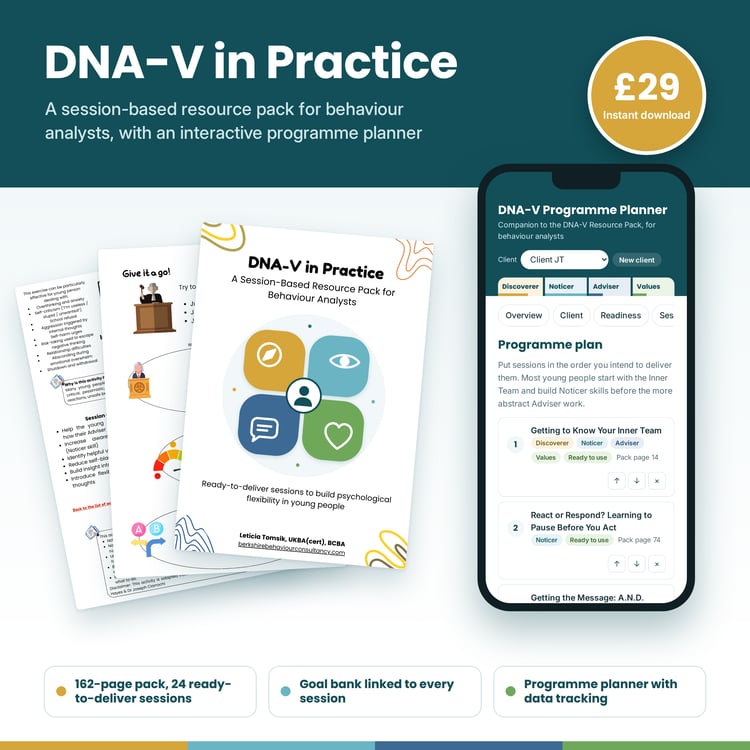
DNA-V in Practice is a session-based resource pack with scripts, experiential activities, home practice sheets, a goal bank and the DNA-V Programme Planner. Get both together in the bundle and save.
Who it’s for
Behaviour analysts (BCBA, UKBA(cert), BCaBA, UKiBA), psychologists, therapists, SENCOs and other professionals supporting children and young people aged 4 to 18, with or without disability. The take-home sheets are written in plain, warm language, so parents, carers and school staff can use them straight away.
If you’d like ongoing support with this kind of work, The Calm Circle membership offers it all year round.
About the author
Created by Leticia Tomsik, UKBA(cert), BCBA, founder of Berkshire Behaviour Consultancy, a PDA-informed, neuro-affirming behaviour support practice.
DNA-V was developed by Dr Louise Hayes and Dr Joseph Ciarrochi. The activities in this tool are original, and the tool is not an official or endorsed DNA-V product.