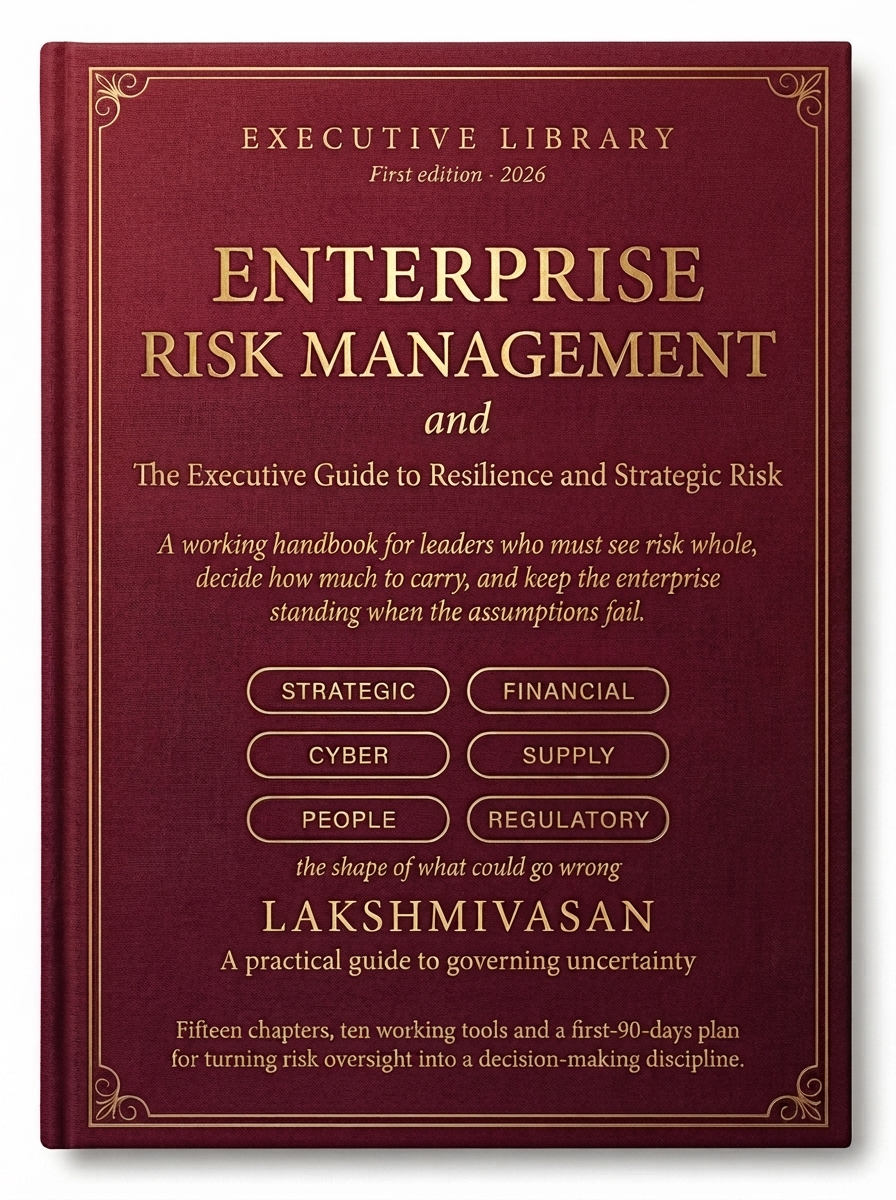
Enterprise Risk Management: The Executive Guide to Resilience and Strategic Risk
EXECUTIVE LIBRARY | BY LAKSHMIVASAN
MAKE THE RISK VIEW USEFUL.
A CEO-LEVEL HANDBOOK FOR SEEING EXPOSURE, SETTING LIMITS AND PROVING RESILIENCE — WITH 15 CHAPTERS, 10 WORKING TOOLS, A FILLABLE WORKBOOK AND A COMPLETED WORKED EXAMPLE.
Most organisations can produce a risk register within a week.
Far fewer can explain, in a single page, which of their strategic ambitions are most exposed, how much loss they are prepared to absorb, and who has the authority to stop a decision that breaches the limit.
The register is the artefact. The reasoning is the discipline.
When the reasoning is missing, the register fills with generic hazards. Treatment becomes a wish. Nobody discovers that a control stopped operating two years ago. And the exposures that actually threaten the strategy sit in different functions, owned by different people, never seen together.
A supplier concentration in operations. A cyber dependency in technology. A covenant test in finance. A licence condition in legal. A reputational exposure in communications.
Each is real. None is aggregated.
Enterprise Risk Management: The Executive Guide to Resilience and Strategic Risk is a practical handbook for connecting those exposures to the objectives they threaten — and for turning assessment into limits, limits into decisions, and decisions into evidence that the organisation can absorb a hit.
It brings together risk architecture, strategic identification, assessment methods, appetite and tolerance, financial and market exposure, operational and technology risk, cybersecurity, regulatory obligations, reputation, business continuity, crisis management, third-party risk, governance, analytics and resilience measurement.
Across 15 chapters and five structured parts, the handbook examines how an organisation moves from a list of hazards to a governed system of limits, evidence and rehearsed response.
It addresses the questions that matter to boards, CEOs, CFOs, COOs, chief risk officers, audit committees and risk professionals:
- What does risk mean when it is attached to an objective, rather than collected as a category?
- How should strategic exposure be identified instead of assembled from departmental lists?
- What can qualitative, quantitative and scenario assessment each prove — and where do they mislead?
- How does a board convert appetite into a limit a manager can apply and a committee can enforce?
- Which financial, operational, cyber and regulatory exposures are underestimated because they are owned in silos?
- How do you judge whether a control is actually working, rather than well designed?
- What should a business impact analysis establish before recovery targets are chosen?
- How should a crisis be declared, convened and recorded in the first hour?
- Where does third-party and supply chain exposure hide several tiers from the contract?
- How can analytics produce earlier warning without creating false confidence?
- Which measures prove that the enterprise is more resilient this year than last?
- What should an executive team review every quarter to keep the system honest?
The central principle is straightforward:
The purpose of risk management is not to reduce uncertainty. It is to make better decisions inside it — and to remain standing when the decision turns out badly.
This handbook provides a structured management method for doing that work.
A COMPLETE FRAMEWORK FOR ENTERPRISE RISK MANAGEMENT
FROM REGISTER TO REASONING
Risk management is often approached as a documentation exercise attached to an audit cycle.
A register is refreshed. A heat map is produced. A committee reviews a pack. The same twelve risks appear, with slightly different colours.
Nothing is decided differently as a result.
An effective approach begins with the objectives at stake. It examines the exposure that threatens them, the evidence about likelihood and consequence, the limit the board has set, the owner accountable for the response, and the assurance that the response is working. Break any link and the system degrades into paperwork.
This handbook organizes that approach into five interconnected parts.
PART I — FOUNDATIONS: FROM REGISTER TO REASONING
Establish a shared language for uncertainty before attempting to govern it.
Understand what risk means when attached to objectives, how strategic exposure is identified rather than collected, how assessment methods differ in what they can prove, and how appetite turns intention into a limit someone can enforce.
PART II — THE LANDSCAPE: WHERE EXPOSURE ACTUALLY LIVES
Examine the four domains where most enterprise exposure sits: financial and market, operational and technology, cybersecurity and information, and regulatory and compliance.
The categories are familiar. The judgement is not. Each chapter asks the same question in a different domain: what does good oversight look like when the risk is specific, technical and owned by specialists? The answer always includes a limit, a measure and a named executive — and never stops at the framework diagram.
PART III — CONSEQUENCE: TRUST, CONTINUITY AND THE BAD DAY
Some risks are managed through limits and controls. Others are managed through preparation for the moment the controls fail.
Address the consequences that outlast the event itself: trust that erodes, services that stop, and a crisis judged by how the organisation behaves rather than by what it intended.
PART IV — SYSTEM AND FORESIGHT: MAKING RISK A CAPABILITY
Individual exposures can be managed by capable people. A portfolio cannot.
Examine the machinery that makes risk management repeatable: the third parties the enterprise depends on, the governance that allocates authority and attention, and the analytics that turn data into earlier warning.
PART V — ENDURANCE: PROVING RESILIENCE
Resilience is not the absence of incidents; it is the capacity to absorb, adapt and recover — and it can be measured, tested and governed like any other capability.
Together, these five parts provide an integrated management approach for identifying, assessing, governing and surviving enterprise risk.
WHAT MAKES THIS HANDBOOK DIFFERENT?
IT ENDS IN A DECISION, NOT A DOCUMENT.
If a capital request, a contract award, a hiring plan or a pricing change can proceed without reference to the risk view, the system is peripheral.
Mature organisations make the risk view a required input at a small number of defined decision points, and leave it silent everywhere else. This handbook is built around that discipline.
1. RISK IS ATTACHED TO AN OBJECTIVE, OR IT IS NOT A RISK
If an entry cannot name an objective and an owner, it is an observation. Move it to a watch list or remove it. A register that holds everything explains nothing.
2. APPETITE IS A NUMBER, NOT AN ADJECTIVE
Boards approve statements that say “low tolerance for regulatory breach” and then discover they have no way to know whether a decision breached it.
Every line of an appetite statement here needs a metric, a limit and an escalation authority. If the statement has never caused a decision to be declined or reshaped, it describes aspiration rather than appetite.
3. CONTROLS ARE JUDGED ON OPERATING EVIDENCE
Design is not effectiveness. The control matrix separates design from dated operating evidence, and treats a stale or bypassed control as partial — because that is what it is.
4. CONTINUITY IS TESTED FOR INDEPENDENCE
A fallback that shares power, network or people with the primary site is not a fallback. Recovery targets follow from tolerable disruption, not from what happens to be achievable.
5. IT SHOWS A FINISHED ANSWER, NOT JUST A BLANK TEMPLATE
The product includes a completed worked example where all ten tools are filled end to end for the fictional Kestrel Group — including the uncomfortable lines. A scorecard where everything is green is a scorecard with measures that are too easy.
6. IT IS BUILT AROUND EXECUTIVE REVIEW
Each chapter ends with a boardroom question that connects the subject to a live decision. The tools provide structured records for assessment, appetite, continuity, crisis, control testing and measurement.
WHAT'S INSIDE
15 CHAPTERS ACROSS FIVE PARTS OF ENTERPRISE RISK MANAGEMENT
The handbook progresses from establishing a shared language for risk, through the domains where exposure lives, to continuity, governance, analytics and resilience measurement.
PART I — FOUNDATIONS
01. Enterprise Risk Management Fundamentals
Understand risk as the effect of uncertainty on objectives. Examine the five links that turn a register into a system — objective, exposure, assessment, response with an owner, and assurance — and the accountability test that separates a functioning system from paperwork.
02. Strategic Risk Identification
Examine how strategic exposure is found rather than collected. Explore objective-led identification, scenario prompts, correlation between apparently separate risks, and the exposures that departmental registers systematically miss.
03. Risk Assessment Methodologies
Understand what different methods can prove. Explore qualitative assessment, quantitative modelling, scenario and stress testing, calibration, evidence quality and the limits of each approach in management decisions.
04. Risk Appetite and Tolerance
Examine how board intention becomes an enforceable limit. Explore appetite, tolerance and capacity, domain-level statements, metrics and escalation triggers, and why an appetite statement without numbers cannot govern a deal.
PART II — THE RISK LANDSCAPE
05. Financial and Market Risks
Examine liquidity, covenants, currency, interest rates and market confidence. Explore how separate financial exposures converge in a bad week, and what oversight prevents a solvency surprise.
06. Operational and Technology Risks
Understand process failure, capacity constraints, key-person dependency and the technology estate underneath operations. Explore operational resilience, change risk and the assumptions embedded in systems.
07. Cybersecurity and Information Risks
Examine threat, exposure, identity, data and third-party access. Explore the oversight questions a board can actually ask, and why “we have a framework” is not evidence of control.
08. Regulatory and Compliance Risks
Understand obligations, evidence of control and the exposures that breach quietly between audits. Explore regulatory mapping, reporting duties, licensing conditions and the management of supervisory relationships.
PART III — CONSEQUENCE AND CONTINUITY
09. Reputational Risk Management
Examine reputation as an outcome rather than a message. Explore stakeholder expectation, the gap between sentiment and impact, and how credibility is rebuilt after a failure.
10. Business Continuity Planning
Understand impact analysis, maximum tolerable disruption and recovery objectives. Explore dependency mapping, recovery strategy, independence of fallbacks and the testing that proves a plan works.
11. Crisis Management and Recovery
Examine declaration authority, convening, first-hour actions, holding statements and decision logging. Explore how recovery is governed from day two, and why a plan depending on one heroic leader collapses within a week.
PART IV — SYSTEM AND FORESIGHT
12. Third-Party and Supply Chain Risks
Understand that outsourcing transfers activity, not accountability. Explore concentration, subcontractor visibility, service-level assurance, exit risk and the information gaps created by long supply chains.
13. Enterprise Risk Governance
Examine decision rights, committee rhythm, the three lines model and the authority to stop a decision. Explore board reporting that supports action rather than activity, and escalation that works without a crisis.
14. Risk Analytics and Predictive Intelligence
Understand how data produces earlier warning. Explore indicator design, leading versus lagging measures, model risk, false confidence and the governance of quantitative insight.
PART V — ENDURANCE
15. Enterprise Resilience Measurement
Bring the portfolio together. Examine how resilience can be measured as a capability — tested recovery, briefed deputies, current assurance and retained trust — and governed like any other strategic capability.
TEN EDITABLE BONUS WORKSHEETS INCLUDED
A FILLABLE WORKBOOK AND A COMPLETED WORKED EXAMPLE
Understanding risk management is important.
Applying it to a live portfolio requires structured tools.
This product includes a separate interactive workbook containing fillable versions of all ten tools. Answers save automatically in your browser, each tool can be exported to CSV, and the whole workbook prints cleanly to PDF for a signed record.
It also includes a completed worked example, filled end to end for the fictional Kestrel Group — an engineering, freight and scheduling business of 9,000 people. Use it to see the standard of a finished answer before you start. Copy the shape, not the content.
The tools fall into four groups: see, decide, prepare and prove. Use only the ones that change a decision, a limit or an owner. A completed template is not an outcome.
SEE — THE PORTFOLIO AND ITS MOVEMENT
TOOL 01 — ENTERPRISE RISK REGISTER
The portfolio record: what could happen, which objective it threatens, who owns it and what treatment is in place.
- Record only exposures that could move an objective beyond threshold.
- Name a role as owner, not a committee.
- Rate inherent and residual exposure separately.
- Attach a treatment and a review date.
TOOL 02 — ENTERPRISE RISK HEAT MAP
A portfolio view of where exposures sit, how they move and which cluster in the same region of consequence.
- Calibrate axes to frequencies and amounts.
- Plot inherent and residual positions separately.
- Record why an exposure moved, not only where it landed.
TOOL 06 — RISK IDENTIFICATION AND ASSESSMENT CHECKLIST
Structured prompts that surface exposures a category-based register misses, with the evidence behind each answer.
- Use at project start, market entry or acquisition.
- Record status as yes, partial or gap.
- Name an owner for every unanswered question.
DECIDE — LIMITS AND CONTROL EVIDENCE
TOOL 03 — RISK APPETITE AND TOLERANCE STATEMENT
A short statement per domain that converts board intention into a limit a manager can apply and a committee can enforce.
- State appetite, metric and tolerance for each domain.
- Define the escalation trigger and authority.
- Test it at investment, contracting and hiring gates.
TOOL 07 — RISK MITIGATION AND CONTROL EFFECTIVENESS MATRIX
Evidence that the controls attached to a risk actually reduce it, and a record of the gap where they do not.
- Separate design from operating evidence.
- Date every test result.
- Score stale or bypassed controls as partial.
PREPARE — IMPACT, CONTINUITY AND CRISIS
TOOL 04 — BUSINESS IMPACT ANALYSIS (BIA) TEMPLATE
A structured judgement about which activities must continue, at what level, and for how long before consequence becomes unacceptable.
- Model impact at 4, 24 and 72 hours.
- Set maximum tolerable disruption first.
- Derive RTO and RPO from the judgement.
TOOL 05 — CRISIS RESPONSE AND MANAGEMENT PLAN
The first-hour playbook: who declares, who convenes, what is said and how decisions are recorded.
- Name declaration authority and deputies.
- Define the four or five immediate actions.
- Record holding statements and a decision log.
TOOL 09 — BUSINESS CONTINUITY AND DISASTER RECOVERY FRAMEWORK
The structure that connects impact analysis to recovery strategy, testing and invocation.
- Set recovery priorities from the BIA.
- Test independence of power, network and people.
- Schedule tabletop, simulation and failover tests.
PROVE — EARLY WARNING AND RESILIENCE
TOOL 08 — KEY RISK INDICATORS (KRI) DASHBOARD
A small set of leading measures with thresholds, owners and pre-agreed responses.
- Use six indicators, not thirty.
- State the calculation and data source.
- Name who acts at amber and red.
TOOL 10 — ENTERPRISE RESILIENCE AND RISK PERFORMANCE SCORECARD
A judgement about whether the enterprise is more resilient this year than last, supported by evidence rather than activity counts.
- Measure capability, not effort.
- Record evidence, trend and owner per dimension.
- Expect at least one uncomfortable line.
THE FIRST NINETY DAYS
A SEQUENCE FOR A NEW RISK LEADER — OR AN EXISTING ONE STARTING AGAIN
Ninety days is enough to establish credibility and not enough to rebuild a function. The aim is to produce three things: a defensible view of the largest exposures, one visible decision changed by the work, and a governance rhythm that survives the next quarter.
Days 1–15 · Listen and read. Interview ten executives. Review board packs, audit findings and last year's incidents. Test: you can state the three objectives most exposed, and why.
Days 16–30 · Baseline the portfolio. Produce a one-page exposure view. Reduce the register to material entries with owners. Test: every entry has an objective, an owner and a date.
Days 31–45 · Test the limits. Draft an appetite statement for three domains and compare it against current exposure. Test: at least one live decision is tested against a limit.
Days 46–60 · Find the fragile service. Complete a BIA for two critical services, map dependencies and list untested fallbacks. Test: the executive team agrees the top fragility.
Days 61–75 · Exercise the response. Run a tabletop with the executive team and review the decision log. Test: two concrete changes to the crisis plan.
Days 76–90 · Institutionalise. Set the quarterly governance calendar, a six-page board pack and a KRI set of six. Test: the board receives a pack it can act on in one meeting.
What to avoid in the first quarter: do not launch a new framework, a new taxonomy or a new system. Do not produce a 200-page register. Do not run a risk workshop for the whole organisation. Each signals activity and consumes the goodwill you need for the one thing that matters — changing a decision the executive team already cares about.
WHO THIS IS FOR
- Boards and risk committees testing whether limits are real, controls evidenced and resilience demonstrated.
- CEOs, CFOs and COOs weighing exposure against strategy and explaining trade-offs honestly.
- Chief risk officers and risk leaders making the discipline useful inside ninety days.
- Audit, compliance and continuity teams needing a shared method for assessment, control evidence and reporting.
- Strategy, operations and technology leaders owning exposures that only make sense when seen together.
WHAT YOU RECEIVE
- The handbook — all 15 chapters, designed for screen reading and clean printing to PDF.
- The blank workbook — fillable versions of all ten tools, automatic browser saving, CSV export and print/PDF.
- The completed example — every tool filled end to end for Kestrel Group, as a model of a finished answer.
- The first-90-days plan — listen, baseline, test limits, exercise, institutionalise.
- Worked examples and working sketches — a correlated portfolio, a fragile service, a crisis decision log.
- Boardroom questions — one at the end of every chapter.
- A working glossary — inherent and residual risk, appetite, tolerance, capacity, MTD, RTO, RPO, KRI, reverse stress test and more.
- Instant access — available immediately after checkout, with no subscription.
All three files are self-contained HTML documents. They open in any modern browser on desktop, tablet or phone, print cleanly to PDF, and require no installation or account.
A NOTE ON THE EXAMPLES
The running case, Kestrel Group, is fictional. It describes an engineering, freight and scheduling business of 9,000 people carrying ordinary, correlated and consequential exposures across a service transition portfolio.
All figures, thresholds and outcomes are illustrative. The thresholds shown are plausible for a mid-sized industrial services group; they are not recommendations. Calibrate limits to your own capital, obligations and risk capacity.
This book is a general management reference. It is not legal, regulatory, financial, insurance, security, employment or professional advice, and it is not a substitute for advice from qualified professionals familiar with the organisation, its facts and its jurisdiction.
Take the largest exposure on your register, name the decision it should change, and change it this quarter. Everything else in the discipline follows from that first act.
Fifteen chapters. Ten working tools. One completed example. Ninety days.
EXECUTIVE LIBRARY · LAKSHMIVASAN · FIRST EDITION, 2026