

🌻 LOOK BEYOND BEHAVIOUR
🌻 LOOK BEYOND BEHAVIOUR
Understanding Sensory Demands, Fatigue, Unmet Needs, Illness and Pain
💛 FREE EDUCATIONAL RESOURCE | UK EDITION | NO WATERMARK
Behaviour can be a clue, but it does not explain the whole picture.
When an autistic child becomes distressed, withdrawn, overwhelmed or struggles with everyday expectations, it can be easy for adults to focus on what they can see.
But outward behaviour does not always tell us what the child is experiencing internally.
A child may be managing sensory overload, physical discomfort, fatigue, anxiety, communication barriers or accumulated demands.
For nonspeaking and minimally speaking children, identifying and communicating these experiences may require additional support.
Look Beyond Behaviour is a free, illustrated educational poster designed to encourage parents, carers, educators and professionals to consider what may be happening in a child's body, environment and daily experiences before making assumptions about behaviour.
The resource promotes compassionate observation, accessible communication, reasonable adjustments and appropriate consideration of physical health.
The central message:
Behaviour is a signal, not a diagnosis. Context, patterns and body-based clues matter.
🧠 WHAT THIS POSTER EXPLORES
🌿 1. What May Be Driving the Behaviour?
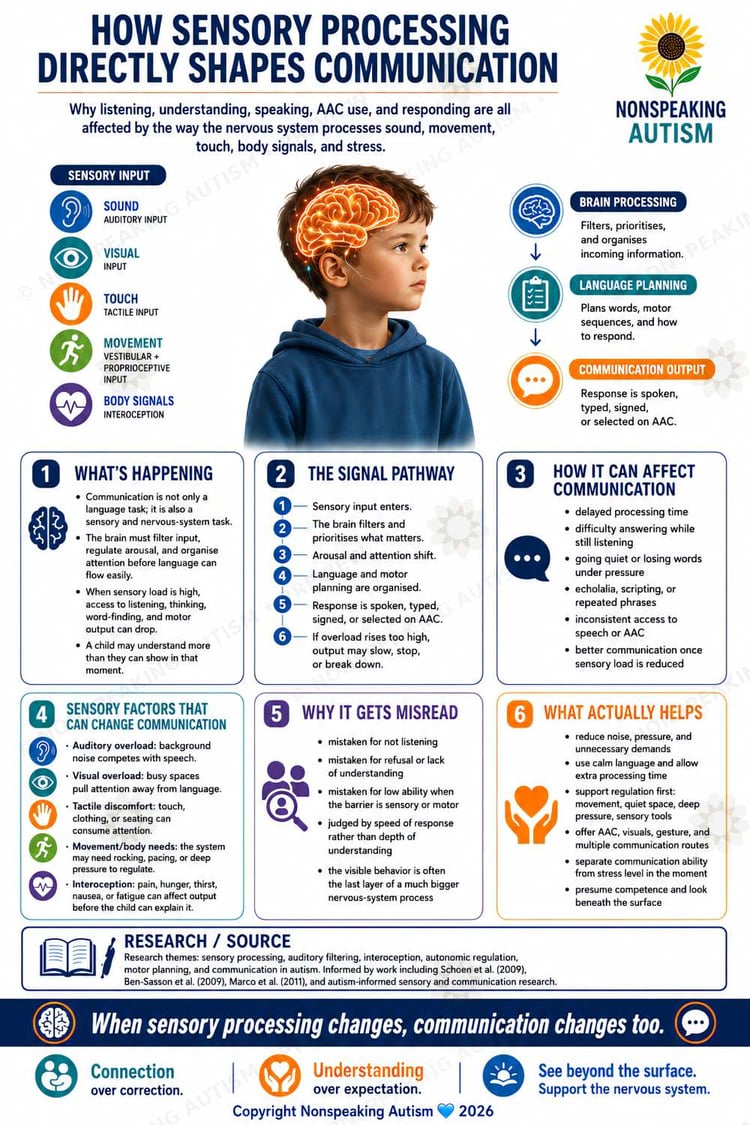
A child's outward response may have several possible contributing factors.
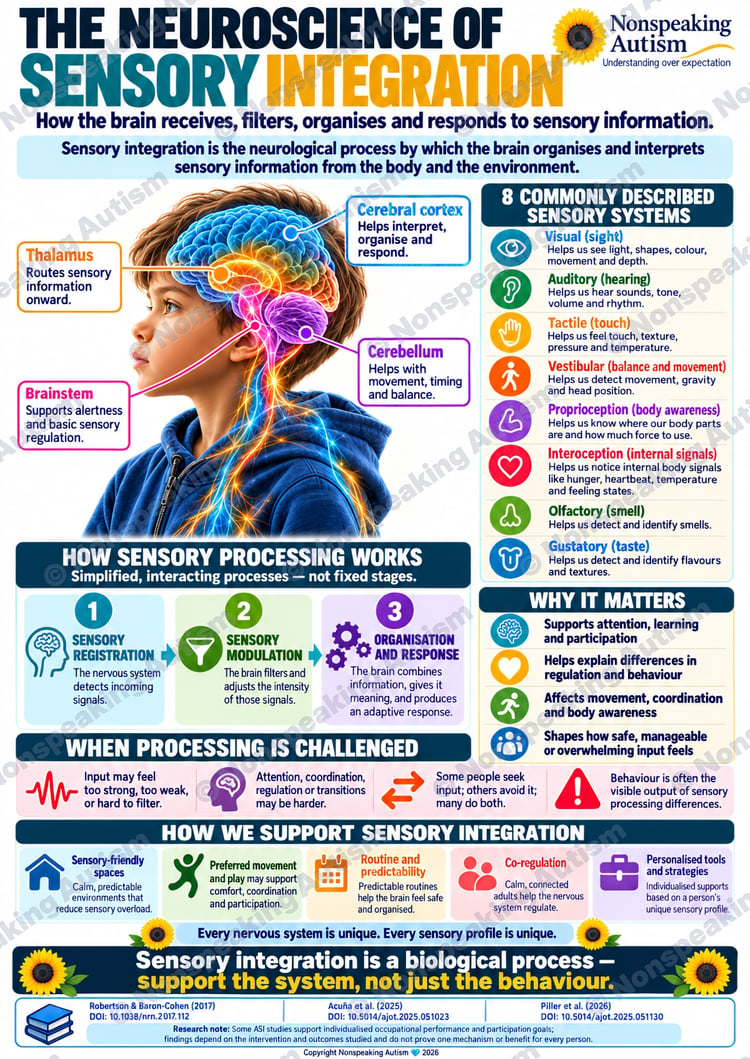
Sensory overload or discomfort
Noise, lighting, touch, crowds, movement or other sensory experiences may become uncomfortable or overwhelming.
Fatigue after demands or transitions
A child may have managed several difficult activities, social expectations or transitions before showing signs of distress.
Pain, illness, hunger or thirst
Physical needs may affect comfort, communication and participation.
Pain or illness should not be overlooked simply because a child cannot explain what is wrong.
Anxiety, uncertainty or loss of control
Unexpected changes, unfamiliar expectations or uncertainty may contribute to distress.
These factors may interact, and the same behaviour can have different explanations on different occasions.
💙 2. Why Understanding the Cause Matters
The poster highlights several important distinctions.
- The same behaviour may have different contributing factors.
- Loud, quiet or withdrawn behaviour may all occur during distress.
- Outward behaviour does not always reveal internal experience.
- Understanding possible causes helps adults choose more appropriate support.
For example, a child who becomes quieter may be tired, concentrating, overwhelmed or experiencing discomfort.
A child who leaves an activity may be responding to sensory demands, pain, uncertainty or another need.
Neither response establishes a specific cause on its own.
Understanding begins with considering the whole situation rather than relying on assumptions.
🌻 3. What Adults Can Do First
Before interpreting behaviour as deliberate defiance or misbehaviour, consider the following steps.
Pause before making assumptions.
Avoid immediately assigning intent or blame.
Look at the environment and context.
Consider noise, lighting, recent changes, demands and transitions.
Check physical needs.
Think about pain, illness, hunger, thirst, fatigue or other possible discomfort.
Notice what is different.
Changes from the child's usual communication, movement, eating, sleep or behaviour may provide useful clues.
Observe patterns over time.
Look at what happened before, during and after the difficulty without assuming that one observation proves a cause.
❤️ 4. What May Help
Support should reflect the individual child and the situation.
Possible approaches include:
- Reducing unnecessary demands.
- Using fewer words during distress.
- Offering quiet or space.
- Allowing preferred, safe movement.
- Providing appropriate sensory supports.
- Maintaining AAC and other communication access.
- Allowing additional processing time.
- Sharing useful observations between home, school and relevant professionals.
No single strategy works for every child.
What helps one child may be uncomfortable or ineffective for another.
The aim is to understand and respond to the child's needs, not simply to stop visible behaviour.
💬 WHY THIS MATTERS FOR NONSPEAKING CHILDREN
Nonspeaking does not mean a child has nothing to communicate.
A child may communicate through:
- AAC devices.
- Pictures and symbols.
- Gestures and pointing.
- Facial expressions.
- Body movements.
- Behavioural changes.
- Other individual communication methods.
Some children may understand what is happening but find it difficult to respond during distress.
Others may struggle to identify or express physical discomfort.
Adults should maintain communication access and avoid assuming that a lack of spoken explanation means there is no underlying need.
Every child deserves to have their communication recognised and respected.
🏡 PRACTICAL SUPPORT AT HOME AND SCHOOL
At Home
Notice changes in sleep, eating, energy, movement and communication.
Consider whether the child has experienced an unusually demanding day.
Offer recovery time and reduce unnecessary pressure where helpful.
At School
Review the sensory environment, classroom expectations, transitions and communication demands.
Consider reasonable adjustments and individual support plans.
Do not assume that a child who appears to be coping is necessarily comfortable.
Working Together
Families, schools and professionals can share observations about:
- Possible environmental triggers.
- Physical health concerns.
- Communication attempts.
- Early signs of distress.
- Helpful adjustments.
- Recovery needs.
Information should be shared appropriately, respecting the child's privacy, dignity and individual needs.
🔬 RESEARCH & GUIDANCE-INFORMED
This resource is informed by UK autism guidance concerning sensory differences, communication needs, physical health and behaviour that challenges.
NICE guidance recommends considering possible contributing factors when assessing behaviour that challenges in autistic children and young people.
These may include physical health conditions, communication difficulties, sensory sensitivities, environmental factors and changes in routine.
The National Autistic Society also provides guidance about sensory differences and individualised support.
The evidence supports looking beyond a single outward behaviour, but it does not mean that every behaviour has one identifiable cause.
Careful observation, individual context and appropriate professional assessment remain important.
📚 SELECTED RESEARCH AND GUIDANCE
1. National Institute for Health and Care Excellence (NICE). (2013; updated 2021).
Autism spectrum disorder in under 19s: support and management.
Clinical guideline CG170.
https://www.nice.org.uk/guidance/cg170
2. National Institute for Health and Care Excellence (NICE).
Autism — Quality standard QS51.
Statement 7 addresses assessment of factors that may trigger or maintain behaviour that challenges.
https://www.nice.org.uk/guidance/qs51
3. National Autistic Society.
Sensory differences.
Information about sensory experiences and support needs in autistic people.
Sources:
- NICE QS51, Quality statement 7
- NICE QS51 quality statements
- NAS – What can my autistic child get support with at school?
- NICE CG170
Further Resources
- NICE QS51, Quality statement 7: Assessing possible triggers for behaviour that challenges: https://www.nice.org.uk/guidance/qs51/chapter/Quality-statement-7-Assessing-possible-triggers-for-behaviour-that-challenges
- NICE CG170 – Autism spectrum disorder in under 19s: support and management: https://www.nice.org.uk/guidance/cg170
- National Autistic Society – Sensory differences: https://www.autism.org.uk/advice-and-guidance/topics/sensory-differences/sensory-differences/all-audiences
- National Autistic Society – What can my autistic child get support with at school?: https://www.autism.org.uk/advice-and-guidance/education/extra-help-at-school/what-can-my-autistic-child-get-support-with-at-school
📖 IMPORTANT RESEARCH LIMITATION
This poster is a simplified educational resource.
Behaviour alone cannot reliably identify the presence of pain, sensory overload, anxiety or another underlying cause.
Several factors may contribute simultaneously, and individual patterns vary.
The nervous system illustration is conceptual and does not represent a clinical brain scan or diagnostic finding.
The resource should not be used to diagnose or explain an individual child's behaviour without appropriate assessment.
👨👩👧 WHO IS THIS FREE RESOURCE FOR?
This poster may be useful for:
- Parents and carers of autistic children.
- Families of nonspeaking and minimally speaking children.
- Mainstream and specialist school staff.
- SENCOs and SEND teams.
- Teaching assistants and learning support workers.
- Speech and language therapists.
- Occupational therapists.
- Educational psychologists.
- Paediatric and community healthcare professionals.
- Autism support workers.
- Parent and carer support groups.
- Staff training and professional development.
🏫 HOW THIS RESOURCE CAN BE USED
At home: To encourage families to consider physical, sensory and emotional needs before making assumptions.
In classrooms: To support discussions about reasonable adjustments, communication access and the demands of the school environment.
In therapy rooms: As an educational visual aid for exploring possible contributing factors to distress.
During SEND training: To reinforce the importance of looking beyond outward behaviour.
In parent and carer groups: To promote compassionate understanding and shared learning.
📦 WHAT YOU RECEIVE — FREE DOWNLOAD 💛
1 × Look Beyond Behaviour — UK Educational Poster
Your free resource includes:
- Possible sensory, physical and emotional contributing factors.
- Why the same behaviour may have different explanations.
- What adults can do before making assumptions.
- Practical support strategies.
- Considerations for home and school.
- Selected UK research and guidance references.
- Nonspeaking Autism illustrations and branding.
💛 YOUR FREE DOWNLOAD
✅ 100% FREE — £0.00
✅ NO WATERMARK
✅ No purchase required.
✅ UK English spelling and terminology.
✅ Suitable for educational use at home, school and in professional settings.
✅ Printable digital resource.
Format: Digital PNG poster.
Print size: A2-style layout; final print dimensions and resolution should be confirmed before advertising it as A2 print-ready.
Digital download only — no physical product will be shipped.
⚠️ IMPORTANT EDUCATIONAL DISCLAIMER
This resource is provided for educational and informational purposes only.
It is not a diagnostic tool, validated behavioural assessment, medical evaluation, treatment programme or substitute for professional advice.
Changes in behaviour may have physical, sensory, emotional, communication-related or environmental causes.
No single behaviour reliably identifies an underlying condition or unmet need.
New, persistent, severe or unexplained changes should prompt consideration of medical or other appropriate professional assessment.
Support should respect the child's communication, dignity, safety, preferences and individual needs.
©️ COPYRIGHT & PERMITTED USE
Copyright © 2026 Nonspeaking Autism. All rights reserved.
Although this resource is free, it remains protected by copyright.
Permitted Use
You may download, print and publicly display this poster for:
- Personal and family use.
- Schools and educational settings.
- Therapy rooms and clinical environments.
- Staff training.
- Community and support settings.
- Educational discussion and awareness.
Not Permitted
Without prior written permission, you may not:
- Resell or redistribute the digital file.
- Upload the poster to other websites or public download platforms.
- Remove copyright information.
- Edit or rebrand the artwork.
- Include the poster in another commercial product.
- Reproduce the design for resale.
Please direct others to the original Payhip listing to obtain their own free copy.
💛 THE MESSAGE BEHIND THIS RESOURCE
A child may be overwhelmed.
They may be exhausted.
They may be anxious.
They may be hungry, thirsty or experiencing pain.
They may be trying to communicate something that adults have not yet understood.
And sometimes several needs may be present at once.
Behaviour is a clue, not the whole explanation.
When adults look beyond what they can see, they are better placed to recognise what a child may need.
We can pause before making assumptions.
We can listen to communication in all its forms.
We can consider physical health.
We can reduce unnecessary demands.
And we can respond with compassion.
When we look beyond behaviour, we are more likely to notice the child's actual needs.
🌻 Connection over correction. Understanding over expectation.
Nonspeaking Autism © 2026
Different needs. Equal belonging.