
🌻 THE NEUROSCIENCE OF SENSORY INTEGRATION
🌻 THE NEUROSCIENCE OF SENSORY INTEGRATION
How the Brain Receives, Filters, Organises and Responds to Sensory Information
UK Edition | Research-Informed Autism & Sensory Processing Educational Poster | Nonspeaking Autism
💙 Every nervous system is unique. Every sensory profile is unique.
Why might a child cover their ears in a busy classroom?
Why might another seek movement, pressure or repetitive sensory experiences?
Why can everyday environments feel manageable at one moment and overwhelming at another?
Understanding sensory integration can help us consider how sensory information, attention, movement, body awareness and the environment interact.
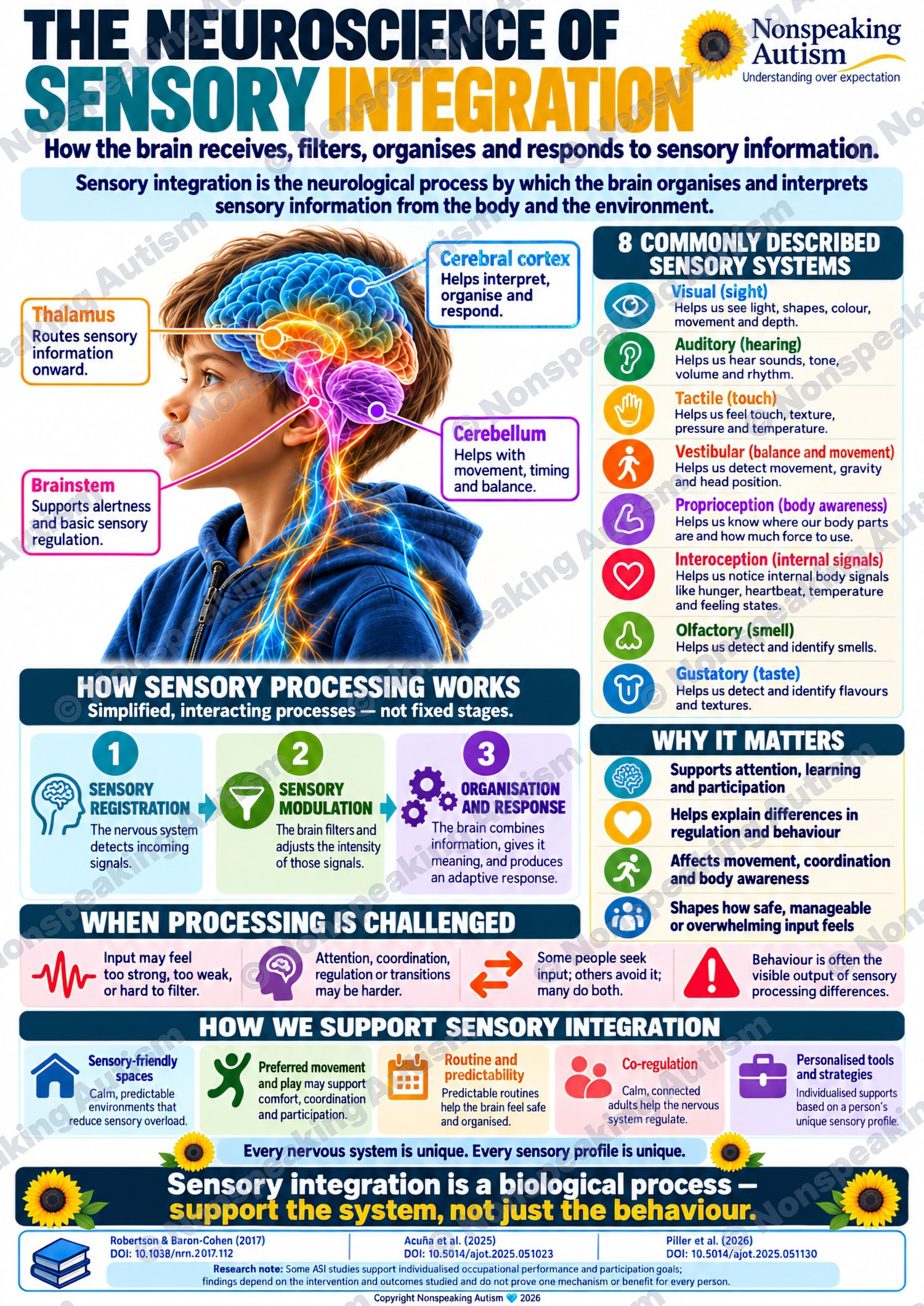
The Neuroscience of Sensory Integration is a detailed, illustrated educational poster exploring the neurological processes involved in receiving, processing and responding to sensory information.
It introduces eight commonly described sensory systems, relevant brain structures, sensory modulation and practical approaches to supporting autistic people with different sensory needs.
Designed for parents, carers, teachers, SENCOs, occupational therapists, speech and language therapists and SEND professionals, this poster encourages understanding rather than assumptions about behaviour.
The central message:
Sensory integration is a biological process — support the system, not just the behaviour.
🧠 WHAT IS SENSORY INTEGRATION?
Sensory integration refers to the neurological processes through which the nervous system receives, combines, organises and interprets information from the body and surrounding environment.
These processes contribute to how people:
- Recognise sounds, sights, smells, tastes and touch
- Maintain balance and coordinate movement
- Understand body position
- Notice internal bodily sensations
- Direct attention
- Respond to environmental changes
- Participate in everyday activities
Sensory processing is not controlled by one brain area acting alone.
It involves interacting neural pathways and systems.
People can experience the same environment differently, and an individual's sensory responses may also change with fatigue, stress, illness, context or other demands.
Sensory differences do not automatically indicate a disorder, and there is no single sensory profile shared by all autistic people.
🌈 THE EIGHT COMMONLY DESCRIBED SENSORY SYSTEMS
The poster introduces eight sensory systems often discussed in sensory processing education.
1. 👁️ VISUAL — SIGHT
The visual system helps us detect and interpret light, colour, shapes, movement and depth.
Some autistic people may find bright lights, glare, flicker or visually crowded environments uncomfortable.
Others may enjoy particular visual patterns or movements.
2. 👂 AUDITORY — HEARING
The auditory system supports the detection and processing of sounds, including their pitch, intensity, rhythm and timing.
Some individuals may find competing noise or unpredictable sounds difficult to tolerate.
Others may enjoy repeated or preferred sounds.
3. 🖐️ TACTILE — TOUCH
The tactile system provides information about touch, texture, pressure and aspects of temperature.
Some people may avoid particular clothing textures or unexpected touch.
Others may enjoy preferred tactile experiences.
4. 🚶 VESTIBULAR — BALANCE & MOVEMENT
The vestibular system contributes to sensing head movement, orientation and balance.
It works with vision and proprioception to support posture and movement.
5. 💪 PROPRIOCEPTION — BODY POSITION
Proprioception provides information about the position and movement of body parts.
It contributes to coordination, posture and adjusting movement.
Some individuals may enjoy activities that provide muscle and joint input, although these activities do not help everyone in the same way.
6. ❤️ INTEROCEPTION — INTERNAL BODY SIGNALS
Interoception concerns sensing and interpreting internal bodily conditions.
Examples include sensations associated with hunger, thirst, heartbeat, breathing, temperature and discomfort.
People may differ in how clearly they notice, identify or communicate these sensations.
7. 🌻 OLFACTORY — SMELL
The olfactory system detects odours.
Some smells may be pleasant, distracting, intense or uncomfortable depending on the person and situation.
8. 🍋 GUSTATORY — TASTE
The gustatory system contributes to detecting taste qualities.
Food experiences also involve smell, texture, temperature and other sensory information.
This means food preferences cannot always be understood through taste alone.
These eight categories are a useful educational framework, not eight completely independent neurological pathways.
🔬 THE BRAIN AND SENSORY PROCESSING
The poster introduces four important brain structures.
THALAMUS — SENSORY RELAY AND PROCESSING
The thalamus contributes to relaying and processing many forms of sensory information and interacting with wider brain networks.
Not all sensory pathways follow the same route. For example, olfactory processing differs from the pathways of several other senses.
CEREBRAL CORTEX — INTERPRETATION AND RESPONSE
Different cortical regions contribute to processing sensory information, attention, perception and planning responses.
Sensory processing involves distributed networks rather than one single cortical location.
BRAINSTEM — AROUSAL AND BASIC FUNCTIONS
The brainstem contributes to functions including arousal, autonomic regulation and aspects of sensory processing.
CEREBELLUM — COORDINATION AND TIMING
The cerebellum contributes to movement coordination, timing and adaptation, as well as other functions.
These structures interact with many additional neural systems.
The brain illustration is a simplified educational diagram, not a medical scan or an exact map of sensory integration pathways.
🔄 HOW SENSORY PROCESSING WORKS
The poster uses three simplified, interacting processes.
1. SENSORY REGISTRATION
The nervous system detects incoming sensory signals.
For example, a person may detect a sound, movement, touch or internal bodily sensation.
2. SENSORY MODULATION
Sensory modulation refers to processes influencing how sensory information is responded to and managed.
These processes can affect whether input is experienced as noticeable, manageable, distracting or overwhelming.
3. ORGANISATION AND RESPONSE
The nervous system combines information with context, prior experience and other processes to help guide perception and action.
Responses may include movement, communication, changes in attention or other actions.
These are not three fixed stages that always happen in the same order.
Sensory processing involves ongoing interactions and feedback.
💙 WHEN SENSORY PROCESSING IS CHALLENGING
Some autistic individuals experience sensory input as unusually intense, difficult to distinguish, distracting or overwhelming.
Others may notice particular sensations less readily or seek additional input.
Some people experience both sensory seeking and sensory avoidance, depending on the type of input and the situation.
Possible experiences include:
- Discomfort in noisy environments
- Difficulty concentrating with competing sensory information
- Avoiding particular textures
- Seeking preferred movement
- Needing recovery after busy activities
- Difficulty with transitions when sensory demands change
- Challenges coordinating movement
- Differences in noticing internal body signals
These experiences can affect comfort, communication, participation and everyday routines.
However, outward behaviour alone cannot establish what a person is experiencing.
A child covering their ears may be distressed by noise, but the response could also have other explanations.
Context, communication, physical wellbeing and individual preferences matter.
🌻 WHY SENSORY INTEGRATION MATTERS
Sensory processing contributes to many everyday activities.
Attention and Learning
Sensory environments may affect a person's ability to focus, access information and participate.
Emotional Regulation
Uncomfortable or overwhelming sensory experiences may contribute to distress for some people.
However, emotional regulation involves many factors beyond sensory processing.
Movement and Coordination
Sensory information contributes to balance, posture and movement control.
Body Awareness
Proprioceptive, vestibular, tactile and interoceptive information can contribute to how people experience and respond to their bodies.
Comfort and Participation
A supportive environment may reduce avoidable sensory barriers.
The goal is not to eliminate sensory differences. It is to support comfort, choice, safety and meaningful participation.
🏡 HOW TO SUPPORT INDIVIDUAL SENSORY NEEDS
The poster highlights five practical approaches.
1. SENSORY-FRIENDLY SPACES
Consider whether the environment includes unnecessary sensory demands.
Possible adjustments include:
- Reducing unwanted noise
- Offering softer lighting
- Providing quieter spaces
- Reducing visual clutter
- Allowing comfortable clothing
- Making breaks accessible
A sensory-friendly environment should reflect the person's preferences rather than a universal checklist.
2. PREFERRED MOVEMENT AND PLAY
Some people enjoy activities such as walking, swinging, stretching, jumping or other movement.
Preferred movement may contribute to comfort, enjoyment or participation.
Activities should be safe, voluntary and appropriate to the person's needs.
3. ROUTINE AND PREDICTABILITY
Predictable routines may help some people prepare for changes and manage uncertainty.
Possible supports include:
- Visual schedules
- Advance information
- Familiar routines
- Accessible communication
- Choices during transitions
- Additional processing time
4. CO-REGULATION
Supportive relationships and calm, responsive interactions may help people manage distress.
Useful approaches may include:
- Staying calm
- Reducing unnecessary demands
- Respecting personal space
- Using preferred communication methods
- Allowing recovery time
- Avoiding unwanted touch
5. PERSONALISED TOOLS AND STRATEGIES
Some people find particular sensory tools or environmental adjustments helpful.
Examples might include:
- Ear defenders
- Comfortable seating
- Preferred tactile items
- Movement breaks
- Quiet spaces
- Individualised communication supports
Different sensory strategies have different levels of research support.
A tool should be selected according to the person's preferences, safety, needs and meaningful outcomes — not simply because it is marketed as a sensory intervention.
🏫 USING THIS RESOURCE IN UK SCHOOLS & SEND SETTINGS
This poster may support discussions about sensory accessibility in nurseries, mainstream schools, specialist schools and other educational settings.
It can help staff consider:
- Sensory demands in classrooms
- Busy corridors and assemblies
- Lighting and sound
- Sensory-friendly workspaces
- Movement and rest breaks
- Communication access
- Sensory needs during transitions
- Individual support planning
- Reasonable adjustments
- Collaborative occupational therapy input where appropriate
A pupil who withdraws from an activity may be overwhelmed, fatigued, unwell or experiencing another difficulty.
A pupil who seeks movement may have a preferred sensory need, but the reason should not be assumed without understanding the individual.
A child who finds a classroom difficult may benefit from adjustments to the environment rather than increased pressure to tolerate discomfort.
In England, sensory accessibility needs may be considered in SEND support planning or an Education, Health and Care Plan (EHCP), where relevant.
Support should be guided by the person's actual experience and functional needs.
📚 RESEARCH & SCIENTIFIC EVIDENCE
The poster refers to research concerning sensory integration approaches and occupational therapy interventions.
It is important to distinguish between:
Sensory integration as a neurological process, which refers to how the nervous system processes and combines sensory information;
and
Ayres Sensory Integration (ASI) therapy, a specific intervention approach with defined principles and fidelity requirements.
These are related concepts, but they are not interchangeable.
Evidence for sensory-based interventions varies according to the intervention, population and outcomes measured.
Some studies report improvements in selected individualised functional goals. These findings should not be interpreted as proof that all sensory interventions work for everyone.
Selected Research Printed on the Poster
Robertson & Baron-Cohen (2017)
Research reviewing sensory perception in autism.
DOI: 10.1038/nrn.2017.112
Acuña et al. (2025)
Research concerning sensory integration or occupational therapy intervention outcomes.
DOI: 10.5014/ajot.2025.051023
Piller et al. (2026)
Research concerning sensory-based approaches.
DOI: 10.5014/ajot.2025.051130
- Robertson, C. E., & Baron-Cohen, S. (2017). Sensory perception in autism. Nature Reviews Neuroscience, 18(11), 671–684. https://doi.org/10.1038/nrn.2017.112
- Acuña, C., Gallegos, S., Barfoot, J., Meredith, P., & Hill, J. (2025). Ayres Sensory Integration® with children ages 0 to 12: A systematic review of randomized controlled trials. American Journal of Occupational Therapy, 79(3). https://doi.org/10.5014/ajot.2025.051023
- Piller, A., Glennon, T. J., Andelin, L., Auld-Wright, K. D., McHugh Conlin, J., Teng, K., & Tarver, T. (2026). Occupational therapy interventions using Ayres Sensory Integration® for children and youth (2015–2024): A systematic review. American Journal of Occupational Therapy, 80(1), 38–48. https://doi.org/10.5014/ajot.2025.051130
Reference verification note: The author–year details and DOIs above are transcribed from the poster. The complete publication records and precise findings have not been independently verified for this listing.
EVIDENCE NOTE
This poster is research-informed educational material.
It is not a validated sensory assessment, diagnostic instrument or treatment protocol.
The neurological illustration and three-process model are simplified explanations.
They should not be interpreted as definitive maps of brain function or proof that a particular intervention will benefit an individual.
👨👩👧 WHO IS THIS RESOURCE FOR?
This educational poster may be useful for:
- Autistic children, young people and adults
- Parents and carers
- Teachers and teaching assistants
- SENCOs and SEND teams
- Occupational therapists
- Speech and language therapists
- Educational psychologists
- Early years practitioners
- Paediatric professionals
- Autism support workers
- Professionals involved in sensory accessibility
- Anyone wanting to understand sensory processing differences
It may be displayed in homes, classrooms, SEND support areas, therapy rooms, staff training spaces and other educational environments.
📦 WHAT YOU RECEIVE
PAID DIGITAL DOWNLOAD — INDIVIDUAL POSTER
Your purchase includes:
1 × The Neuroscience of Sensory Integration — Educational Poster
The poster features:
- A definition of sensory integration
- Eight commonly described sensory systems
- An illustrated overview of relevant brain structures
- Sensory registration
- Sensory modulation
- Organisation and response
- Possible sensory processing challenges
- Links to attention, movement, body awareness and participation
- Five practical support approaches
- Selected research references
- Nonspeaking Autism illustrated design
The product preview contains promotional watermarks.
The final purchased file should be provided without these preview watermarks.
Digital download only — no physical poster will be posted.
Exact printable dimensions and resolution should be confirmed against the final downloadable file.
⚠️ IMPORTANT DISCLAIMER
This poster is intended for educational and informational purposes only.
It does not provide a diagnosis, clinical assessment, occupational therapy evaluation or individualised treatment plan.
Sensory differences vary considerably between people.
Not every autistic person experiences sensory processing challenges, and not every sensory response is caused by autism.
Pain, illness, fatigue, anxiety, communication barriers and environmental factors may also influence how someone responds.
Sensory tools and activities should never be forced.
Where concerns are persistent, significant or affecting everyday functioning, seek advice from an appropriately qualified professional.
©️ COPYRIGHT & PERMITTED USE
Copyright © 2026 Nonspeaking Autism. All rights reserved.
Purchase permits personal, family, classroom, school and individual professional educational use.
You may print the poster for these purposes.
You may not:
- Resell the poster or digital file
- Redistribute the purchased file
- Upload the artwork to another website or platform
- Remove branding and claim the artwork as your own
- Reproduce it commercially
- Include it in another product for resale without permission
Please share the original Payhip listing rather than distributing the purchased file.
💛 THE MESSAGE BEHIND THIS RESOURCE
A busy environment may feel comfortable to one person and overwhelming to another.
A sound that seems ordinary to one child may be distressing to someone else.
A child may seek movement because they enjoy it.
Another may need quiet to recover.
And the same person may have different sensory needs on different days.
There is no single sensory profile.
There is no universal sensory strategy.
And there is no one intervention that meets everyone's needs.
Understanding sensory integration means looking beyond outward behaviour and considering the whole person.
We can listen.
We can observe.
We can offer choices.
We can reduce barriers.
And we can create environments that respect individual sensory experiences.
Sensory integration is a biological process — support the system, not just the behaviour.
🌻 Connection over correction. Understanding over expectation. 💙