
Why Some Autistic Individuals Seek Shoulder & Upper-Back Pressure
Why Some Autistic Individuals Seek Shoulder & Upper-Back Pressure
What Sensory Neuroscience Can — and Cannot — Tell Us
A Research-Informed Educational Poster
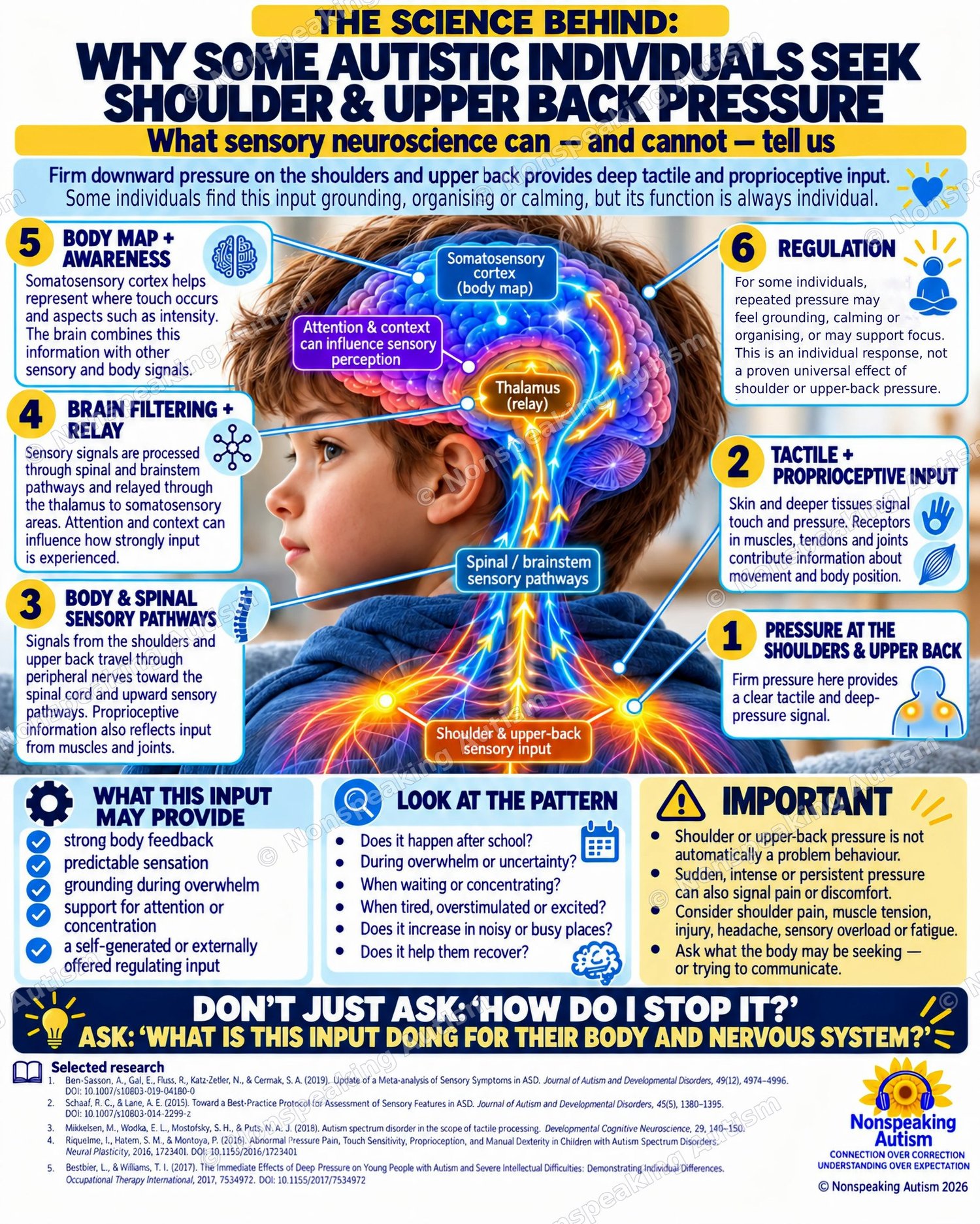
Firm pressure across the shoulders or upper back can provide tactile and proprioceptive sensory input. For some autistic people, predictable pressure may feel grounding, organising or calming, or may support attention and regulation.
But the same visible behaviour does not have one universal meaning.
Some people may actively seek this type of input. Others may prefer pressure only in certain situations, while some may find it uncomfortable or distressing. New or persistent pressure-seeking may also occur alongside pain, muscle tension, fatigue or other physical needs.
Why Some Autistic Individuals Seek Shoulder & Upper-Back Pressure is a research-informed educational poster from Nonspeaking Autism, created to help families, educators and professionals look beyond the surface of behaviour and consider the whole person.
The central question is not simply:
“How do I stop it?”
It is:
“What might this input be doing for their body and nervous system?”
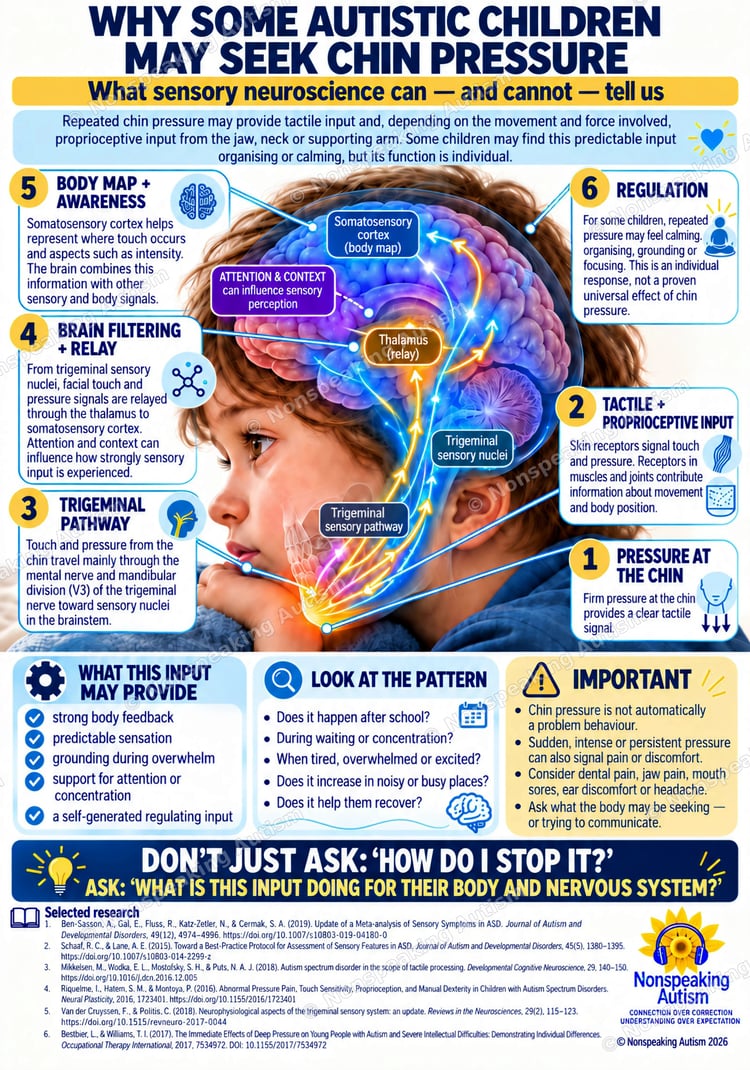
🫶 1. Pressure at the Shoulders & Upper Back
Firm pressure to the shoulders and upper back creates clear tactile input.
Depending on the type of pressure, posture and movement involved, it can also involve feedback from muscles and joints.
For some people, this kind of input may be experienced as:
- strong body feedback
- predictable sensation
- grounding input
- comforting pressure
- support during overwhelm
- input used during concentration
- a familiar regulating experience
These are possibilities rather than guaranteed effects.
A person repeatedly seeking shoulder pressure does not by itself tell us why they want it.
✋ 2. Tactile & Proprioceptive Input
Touch and pressure are detected through sensory receptors in the skin and deeper tissues.
Information from muscles, tendons and joints contributes to proprioception — our sense of body position, movement and force.
Together, these systems provide the nervous system with information about what is happening to and within the body.
This helps explain how pressure can generate sensory information.
It does not prove that shoulder or upper-back pressure is regulating for every autistic person.
🧠 3. Body & Spinal Sensory Pathways
Sensory information from the shoulders and upper back travels through peripheral nerves towards the spinal cord and onward through sensory pathways in the central nervous system.
Proprioceptive information also reflects input from muscles and joints.
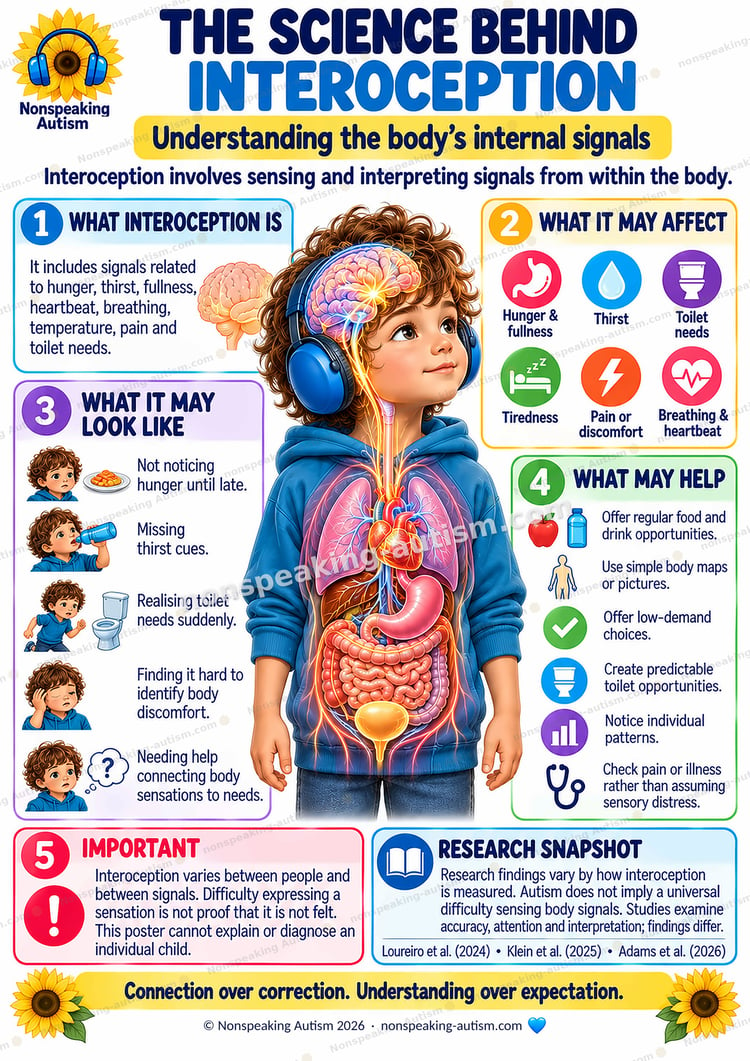
The nervous system does not simply receive this information in isolation. Sensory signals interact with wider systems involved in:
attention • movement • perception • emotion • arousal • memory • context
The neurological diagram on the poster is therefore a simplified educational representation, not a literal map of what is happening in one person's brain.
🔄 4. Brain Filtering, Relay & Context
Sensory signals are processed through multiple neural pathways and brain regions.
The thalamus participates in relaying much sensory information to cortical areas, while attention and context can influence how sensory experiences are perceived.
This means pressure that feels useful at one moment may not feel useful at another.
The experience may vary depending on:
- sensory load
- stress or arousal
- fatigue
- pain
- predictability
- environment
- attention
- previous experiences
- who is providing the input
- whether the person chose it
- the amount and duration of pressure
Context matters. Consent matters. Individual response matters.
🗺️ 5. Body Map & Awareness
The somatosensory cortex contributes to processing sensory information from different areas of the body, including aspects such as the location and characteristics of touch.
But sensation does not come from one brain region working alone.
Sensory experiences emerge through interactions across multiple neural systems.
This is particularly important when interpreting a visible behaviour.
We can observe the movement. We cannot automatically observe its meaning.
💙 6. Regulation
For some autistic people, repeated pressure may accompany periods of:
- sensory overload
- uncertainty
- waiting
- concentration
- excitement
- tiredness
- recovery after demanding environments
Pressure may feel grounding or organising for some individuals.
It may support focus for others.
And some people may dislike it entirely.
There is no proven universal regulatory effect of shoulder or upper-back pressure.
The person's own response should guide support.
⚙️ What Might This Input Provide?
Depending on the individual, shoulder or upper-back pressure may provide:
Strong body feedback
A noticeable sensory signal.
Predictable sensation
Particularly when the person controls when and how the pressure occurs.
Grounding during overwhelm
Some people report or demonstrate preferences for stronger sensory input when overloaded.
Support during concentration
Pressure-seeking may appear while waiting, listening, focusing or completing tasks.
Self-generated sensory input
A person may lean against furniture, press against surfaces or position their body to create pressure.
Externally offered pressure
Some people may actively request or consent to another person providing pressure.
Self-generated and externally provided pressure are not equivalent.
🔍 Look at the Pattern
Rather than assigning a meaning from one observation, look for repeated patterns.
Consider:
Does it happen after school or another demanding environment?
Does it occur during overwhelm or uncertainty?
Does it happen while waiting or concentrating?
Does it increase when the person is tired, overstimulated or excited?
Is it more common in noisy, crowded or unpredictable places?
Does the person actively request the pressure?
Do they move towards it — or away from it?
Does it appear to help them continue or recover?
Has the behaviour suddenly changed?
Repeated observations across different contexts can provide more useful information than a single incident.
🛑 Consent Is Essential
There is an important distinction between someone seeking pressure themselves and another person applying pressure to them.
Never assume that because a person sometimes enjoys pressure, they want another person to provide it.
Preferences can change from moment to moment.
Where pressure is offered by another person:
- seek consent or assent
- respect refusal
- stop when the person indicates they want it to stop
- never force pressure as a behavioural intervention
- do not use pressure to obtain compliance
- consider communication differences
- follow individualized professional guidance where appropriate
A sensory preference is not blanket consent.
⚠️ Don't Automatically Assume Sensory Seeking
Shoulder or upper-back pressure is not automatically a problem behaviour.
But it is also not automatically a sensory-regulation strategy.
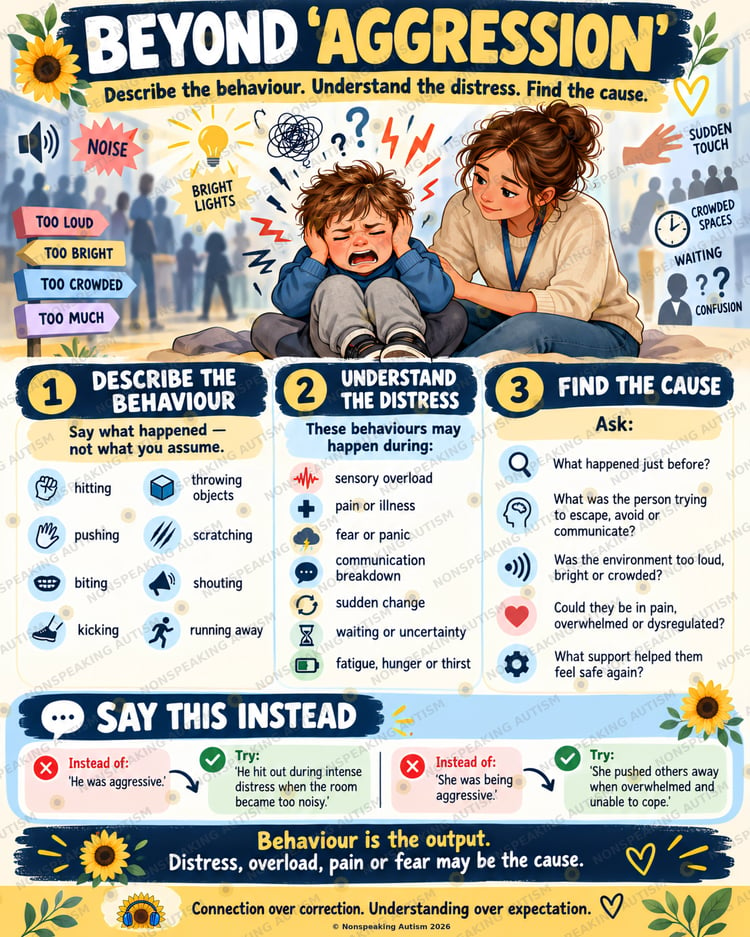
New, unusually intense or persistent behaviour may sometimes accompany physical discomfort.
Consider possible:
- shoulder pain
- neck or back discomfort
- muscle tension
- injury
- headache
- fatigue
- illness
- changes in posture or movement
- sensory overload
The behaviour alone cannot diagnose any of these.
But significant changes should prompt curiosity about the body rather than automatically being attributed to autism.
Check sensory needs — and check physical needs too.
🧠 What Does Research Say About Deep Pressure?
Research into deep-pressure interventions provides useful background, but the evidence should be interpreted carefully.
Studies have reported that some autistic people show changes in physiological arousal or appear to benefit from particular forms of deep pressure. Other findings demonstrate substantial individual differences.
The evidence does not establish that deep pressure works for every autistic person, nor does research on one form of pressure prove that shoulder or upper-back pressure has the same effect.
Therefore:
Pressure should be individualized, preferred, safe and never forced.
The aim is not to make someone appear calmer.
The meaningful question is whether a support improves the person's comfort, regulation, communication, participation or wellbeing.
🔬 Research-Informed
This poster draws on broader evidence concerning:
- sensory-processing differences in autism
- tactile processing
- proprioceptive information
- sensory assessment
- pressure-related sensory experiences
- individual responses to deep pressure
- somatosensory processing
Research supports the importance of considering sensory differences and individual sensory profiles.
It does not allow us to infer the exact neurological purpose of an individual's behaviour simply by observing it.
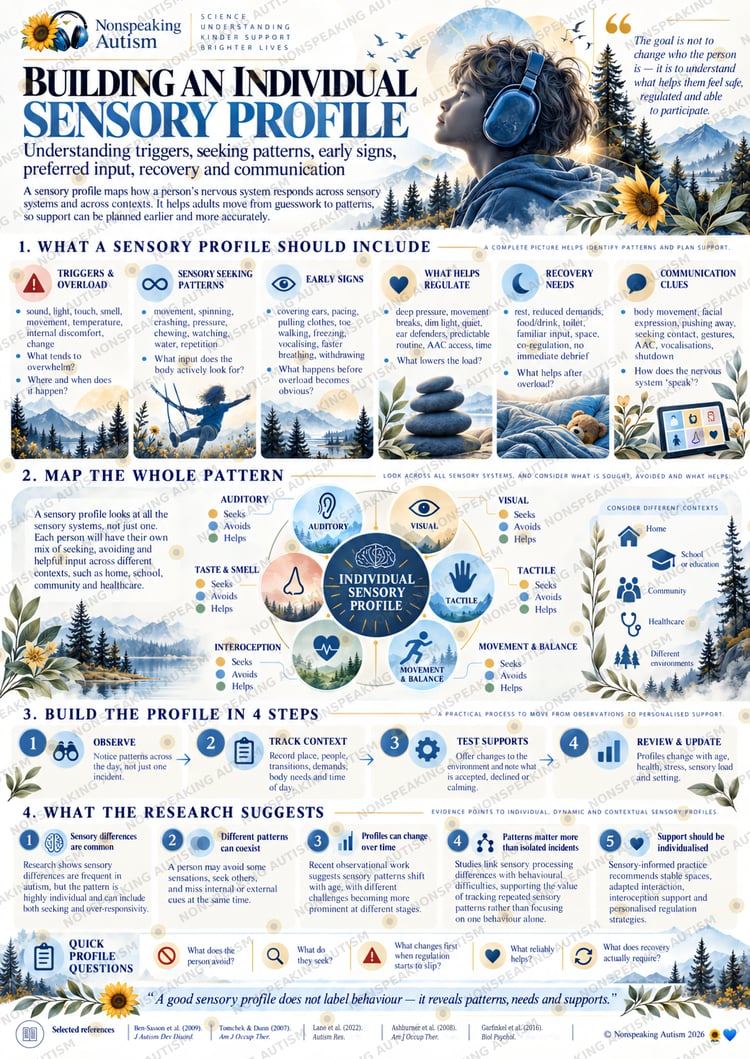
Observe the pattern. Consider the context. Check the body. Ask the person. Individualise support.
📚 Selected Research & References
Ben-Sasson, A., Gal, E., Fluss, R., Katz-Zetler, N., & Cermak, S. A. (2019). Update of a Meta-analysis of Sensory Symptoms in ASD: A New Decade of Research. Journal of Autism and Developmental Disorders, 49(12), 4974–4996.
Schaaf, R. C., & Lane, A. E. (2015). Toward a Best-Practice Protocol for Assessment of Sensory Features in ASD. Journal of Autism and Developmental Disorders, 45(5), 1380–1395.
Mikkelsen, M., Wodka, E. L., Mostofsky, S. H., & Puts, N. A. J. (2018). Autism spectrum disorder in the scope of tactile processing. Developmental Cognitive Neuroscience, 29, 140–150.
Riquelme, I., Hatem, S. M., & Montoya, P. (2016). Abnormal Pressure Pain, Touch Sensitivity, Proprioception, and Manual Dexterity in Children with Autism Spectrum Disorders. Neural Plasticity, 2016, 1723401.
Bestbier, L., & Williams, T. I. (2017). The Immediate Effects of Deep Pressure on Young People with Autism and Severe Intellectual Difficulties: Demonstrating Individual Differences. Occupational Therapy International, 2017, 7534972.
📚 RESEARCH & REFERENCES
This poster is research-informed, drawing on recent published literature (2024–2026) on sensory reactivity, deep pressure tactile input, sensory-based support, stimming, uncertainty and pain in autism.
🔬 Up-to-date research (2024–2026)
Tavassoli, T., Marco, E. J., & Puts, N. A. J. (2026). Sensory reactivity in autism: Integrating behavioural, affective, physiological, and neural dimensions. Current Psychiatry Reports, 28, Article 36.
→ Supports: Tactile + Proprioceptive Input; Brain Filtering + Relay; Body Map + Awareness
Piller, A., McHugh Conlin, J., Glennon, T. J., Andelin, L., Auld-Wright, K., Teng, K., & Tarver, T. (2025). Systematic review of sensory-based interventions for children and youth (2015–2024). Frontiers in Pediatrics, 13, 1720179. https://doi.org/10.3389/fped.2025.1720179
→ Supports: Regulation; What This Input May Provide; "its function is always individual"
Chen, Y., Xi, Z., Saunders, R., Simmons, D., Totsika, V., & Mandy, W. (2024). A systematic review and meta-analysis of the relationship between sensory processing differences and internalising/externalising problems in autism. Clinical Psychology Review, 114, 102516. https://doi.org/10.1016/j.cpr.2024.102516
→ Supports: Look at the Pattern; links between sensory seeking, overwhelm and wellbeing
Morris, I. F., Sykes, J. R., Paulus, E. R., Dameh, A., Razzaque, A., Vander Esch, L., Gruenig, J., & Zelazo, P. D. (2025). Beyond self-regulation: Autistic experiences and perceptions of stimming. Neurodiversity, 3. https://doi.org/10.1177/27546330241311096
→ Supports: "a self-generated or externally offered regulating input"; "not automatically a problem behaviour"
Bird, S., Moid, L. A. E., Jones, C. A., & Surtees, A. D. R. (2024). The relationships between restrictive/repetitive behaviours, intolerance of uncertainty, and anxiety in autism: A systematic review and meta-analysis. Research in Autism Spectrum Disorders, 117, 102428.
→ Supports: Look at the Pattern ("During overwhelm or uncertainty?")
Kumar, J., Hartzell, C., Abelson, E., Jastrowski Mano, K., & Chidambaran, V. (2026). Prevalence, expression, assessment, mechanisms, and management of pain in autistic children: A scoping review. A&A Practice, 20(4), e02178. https://doi.org/10.1213/XAA.0000000000002178
→ Supports: Important ("Sudden, intense or persistent pressure can also signal pain or discomfort")
📖 Foundational research also cited on the poster
Ben-Sasson, A., Gal, E., Fluss, R., Katz-Zetler, N., & Cermak, S. A. (2019). Update of a meta-analysis of sensory symptoms in ASD: A new decade of research. Journal of Autism and Developmental Disorders, 49(12), 4974–4996. https://doi.org/10.1007/s10803-019-04180-0
Schaaf, R. C., & Lane, A. E. (2015). Toward a best-practice protocol for assessment of sensory features in ASD. Journal of Autism and Developmental Disorders, 45(5), 1380–1395. https://doi.org/10.1007/s10803-014-2299-z
Mikkelsen, M., Wodka, E. L., Mostofsky, S. H., & Puts, N. A. J. (2018). Autism spectrum disorder in the scope of tactile processing. Developmental Cognitive Neuroscience, 29, 140–150. https://doi.org/10.1016/j.dcn.2016.12.005
Riquelme, I., Hatem, S. M., & Montoya, P. (2016). Abnormal pressure pain, touch sensitivity, proprioception, and manual dexterity in children with autism spectrum disorders. Neural Plasticity, 2016, 1723401. https://doi.org/10.1155/2016/1723401
Bestbier, L., & Williams, T. I. (2017). The immediate effects of deep pressure on young people with autism and severe intellectual difficulties: Demonstrating individual differences. Occupational Therapy International, 2017, 7534972. https://doi.org/10.1155/2017/7534972
🔗 FURTHER RESOURCES
National Autistic Society — Autism and sensory processing
An accessible overview of sensory differences, including how autistic people can be over- or under-sensitive, often with a mix of both.
https://www.autism.org.uk/advice-and-guidance/about-autism/sensory-processing
National Autistic Society — Ten simple sensory strategies for autistic children
Practical ideas from an occupational therapist, including options for children who seek pressure or hugs (such as Lycra base layers and weighted lap pads).
https://www.autism.org.uk/advice-and-guidance/professional-practice/sensory-strategies
Royal College of Occupational Therapists — Sensory approaches
RCOT's resource page on sensory approaches for children and young people.
https://www.rcot.co.uk/explore-resources/children-young-people-families/sensory-approaches
Royal College of Occupational Therapists — Weighted blankets guide
Official guidance on the safe use of weighted blankets for children and adults, written for OTs but useful for families considering one.
https://www.rcot.co.uk/latest-news/rcot-weighted-blankets-guide-occupational-therapists
Cerebra — Weighted blankets for sleep difficulties in children (factsheet)
A parent-friendly summary of the evidence and the safety recommendations.
https://cerebra.org.uk/wp-content/uploads/2023/11/Weighted-blanket-2023.pdf
💛 A note on safety and consent
Pressure should always be offered, never imposed. The person must be able to move away from or remove any pressure or weighted item themselves, and weighted items should never be used as a form of restraint. For weighted products, seek individual advice from an occupational therapist.
🔬 How the research is used
Findings are presented as group-level evidence, not predictions about an individual. Research can identify patterns and associations; it cannot tell us why one person seeks shoulder or upper-back pressure, or what it does for them.
Observe the individual. Look at context. Track patterns. Adjust support. Review again.
📖 Evidence Note
These references support the broader sensory-processing, tactile, proprioceptive and pressure-response principles discussed in this resource.
They should not be interpreted as proving that shoulder or upper-back pressure has a particular neurological function in an individual autistic person.
Research concerning deep-pressure interventions also does not automatically validate every form of pressure-based sensory input.
This is a research-informed educational resource, not a standardized or validated sensory assessment tool.
👨👩👧 Who Is This Resource For?
This poster may be useful for:
- autistic people and their families
- parents and carers
- teachers and teaching assistants
- SENCOs and SEND teams
- mainstream and specialist schools
- occupational therapists
- speech and language therapists
- physiotherapists
- paediatric professionals
- healthcare professionals
- psychologists
- support workers
- respite and social-care teams
- autism and disability organisations
It can be used to support family education, staff training, professional reflection and conversations about individualized sensory support.
📦 What You Receive
Your purchase includes:
1 × Why Some Autistic Individuals Seek Shoulder & Upper-Back Pressure educational poster
1 × high-resolution printable digital PDF
The purchased file is supplied clear and without the promotional preview watermark visible on the Payhip listing image.
Watermarks shown in promotional images are used for preview and copyright protection only.
Digital download only — no physical product will be shipped.
⚠️ Important Disclaimer
This resource is for educational and informational purposes only.
It is not medical advice, diagnosis, occupational therapy assessment, physiotherapy assessment, neurological assessment, sensory assessment, pain assessment, behaviour assessment or an individualized treatment plan.
The examples describe possibilities rather than fixed meanings.
Sudden, painful, unusually intense, persistent or significantly changed pressure-seeking behaviour should not automatically be attributed to autism or sensory regulation. Appropriate medical or professional assessment should be sought where pain, injury, weakness, movement changes or other physical concerns are suspected.
Sensory strategies should be individualized, safe, consensual and responsive to the person's preferences.
Deep pressure or other physical sensory input should never be forced simply because it is believed to be regulating.
©️ Copyright & Permitted Use
Copyright © 2026 Nonspeaking Autism. All rights reserved.
Purchase permits use for personal/home use, your own classroom or educational setting, your own clinic or individual professional educational practice, and direct educational/support work with people you support.
The digital file may not be resold, redistributed, file-shared, uploaded elsewhere, commercially reproduced, altered for resale or incorporated into another product for sale or distribution.
Please direct others who would like their own copy to the original Nonspeaking Autism listing.
💛 The Message Behind the Resource
When someone repeatedly seeks pressure around their shoulders or upper back, the movement is visible.
Its meaning is not.
It might be useful sensory input.
It might accompany concentration.
It might appear during overwhelm.
It might feel grounding.
It might simply be comfortable.
Or a change in behaviour might indicate that something hurts.
The goal is not to assign one explanation.
The goal is to observe, communicate, understand and support.
**See beyond the surface.
Support the whole system.
Respect communication.
Respect consent.
Individualise support.**
DON'T JUST ASK: “HOW DO I STOP IT?”
ASK: “WHAT MIGHT THIS INPUT BE DOING FOR THEIR BODY AND NERVOUS SYSTEM?”
Connection over correction. Understanding over expectation. 💙🌻
© Nonspeaking Autism 2026