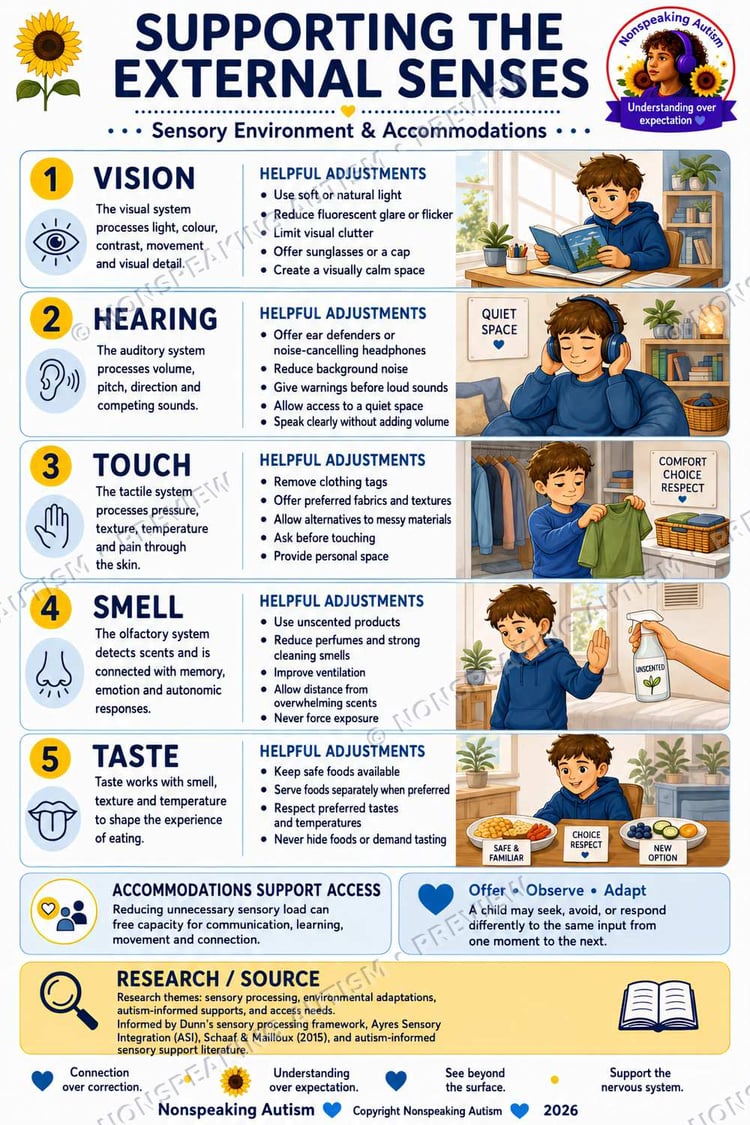

Building an Individual Sensory Profile
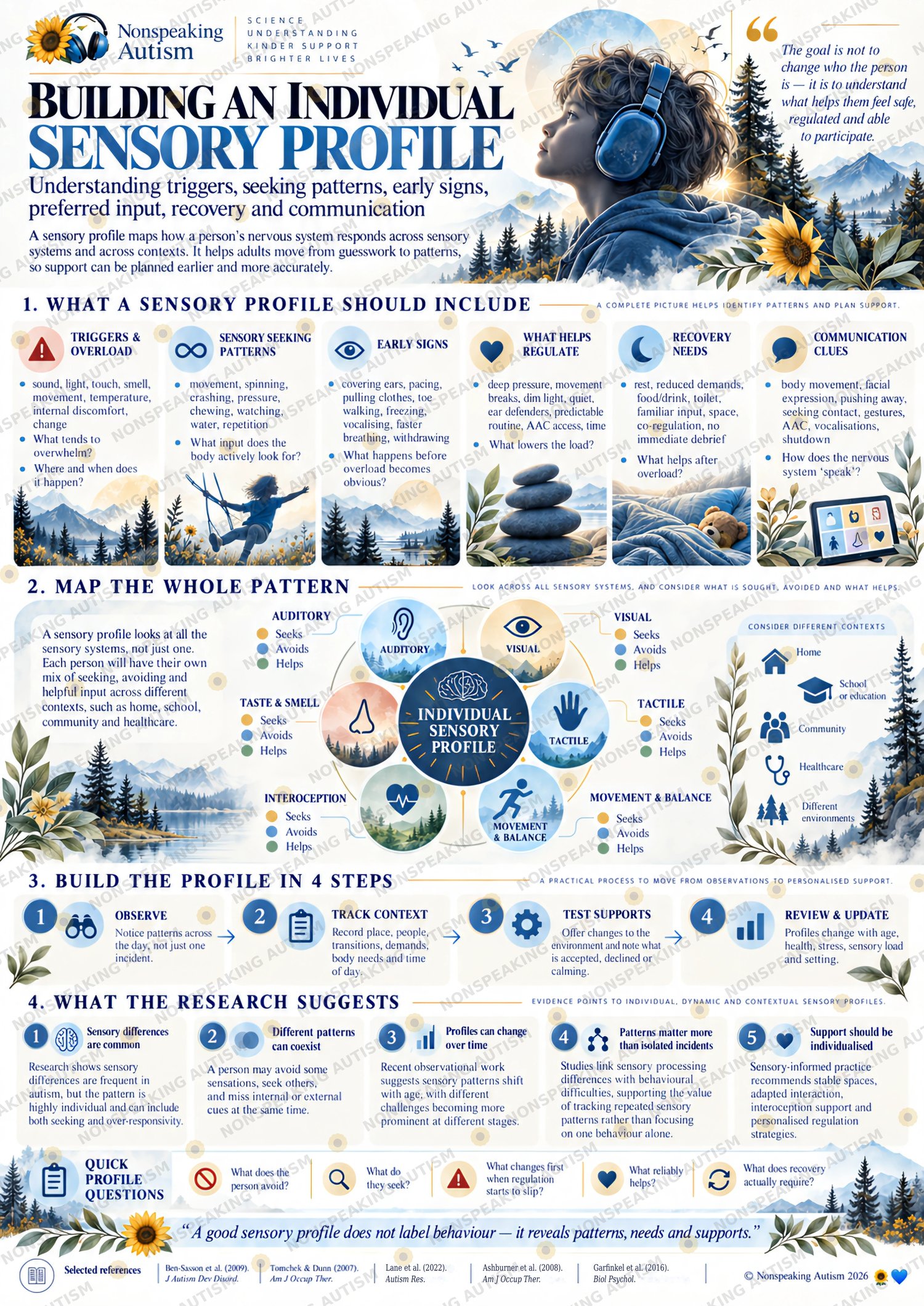
Building an Individual Sensory Profile
Understanding triggers, seeking patterns, early signs, preferred input, recovery and communication
A sensory profile should tell us much more than whether someone is “sensitive to noise” or “likes movement.”
A useful profile looks at the whole person.
What sensory input do they seek?
What do they avoid?
What tends to overwhelm them?
What are their earliest signs that sensory load is becoming difficult?
What helps them regulate?
What does genuine recovery look like?
How do they communicate when their nervous system is under pressure?
And importantly — does the pattern change depending on the environment, people, health, fatigue or demands?
Building an Individual Sensory Profile is a research-informed educational resource designed to help families, educators and professionals move away from isolated observations and towards a more complete, individualized understanding of sensory needs.
The central message is:
The goal is not to change who the person is — it is to understand what helps them feel safe, regulated and able to participate. 💛
🧠 What Is an Individual Sensory Profile?
A sensory profile maps how a person's sensory experiences and responses appear across different sensory systems, situations and environments.
It can help supporters move from:
“They hate loud noises.”
towards a more useful picture:
Which noises?
At what intensity?
In which environments?
When tired or well-rested?
What happens first?
What does the person do to regulate?
What actually helps?
The purpose is not to put someone into a sensory category.
It is to identify patterns that can inform support.
1️⃣ What a Sensory Profile Should Include
This resource organizes an individual sensory profile around six interconnected areas.
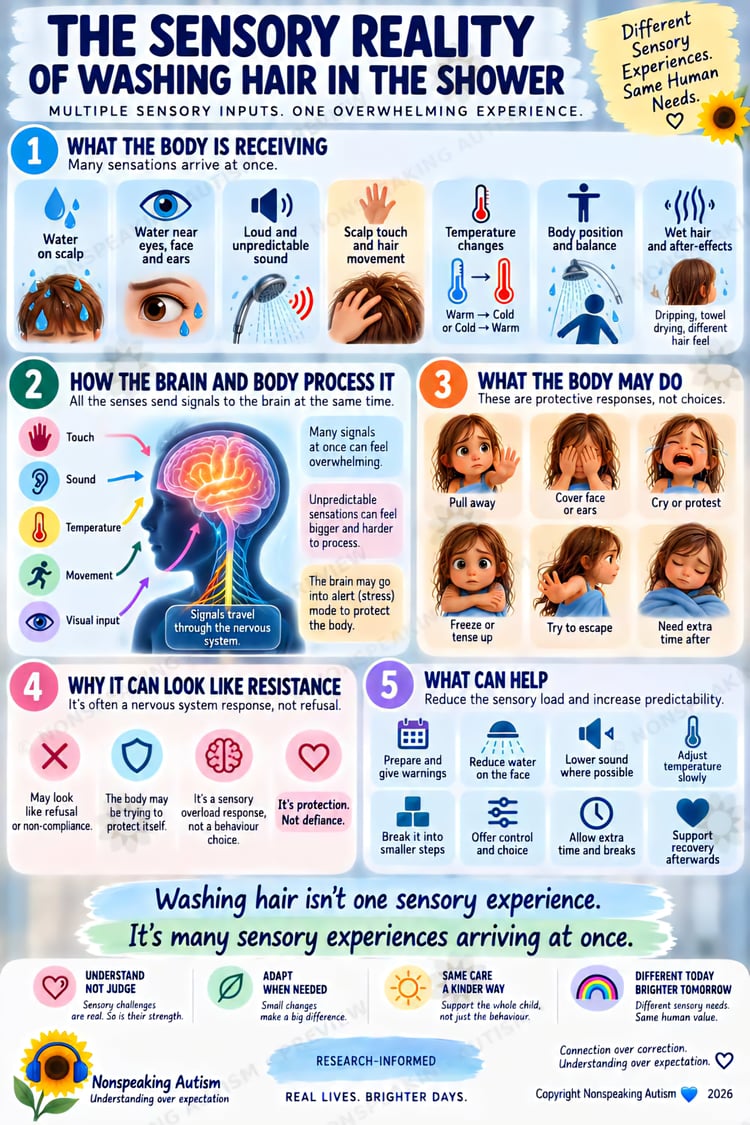
🚨 Triggers & Overload
Consider sensory and environmental experiences that appear difficult or overwhelming.
These may include:
sound
light
touch
smell
movement
temperature
internal discomfort
unexpected change
and combinations of several demands at once.
Useful questions include:
What tends to overwhelm this person?
Where does it happen?
When is it most likely?
The same sensory input may also be manageable on one day and difficult on another.
Context matters.
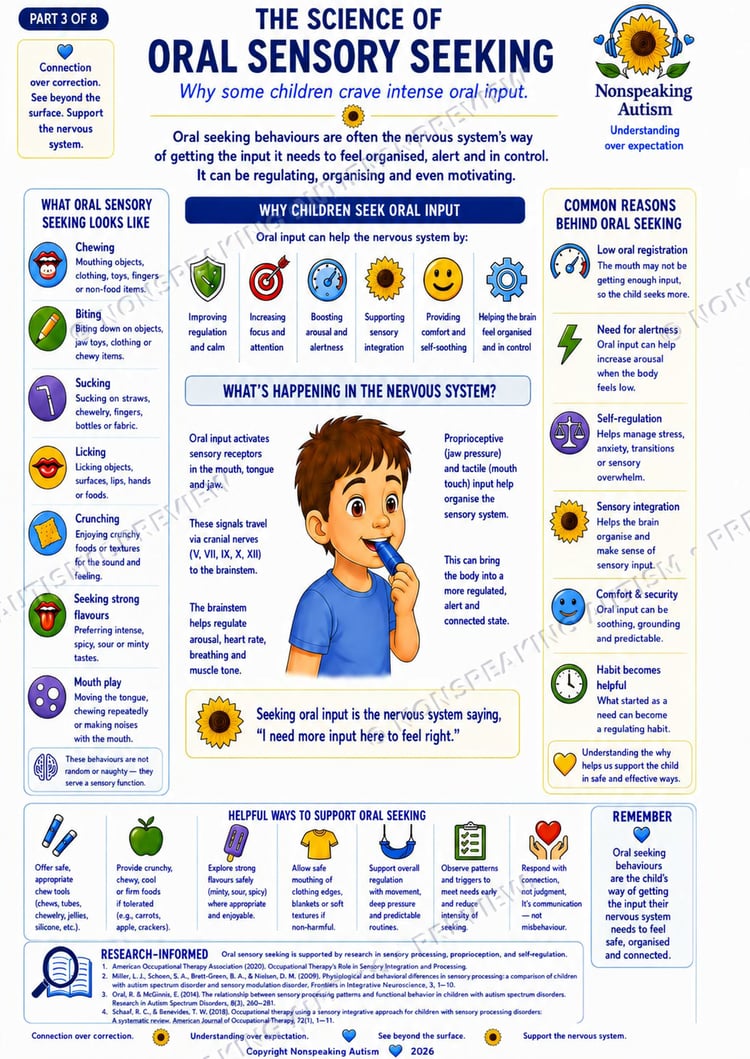
♾️ Sensory-Seeking Patterns
Sensory differences are not only about avoiding input.
Some people actively seek particular sensations.
This might include:
movement
spinning
rocking
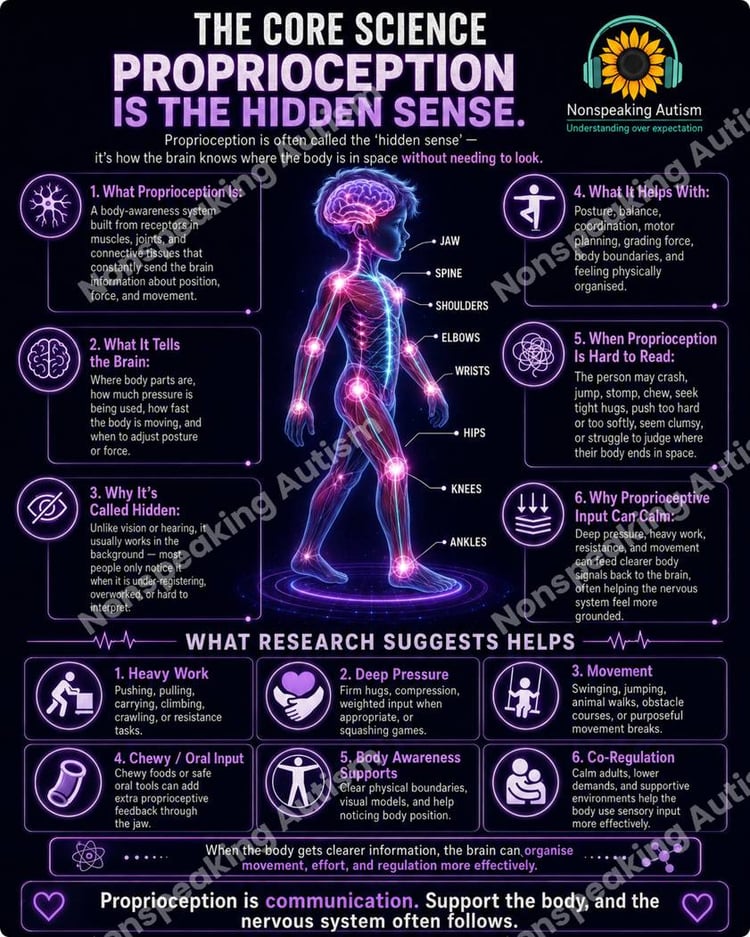
crashing
pressure
chewing
watching particular visual input
water
repetition
or other preferred experiences.
Rather than automatically trying to stop these behaviours, ask:
“What input does the person's body actively look for?”
Sensory seeking may serve different functions at different times and should be understood in context.
👁️ Early Signs
Recognizing the person's earliest changes can be more useful than waiting for obvious distress.
Possible signs might include:
covering the ears
pacing
pulling at clothing
increased movement
attempting to leave
freezing
increased vocalisation
faster breathing
withdrawal
communication changes
or other individual patterns.
These are examples — not universal signs of overload.
The important question is:
“What happens before overload becomes obvious for this person?”
Recognizing those changes can create an opportunity to offer support sooner.
💛 What Helps Regulation?
Once patterns have been identified, the next question is not:
“How do we make the behaviour stop?”
It is:
“What lowers the load?”
Depending on the person, useful supports might include:
deep or firm pressure where actively preferred
movement
sensory breaks
dim lighting
quiet
ear defenders
predictable routines
AAC access
additional processing time
environmental changes
familiar objects
or simply having fewer demands.
No sensory strategy is universally regulating.
Something calming for one person may be uncomfortable or dysregulating for another.
Support therefore needs to be individualized and responsive.
🌙 Recovery Needs
Regulation is not simply about what happens during distress.
What happens afterwards matters too.
Recovery might require:
rest
reduced demands
food or drink
toileting
quiet
familiar sensory input
space
sleep
co-regulation
or substantial time.
A person may look calmer before their full capacity for communication, learning, social interaction or decision-making has returned.
This makes another question important:
“What genuinely helps this person after overload?”
Recovery is part of the sensory profile.
💬 Communication Clues
Communication can change as sensory load increases.
Depending on the person, this might include changes in:
body movement
facial expression
speech
AAC use
gesture
vocalisations
proximity
seeking contact
moving away
or periods of reduced communication.
Rather than assigning fixed meanings to these behaviours, look at:
pattern + context + the person's established communication
The goal is not to “decode” every movement from the outside.
It is to make the person's own communication more accessible and easier to respond to.
🗺️ 2️⃣ Map the Whole Pattern
A comprehensive sensory profile looks across multiple sensory systems, rather than focusing on one highly visible difficulty.
The resource encourages consideration of:
👂 Auditory
👁️ Visual
✋ Tactile
🏃 Movement & Balance
🫀 Interoception
👃 Taste & Smell
For each area, consider three useful questions:
What does the person seek?
What do they avoid?
What helps?
This matters because apparently contradictory patterns can coexist.
Someone might avoid one kind of sound while repeatedly seeking another.
They might seek intense movement but dislike unexpected movement.
They might crave pressure while finding light touch distressing.
Sensory profiles are rarely as simple as “sensitive” or “not sensitive.”
🏠 Context Matters
The poster encourages observation across environments including:
home
school or education
community settings
healthcare environments
and other relevant places.
A person may appear to have different sensory needs in different environments.
That does not necessarily mean the observations contradict each other.
Different environments contain different:
sounds
lighting
people
expectations
movement
predictability
communication demands
and opportunities to regulate.
The sensory system does not exist separately from the environment.
🔄 3️⃣ Build the Profile in Four Steps
This resource provides a simple practical process:
1. 👀 Observe
Notice repeated patterns across time.
Avoid drawing strong conclusions from one isolated incident.
2. 📋 Track Context
Record useful contextual information such as:
place
people
transitions
demands
body needs
health
time of day
and what happened immediately beforehand.
3. ⚙️ Test Supports
Offer appropriate environmental changes or support and observe what happens.
Was the support:
accepted?
declined?
helpful?
neutral?
uncomfortable?
Did participation actually improve?
4. 📊 Review & Update
Sensory profiles are not permanent.
Needs may change with:
age
development
health
stress
fatigue
puberty
environment
sensory load
and changing circumstances.
Observe → Track → Support → Review
🌻 A Profile Should Be Dynamic — Not a Label
A sensory profile should never become a permanent statement such as:
“This person cannot cope with noise.”
A more useful description might be:
“Busy, unpredictable environments currently appear to increase sensory load. Advance warning, access to quieter spaces and preferred hearing protection appear to improve participation.”
That distinction matters.
One creates a label.
The other provides useful information for support.
🔬 4️⃣ What the Research Suggests
Research has consistently documented sensory processing differences among autistic people, while also demonstrating substantial individual variability.
The evidence supports several important principles reflected in this resource.
1️⃣ Sensory Differences Are Common
Autistic people may experience sensory input differently, including patterns of heightened responsiveness, reduced responsiveness and sensory seeking.
2️⃣ Different Patterns Can Coexist
A single person may show a mixture of seeking, avoiding and other sensory-response patterns.
3️⃣ Profiles Can Change
Sensory responses are not necessarily static. Context, age, health, stress and other factors can influence what is manageable.
4️⃣ Repeated Patterns Matter
Looking across time and situations can provide more useful information than interpreting one behaviour in isolation.
5️⃣ Support Should Be Individualized
The same sensory strategy will not work for everyone.
Support should respond to the individual person and the actual barriers affecting their participation.
📝 Quick Profile Questions
The poster finishes with five simple questions that can help supporters keep the focus on the individual:
🚫 What does the person avoid?
🔍 What do they seek?
🚨 What changes first when regulation starts to slip?
💙 What reliably helps?
🔄 What does recovery actually require?
These questions can be revisited as circumstances change.
🤝 Build the Profile With the Person
Wherever possible, a sensory profile should be created with the person rather than simply about them.
Depending on their communication preferences, this may involve:
speech
AAC
typing
writing
symbols
gesture
visual choices
drawing
or another accessible communication method.
Someone's behaviour may provide useful information, but outside observation cannot tell us exactly what a sensory experience feels like.
The person's own communication, preferences, boundaries and consent matter.
🩺 Remember the Body
Not every apparent sensory response is caused by sensory processing.
A sudden intolerance of sound might accompany:
ear pain
headache
migraine
illness
or another physical problem.
Changes in movement might reflect pain or injury.
Changes around eating might involve gastrointestinal, dental, swallowing or feeding difficulties.
Changes in regulation might relate to sleep, medication, hormones, illness or other physical needs.
New, significant or unexplained changes should therefore prompt consideration of health and medical causes where appropriate.
📚 Selected Research
This resource is informed by research examining sensory processing, sensory-response patterns, participation, classroom outcomes and interoception in autism.
Ben-Sasson, A., et al. (2009). A meta-analysis of sensory modulation symptoms in individuals with autism spectrum disorders. Journal of Autism and Developmental Disorders, 39(1), 1–11.
Tomchek, S. D., & Dunn, W. (2007). Sensory processing in children with and without autism: A comparative study using the Short Sensory Profile. American Journal of Occupational Therapy, 61(2), 190–200.
Lane, A. E., et al. (2022). Research examining sensory features and patterns across autism development.
Ashburner, J., Ziviani, J., & Rodger, S. (2008). Sensory processing and classroom emotional, behavioral, and educational outcomes in children with autism spectrum disorder. American Journal of Occupational Therapy, 62(5), 564–573.
Garfinkel, S. N., et al. (2016). Discrepancies between dimensions of interoception in autism: Implications for emotion and anxiety. Biological Psychology, 114, 117–126.
🔎 Evidence Note
The research supports the overall principles behind individualized and contextual sensory profiling. It does not mean that every example, behaviour or support listed in this resource has one scientifically established meaning or effect.
Sensory behaviours should therefore be interpreted as possible information to investigate, rather than proof of a specific internal state.
This resource is research-informed but is not a standardized or validated sensory assessment instrument.
👨👩👧 Who Is This Resource For?
This resource may be useful for:
- autistic children and young people
- autistic adults
- people with sensory processing differences
- nonspeaking and minimally speaking people
- AAC users
- parents and caregivers
- teachers and teaching assistants
- SENCOs and SEND teams
- occupational therapists
- speech and language therapists
- support workers
- healthcare professionals
- multidisciplinary teams
- autism and disability organizations
- home-education settings
It can be used as an educational visual, staff-training resource or starting point for conversations about individualized sensory support.
📦 What You Receive
This download includes:
1 × Building an Individual Sensory Profile educational poster
1 × high-resolution printable PDF
The downloaded file is supplied clear and without the promotional preview watermark shown on the Payhip listing image.
Any watermarks visible on promotional images are used for preview and copyright protection only and will not appear on the downloadable resource.
💛 DIGITAL DOWNLOAD
This educational resource is available to purchase through Payhip. It provides practical, research-informed sensory information for autistic people, families, educators and professionals.
This is a digital PDF download only. No physical product will be supplied.
Digital download only — no physical product will be shipped.
⚠️ Important Educational, Medical & Professional Disclaimer
This resource is provided for educational, informational and support-planning purposes only.
It is not a diagnostic tool, standardized or validated sensory assessment, occupational therapy assessment, psychological assessment, behavioural assessment, medical assessment or individualized treatment plan.
Examples of sensory behaviours, triggers, early signs and communication cues are possibilities rather than fixed meanings. The same behaviour can have different functions or causes for different people and in different contexts.
Sensory seeking, sensory avoidance, withdrawal, changes in communication, distress or changes in behaviour should not automatically be attributed to autism or sensory processing.
Physical health, pain, illness, sleep, medication, communication barriers, anxiety, environmental demands and other factors may also contribute.
New, severe, persistent or unexplained changes warrant appropriate professional or medical consideration.
Sensory supports should be individualized according to the person's needs, communication, preferences and circumstances. They should not be used to force tolerance of distressing sensory input, suppress harmless self-regulation or override the person's autonomy and consent.
Where individualized sensory assessment is required, advice from an appropriately qualified professional, such as an occupational therapist where relevant, should be considered.
💛 The Message Behind the Resource
A useful sensory profile is not a list of everything a person “can't cope with.”
It is a map.
A map of what overwhelms.
A map of what they seek.
A map of the earliest signs.
A map of what helps.
A map of how they communicate.
And a map of what recovery really requires.
Most importantly, that map should never be used to limit the person.
It should help the people around them understand where the barriers are and how those barriers might be reduced.
Because the question is not:
“How do we make this person tolerate more?”
It is:
“What helps this person feel safe, regulated and able to participate?”
A good sensory profile does not label behaviour — it reveals patterns, needs and supports.
Different Ways. Bright Minds.
Connection over correction. Understanding over expectation.
© Nonspeaking Autism 2026 🌻💙