
Understanding the Autistic Sensory System
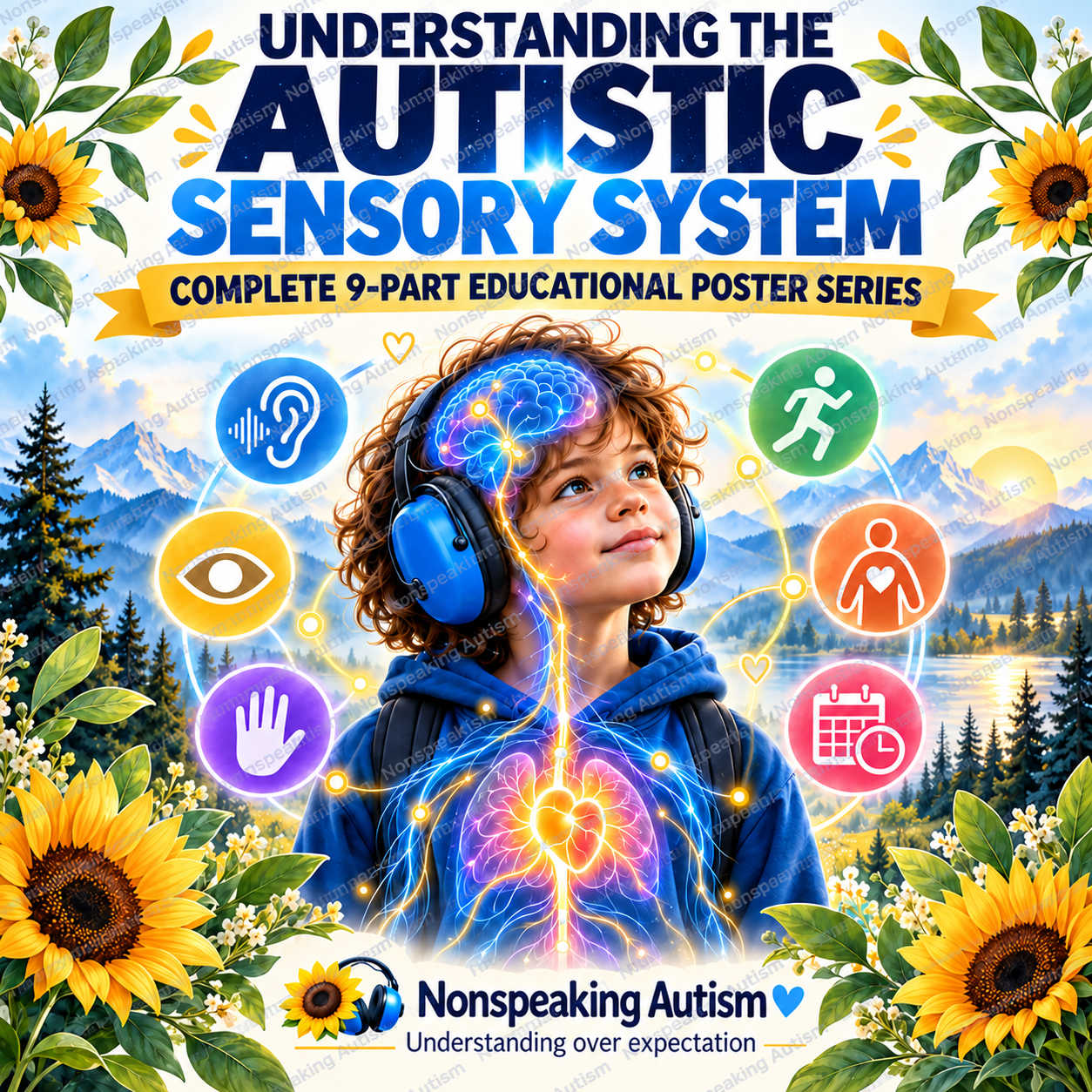
Understanding the Autistic Sensory System
Complete 9-Part Educational Poster Series
Sensory Processing • Nervous-System Signals • Sensory Profiles • Accessibility • Regulation • Communication • Participation
Autistic sensory experiences are not simply about being “too sensitive” or “not liking” certain sounds, textures, lights or environments.
Sensory processing can influence how a person experiences their body, surroundings, communication, learning, transitions, participation and everyday life.
Understanding the Autistic Sensory System is a comprehensive 9-part research-informed educational poster collection from Nonspeaking Autism, designed to help families, educators, professionals and support teams move beyond surface behaviour and begin asking:
“What is the nervous system telling us — and what support might make this situation more accessible?”
Rather than trying to make autistic people tolerate every environment or suppress sensory responses, this collection focuses on understanding individual patterns, recognising cues, adapting environments, maintaining communication and supporting meaningful participation.
🧠 What This 9-Part Collection Explores
Across the series, the posters explore the sensory system from several connected perspectives:
- nervous-system and sensory cues
- safety, stress, seeking, overload and recovery
- how sensory profiles may change with age
- sensory-informed therapy
- building an individual sensory profile
- sensory accessibility in public environments
- sensory tools and regulation
- sound sensitivity and misophonia
- transitions, uncertainty and sensory load
Together, the resources create a much broader picture than simply asking whether somebody is “sensory seeking” or “sensory avoidant.”
Same sensory systems. Different experiences. Individual support.
💙 Part 1 — Understanding Autistic Nervous-System Signals
This poster explores how changes in body, movement, communication and behaviour may provide useful information about what a person is experiencing.
It considers several possible states and experiences, including:
🛡️ Safety & Regulation
When a person feels safer and adequately regulated, they may have greater capacity for:
- thinking and learning
- communication
- connection
- flexible movement
- engagement
- familiar interaction
☀️ Early Stress
Possible early changes might include:
- quicker or shallower breathing
- pacing or repetitive movement
- withdrawal
- reduced speech or AAC use
- looking away
- increased muscle tension
- greater need for predictability
These are possible clues rather than a universal checklist.
⭐ Sensory Seeking
Movement, pressure, vocalisation and repetitive sensory experiences may sometimes help a person obtain useful sensory input.
⚡ Overload
When sensory, cognitive or social demands exceed available capacity, a person may need escape, reduced input, communication support, time and recovery.
🌙 Recovery
Recovery may require considerably more than simply stopping the immediate activity.
Quiet, rest, familiar input, fewer demands, movement, communication access and time may all be relevant.
❤️ Pain & Body Distress
Importantly, a behavioural change does not prove pain, but pain and physical discomfort should not be overlooked simply because someone is autistic or communicates differently.
🌱 Part 2 — Sensory Profiles Can Change With Age
A sensory plan is a snapshot — not a lifetime prescription.
This research-focused poster explores an important concept:
Sensory needs can change.
Group-level research suggests that different sensory domains may show different developmental patterns across childhood.
The poster explores examples involving:
- sensory seeking
- sound-related challenges
- sensitivity
- avoidance
- visual processing
- oral sensory patterns
- movement processing
But it also makes an essential distinction:
These patterns are not a developmental prediction for an individual child.
Sensory development is heterogeneous.
A strategy that was extremely useful several years ago may become less useful later — not because the child has “failed” the strategy, but because their body, environment, demands or sensory profile may have changed.
The practical message is:
Reassess — don't simply recycle.
Review sensory support following significant:
growth • school transitions • puberty • illness • environmental changes • changing demands
and whenever a previously useful strategy stops helping.
🌻 Part 3 — Sensory-Informed Therapy Practice
Therapy does not occur separately from the sensory environment.
A child may be expected to communicate, learn, interact or participate while simultaneously managing:
noise, lighting, visual clutter, unfamiliar people, proximity, body sensations, communication demands and uncertainty.
This poster explores ways therapists and other professionals can consider sensory access within their practice.
It includes:
1. Creating Sensory-Stable Spaces
Reducing unnecessary sensory disturbance and adapting the room to the individual rather than assuming one standard environment suits everybody.
2. Adapting Voice & Body
Considering:
- voice volume and pace
- timing
- intensity
- movement
- proximity
- processing time
- physical space
- visual supports
3. Tailoring Empathy
Cross-neurotype differences matter.
Observable behaviour should not automatically be interpreted using neurotypical assumptions about what another person must be feeling or intending.
4. Building Interoceptive Awareness
Where useful and appropriate, helping a person notice body sensations and connect them with personally meaningful regulation needs and actions.
5. Creating a Personalised Feelings Vocabulary
Communication about internal experiences does not have to depend on conventional emotional labels.
Words, symbols, drawings, objects, AAC, gesture and personally meaningful descriptions can all be valuable.
Don't ask the child to fit the therapy room. Adapt the therapy so the child can access it.
Part 4 — Building an Individual Sensory Profile
This practical poster helps adults move from isolated observations towards a more complete, individualized picture.
A sensory profile may consider:
🚨 Triggers & Overload
What tends to overwhelm the person, and in which situations?
♾️ Sensory-Seeking Patterns
What input does the body actively appear to seek?
👁️ Early Signs
What changes before overload becomes obvious?
💛 What Helps Regulate
Which environmental changes, activities, objects or supports appear helpful?
🌙 Recovery Needs
What does the person genuinely require after significant load?
💬 Communication Clues
How does the person communicate comfort, distress, refusal, seeking, overload or the need for support?
The resource encourages looking across:
auditory • visual • tactile • taste/smell • interoception • movement and balance
and across different contexts such as:
home • education • community • healthcare • unfamiliar environments
It provides a simple four-step process:
Observe → Track Context → Test Supports → Review & Update
A sensory profile should evolve as the person and their circumstances change.
A good sensory profile does not label behaviour — it reveals patterns, needs and supports.
🏙️ Part 5 — Sensory Accessibility in Public Spaces
Sensory accessibility is not only something to consider at home, school or in therapy.
Community environments can create substantial barriers.
This poster examines sensory accessibility across:
- shops and supermarkets
- restaurants and cafés
- healthcare settings
- public transport
- leisure centres
- community events
It considers practical adjustments such as:
quieter periods
reduced lighting
clear signage
predictable information
quieter waiting areas
sensory tools
additional transition time
reduced crowding
access to retreat spaces
and staff awareness.
The poster also includes a sensory-accessibility checklist that can help organisations consider how their environment could become easier to access.
Sensory inclusion benefits more than autistic people.
Many accessibility improvements can also benefit people with other sensory, neurological, communication or disability-related needs.
🎧 Part 6 — The Science Behind Sensory Tools
Sensory tools do not “fix” an autistic nervous system.
Their purpose is not to make somebody look less autistic or force stillness.
Instead, an appropriate sensory tool may alter the amount, type or predictability of sensory input and potentially make an environment or activity more manageable.
The poster explores:
🧠 Sensory Filtering
Why ordinary environments may require substantial processing when incoming sensory information is difficult to filter or adapt to.
🔉 Reducing Input
Examples include:
- ear defenders
- quieter spaces
- dimmer lighting
- reducing visual clutter
👐 Deep Pressure
Firm, predictable pressure may be regulating for some people, but preferences and responses vary.
Deep pressure should be individualized and never forced.
🏃 Movement & Proprioception
Movement may provide useful information about body position and support regulation for some people.
❤️ Autonomic Arousal
Sensory processing and physiological arousal can interact.
📅 Predictability
Knowing that a sensory tool, quiet space or familiar routine is available can itself make an experience more manageable.
🎯 Participation — Not Stillness
The goal is not:
“Does this make the person look calm?”
A better question is:
“Does this help the person feel safer, communicate, participate or access what matters to them?”
🎧 Part 7 — Autism, Sound Sensitivity & Misophonia
This research-focused poster explores the relationship between autism, sensory processing and misophonia.
Misophonia is more than simply disliking loud noise.
Specific pattern-based sounds — such as chewing, tapping, breathing, clicking or typing — can provoke intense emotional and physiological reactions for some people.
The resource explores:
- anger or irritation
- disgust
- panic or urge to escape
- muscle tension
- autonomic arousal
- hearing sensitivity
- visual sensitivity
- sensory processing
- emotional salience
It also distinguishes:
Misophonia
Strong emotional and physiological reactions to particular sounds or associated cues.
from
Hyperacusis
Reduced tolerance to sound intensity or loudness more generally.
The poster emphasizes that current findings describe associations and group-level patterns, not proof of one universal mechanism or experience.
The reaction is real. The trigger may be specific. The sensory system is broader than sound alone.
🔄 Part 8 — The Science Behind Transition Distress
Transitions can involve much more than simply “moving on.”
A transition may require someone to:
- stop an existing activity
- disengage attention
- predict what happens next
- reorganise action
- manage uncertainty
- tolerate environmental changes
- cope with sensory and social changes
What looks like refusal or resistance may sometimes reflect a much more complex interaction between prediction, uncertainty, processing, sensory load and regulation.
The poster explores what transition distress may look like and practical ways to reduce transition load, including:
Before
- advance warning
- visual structure
- clear sequences
- simple information about what comes next
- predictable routines where possible
During
- additional processing time
- reduced verbal pressure
- calm co-regulation
- one step at a time
- space to finish and reorganise
The body may go into protection before the transition feels safe.
👁️ Part 9 — Understanding Sensory Cues
The final poster brings the collection together by exploring sensory cues across several systems.
It looks at possible patterns involving:
👂 Auditory
Covering ears, startling, vocalising, seeking ear protection or leaving noisy environments.
👁️ Visual
Squinting, looking away, avoiding bright lights, distress in visually busy spaces or seeking particular visual input.
✋ Tactile
Pulling at clothing, avoiding grooming, disliking unexpected touch or seeking blankets and pressure.
🏃 Movement & Body Position
Rocking, jumping, spinning, pacing, toe walking or seeking pressure.
❤️ Interoception
Changes involving toileting, food, pain, thirst, hunger, temperature and other internal body signals.
The poster also connects sensory research with a practical four-step framework:
1. Notice early signs → 2. Check the context → 3. Adjust the load → 4. Support recovery
Cues are data. Support should match the nervous system, not fight it.
🔄 Seeking and Avoiding Can Coexist
A person does not have to be entirely “sensory seeking” or entirely “sensory avoidant.”
The same person may:
seek movement,
avoid particular sounds,
enjoy deep pressure,
dislike unexpected touch,
seek repetitive visual input,
and need a quiet environment to recover.
Responses can also vary depending on:
fatigue • illness • stress • environment • predictability • developmental stage • accumulated sensory load • physical discomfort
This is why individualized observation is so important.
💬 Communication Is Part of Sensory Support
Sensory distress and communication access can interact.
During overload or high stress, some people may have reduced access to speech or another usual communication method.
The collection therefore encourages adults to keep multiple communication options available, including where appropriate:
AAC • gesture • pointing • symbols • writing • typing • body movement • familiar yes/no systems • speech
Reduced speech during distress should not automatically be interpreted as refusal, lack of understanding or unwillingness to communicate.
❤️ Sensory Support Should Protect Autonomy
Sensory support should not become another form of control.
Where possible:
- offer rather than force
- respect refusal
- notice individual preferences
- preserve communication
- provide choices
- avoid suppressing harmless stimming simply for appearance
- consider the person's own experience
- review strategies when they stop helping
A sensory tool is useful because it improves access, comfort, regulation or participation — not because it makes somebody appear more neurotypical.
🔬 Research-Informed
The collection draws on research examining sensory processing in autism, sensory profiles across development, participation and classroom outcomes, physiological responses, sound sensitivity, misophonia, interoception, distress communication and sensory-informed support.
An important principle throughout the series is the distinction between group-level research findings and an individual person's needs.
Research can identify patterns and associations.
It cannot tell us, from a single behaviour alone, exactly what one person's nervous system is experiencing.
Observe the individual. Look at context. Track patterns. Adjust support. Review again.
👨👩👧 Who Is This Resource For?
This 9-part collection may be useful for:
- autistic people and their families
- parents and carers
- teachers and teaching assistants
- SENCOs and SEND teams
- mainstream and specialist schools
- occupational therapists
- speech and language therapists
- psychologists
- therapists and clinicians
- healthcare professionals
- support workers
- social-care teams
- autism organizations
- community and public-service staff
- professionals developing sensory-accessible environments
The posters may be used for education, professional reflection, staff development, parent/carer learning and conversations about individualized support.
📦 What You Receive
Your purchase includes the complete Understanding the Autistic Sensory System — 9-Part Educational Poster Series:
- Understanding Autistic Nervous-System Signals
- The Science Behind: Sensory Profiles Can Change With Age
- The Science Behind: Sensory-Informed Therapy Practice
- Building an Individual Sensory Profile
- Sensory Accessibility in Public Spaces
- The Science Behind Sensory Tools
- The Science Behind: Autism, Sound Sensitivity & Misophonia
- The Science Behind Transition Distress — Part 1: The Reframe
- Understanding Sensory Cues
9 educational posters in total
The purchased files are supplied clear and without the promotional preview watermarks shown on selected listing images.
Watermarks on the Payhip preview images are used for copyright and listing protection only.
Digital download only — no physical item will be shipped.
⚠️ Important Disclaimer
This collection is a research-informed educational resource.
It is not medical advice, diagnosis, occupational therapy assessment, sensory assessment, psychological assessment, individualized therapy, behavioural assessment, treatment, crisis planning or a substitute for professional evaluation.
The sensory cues and patterns described throughout the collection are examples, not diagnostic signs or universal checklists.
A behaviour cannot reliably establish its cause on its own. Similar outward behaviours can occur for many different reasons.
Sensory strategies should be individualized. Something that regulates one person may be uncomfortable or distressing to another.
New, sudden, severe, persistent or unusual changes in sensory tolerance, behaviour, communication, eating, sleep, movement or physical presentation should not automatically be attributed to autism. Pain, illness, medication effects and other health concerns may require appropriate medical assessment.
📚 Research & References
This Understanding the Autistic Sensory System — Complete 9-Part Educational Poster Series is research-informed and draws on published literature exploring sensory processing differences, sensory modulation, participation, classroom experiences, nervous-system regulation and individualized sensory support.
Selected references include:
Tomchek, S. D., & Dunn, W. (2007). Sensory processing in children with and without autism: A comparative study using the Short Sensory Profile. American Journal of Occupational Therapy, 61(2), 190–200. DOI: 10.5014/ajot.61.2.190.
This study compared sensory processing in 281 autistic children aged 3–6 with age-matched typically developing children and found substantial differences across sensory-processing domains. PubMed
Ben-Sasson, A., Hen, L., Fluss, R., Cermak, S. A., Engel-Yeger, B., & Gal, E. (2009). A meta-analysis of sensory modulation symptoms in individuals with autism spectrum disorders. Journal of Autism and Developmental Disorders, 39(1), 1–11. DOI: 10.1007/s10803-008-0593-3.
The meta-analysis found sensory modulation differences were common in autistic groups while also emphasizing their heterogeneous presentation. PubMed
Ashburner, J., Ziviani, J., & Rodger, S. (2008). Sensory processing and classroom emotional, behavioral, and educational outcomes in children with autism spectrum disorder. American Journal of Occupational Therapy, 62(5), 564–573. DOI: 10.5014/ajot.62.5.564.
This research examined associations between sensory processing and classroom emotional, behavioural and educational outcomes, supporting the importance of considering sensory needs within educational environments. Sage Journals
Ismael, N., Lawson, L. M., & Hartwell, J. (2018). Relationship between sensory processing and participation in daily occupations for children with autism spectrum disorder: A systematic review of studies that used Dunn’s Sensory Processing Framework. American Journal of Occupational Therapy, 72(3), 7203205030p1–7203205030p9. DOI: 10.5014/ajot.2018.024075.
This systematic review found evidence linking sensory processing with participation in everyday occupations, while noting that the included evidence was of low to medium level and that stronger research was needed. PubMed
🔬 How the Research Is Used
Research findings throughout this collection are presented as group-level evidence rather than predictions about an individual autistic person.
Sensory experiences are highly individual and may vary according to sensory system, environment, age, health, stress, fatigue, predictability, communication demands and other contextual factors.
The posters therefore encourage a practical approach:
Observe → understand the context → identify patterns → adapt support → review again.
Research should inform individualized support — not replace listening to the autistic person or assuming that one sensory strategy will work for everyone.
💛 Research-Informed, Not Prescriptive
This collection does not promote a single sensory programme or claim that sensory tools, environmental adaptations or regulation strategies will work universally.
Instead, its central principle is:
Cues are data. Support should match the nervous system, not fight it.
Different sensory needs. Different support. Equal value.
©️ Copyright & Permitted Use
Copyright © 2026 Nonspeaking Autism. All rights reserved.
Purchase permits use for personal/home use, your own classroom or school, your own clinic or individual professional educational practice, and direct educational/support work with people you support.
Files may not be resold, redistributed, file-shared, uploaded elsewhere, commercially reproduced, repackaged, or included in another digital or physical product for resale or distribution.
💛 The Message Behind the Collection
Sensory differences are not simply inconveniences to train away.
A person covering their ears may be communicating something.
Movement may serve a purpose.
Avoidance may contain useful information.
A sensory tool may create access.
A transition may require far more neurological work than we can see.
Recovery may take longer than the visible distress.
And the support that worked yesterday may need changing tomorrow.
The goal is not to create a person who can tolerate everything.
The goal is to understand the individual well enough to create greater:
safety
communication
autonomy
access
participation
comfort
and belonging.
Different sensory needs. Different support. Equal value.
Connection over correction. Understanding over expectation.
See beyond the surface. Support the whole system. 💙🌻
© Nonspeaking Autism 2026